

Second in a series. The first installment, “RV Calypso: The Wreck and the Restoration,” told the story of the ship’s sinking and the strange legal afterlife that followed. This piece, and the two that follow it, look more closely at the people who fought over what should happen to her, as bits and pieces of the legendary vessel adored by millions lie scattered from Istanbul to storage in France and Norfolk, Virginia.
On January 8, 1996, a barge being repositioned in Singapore harbor struck the wooden hull of the RV Calypso below her waterline, and she soon sank with only her superstructure above the surface. This little ship was treasured in the hearts of millions of TV viewers of the undersea exploration programs of Jacques Cousteau. News of the sinking soon traveled around the world.
She was raised seventeen days later, her wooden hull soaked through, her hold full of harbor silt. Jacques Cousteau was eighty-five years old and in failing health. He did not go to Singapore himself. By most accounts, there was an atmosphere of disbelief at the extent of the damage to the hull. Cousteau was not confident that the people on the scene — there to prepare Calypso for her next voyage — could tell him whether the ship could still be saved.
There is no formal record of what happened next — no cable, no logged instruction, nothing that survives in an archive. But those who knew Cousteau’s habits find it hard to imagine he would have trusted anyone but Albert Falco to make that judgment. Falco had been gone from the Calypso for six years by then, retired since 1990 after thirty-seven years aboard her — first as a deckhand, then as her chief diver, then, after Simone Melchior fought the French maritime bureaucracy to get him certified despite the injury to his hand, as her captain. His retirement had been reported in the French press as a small national event. If Cousteau wanted one honest opinion on whether Calypso could still be brought home, Falco is the man the story keeps pointing to — not because a document says so, but because everyone else in it seems to assume it.
Falco’s own path to the ship had nothing to do with the sea’s romance and everything to do with bad luck turning, eventually, into good luck. In 1946, at eighteen, he was helping clear wartime mines near Marseille when a device detonated and took four finger segments from his left hand. The injury made him hard to hire. Years later, a friend recommended him to Cousteau anyway, for the roughest kind of work — laborer, deckhand — on a ship the Cousteaus had only just acquired. Cousteau took him on. The hand that had cost him other jobs turned out not to matter underwater, and within a few years the crew were calling him l’homme poisson — the fish-man — for how naturally he moved in it.
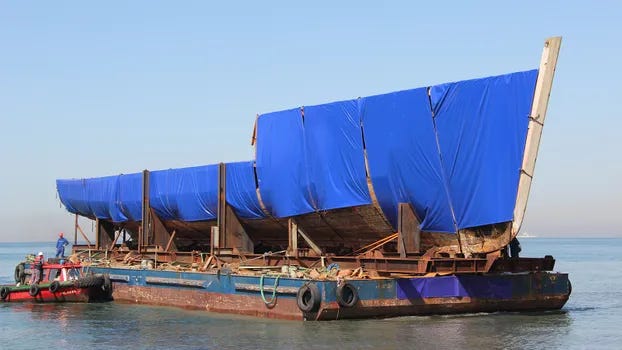
Divers patched the damaged hull so that she could be pumped out and raised, and Falco inspected what was left. Placed on a transport barge, she was towed back to France and settled into the dry dock of the maritime museum basin at La Rochelle, where she was meant to be evaluated and, eventually, restored. Cousteau died on June 25, 1997, before any details could be resolved, having written that he wanted the ship to remain “at the service of science and education.” What he left behind instead was a hull with nowhere to go and no one yet empowered to decide what “restoration” would even mean — a working ship again, or a static display for visitors drawn by sentiment and curiosity.
She sat at La Rochelle rotting for years while the ownership question worked its way through lawyers and courts. It was in the middle of that limbo — with nothing moving, nothing permitted, no conservation work allowed while Francine Cousteau, his second wife and sole designated successor, held the ship in a kind of legal suspension — that Falco is understood to have first put words to what everyone who saw her could tell just by looking. Asked whether Calypso could ever sail the oceans again, he said: “Everything which is not rusted is rotten, and everything which is not rotten is rusted.” The line would later be attributed, in a 2003 Guardian piece, to Patrick Schnepp, the director of the La Rochelle maritime museum — Schnepp, by that account, was expressing his own disgust at the ship’s condition and repeating an observation that had already taken hold among the people who dealt with her daily. By the accounts of those who worked around the ship, Falco said it first. Schnepp, and everyone since, has been quoting him.
The line did more than describe a hull. It captured the trap the ship was already in, years before anyone outside the family understood why nothing was happening. Calypso was not simply neglected. She was frozen — held in a legal and emotional standoff between two competing ideas of what Cousteau himself would have wanted for her, argued over by people who had never agreed on much else. That argument, and the divers and family members who lined up on either side of it, is where this story goes next.
© 2026 Farooq Hussain
Next: Two Widows, Two Visions — the fight between Francine Cousteau and Alexandra Cousteau granddaughter of Cousteau’s first wife Simone Melchior over what Jacques Cousteau’s own wish for the ship actually was, and how a Guinness heir ended up deciding between them.
Further reading:
