


Click the image above to play the animation video of the Eagle Nebula showcases the superb resolution and wide field of view of NASA’s Nancy Grace Roman Space Telescope. It begins with a Hubble image of the famous Pillars of Creation superimposed on a ground-based image. The view then zooms out to show the full field of view of Roman’s Wide Field Instrument. Roman’s images has the resolution of Hubble while covering an area about 100 times larger in a single pointing. Credit: Leah Hustak (STScI)
In the beginning
Gazing in wonderment at the stars in the night sky has been a human activity since the earliest times. Ancient Egyptian priests tracked the pre-dawn rising of specific “decan” stars to mark the night's hours and fix the calendar that governed the Nile's flooding. Polynesian navigators crossed thousands of kilometers of open Pacific using nothing but the positions of stars, swells, and bird flight paths, memorized and passed down without writing. By the 15th century, European sailors going around Africa and across the Atlantic depended on instruments — the quadrant, the mariner’s astrolabe — to fix latitude by the height of the Pole Star or the sun. None of this was science in the modern sense. It was navigation, timekeeping, and religion, but it was built on the same underlying act that drives a $10 billion space telescope: looking up and trying to extract meaning from what’s there.
The turn from sky-“reading” to sky-“science” happened first in the Islamic world. Caliph al-Ma’mun founded an observatory at Baghdad’s Shammasiyah quarter around 828, part of the broader House of Wisdom project that translated and extended Greek, Persian, and Indian astronomical texts. Al-Battani, working in the late 9th and early 10th centuries, refined Ptolemy’s trigonometric tables with new naked-eye observations precise enough that Copernicus cited them directly six centuries later. The clearest ancestor of the modern research institution came in the 13th century, when the astronomer and polymath Nasir al-Din al-Tusi persuaded the Mongol ruler Hulagu Khan to fund an observatory at Maragheh, in present-day Iran — a permanent, salaried staff of scholars, a shared library, and instruments built specifically for the site’s research program, rather than one astronomer working alone. That institutional model, as much as any single measurement to come out of it, is what modern astronomy inherited.
The atmosphere is the obvious reason a telescope goes to space, and it is worth stating plainly. Visible light survives the trip through the air, but arrives smeared and shimmering — the same turbulence that makes stars twinkle to the naked eye limits how sharp any ground-based image can be, even with modern adaptive optics correcting for it in real time. Ultraviolet light, X-rays, and gamma rays never reach the ground at all; the atmosphere absorbs them completely, which is fortunate for anyone standing on the surface and useless for anyone trying to study them. Infrared observation from the ground works only in a few narrow atmospheric “windows,” and even there the atmosphere’s own heat competes with the faint signal astronomers are measuring. A telescope in orbit sidesteps all of this at once.
Listening, not looking
That argument covers most of the spectrum, but it does not explain radio astronomy, because radio waves pass through the atmosphere largely undisturbed. For most of the 20th century, the biggest instruments in this field were not telescopes that looked at the universe so much as ones that listened to it — enormous dishes built on the ground, in a scattered international network that took shape well before space telescopes existed at all.
Britain’s Jodrell Bank Observatory, outside Manchester, had its 250-foot dish barely operational in October 1957 when the Soviet Union launched Sputnik. The satellite’s own radio “beep” was famously simple enough to be picked up on an ordinary household set; Jodrell Bank’s contribution was tracking Sputnik’s spent rocket booster by radar, a feat no other Western instrument could manage.
The Soviet Union had its own substantial listening infrastructure by the same period. The Pulkovo Observatory outside Leningrad completed a large radio telescope in 1956, and by 1969 the American National Radio Astronomy Observatory was running joint long-baseline interferometry experiments with Soviet scientists using the 22-meter dish at Simeiz, in Crimea — one of the earliest US-Soviet scientific collaborations of the Cold War, arranged in the brief thaw of détente. Japan entered the field in 1949, with solar radio observations at the Tokyo Astronomical Observatory and Osaka University, though its flagship observatory at Nobeyama was not founded until 1982. India and China built their major radio telescopes later still — India’s first, at Ooty, in 1970; China’s not reaching real scale until the 1980s.
“The Cosmos is all that is, or ever was, or ever will be” - Carl Sagan
Carl Sagan, an American astronomer and one of the most effective science communicators of the 20th century, made astronomy a popular interest and gave the search for extraterrestrial intelligence a scientific footing, unorthodox as it has remained. In 1974 he and Frank Drake composed the radio message beamed toward the globular cluster M13 from the Arecibo dish. His 1980 television series Cosmos introduced a global audience to the scale of the universe and to the idea that studying it was worth public money and attention. Sagan spent his career turning the technical work of places like Jodrell Bank and Pulkovo into something a general audience could feel was theirs too. His lasting legacy is the habit of treating astronomy as a shared human project rather than a specialist’s hobby. He had a British precursor: Sir Patrick Moore, whose BBC program The Sky at Night began in 1957, more than two decades before Cosmos, and is still on the air.
When the ground fails
Radio astronomy on the ground still works well — the Very Large Array in New Mexico, dedicated in 1980, remains one of the most scientifically productive instruments ever built, its 27 dishes spread in a Y-shaped configuration up to 36 kilometers across.1 But matching that resolving power on the ground means occupying tens of square kilometers of land, requiring continuous upkeep, and staying exposed to weather, seismic activity, and structural fatigue over decades of service—costs a space telescope simply doesn’t carry.
The clearest illustration of that exposure is the Arecibo Observatory in Puerto Rico. Its 305-meter dish, suspended beneath a 900-ton instrument platform, operated for 57 years and contributed to work ranging from the discovery of the first planets found orbiting a pulsar to asteroid radar tracking. Hurricane damage in 2017 was followed by a string of cable failures in 2020: an auxiliary cable tore through the dish that August, a main cable snapped in November at only 60 percent of its rated strength, and on December 1 the platform came down through the reflector entirely.2 The National Science Foundation, which had been spending about $7.5 million a year to keep Arecibo running, decided in 2022 not to rebuild it — cleanup alone was estimated at roughly $50 million — and committed instead to a $5 million STEM education center on the site.3 No comparable single-point structural failure threatens a telescope in orbit. But nothing can be sent up to fix one either, a problem NASA solved for Hubble, uniquely among space telescopes so far, by designing it to be serviced by astronauts across five shuttle missions.
The current fleet
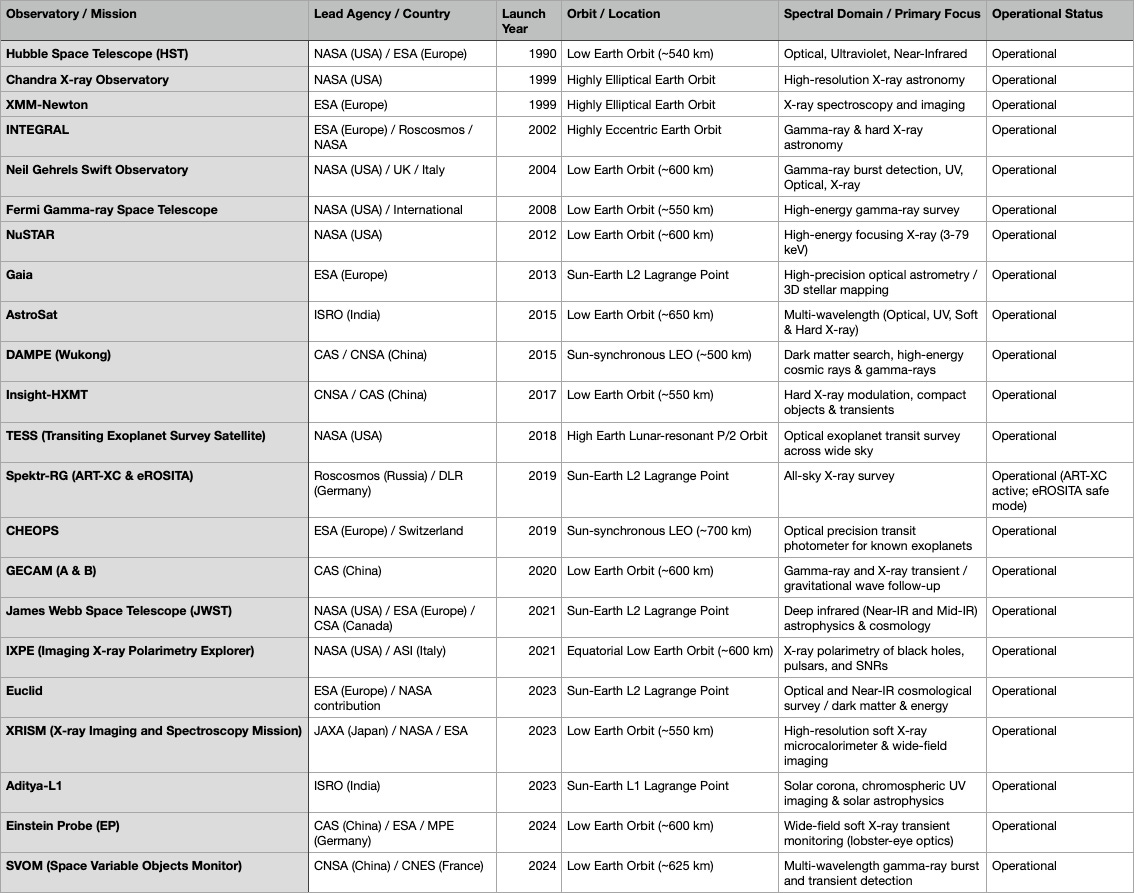
Counting active space telescopes precisely is harder than it sounds, because no single registry tracks them under that label. Jonathan McDowell’s General Catalog of Artificial Space Objects, maintained at the Center for Astrophysics at Harvard and Smithsonian, is generally considered the most authoritative source, sorting payloads by mission class, country of origin, and launch and retirement dates. The Union of Concerned Scientists keeps a parallel operational-satellite database searchable by purpose and country. The UN Office for Outer Space Affairs maintains the formal treaty-mandated registry of all objects launched into orbit, and the European Space Agency’s debris office tracks active payloads by owner state. Depending on where the line is drawn between a flagship observatory, a solar-monitoring platform, and a technology-demonstration CubeSat, these sources put the number of primary space telescopes operating at any point over the past decade at somewhere between two or three dozen — and that number has gotten harder to assign to a single country, since most flagship missions now split instruments, launch vehicles, and operations across international consortia rather than one national space agency.
Space Telescopes Major Operating Missions
What it costs
The costs scale with ambition. Hubble’s 1990 launch carried a price tag of $1.5 billion; across five servicing missions and more than three decades of continuous operation, its total public cost is commonly put at roughly $16 billion.4 JWST’s lifecycle cost through its first five years of science operations came to $9.7 billion from NASA alone, with the European Space Agency contributing the Ariane 5 launch vehicle and two science instruments, and the Canadian Space Agency contributing a third.5 By contrast, the VLA — one of the most productive ground instruments ever built — cost $78.6 million in 1972 dollars, on the order of $485 million today. The gap is not simply a matter of space being more expensive per dollar of science; it reflects a difference in what each kind of instrument has to survive, and what happens when something goes wrong 500 kilometers up, or a million and a half kilometers out.
The payoff
That money buys access to information no ground instrument can gather at any price. The cosmic microwave background cannot be measured through an atmosphere that itself glows in microwave. The deepest galaxy surveys, reaching light from a few hundred million years after the Big Bang, require the infrared sensitivity and cold operating environment that only a telescope parked at the Sun-Earth L2 point, a million and a half kilometers from any source of atmospheric or planetary heat, can sustain. X-ray and gamma-ray astronomy exists only because instruments were lifted above the layer of air that would otherwise absorb every photon before it arrived. From Egyptian decan stars to Baghdad’s House of Wisdom to Jodrell Bank’s Sputnik-era listening post to twenty-some spacecraft now parked in orbit or at L2, the tools have changed by orders of magnitude. The impulse behind them hasn’t.
© 2026 Farooq Hussain
Further reading / Notes
General Catalog of Artificial Space Objects (Jonathan McDowell / CfA) — The closest thing to an authoritative registry of every payload ever launched, sortable by mission class.
Space Telescope Science Institute — Science operations hub for Hubble, JWST, and Roman, including the Roman/Hubble field-of-view comparisons.
National Radio Astronomy Observatory — Home institution for the VLA and its planned successor, the ngVLA.
Karl G. Jansky Very Large Array, National Radio Astronomy Observatory.
Arecibo Observatory collapse timeline, National Science Foundation and contemporaneous reporting, 2020.
NSF decision not to rebuild Arecibo; STEM education center funding, 2022.
Hubble lifetime cost estimates, various sources.
JWST lifecycle cost, NASA budget documents via The Planetary Society, 2021.