

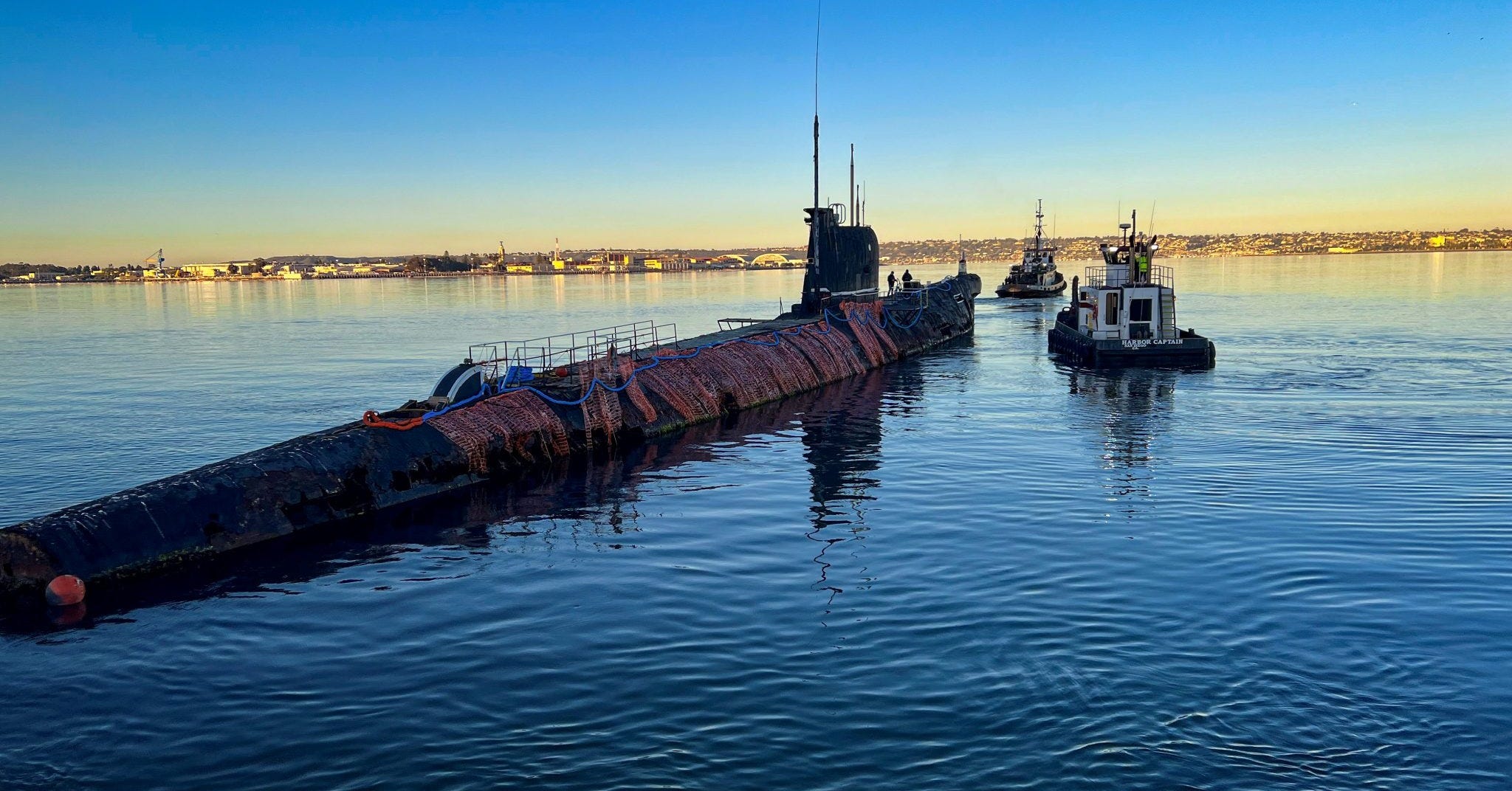
On the very early morning of February 7, 2022, a tugboat named Blarney eased away from San Diego’s Embarcadero with a rusting hulk in tow. The submarine trailing behind her had a slight list and a hull streaked with peeling paint, the kind of vessel harbor traffic barely notices anymore. Seventy nautical miles south, in Ensenada, Mexico, a scrapyard was waiting to cut her into steel.1
Seventeen years earlier, this same boat had arrived in San Diego amid crowds and fanfare, a genuine Soviet attack submarine, NATO designation Foxtrot. She would be open for public tours, her torpedo room and cramped berths drawing schoolchildren and Cold War history buffs by the thousands. Before that, she had spent decades on real patrols: shadowing American warships along the Pacific coast, prowling the Arctic, ranging as far as the Indian Ocean under orders from a Soviet Pacific Fleet that no longer exists. She was B-39, a diesel-electric attack submarine, one of the largest non-nuclear submarines the Soviet Navy ever built.


Doppelgänger
She was not, whatever some of her later promotional material implied, the submarine that nearly started a nuclear war. That distinction belongs to her sister ship, B-59, scrapped and forgotten decades earlier without ceremony, tugboat, or send-off. But B-39 was built to the same design, in the same era, for the same purpose, and her quiet, sentimental final departure from her foster home for nearly two decades - the Maritime Museum of San Diego - says something about how the Cold War’s near-catastrophes get remembered — or don’t.
B-39 was one of four Foxtrot-class submarines the Soviet Union sent toward Cuba in October 1962, part of Operation Anadyr, the covert deployment that had already placed nuclear-armed missiles ninety miles from Florida.2 Each of the four boats carried a weapon few in Washington knew about: a torpedo tipped with a ten-kiloton warhead, roughly the size of the bomb dropped on Hiroshima. American planners assumed the submarines were conventionally armed. They were wrong.
On October 27, at the height of the crisis, eleven U.S. Navy destroyers and the aircraft carrier USS Randolph cornered one of the four boats, B-59, in international waters outside the formal quarantine line. The Americans wanted the submarine to surface for identification, and their method was to drop small depth charges near the hull — practice ordnance, harmless by design, but nobody had told the men inside. B-59 had been running deep and silent for days, its batteries draining, its air growing foul, cut off from Moscow and from any news of whether the crisis above had already become a war. When the explosions started, the crew had every reason to believe they were under attack.
Soviet doctrine gave B-59 the authority to fire its nuclear torpedo without further clearance from Moscow, provided three officers agreed: the captain, the political officer, and the flotilla’s chief of staff, who happened to be aboard this particular boat. Captain Valentin Savitsky, convinced the war had started, wanted to fire. The political officer agreed. That left Vasili Arkhipov, thirty-four years old, a submariner who a year earlier had been irradiated helping bring a runaway reactor under control aboard the submarine K-19. Arkhipov refused. He argued the depth charges were signals, not an attack, and that the boat should surface and attempt to raise Moscow before doing anything irreversible. Savitsky, outranked in this instance by Arkhipov’s position within the flotilla command structure, backed down. B-59 surfaced. No torpedo was fired.
Nobody outside a small circle in Moscow knew any of this had happened for forty years. Cuban Missile Crisis scholarship in the West — the memoirs, the ExComm transcripts, the standard histories that shaped how several generations understood the crisis — was written and largely settled before the story ever reached print. It surfaced only in 2002, when a retired B-59 crewman, Vadim Orlov, described the episode publicly at a Havana conference marking the crisis’s fortieth anniversary. By then, the canonical version of October 1962 had already hardened into its familiar shape: a crisis of missiles on Cuban soil and warships on a quarantine line, resolved by back-channel diplomacy between Kennedy and Khrushchev. A submarine’s three-man vote, decided in the dark by men who thought the war had already begun, had no place in that version, because almost no one writing it had ever heard of it.
It’s worth being precise about what the evidence for this actually is. The Arkhipov story, as it’s usually told, rests heavily on testimony collected well after the fact — Orlov’s 2002 account and oral histories gathered later by researchers, including Svetlana Savranskaya.3 When Russia’s Ministry of Defense declassified a tranche of Cuban Missile Crisis-related documents in 2022, the historian Sergey Radchenko noted that the Arkhipov episode was not among them.4 That doesn’t mean the story is false; several surviving crew members’ accounts converge on the same broad sequence of events, and no contemporaneous account contradicts it. But it does mean the version now repeated in documentaries and prize citations is built substantially on memory, recovered decades later, rather than on a paper trail Moscow has ever chosen to confirm.
That’s a natural stopping point before moving into the recognition/non-recognition section. Want me to continue straight into that — the Future of Life Award, the absence of any Russian state honor, and the parallel with Petrov — or do you want to look this over first?
For an act now routinely described as having saved the world, Arkhipov received remarkably little for it. He returned to Soviet naval service, was promoted to rear admiral and later vice admiral, and eventually commanded the Kirov Naval Academy before retiring in 1988. He died in 1998, largely unknown outside a small circle of historians and archivists who had begun piecing together what happened aboard B-59. No Soviet decoration marked the decision. No Hero of the Soviet Union title, and after 1991, no equivalent Russian honor either. His family has said he never spoke of it as heroism, only as a job he had done correctly.
Recognition, when it came, came from elsewhere. In 2017, on the fifty-fifth anniversary of the incident, the Future of Life Institute — an American nonprofit focused on existential risk, not a branch of any government — flew Arkhipov’s daughter and grandson to London and presented them with the institute’s inaugural award and a fifty-thousand-dollar prize. It was, by design, an award for people who had done something enormous without ever being properly thanked for it. Arkhipov qualified by every measure except the obvious one: his own country had never thanked him at all. When Russia’s Ministry of Defense declassified Cuban Missile Crisis documents in 2022, sixty years after the fact, the Arkhipov episode did not appear among them — not disputed, not confirmed, simply absent, as though the institution with the most direct interest in the story had decided it wasn’t the government’s story to tell.
He was not alone in this. The Future of Life Institute’s second honoree was Stanislav Petrov, the Soviet air defense officer who, in 1983, correctly judged a satellite warning of incoming American missiles to be a false alarm rather than passing it up the chain toward a possible retaliatory launch. Petrov, too, went essentially unrecognized at home for decades, living out his later years in modest circumstances outside Moscow until Western journalists and filmmakers rediscovered his story in the 2000s. Two men, in two different decades, made the single most consequential decision available to them under conditions of maximum uncertainty and minimum information — and in both cases, the institutions best positioned to preserve and honor that judgment let it lapse into obscurity, or worse, quietly declined to claim it.5
There’s a version of this that reads as simple irony: the government’s incentive not to advertise how close its own protocols came to causing a catastrophe, versus a private institute’s incentive to make exactly that point as loudly as possible. But it’s also a preservation problem, not just a recognition problem. A near-miss with no official record and no state-sanctioned narrative depends entirely on individuals — retired crewmen willing to talk, historians willing to chase down oral testimony, a foundation willing to fund an award ceremony — to keep it from disappearing. It is, in miniature, the same dynamic now playing out with the physical infrastructure of the Cold War itself.
The infrastructure of the Manhattan Project raises the same question with even higher stakes, because unlike a submarine’s three-man vote, it left physical evidence — buildings, control rooms, test craters — spread across three states. Manhattan Project National Historical Park, established in 2015, jointly manages sites at Los Alamos, Hanford, and Oak Ridge through an unusual partnership between the National Park Service and the Department of Energy, the two agencies with the most direct institutional memory of what happened at each location.
That access is narrowing at the institutional level too. The National Park Service has lost close to a quarter of its permanent workforce since January 2025, through a combination of mass terminations, deferred resignations, and early retirements. The administration’s proposed 2027 budget calls for further cuts to park operations and to the Historic Preservation Fund, the primary federal mechanism for protecting historic and cultural sites nationwide; Congress rejected the most severe version of these cuts for fiscal year 2026, but only after NPS had already shed thousands of positions, and only through flat funding rather than any increase to match rising visitation and deferred maintenance. Visitor centers are reducing hours. Interpretive staff — the rangers whose job is specifically to explain what a place like Trinity or the Los Alamos Gun Site actually means — are among the hardest-hit positions because they sit furthest from the “visitor-facing” roles the Department of the Interior has prioritized in recent restructuring.
The pattern is not unique to nuclear history, but it carries particular weight there because the thing being under-resourced isn’t scenery — it’s the institutional memory of the single closest call to nuclear war in recorded history, and the sites where the weapons that made it possible were built. A generation from now, the difference between an actively staffed historic site with rangers trained to explain what the Trinity Test actually demonstrated, and an unstaffed one where visitors read a plaque and move on, is the difference between a nation that remembers why it built the thing that nearly destroyed everything, and one that merely owns the real estate.
I have seen a version of this erosion firsthand. A lottery ticket got me onto one of Los Alamos National Laboratory’s Behind-the-Fence tours, four hours inside the security perimeter at Technical Area 18, standing in the Slotin Building where a 1946 criticality accident killed a physicist and reshaped laboratory safety culture for a generation. The tour still runs — the October 2026 lottery closed in June, and results went out on schedule — which is worth saying plainly, because not every closure in this story is speculative. Hanford’s B Reactor is a cleaner example of what’s actually being lost. Tours there, once a reliable way to stand inside the world’s first full-scale plutonium production reactor, were suspended after the 2023 season for preservation work originally expected to last two seasons. That closure has since been extended through 2028, five years of a National Historic Landmark inaccessible to the public it belongs to, closed not by any single decision to shut it down but by a preservation timeline that keeps slipping.
Neither of these closures happened because anyone decided nuclear history wasn’t worth funding. That’s what makes the broader pattern worth taking seriously rather than dismissing as routine maintenance. The National Park Service has lost close to a quarter of its permanent workforce since January 2025. Congress has twice rejected the administration’s most severe proposed cuts to park operations, in both the 2026 and 2027 budget cycles, but only by holding funding roughly flat while a mounting backlog of deferred maintenance and rising visitation grow. Interpretive rangers — the staff whose specific job is explaining to a visitor why the Slotin Building or the B Reactor control room matters — sit further from the “visitor-facing” roles the Department of the Interior has prioritized in recent restructuring than the term might suggest. The sites aren’t being shuttered. They’re being allowed to thin out, one unfilled position and one deferred repair at a time, until the history they hold becomes harder to reach and harder to explain.
The clearest single image of this pattern isn’t in New Mexico or Washington State, though. It’s in North Dakota, at a site most Americans have never heard of. The Stanley R. Mickelsen Safeguard Complex outside Nekoma was the only base ever completed under the Safeguard anti-ballistic missile program — a pyramid-shaped radar facility, part of a defense system so expensive and so quickly obsolete that Congress voted to deactivate it after eight months of operation in 1975. It sat abandoned for decades before selling at a government auction in 2012 to a Hutterite farming colony, whose leaders, fittingly for a pacifist Christian sect, called it a monument to peace. In October 2022, the National Park Service identified the Missile Site Radar as worthy of National Historic Landmark consideration, a genuine step toward federal preservation. That same year, North Dakota’s governor announced that a county development authority had struck a deal to sell the site to a cryptocurrency-mining company, which planned to convert the pyramid into a data center, with a museum and interpretive center offered as an afterthought alongside the servers. The governor who made that announcement, Doug Burgum, is now the Secretary of the Interior, overseeing the same National Park Service now absorbing the staffing losses described above.
There’s no need to call this corruption. It’s simpler and more revealing than that: given a Cold War site the federal government had just flagged as historically significant, the choice was commercial redevelopment, not preservation, and the man who made that choice now sets policy for every other site like it in the country.
Which brings the argument back to where it started, on a tugboat towing a rusting submarine toward a scrapyard in Ensenada. B-39 was saved from that fate once already — not by the Navy that built her, not by either government that owned her afterward, but by teachers and enthusiasts who objected when a museum considered scuttling her as an artificial reef. Arkhipov’s decision aboard B-59 survived in public memory not because Moscow archived it as a lesson in restraint, but because a retired crewman chose to talk, four decades later, at a conference nobody in Washington was required to attend. The Nekoma pyramid survives today as a museum footnote inside a crypto facility because a state government decided that it was worth more than what the Park Service had just recognized in it.
None of these are memory-keeping systems working as designed. They are surviving in memory anyway, on the initiative of people with no institutional obligation to preserve it, despite institutions that had every obligation and let it slide. Avoiding a nuclear exchange over Cuba in October 1962 should sit in the same rank of historical consequence as the Trinity test itself — the day the theoretical became a working weapon, and the day, seventeen years later, a single officer’s judgment kept that weapon from being used against the country that split the atom to build it. That the first event is barely taught and the second is losing its rangers isn’t a coincidence. Both are inconvenient to remember: one because it exposes how thin the margin actually was, the other because remembering it costs money nobody in power has chosen to keep spending. The amateurs keep showing up anyway. Whether that’s a comfort or an indictment probably depends on how long you’re willing to wait for anyone else to.
“The Underwater Cuban Missile Crisis at 60,” National Security Archive, October 2022 — A briefing book assembled from the 2002 Havana conference and subsequent interviews with B-59 veterans, including the core declassified U.S. and Soviet records; the primary documentary basis for the standard Arkhipov narrative.
Sergey Radchenko, interview with Meduza, December 2024 — Radchenko, a historian at Johns Hopkins SAIS and author of To Run the World: The Kremlin’s Cold War Bid for Global Power (Cambridge, 2024), argues that the Arkhipov story as commonly told rests on oral testimony collected decades after the fact, and notes that Russia’s 2022 declassification of Cuban Missile Crisis materials did not include any documentation of the incident. His skepticism concerns the sourcing, not the broader danger of the crisis, which he doesn’t dispute.
© 2026 Farooq Hussain
B-39 on its last journey being towed from the Maritime Museum San Diego to be scrapped. YouTube https://tinyurl.com/43x2uejx
See Sherwin, Martin J. Gambling with Armageddon: Nuclear Roulette from Hiroshima to the Cuban Missile Crisis (Knopf, 2020) — The definitive account of the crisis’s near-misses, tracing the chain of accident and misjudgment from the first atomic tests through the thirteen days in October; essential for understanding how close the world came beyond the official Kennedy-Khrushchev narrative.
“The Underwater Cuban Missile Crisis at 60,” National Security Archive, October 2022 — A briefing book assembled from the 2002 Havana conference and subsequent interviews with B-59 veterans, including the core declassified U.S. and Soviet records; the primary documentary basis for the standard Arkhipov narrative.
Sergey Radchenko, interview with Meduza, December 2024 — Radchenko, a historian at Johns Hopkins SAIS and author of To Run the World: The Kremlin’s Cold War Bid for Global Power (Cambridge, 2024), argues that the Arkhipov story as commonly told rests on oral testimony collected decades after the fact, and notes that Russia’s 2022 declassification of Cuban Missile Crisis materials did not include any documentation of the incident. His skepticism concerns the sourcing, not the broader danger of the crisis, which he doesn’t dispute.
“55 Years After Preventing Nuclear Attack, Arkhipov Honored With Inaugural Future of Life Award,” Future of Life Institute, October 2017 — The organization’s own account of the 2017 ceremony in London, where Arkhipov’s daughter and grandson accepted the award on his behalf; useful as the clearest record of what recognition he did eventually receive, and from whom.