

Charles Darwin developed his theory about 20 years before Alfred Russel Wallace independently arrived at the same idea.1 Darwin had shared his ideas on natural selection in confidence with close scientific friends but was hesitant to publish even though they encouraged him to do so. Coming up with essentially the same concept while on expedition in the Malay archipelago, Wallace shared his paper with Darwin, leading to their joint presentation (with Wallace in absentia) at the Linnean Society on July 1, 1858. Encouraged and spurred on by Wallace’s findings, Darwin published On the Origin of Species in 1859. It’s surprising, if not shocking, that the tensions between religious beliefs about creation and the veracity of scientific reasoning that enveloped the theory of evolution when it was first presented are still thriving today.
The Galapagos and Malay Archipelagos
The foundations of Darwin and Wallace's parallel theories emerged from dramatically different expeditionary experiences. Darwin's insights grew from his carefully documented five-year voyage on the HMS Beagle, where he accumulated extensive specimens and detailed observations. Wallace's path proved far more tumultuous. After four years of collecting in the Amazon, disaster struck when his ship caught fire and sank during his return journey to England in 1852, destroying his entire collection and field notes. Undeterred, Wallace launched a second expedition to the Malay Archipelago (modern-day Indonesia and Malaysia) in 1854. It was during his eight years exploring these islands that he made the critical observations of species distribution and variation that led him to independently conceive of natural selection—the same mechanism Darwin had identified some twenty years earlier but was too apprehensive to publish.
Wallace sent his paper "On the Tendency of Varieties to Depart Indefinitely from the Original Type" to Darwin in June 1858. When Darwin received Wallace's manuscript, he was shocked to see that Wallace had arrived at essentially the same theory that he had been developing for two decades. Darwin began formulating his theory of evolution by natural selection in the late 1830s, after his return from the Voyage of the Beagle (1831-1836). He first sketched out his ideas in his "First Notebook on Transmutation of Species" in 1837. By 1844, he had written a 230-page essay outlining his theory.
Darwin was always aware that the concept of natural selection was religiously contentious. Moreover, his wife was deeply disturbed by the fact that her husband’s theory was seriously at odds with their shared Christian beliefs. Charles’ perfectionist drive to gather ever more supporting evidence, his methodical work ethic, and his constant appetite for collecting specimens all likely contributed to his apprehension about the inevitable controversy his ideas would spark in Victorian society, all likely combined to delay his early publication of the theory.
After sharing Wallace’s paper with his friends Charles Lyell and Joseph Hooker, a solution was found to allow both Darwin and Wallace to share prescedence for the discovery. Wallace's paper and extracts from Darwin's unpublished writings were presented jointly at the Linnean Society on July 1, 1858. After this, Darwin followed up quickly to publish "On the Origin of Species" in 1859.
Charles Darwin was a man of distinct habits and peculiarities, shaped both by chronic health issues and an introspective nature. Returning from his voyage on HMS Beagle, he married and settled in a distant suburb of London. He maintained a regimented daily routine: reading his newspaper spread across the billiards table and taking precisely measured walks along his "thinking path," a gravel track he called the Sandwalk. His reclusiveness extended to an aversion to being photographed, and he notably refused requests to be photographed alongside Alfred Wallace. While Darwin preferred the quiet life of observation and correspondence, he became the focus of scientific attacks and contempt from the religious orthodoxy.
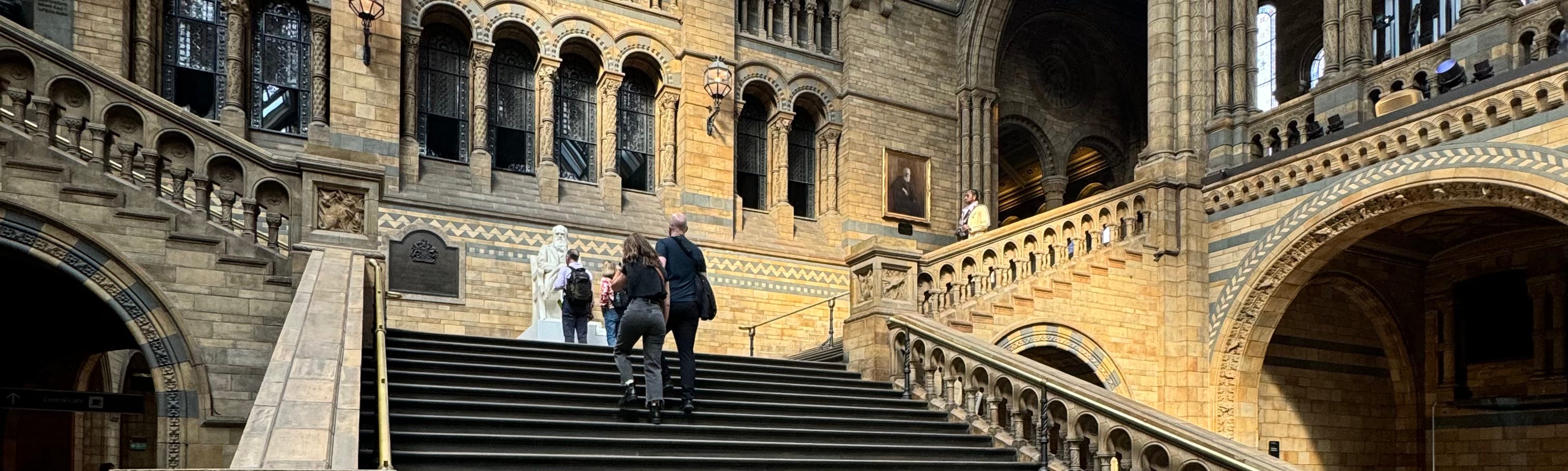
Darwin’s Bulldog
Richard Owen, the preeminent Victorian naturalist, led the vitiperous scientific opposition to Darwin's theory. Owen's reputation for ruthlessness was well-established, most notoriously in his persecution of paleontologist Gideon Mantell, whose discoveries he appropriated and continued to claim even after Mantell's tragic suicide. Despite this dark legacy, Owen wielded considerable influence in Victorian society, crowned by his achievement in establishing the British Museum's natural history collection as an independent museum.2
Darwin, who deliberately avoided defending his theory, particularly against religious criticism, proved an ideal target for Owen's attacks. His social position as a gentleman scientist and his marriage into the wealthy Wedgwood pottery family made him particularly vulnerable to social pressure. After returning from his voyage on the HMS Beagle, Darwin and his wife Emma had settled into a quiet life at Down House in Kent, where they raised their family. The death of their daughter Annie profoundly affected Darwin, deepening his tendency toward seclusion.3 Emma, particularly distressed by the controversy surrounding her husband's work, sought to shield their private lives from public scrutiny.
Meanwhile, Wallace, still in the Malay Archipelago when the controversy erupted, could only defend Darwin through correspondence. His own evolutionary ideas, though similar to Darwin's, had not yet been fully developed or publicly scrutinized to the same degree. Darwin found his most formidable defender in Thomas Henry Huxley, whose path to scientific prominence had been unconventional. Without formal university education, Huxley had trained at Charing Cross Hospital before serving as a naval surgeon aboard HMS Rattlesnake (1846-1850), where his research on marine invertebrates launched his scientific career. His expertise in comparative anatomy, paleontology, and embryology, developed through work with the Royal College of Surgeons, the Geological Society, and the Royal Society, proved invaluable in defending evolutionary theory. Huxley's contributions extended beyond research to education, notably in establishing Imperial College London's biological sciences programs.
Huxley's fierce intellect and formidable debating skills earned him the nickname "Darwin's Bulldog." His most famous confrontation came in 1860 at the Oxford University Union, where he debated Bishop Samuel Wilberforce (son of the anti-slavery campaigner). The debate proved a turning point: Huxley's systematic dismantling of Wilberforce's arguments helped shift public opinion toward accepting natural selection as the mechanism of evolution. While Huxley famously confronted Bishop Samuel Wilberforce in the heated Oxford debate of 1860, Wallace used his expertise and field experience to systematically dismantle critiques from both religious and scientific quarters, including those from the influential anatomist Richard Owen. From his rural retreat, Darwin could thus focus on his research while Huxley and Wallace fought many of the public battles against establishment figures who sought to discredit evolutionary theory.
How they are remembered.
By the time of his death in 1882, Charles Darwin’s theory of evolution by natural selection had reshaped biology, but it remained controversial, particularly among religious groups. Despite initial resistance, his ideas gained increasing acceptance within the scientific community, thanks in part to the vigorous defense by figures like Huxley and Wallace. Recognizing his immense contributions to science, Darwin was given the rare honor of burial in Westminster Abbey, near Sir Isaac Newton, a symbolic placement affirming his status as one of history’s great scientific minds. However, this decision was not without opposition; religious figures protested, arguing that his work challenged the foundational beliefs of creation.
Alfred Russel Wallace remained highly respected and acclaimed. A tribute appearing in the New York Times on his death honored his contributions to evolutionary biology and devotion to Darwin; Wallace’s wishes were that he be buried in Poole, Dorset. Two years after his death in 1913, a plaque was placed near Darwin in Westminster Abbey, acknowledging the significance of his contribution to the theory and it’s defense. An appropriate acknowledgement for the man who played a crucial yet often overshadowed role in one of science’s most transformative discoveries.4
As the theory of evolution gained acceptance, it faced new challenges and underwent significant refinement particularly with the advent of genetics. While Darwin was unaware of Gregor Mendel’s groundbreaking work on inheritance, later scientists would integrate Mendelian genetics with evolutionary theory, leading to the modern synthesis of evolution. Among the most influential figures in this ongoing development is Richard Dawkins, whose book The Selfish Gene offered a gene-centered view of evolution and brought a new level of clarity to the mechanisms of natural selection. Beyond his contributions to evolutionary biology, Dawkins became one of Darwin’s most formidable defenders, particularly in his critique of scientific creationism. In the next article, we will explore how the discovery of DNA, the rise of molecular biology, and the insights of thinkers like Dawkins have shaped our understanding of evolution, further cementing its place as one of the most profound scientific theories of all time.
This is the first of a series exploring the discoveries that have advanced our understanding of evolution and shaped society. From Mendel’s inheritance laws to the human genome project, we’ll explore how evolutionary science has transformed medicine and biotechnology, meet some founders of molecular biology, and trace humanity’s origins through ancient DNA.
While Darwin had formulated his theory of evolution by natural selection from the 1830s onward, he procrastinated over publication. His hand was forced once he received Wallace’s draft in manuscript outlining remarkably similar ideas. Rather than claim precedence, Darwin arranged for both their works to be presented jointly to the Linnean Society. This scientific coincidence led not to rivalry but to a lasting friendship characterized by mutual respect and admiration that lasted their lifetimes. Wallace, consistently acknowledged Darwin's primacy and became one of the strongest defenders of Darwinian evolution. Their relationship stands as a remarkable example of scientific collegiality, with Wallace later writing that Darwin's consideration of his work was "an act of unexampled self-abnegation and generosity."
Friends of Charles Darwin and the Alfred Russel Wallace websites are excellent starting points to further explore their lives and work.
Bill Bryson, in his book "A Short History of Nearly Everything," portrays Sir Richard Owen as a brilliant but deeply flawed figure. Bryson highlights Owen's significant contributions to paleontology, particularly his coining of the term "Dinosauria" and his role in establishing the Natural History Museum in London.
Darwin’s beloved eldest daughter, died at the age of ten after a prolonged battle with illness, likely tuberculosis or a related condition. Her death devastated Darwin, who had personally nursed her during her final weeks at a water-cure establishment in Malvern in a desperate attempt to improve her health. It’s thought that Annie’s loss profoundly affected Darwin, deepening his religious skepticism. Her death possibly reinforced his hesitation to publish his theory of evolution, knowing it would challenge the comfort many found in religious beliefs about death and the afterlife even as he became more skeptical about these. In personal writings, Darwin described Annie as “dear and good,” with “a remarkably sweet and pleasant expression” and a nature that was “open, frank, honest, and engaging.” Grief stricken, Darwin never visited her grave again, though Emma did, and he kept Annie’s writing case by his bedside for the rest of his life. Her death also appears to have intensified his concerns about inbreeding, as he had married his first cousin, Emma Wedgwood. This preoccupation led him to study the effects of cross-fertilization versus self-fertilization in plants, research that would later influence his work on heredity and variation.
Pain,S. Alfred Russel Wallace: A very rare specimen, New Scientist, November 6, 2013