

This the last in this series about the Rosetta Stone delves into why I believe that millions of people visiting the British Museum to see it are able ‘to see the world in a 760 kilogram lump of rock’ to poorly paraphrase British poet and visionary William Blake .
Next year, we will return to the topic of the repatriation of art and artifacts of importanance to cultural heritage, of colonial looting, institutional mismanagement, theft and fraud. The Rosetta Stone is merely one of so many controversies —a world of complex and nuanced stories where the Koh-i-Noor diamond -the jewel in the British crown and the Parthenon Marbles are similarly held captive, using very different if equally perverse arguments. Where the very museums that guard them, like the British Museum, are increasingly exposed by evidence of internal corruption and the undeniable demand for repatriation.
You can access the previous Ariadne Rosetta Stone Substack posts here:


A rock that helped us read the writing of a 4000 year civilization
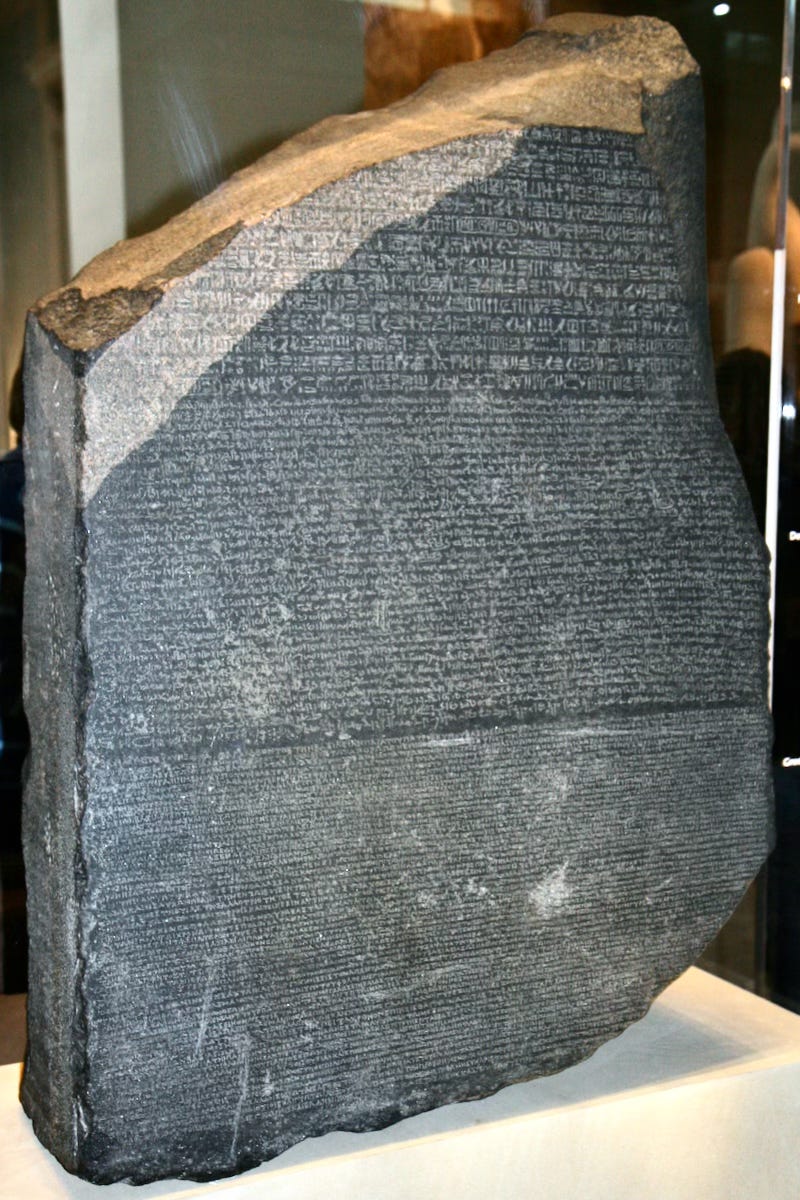
Two centuries after it went on view in March 1802, the Rosetta Stone an immediate hit, remains the British Museum’s most viewed object. Carved in 196 BCE to celebrate young Ptolemy V, the text itself is bureaucratic—tax remissions, royal beneficence. Yet in translating the same decree in hieroglyphic, demotic, and Greek, the slab an important role that let Jean-Frncois Champollion (1822) restore a lost voice to history. The allure of the stone isn’t the decree; it’s what the stone made possible. The enabler to learning about an ancient civilization whose architectural and artistic magnificence captativtated Europe and North America including a period in the early 20th Century called Egyptomania culminating in the discovery of King Tutankhamen’s tomb and extending beyound to the present day.

Giovani Belzoni is a legendrary personality with an Indiana Jones persona but a genuine caring for the preservation of ancient Egyption hieratage. Of course, he like so many others not only acheived great discovery’s and helped protect them for Egyptian heritage, he also found an item or two is one magical sarcophagus of Seti I incribed with the book of the dead on the inside and out. I show it here to illustrate how such marvels can be made accessible to millions through the 3-D videos produced by Factum Arte as well as the careful conservatioin of the Soane Museum.1
How we got here: Napoleon’s “research machine”
In 1798, Napoleon invaded Egypt with soldiers—roughly a hundred and sixty preeminent scientists, naturalists, architects, linguists and so on who founded the Institut d’Égypte in Cairo. The were a a kind of brain trust that Napoleon commissioned to produce a complete history of ancient Egyption civilization. They were themselves supported by hundres of artists encravers and so on making it the biggest scientific expediciton of its type ever embarked on at the time. Their state-backed program of survey, drawing, measurement, and publication (the monumental Description de l’Égypte, 1809–1829) effectively launched modern Egyptology. in mid-July 1799 during an inspection walk of fortification works at Fort Julien near Rashid/Rosetta, a French officer Pierre-François Bouchard noticed the Stone protuding from the ground.. After France’s defeat, the Stone was reluctantly ceded to Britain under the 1801 Capitulation of Alexandria, shipped to London in February 1802, and displayed to the public a month later.
What the Stone is (and isn’t).
A fragment of a larger stela: c. 112.3 cm high (3 ft 8 in), 75.7 cm wide (2 ft 6 in), 28.4 cm thick (11 in); its’ estimated weight is ~760 kg (1,675.51 pounds)
Three scripts, two languages: hieroglyphic (formal, monumental Egyptian), Demotic (a cursive Egyptian script for everyday use), and Ancient Greek (the administrative language of the Ptolemies).
Not a “cipher”: hieroglyphs weren’t secret code; they were a full writing system. The Stone aided decipherment because scholars could correlate known Greek with Egyptian scripts. The begining was with the identification of royal names such as Ptolomey and Cleopatra. These names are ringed by an oval shape that French soldiers likened to their rifle cartridges thus the name cartouche. The stone was used to corroborate the cartouche names for Ptolomey and Cleopatra not discover them. We have William Bankes, Robert Young and Jean-Francois Champillion to thank for that using mulitple scripts and sources, and Bankes lead the way with the Philae obelisk he’d brought home from Egypt (without permission).
Why it captivates (beyond the codebreaking myth)
The Stone’s power lies in recognition. Hieroglyphs look meaningful to modern eyes in a way cuneiform wedges or Linear B signs do not. And its rediscovery arrived as Romanticism met imperial science: Egypt offered the monumental, the mysterious, the sublime—exactly what 19th-century Europe wanted to see. That timing, not just the philology, made the Stone an icon.
(A note of proportion: other decipherments—Ventris on Linear B (1952), the cracking of Maya glyphs—match the Rosetta breakthrough in intellectual significance but lack its mass appeal. The public fascination is as much aesthetic and historical as it is scholarly.)
Why the Rosetta Stone resonates— how the story of it’s solution stacks up against the other ancient languages also deciphered.
The Rosetta story crowns two geniuses working in sequence: Thomas Young (yes—the same Young whose double-slit experiment every physics student learns) established key phonetic values from royal cartouches and mapped crucial features of Demotic; Jean-François Champollion then fused those insights with his deep Coptic to crack the broader system in 1822. It was cumulative, not singular—and that’s the norm in decipherment. Encyclopedia Britannica+2Encyclopedia Britannica+2
Linear B (1952): the “amateur” who wasn’t.
Michael Ventris, a young London architect, proved that Europe’s oldest readable script was Mycenaean Greek, but he stood on foundations laid by scholars like Alice Kober (whose card-index grids revealed inflectional patterns) and Emmett Bennett (systematic sign catalogues). Ventris’s proof, refined with classicist John Chadwick, became Documents in Mycenaean Greek and reset Aegean prehistory. University of Cambridge+2Classics Cambridge+2
Maya glyphs: a mid-century pivot.
For decades, scholars treated Maya signs as purely pictorial. In 1952, Soviet linguist Yuri Knorozov argued they were phonetic/syllabic (building on de Landa’s “alphabet”); later, Tatiana Proskouriakoff showed inscriptions recorded dynastic history, and a new generation (e.g., Linda Schele, David Stuart) unlocked names, dates, and verbs. Intellectually, this rivals Rosetta—less famous, no less brilliant. PBS+1
Cuneiform: the Behistun ‘field test’.
The trilingual Behistun Inscription in Iran played Rosetta-like roles for Mesopotamia. In 1857, four scholars (Rawlinson, Hincks, Oppert, and Fox Talbot) independently translated a newly found Akkadian text; their close agreement convinced the Royal Asiatic Society that cuneiform had been truly deciphered—a rare, documented “replication” moment in the humanities. Khan Academy+1
Still unsolved (and why):
Some scripts resist us because we lack bilinguals, the texts are too short, or the underlying language is unknown—e.g., the Indus script, Linear A, and Rongorongo of Rapa Nui (Easter Island). These aren’t failures; they’re reminders that decipherment needs data, context, and luck. Encyclopedia Britannica+2Encyclopedia Britannica+2
Enter AI (with historians in the loop).
Ithaca (DeepMind & collaborators) helps restore, date, and place fragmentary ancient Greek inscriptions; on benchmarks, it boosts historians’ accuracy from 25% → 72% when used as a partner, not a replacement. Nature+1
MIT CSAIL has shown unsupervised methods that can map some ancient scripts to known languages (e.g., Ugaritic, Linear B) without parallel texts—useful when bilinguals are missing. MIT News+1
Tools like Google’s Fabricius add practical workbenches for hieroglyph transcription/experimentation, speeding routine work and training new readers. blog.google
Perspective: Placing the Rosetta Stone in a contemporary context
Rosetta is the poster-child though visually mundane it apperared at the perfect cultural moment—the pattern is the same across scripts: years of incremental patterning → one or two catalytic insights → collective verification. Young and Champollion’s relay is exemplary, not exceptional. Also, it’s very accessible to any visitor to Egypt as it’s viewable all over monumnents, tombs and scrolls in and out of museums. Students of Egyptology the world over learn to read and write hieroglyphs and there are even mobile phone apps to help the less diligent amateur.
The debate today: London or Cairo?
The British Museum case emphasizes lawful transfer in 1801, consistent public access (free admission), conservation capacity, and the Stone’s global audience. Stewardship, the argument goes, has turned a single artifact into a universal classroom.
Egypt’s case stresses origin, identity, and narrative. The Stone is a touchstone of Egyptian civilizational memory; the Grand Egyptian Museum (GEM) complex near Giza now offers world-class climate control, conservation labs, digitization programs, and a setting that restores context—placing the Stone within Egypt’s own historical continuum. But as many important observers have pointed out the Rosetta Stone would be hard to notice in amongst the stunning grandeur of the new GEM - perhaps lost unnoticeably.2
Both cases have evolved. Provenance scrutiny, cataloging lapses, and illicit-antiquities scandals have pushed museums toward auditability and transparency. Meanwhile, Egypt’s conservation infrastructure, training, and international collaborations have expanded dramatically.
A practical middle road: long-term loan as policy tool
A structured 25-year renewable loan, the creation of physical facsimiles and digialized imaging available as research tools—with conservation benchmarks, reciprocal research residencies, and open-data commitments, and independent monitoring—would broaden access in Egypt while keeping global scholarship intact. Loans of icons can be more than diplomacy; they can be measurable governance compacts that raise standards on both sides.
What the Stone really tells us (about ourselves)
The Stone reveals a truth larger than any national claim: knowledge is collaborative. The decipherment drew on French, British, Swedish, and many other scholars; the field of Egyptology has since been sustained by international digs, labs, and funding alongside Egyptian expertise and stewardship. This is a symbiosis, not a zero-sum game.
Treating the Stone as purely national property misses its most important meaning. It symbolizes humanity’s ability to recover lost knowledge and to share it. Whether in London or Cairo, its future should model openness, access, and verifiable stewardship—the same principles that made its decipherment possible.
Conclusion
Home, for an object like the Rosetta Stone, is where it best serves human learning. Cairo can now make a compelling case on conservation and context; though London has delivered unparalleled access for two centuries. The wisest path is one that binds both to higher standards and broader audiences—so that a single administrative decree carved in 196 BCE continues to unlock entire worlds.
© 2025 Farooq Hussain
Readinglist
Creating a reading list about the Rosetta Stone requires considering both accessible and scholarly texts. I’ve attempted to combine a selection of both consider the distinction between some of them to be a fine line. I’ve not provided MLA citiations because a simple search by title and author will pop up results from any of your favorite online used book sources.
My first reccomnendatioin would be:
"Empress of the Nile" by Lynne Olson, this is a highly-regarded biography of Christiane Desroches-Noblecourt, a prominent French Egyptologist. While not exclusively about the Rosetta Stone, it provides excellent context on French Egyptology and the political and cultural backdrop of the field, which is directly relevant to the story of the stone's decipherment.
"The Exiled Collector," by Anne Sebba, this biography of William Bankes provides a crucial and engaging perspective on the English side of early 19th-century Egyptology, it has been meticulously reseached and will introduce the reader to the atmosphere of competitioin and feeling of intense importance in finding the solutions to Hierolgph decipherment.
I believe these books aside from being really enjoyably reads are very complementary. "Empress of the Nile" highlights the post-decipherment period and the political maneuvering of French Egyptology, Sebba's biography gives you a clear look at the early, foundational period of the field. It's a great way to understand the English context of collecting and discovery that ran alongside the French efforts to decipher the Rosetta Stone. Anne Sebba has done a masterful job in presenting what a significant role was contributed by William Bankes albeit an often overlooked, figure in the story of the compliation of the King’s list and the decipherment of the Rosetta Stone. He was a wealthy collector, an amateur explorer, and a friend of influential figures like Lord Byron. His travels and collections additioinally contributed to the broader European fascination with ancient Egypt. Bankes was a talented man who was forced into exile due to his homo-sexuality in an era when it was a capital offense. This dramatic personal narrative is a highly readable and humanizing element that offers insight into the social history of the time.
While I recommend only these two books in connection with this series, my desk floor is surrounded by so many I hate to leave out, I plan to make corrections ahead,
Below are a selection of titles that are perfect for a general audience. They are well-written, engaging, and focus on the compelling narrative of the stone's discovery and decipherment without getting bogged down in dense academic detail.
• "The Rosetta Stone and the Rebirth of Ancient Egypt" by John Ray
This is widely considered one of the best introductions to the topic. Ray, a renowned Egyptologist, provides a concise yet thorough account of the stone's history and its significance. It's praised for being both knowledgeable and accessible, making it an excellent starting point.
• "The Rosetta Stone: The Story of the Decoding of Hieroglyphics" by Robert Solé and Dominique Valbelle
Written by a novelist and an Egyptologist, this book reads like a detective thriller. It chronicles the international competition between French and British scholars to decipher the hieroglyphs, focusing on the personalities and intrigue of the time.
• "Cracking the Egyptian Code: The Revolutionary Life of Jean-François Champollion" by Andrew Robinson
Robinson's biography of Champollion is a fascinating look at the French genius who made the crucial breakthrough. The book provides a detailed and readable narrative of his life and the intellectual journey that led to his success.
• "The Riddle of the Rosetta: How an English Polymath and a French Polyglot Discovered the Meaning of Egyptian Hieroglyphs" by Jed Buchwald and Diane Greco Josefowicz
This book offers a balanced perspective on the rivalry between Thomas Young and Jean-François Champollion. It's a well-researched and engaging account that highlights the contributions of both men, providing a richer context for the decipherment.
Serious Reading
These books are more detailed and are better suited for those who want a deeper dive into the linguistics, history, and archaeological context surrounding the Rosetta Stone.
• "The Rosetta Stone: Object in Focus" by Richard Parkinson
This small but detailed book from the British Museum provides an authoritative overview. It includes a full translation of the text and explores the stone's history, from its creation to its discovery and eventual decipherment. It is a fantastic resource for a serious student.
"Hieroglyphs: A Very Short Introduction" by Penelope Wilson
While not exclusively about the Rosetta Stone, this book offers a clear and concise explanation of the hieroglyphic system and the process of its decipherment. It is part of the Oxford "Very Short Introductions" series, which is known for its high-quality, accessible academic content.
• "The Rosetta Stone" by E.A. Wallis Budge
Written by a prominent early 20th-century Egyptologist, this book is a classic text. It provides a historical account of the stone's discovery and the early attempts at decipherment. While the language may be a bit dated, it offers a window into the foundational scholarship of the field.
• "Unlocking the Hieroglyphic Code" by Christiane Ziegler and Jean-Pierre Adam
This book, often available from the British Museum, delves into the mechanics of the decipherment itself. It is rich with illustrations and historical documents, making it a valuable resource for understanding the intellectual puzzle that scholars faced.
• "Lost Languages: The Enigma of the World's Undeciphered Scripts" by Andrew Robinson
This book places the Rosetta Stone in a broader context of linguistic decipherment. It dedicates a significant section to hieroglyphs but also explores other undeciphered languages, highlighting what made the Rosetta Stone's trilingual text so unique and invaluable.
• "The Story of Writing" by Andrew Robinson
Similar to "Lost Languages," this book provides a global history of writing systems. It offers an excellent section on the Rosetta Stone as a key moment in the history of linguistics and communication. It's a great choice for understanding the stone's long-term impact.
Sarcophagus of Seti I: https://www.soane.org/features/discovering-setis-sarcophagus-200-years. Factum Arte Seti I Sarcophagus 3-D video
Cooney, Kara, and Jordan Harbour. "The Rosetta Stone and the Repatriation Debate." Ancient/Now, 27 Mar. 2023, ancientnow.substack.com/p/the-rosetta-stone-and-the-repatriation-ef7 Professor Cooney’s podcast on this topic pretty much dissects the whole re-pariation question - if you’ve stuck with my series you’ll observe I’m in line with one of the US’s leading Egyptologists. I encourage enthusiats to subscribe to the podcast.