


Desert Snowflakes
On July 16, 1945, at the Alamogordo bombing range in New Mexico, the first atomic bomb was detonated in the pre-dawn darkness. The test, code-named Trinity, marked humanity’s entry into the nuclear age. What few remember is that nearby, a girls’ summer camp lay downwind of the blast. Military officials made a calculated decision: evacuating the camp would risk revealing the test’s location. The girls stayed.
Within days, some children fell mysteriously ill after playing in the radioactive “snowflakes” that drifted down from the sky. Barbara Kent, the longest-surviving, died at 30. All were victims of radiation-induced cancers from the fallout of the Trinity test.. They were among the first victims of a pattern that would repeat itself thousands of times over the next five decades—from Hiroshima’s Hibakusha to the indigenous peoples of the Pacific islands, from Japanese fishermen caught in fallout zones to communities downwind of test sites in Nevada and Kazakhstan.
That was eighty years ago. Since then, humanity has conducted over 2,000 nuclear tests—from the atmospheric spectacles that turned Las Vegas into “Atomic City” to the underground detonations that shook the Nevada desert, to today’s subcritical experiments conducted in facilities nearly 1,000 feet below ground. Science has evolved from J. Robert Oppenheimer’s “gadget on a tower” to supercomputer simulations and particle accelerators that can image plutonium compression at the nanosecond scale. Yet President Trump’s recent announcement that he’s directing the Pentagon to “immediately resume nuclear weapons testing” threatens to drag us back to an era we thought we’d left behind—for reasons nobody can adequately explain.
Atomic Tourism: When Mushroom Clouds Were Entertainment
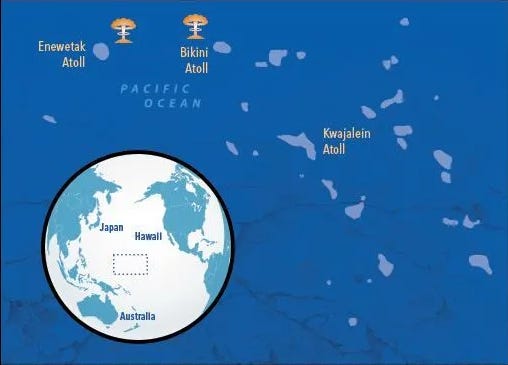
For the post-war development of the hydrogen bomb, the United States used several Marshall Islands in the Pacific, forcibly removing inhabitants and exposing entire populations to radiation—a tragedy that deserves its own reckoning1. But for domestic testing, only one location served: the Nevada Test Site, now called the Nevada National Security Site (NNSS).
Between 1951 and 1962, the site hosted 100 atmospheric nuclear tests. Las Vegas, just 65 miles away, didn’t hide from the detonations. The city marketed them as tourist attractions.
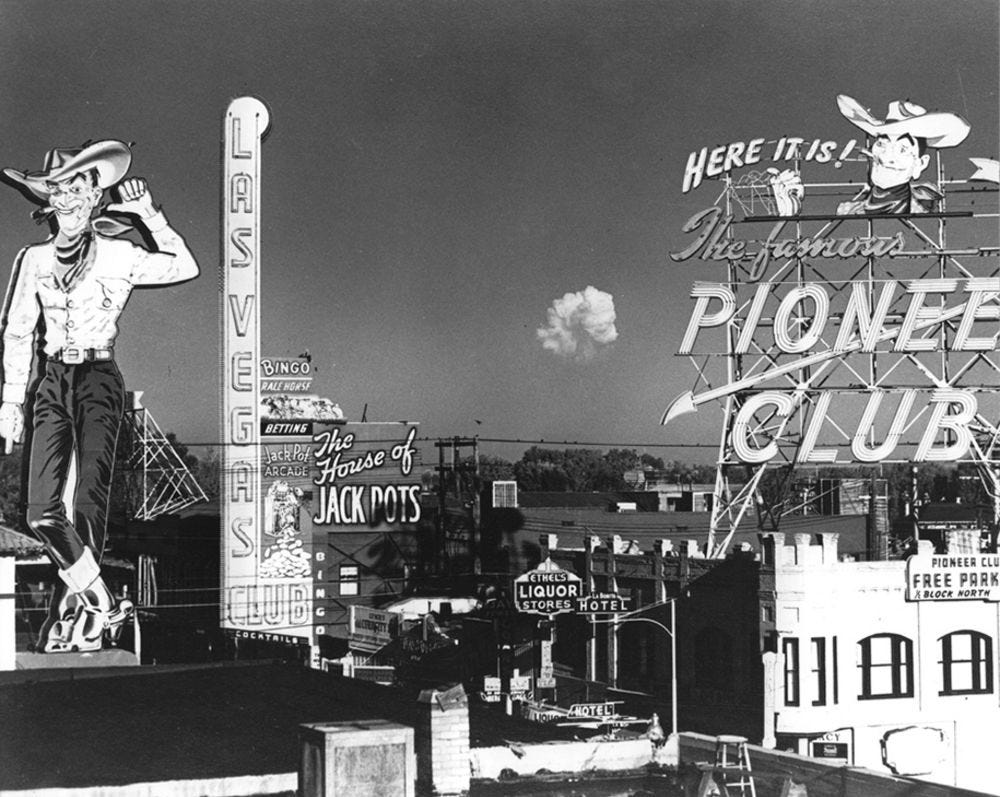
I’ve stood at the National Atomic Testing Museum in Las Vegas, looking at photographs of what they called “Dawn Bomb Parties.” Hotels and casinos hosted them on rooftop terraces, where guests in evening wear would gather in the predawn darkness, cocktails in hand, to watch the flash and the mushroom cloud rise. Bartenders created atomic-themed drinks. The city nicknamed itself “Atomic City.” Beauty pageants crowned “Miss Atomic Bomb,” with winners wearing costumes shaped like mushroom clouds.
It’s surreal to contemplate now—this normalization of apocalyptic weapons as entertainment. But it speaks to how thoroughly we compartmentalized the horror. The flash and the cloud were spectacular. The radiation sickness and cancers came later, invisibly, to people we’d decided didn’t matter.
When the Party Ended
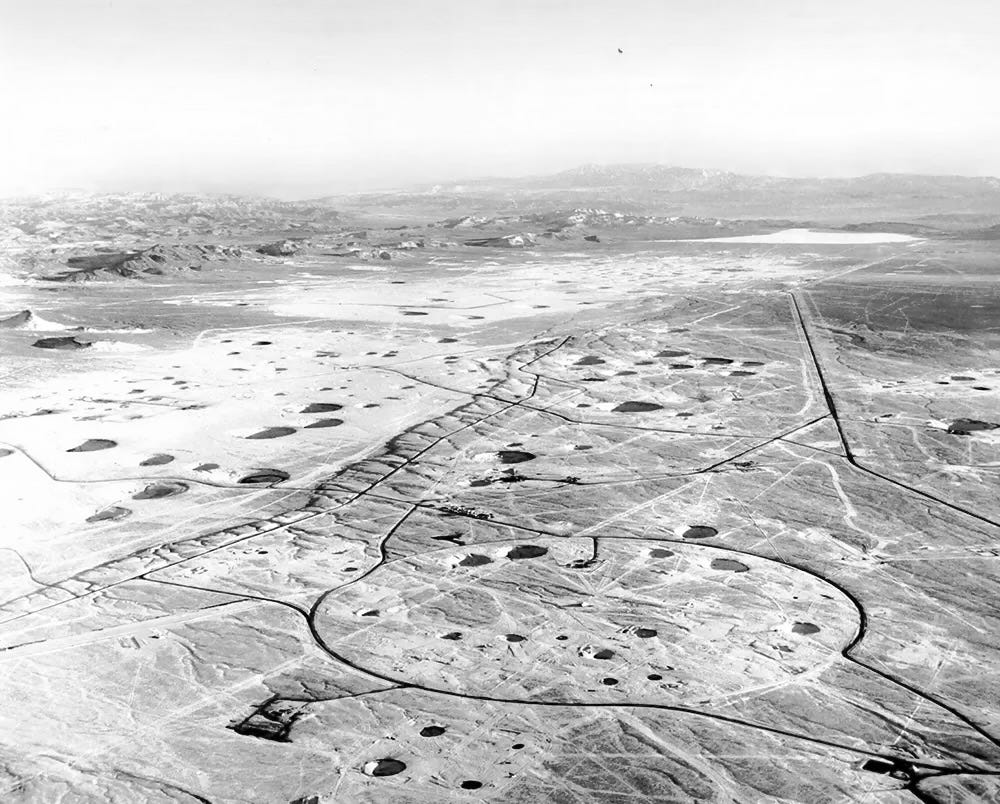
The Partial Test Ban Treaty of 1963 ended atmospheric testing after scientific evidence made the widespread, severe radioactive fallout undeniable. Testing at the Nevada site moved exclusively underground, where it would continue until 1992 — 828 more tests, many creating craters still visible across the desert.
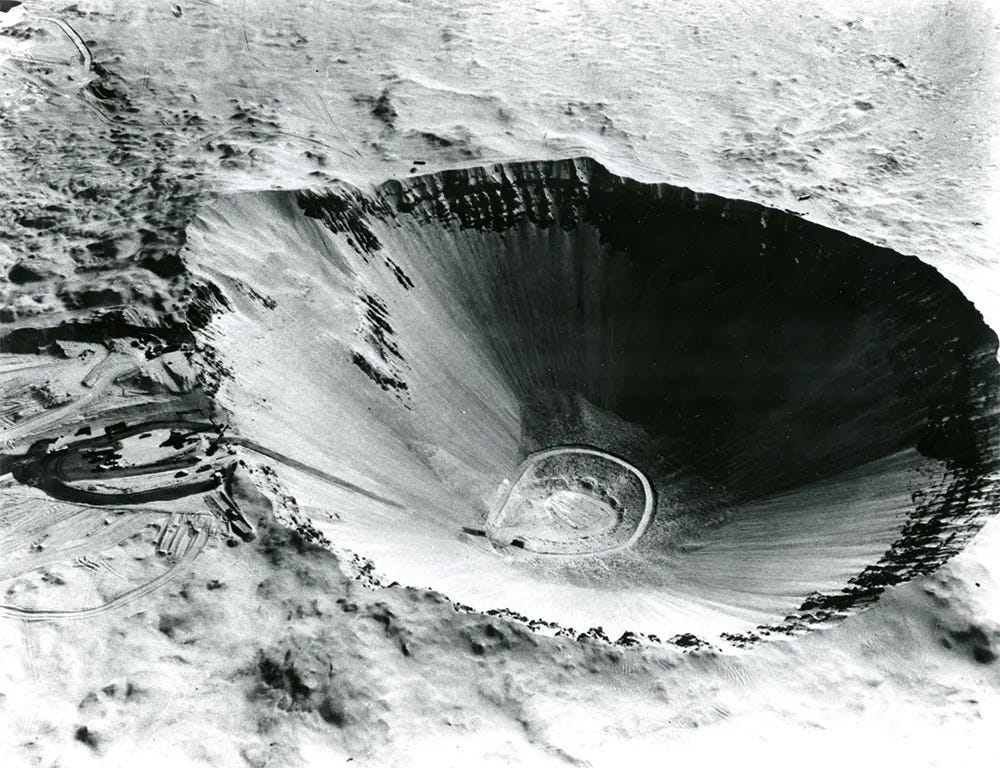
I’ve visited the Sedan Crater, created by a 104-kiloton test in 1962. Standing at its edge—1,280 feet wide, 320 feet deep, with 12 million tons of displaced earth—you grasp the scale of what “underground” testing meant. These weren’t gentle experiments. They were violent releases of nuclear energy, contained only by hundreds of feet of rock and soil.
The Soviet Union conducted tests at Semipalatinsk in Kazakhstan at a similar intensity. Communities downwind still carry the genetic scars. After the Cold War ended, the testing stopped—not because of treaties, but because both superpowers recognized they’d learned what they needed to know, and the cost was too high.
How Nuclear Weapons Science Actually Works Today
Here’s what most people miss when they hear only “nuclear testing”: the science has been revolutionized. Nobody conducts “gadget on a tower” tests anymore.
Compare Trinity to what happens at NNSS now. Oppenheimer’s team assembled a 22-kiloton bomb, hauled it up a 100-foot tower, and detonated it, hoping their calculations were correct. Today, scientists conduct subcritical experiments nearly 1,000 feet underground at facilities such as the Principal Underground Laboratory for Subcritical Experimentation (PULSE).
These experiments use conventional high explosives to compress weapons-relevant quantities of plutonium under extreme pressure. Crucially, no critical mass forms. No self-sustaining nuclear chain reaction occurs. There is no nuclear yield, no explosion, no mushroom cloud, no fallout. The configuration is deliberately designed to stay below the nuclear threshold.
What makes these experiments more valuable isn’t the bang—it’s the data. Powerful particle accelerators and pulsed X-ray radiography systems like Cygnus capture images at nanosecond intervals, revealing exactly how plutonium behaves under the extreme conditions it would experience in a weapon. According to NNSS scientists, these experiments extract information that “surpasses in a pretty great magnitude the data we were able to collect from full-scale tests.”
This is combined with the Stockpile Stewardship Program, which includes advanced supercomputer simulations, materials science, and precision manufacturing. The result? The U.S. understands more about how its weapons work now than it did during the height of Cold War testing, when we were actually detonating them.
This is why, for over three decades, every U.S. president has been able to certify to Congress annually that the nuclear deterrent remains safe and effective without explosive testing. Issues like plutonium pit degradation are addressed through Life Extension Programs and restoration of production capabilities at Los Alamos and Savannah River—routine maintenance that requires no nuclear detonations.
The 33-Year Moratorium
The United States conducted its last nuclear test in 1992. The Soviet Union had stopped in 1990, and by 1996, when the United Nations adopted the Comprehensive Nuclear-Test-Ban Treaty (CTBT), a global norm had taken hold.2
The CTBT has never entered into force—44 countries, including the U.S. and China, have not ratified it. But only North Korea has violated the testing taboo since 1996. For three decades, no nuclear nation found it technically necessary to detonate a weapon.
The U.S. maintained a voluntary moratorium, not out of weakness but out of technical confidence. With over 1,000 tests conducted—compared to 45 by China—we had the data. Our Stockpile Stewardship Program worked. Breaking the moratorium would help our adversaries more than it would help us.
A Political Aberration
Which brings us to President Trump’s October 30, 2025, announcement directing the Pentagon to resume testing “on an equal basis” with Russia and China.
The justification dissolved immediately under scrutiny. Russia had recently tested nuclear-powered delivery systems—a cruise missile and a torpedo—but these are tests of propulsion systems, not nuclear warhead detonations. Neither Russia (last prior test: 1990) nor China (last prior test: 1996) has conducted an explosive nuclear test in decades.
When pressed by reporters about what tests prompted his decision, Trump stated, “I see them testing and I say, ‘Well, if they’re going to test, I guess we have to test”—conflating fundamentally different types of weapons tests.
The announcement reportedly caught even Trump’s advisers off guard. Hours later, the senior military officer nominated to oversee the nuclear arsenal testified on Capitol Hill that he wasn’t “reading anything” into Trump’s Truth Social post—an indication the directive hadn’t been coordinated. Vice President JD Vance defended it by saying, “It’s an important part of American national security to make sure that this nuclear arsenal we have actually functions properly,” then immediately added, “To be clear, we know that it does work properly.”
The scientific consensus from the Department of Energy and National Nuclear Security Administration is unequivocal: explosive testing is not required to advance nuclear weapons design or maintain stockpile reliability. No technical experts called for this. No credible military threat requires it.
Moreover, the U.S. couldn’t conduct a test immediately even if ordered. These projects are planned and fiscally appropriated years in advance. Former NNSA officials note it would take 24-36 months to prepare the infrastructure at Nevada—unless the President declared a national emergency and waived environmental and safety regulations. Otherwise, someone would need to pull ordnance from the stockpile and detonate it underground with minimal preparation. This approach would yield no new data but could result in some unplanned local contamination.
Nevada Remembers
Senator Jacky Rosen of Nevada responded swiftly: “This directly contradicts the commitments I secured from Trump nominees—and the opinion of Administration officials who certify our nuclear stockpile—who’ve told me explosive nuclear testing would not happen & is unnecessary. I’ll fight to stop this.”
Their urgency is rooted in lived experience. Nevada hosted 928 nuclear tests between 1951 and 1992. The state legislature passed a resolution in May 2025 calling on the federal government to maintain its moratorium. Nevadans understand what the rest of the country seems to have forgotten: underground testing, while far safer than atmospheric testing, still carries risks. Radioactive fallout has leaked from test shafts. The detonations shake buildings as far away as Las Vegas, where newer high-rises could be at risk of structural damage.
The Damage Beyond Radiation
The immediate cost of breaking the moratorium wouldn’t be measured in rads or roentgens, but in shattered international norms.
The U.S., as the world’s leading nuclear power, has maintained voluntary restraint since 1992 as a pillar of non-proliferation efforts. Breaking that restraint would undermine our credibility in challenging states like Iran or North Korea. Iranian officials have already seized on Trump’s announcement, calling it a “serious threat to international peace and security.
Russia withdrew from the CTBT in 2023 but stated that it planned to maintain its moratorium unless the U.S. tested first. This announcement hands Moscow exactly the justification it needs to restart its own program, likely followed by China and other nuclear weapons nations.
The timing is particularly destabilizing. The New START treaty—the last remaining arms control agreement between the world’s two most considerable nuclear powers—expires in February 2026, just four months away. Since taking office, Trump has repeatedly stated his desire to significantly reduce global nuclear arsenals, yet his administration has made no tangible efforts to negotiate a post-New START framework. It’s unclear whether a formal negotiating team of subject matter experts from State and Defense has even been assembled. Instead of diplomatic groundwork for the arms control agreement he claims to want, we get a Truth Social post threatening to resume testing. This announcement doesn’t advance negotiations but instead hands Russia and China justification to walk away from the table entirely. This isn’t a strategy. It’s the active dismantling of what remains of the arms control architecture, dressed up as strength.
Former NNSA official Corey Hinderstein noted that other nations “have more to gain by resuming nuclear testing than the United States does. Resuming testing would primarily benefit our adversaries.”
Preserving What We’ve Learned
There’s a strange irony in how the U.S. treats its nuclear testing legacy. The NNSS offers free public tours departing from the Atomic Testing Museum. You can stand at the edge of the Sedan Crater, listed on the National Register of Historic Places. The Manhattan Project sites at Oak Ridge, Hanford, and Los Alamos are preserved as a National Historical Park, with limited “behind-the-fence” tours of historic laboratory areas.
The major weapons labs run educational programs—the Bradbury Science Museum at Los Alamos even has Junior Docent programs for middle and high school students—the entire enterprise balances high security with remarkable public transparency about history and education.
It’s as if we’ve built museums and monuments to commemorate what we’ve moved beyond, only to have a President announce we’re going back.
The Question That Haunts Me
As I write this, I keep returning to those girls at the summer camp in 1945. They played in radioactive snowflakes because military planners decided security concerns outweighed their safety. All died young, their names forgotten, their sacrifice barely recalled.
Eight decades later, we face a similar calculation—but now without even the veneer of military necessity. The decision appears to be pure political theater, a show of strength that actually weakens us by inviting adversaries to resume testing they’d abandoned.
The nuclear taboo—the global norm against testing that has held for three decades—is fragile. It rests not on treaties (remember the CTBT remains unratified) but on collective restraint born from understanding what these weapons do to human beings. To the Hibakusha of Hiroshima and Nagasaki. To the Marshallese people of Bikini Atoll and Enewetak. To the families downwind of Semipalatinsk and the Nevada Test Site.
To those girls playing in summer snowflakes composed of lethal radioactive fallout from the first nuclear weapons test.
If testing resumes, we won’t just be breaking a moratorium; we'll be breaking it. We’ll be summoning ghosts we spent half a century trying to lay to rest—and inviting other nuclear weapons powers to do the same to do the same.
And for what? The question remains unanswered.
last updated: November 16, 2025
© 2025 Farooq Hussain
In his book, Blown to Hell, the legendary Washington Post national security reporter and Pulitzer Prize-winner, Walter Pincus, provides a detailed and well-researched account of the United States’ nuclear weapons testing program in the Marshall Islands from 1946 to 1958 and its devastating impact on the Marshallese people.
The book is characterized as a “scathing exposé” and a “tragic encounter of a pre-modern people with history’s most powerful nation,” revealing the secrecy, immense risks, and outright deceptions embraced by U.S. officials, which resulted in the islanders becoming unwitting test subjects in a large-scale study of nuclear fallout.
However, reviewers from the Bulletin of the Atomic Scientists have raised objections regarding certain depictions of the Marshall Islanders, arguing that unidimensional portrayals of the Marshallese people as solely victims can detract from their “admirable story of resilience and self-reliance”. According to the Marshall Islands National Nuclear Commission, such depictions risk “violently exploiting” the community and contributing to a narrative where outsiders use the Marshall Islands to advance their own interests at the expense of the indigenous community, rather than highlighting their agency and strong cultural networks.
The reviewer noted that “even well-intentioned publications can be invasive and create more hardship for the communities in question, where researchers are literally privileged memory-makers” Fox News. Some Marshallese felt Pincus had immersed himself so deeply in local politics that his perspective took on aspects some characterized as colonial.
Despite these critiques, the book’s documentation of the continuing plight of the Marshall Islanders remains vital. The Runit Dome continues to deteriorate with virtually no remediation planned beyond monitoring. Large areas of the Marshall Islands remain unsafe for human habitation and continue to pose threats to the environment and wildlife. The legacy of the 67 tests persists in genetically inherited diseases among descendants of those exposed to fallout, and the islands face the dual threat of radioactive contamination and rising seas from climate change.
Citation: Pincus, Walter. Blown to Hell: America’s Deadly Betrayal of the Marshall Islanders. Diversion Books, 2021.
Critical Review: [Author name]. “Book Review: Blown to Hell: America’s Deadly Betrayal of the Marshall Islanders by Walter Pincus.” Arms Control Today, May 2022, www.armscontrol.org/act/2022-05/book-reviews/blown-hell-americas-deadly-betrayal-marshall-islanders.
Nihon Hidankyo – Facts – 2024 - NobelPrize.org
Nagasaki: Life After Nuclear War, Susan Southard
Footnote on Documenting the Hibakusha and Their Stories:
The documentation of the atomic bombings of Hiroshima and Nagasaki and the experiences of the hibakusha (atomic bomb-affected people) has been a vital project spanning eight decades, often against official resistance. John Hersey’s 1946 book Hiroshima, originally published in its entirety in a single issue of The New Yorker on August 31, 1946, was the first work to present the effects of the atomic bomb on a human scale to a global audience. Hersey spent three weeks in May 1946 interviewing survivors and told the stories of six ordinary people following their experiences from the moment of the blast through the subsequent days and months, Chicago Tribune, Inland Valley Daily Bulletin. The magazine sold out within hours, and the book has never been out of print since, selling more than three million copies of the Inland Valley Daily Bulletin.
Less well-known is the story of George Weller, a Pulitzer Prize-winning journalist for the Chicago Daily News, who in September 1945 defied military orders and traveled to Nagasaki, becoming the first Western reporter to enter the city. Weller spent weeks documenting the horrific effects of radiation sickness—what he called “Disease X”—interviewing doctors and survivors, and describing in clinical detail the mysterious ailments killing victims who had survived the initial blast. U.S. military censors under General Douglas MacArthur suppressed all of Weller’s dispatches. The reports remained lost for six decades until Weller’s son, Anthony Weller, discovered carbon copies among his father’s papers after his death in 2002. The dispatches were finally published in 2005 as First Into Nagasaki: The Censored Eyewitness Dispatches on Post-Atomic Japan and Its Prisoners of War, revealing what the U.S. government had worked so hard to hide from the American public: that radiation was killing people long after the bombings.
Susan Southard’s Nagasaki: Life After Nuclear War (2015) spent over a decade researching and interviewing hibakusha and atomic bomb historians, physicians, and specialists, following five survivors—all teenagers at the time of the bombing—from 1945 to the present day. The book documents not only the immediate devastation but also the decades of radiation-related cancers, illnesses, and the social stigma and discrimination that hibakusha faced, Al Jazeera CNN. The former Director of the Nagasaki Atomic Bomb Hospital called it “the most extraordinary account ever written by an American author,” CNBC.
In October 2024, the Norwegian Nobel Committee awarded the Nobel Peace Prize to Nihon Hidankyo (the Japan Confederation of A- and H-Bomb Sufferers Organizations), a grassroots movement of atomic bomb survivors formed in 1956, “for its efforts to achieve a world free of nuclear weapons and for demonstrating through witness testimony that nuclear weapons must never be used again” KWTXNPR. The Committee stated that “the testimony of the Hibakusha—the survivors of Hiroshima and Nagasaki—is unique” in establishing the powerful international norm against nuclear weapons use known as “the nuclear taboo,” and warned that “this taboo against the use of nuclear weapons is under pressure” KWTX.
The remarkable story of Tsutomu Yamaguchi, a Japanese man who survived both atomic bombings—first in Hiroshima, then after boarding a train to Nagasaki—will be told in a major feature film by director James Cameron. Cameron purchased the rights to Charles Pellegrino’s books Last Train From Hiroshima (2015) and the forthcoming Ghosts of Hiroshima (2025) from The Washington Post and NPR. Cameron met Yamaguchi just days before his death in 2010, stating, “He was in the hospital. He was handing the baton of his personal story to us, so I had to do it. I can’t turn away from it,” NPR. The film will shoot when Avatar production permits.
Citations:
Hersey, John. Hiroshima. Alfred A. Knopf, 1946.
Weller, George, and Anthony Weller, editor. First Into Nagasaki: The Censored Eyewitness Dispatches on Post-Atomic Japan and Its Prisoners of War. Crown Publishers, 2005.
Southard, Susan. Nagasaki: Life After Nuclear War. Viking, 2015.
“The Nobel Peace Prize 2024.” NobelPrize.org, Norwegian Nobel Committee, 11 Oct. 2024, www.nobelprize.org/prizes/peace/2024/press-release/
Footnote on Scientists Who Argue Testing Is Unnecessary:
In August 1978, three of America’s most influential nuclear weapons physicists—Richard L. Garwin, Norris E. Bradbury, and J. Carson Mark—wrote a letter to the then President of the United States Jimmy Carter himself a nuclear engineer, regarding nuclear weapons stockpile reliability under a Comprehensive Test Ban Treaty. Norris Bradbury had led Los Alamos Laboratory following Robert Oppenheimer’s resignation after Hiroshima and Nagasaki, serving as its longest-tenured director. Carson Mark led the nuclear weapons design team at Los Alamos for decades and was a foundational figure in the U.S. nuclear program. Richard Garwin, at age 23 in 1951, had designed the blueprint for the first hydrogen bomb test (codenamed Mike) at Enewetak Atoll, yet spent the next 70 years working on every treaty to ban nuclear tests, calling the control of nuclear weapons “nothing less than the biggest deal in history” Their 1978 letter to Carter argued that further nuclear testing was unnecessary for stockpile reliability. CNBC. Since then, the view has become internationally accecpted especially with those nuclear nations that have active nuclear weapons modernization underway.
Decades later, physicist Kenneth W. Ford published Building The H Bomb: A Personal History (2015), a memoir of his work in his mid-twenties as a member of the team that designed and built the first hydrogen bomb, working alongside Teller, Fermi, Ulam, von Neumann, and Wheeler at both Los Alamos and Princeton’s Project Matterhorn. Ford published the book over Department of Energy objections, which had requested substantial redactions Trump’s comments on nuclear testing upend decades of US policy. Here’s what to know about it. Ford has not worked on weapons since 1953, and after decades as a teacher, researcher, and writer, felt compelled to document the history while he remained “one of the few contributors to the design of the first hydrogen bomb who is still standing”
Footnote on The Runit Dome: A Crumbling Nuclear Coffin in the Pacific
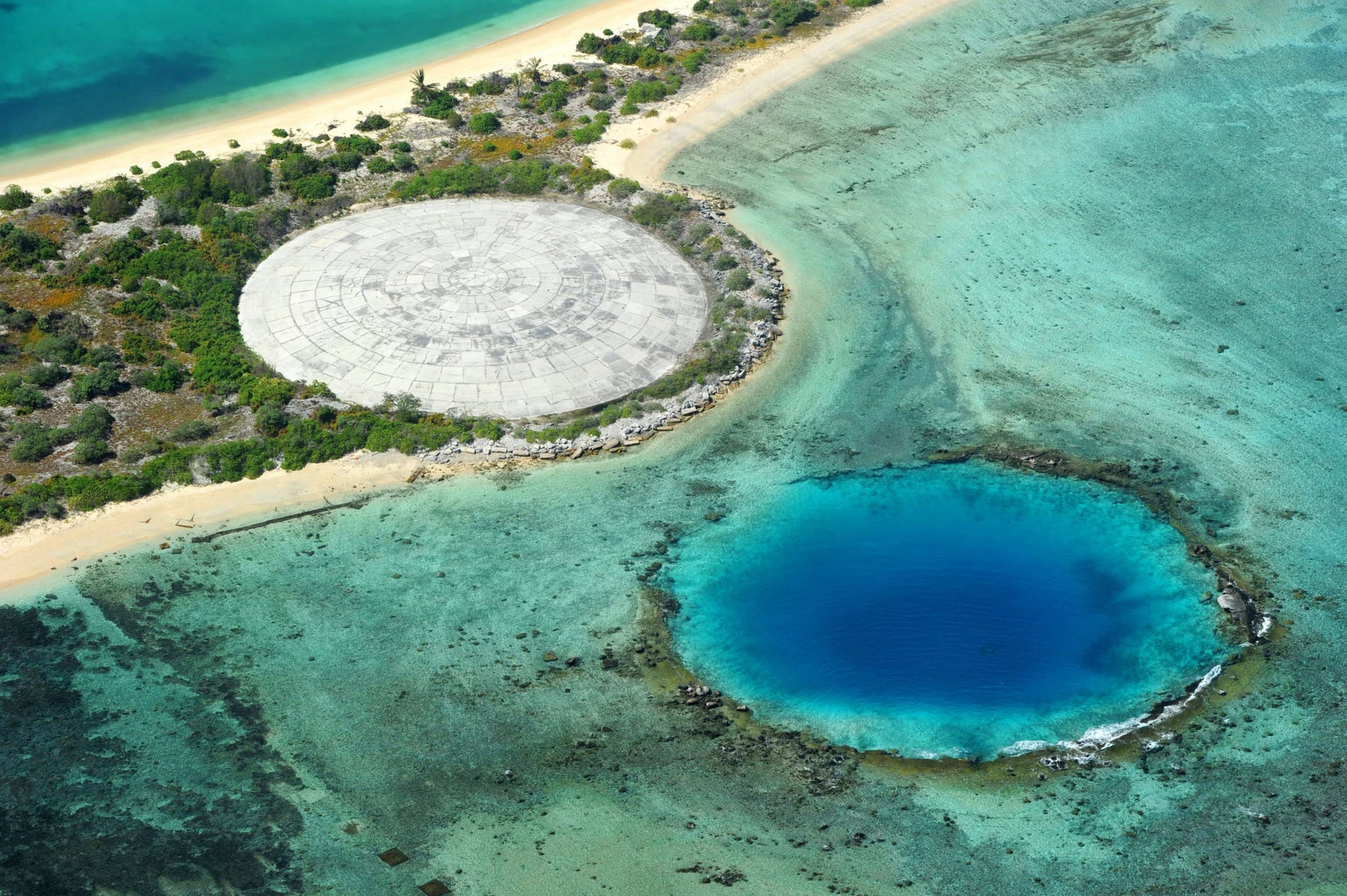
The Runit Dome, also called “The Tomb” by locals, is a 377-foot-diameter, 18-inch-thick concrete cap built at sea level on Runit Island in Enewetak Atoll, Marshall Islands. Between 1977 and 1980, the U.S. collected over 3.1 million cubic feet (approximately 100,000 cubic yards) of radioactive debris from 43 nuclear tests conducted between 1946 and 1958, dumped it into the Cactus Crater—one of the bomb craters on Runit—mixed it with concrete, and sealed it under the dome. Some 4,000 U.S. servicemen, working in extreme heat without adequate protective equipment, shoveled the equivalent of 35 Olympic swimming pools’ worth of contaminated soil into the crater. The waste includes plutonium-239, which has a half-life of 24,000 years.
The Fatal Flaw: No Bottom Liner
To save costs, the plan to line the porous crater bottom with concrete was abandoned. The crater floor consists of permeable coral atoll material, allowing seawater to seep in and out with the tides. Built at sea level over the porous atoll floor, the dome cannot prevent seawater from seeping in from below, potentially leaking radioactive material into the surrounding waters.
Deterioration and Cracking
A 2013 Department of Energy inspection found the concrete dome had weathered with minor cracking of the structure, and visual surveys revealed over 1,000 linear feet of cracks and 34 spalls (concrete fragments breaking off) across the surface. Some panels showed significant spalling, with chipped concrete exposing the contaminated soil-cement mixture below, and surface cracks running across the full width of the panels. Sand has penetrated the structure, groundwater beneath is radioactive, and vines are growing inside the crevices—organic matter penetrating with disturbing ease.
Climate Change and Storm Threats
Runit Dome sits roughly 25 feet above sea level on low-lying Runit Island, making it vulnerable to inundation from rising seas. In 1982, a U.S. government task force raised concerns about a possible breach if a severe typhoon hit the island. Cracks and wear on the concrete, from years of weather and seawater erosion, place the dome at risk of being blown open by a severe storm or typhoon, which would result in the widespread dispersion of nuclear waste across the Pacific.
The Government’s Disturbing Response
The 2013 Department of Energy report stated that the soil around the dome is more contaminated than its contents, so a breach “could not increase the radiation levels by any means” and that “catastrophic failure of the concrete dome and instantaneous release of all its contents into the lagoon will not necessarily lead to any significant change in the radiation dose delivered to the local resident population”. The dome was meant as a temporary solution, but has become a permanent fixture. The U.S. never told the Marshallese that in 1958, it had shipped 130 tons of additional radioactive soil from Nevada to the Marshall Islands.
Recent Assessments
A 2024 climate impact study mandated by Congress found that, for storm scenarios in which Runit Dome remains intact, changes in radiological doses are estimated to be below 0.1 mrem/year across all islands. In the event of hypothetical dome failure, doses are estimated below 0.2 mrem/year for inhabited islands, though approximately 20 mrem could accumulate in areas around Runit Island in the first year following a failure.
The Human Cost
Marshallese Senator Jack Ading stated, “These are matters of life and death for us. We can’t afford to rely solely on reassurances from a single source. We need neutral experts from the international community to weigh in. We didn’t know the Runit Dome waste dump would crack and leak… We didn’t know about climate change. We weren’t nuclear scientists who could independently verify what the U.S. was telling us. We were just island people who desperately wanted to return home”. Many U.S. servicemen who built the dome claim illnesses developed years later from unprotected exposure, with some dying of cancer, though the U.S. government denies any connection and has refused compensation.
The user is correct in highlighting that countries affected by nuclear testing face severe, long-term pollution, and often struggle to get adequate foreign aid to treat victims and recover land. While much of the information on the environmental legacy of nuclear testing focuses on Kazakhstan, where the main Soviet test site, Semipalatinsk, was located, Uzbekistan also has a history of contamination and related challenges with foreign assistance.
Key aspects of this issue include:
Legacy of Soviet Testing: The primary nuclear test site for the Soviet Union was Semipalatinsk in neighboring Kazakhstan, which caused widespread radioactive contamination in the region, including parts of Uzbekistan, due to fallout spread by wind.
Specific Contamination in Uzbekistan: Uzbekistan itself housed the Karshi-Khanabad (K2) air base, a former Soviet military facility used by the U.S. after 9/11. Declassified documents revealed that U.S. service members there were exposed to significant levels of radiation (from depleted uranium and potentially other sources), as well as other toxic chemicals. The base was abandoned without adequate environmental remediation in some areas.
Ongoing Health and Environmental Impacts: Radioactive materials such as cesium-137 and strontium-90 can persist in the environment for many years, entering the food chain and causing long-term health consequences, including cancer and genetic damage, for local populations. Many contaminated areas remain uninhabitable.
Challenges with Foreign Aid:
In the case of the K2 base, U.S. veterans long struggled to receive medical care and disability benefits from the Department of Veterans Affairs, highlighting systemic difficulties in addressing exposure-related illnesses, even among their own citizens.
Political factors can also impede aid; for example, a freeze in U.S. aid funding and military cooperation occurred after an incident in Andijan, which impacted the ability to address some legacy issues.
Generally, communities in former nuclear testing areas often suffer from a lack of resources to move away from contaminated areas and limited international assistance for remediation and victim support.
International Efforts, but Gaps: The international community has a duty to address the harm done, and a recent UN resolution aims to provide victim assistance and environmental remediation to affected states. However, affected countries often face significant challenges in securing the resources and support needed, as comprehensive, accessible compensation schemes and large-scale remediation projects are rare. These nations face immense challenges in recovery and in treating victims due to a lack of sufficient foreign aid, as reported by international organizations and news investigations.
Hibakusha and Their Stories:
The documentation of the atomic bombings of Hiroshima and Nagasaki and the experiences of the hibakusha (atomic bomb-affected people) has been a vital project spanning eight decades, often against official resistance. John Hersey’s 1946 book Hiroshima, originally published in its entirety in a single issue of The New Yorker on August 31, 1946, was the first work to present the effects of the atomic bomb on a human scale to a global audience. Hersey spent three weeks in May 1946 interviewing survivors and told the stories of six ordinary people following their experiences from the moment of the blast through the subsequent days and months, Chicago Tribune, Inland Valley Daily Bulletin. The magazine sold out within hours, and the book has never been out of print since, selling more than three million copies. Inland Valley Daily Bulletin.
Less well-known is the story of George Weller, a Pulitzer Prize-winning journalist for the Chicago Daily News, who in September 1945 defied military orders and traveled to Nagasaki, becoming the first Western reporter to enter the city. Weller spent weeks documenting the horrific effects of radiation sickness—what he called “Disease X”—interviewing doctors and survivors, and describing in clinical detail the mysterious ailments killing victims who had survived the initial blast. U.S. military censors under General Douglas MacArthur suppressed all of Weller’s dispatches. The reports remained lost for six decades until Weller’s son, Anthony Weller, discovered carbon copies among his father’s papers after his death in 2002. The dispatches were finally published in 2005 as First Into Nagasaki: The Censored Eyewitness Dispatches on Post-Atomic Japan and Its Prisoners of War, revealing what the U.S. government had worked so hard to hide from the American public: that radiation was killing people long after the bombings.
Susan Southard’s Nagasaki: Life After Nuclear War (2015) spent over a decade researching and interviewing hibakusha and atomic bomb historians, physicians, and specialists, following five survivors—all teenagers at the time of the bombing—from 1945 to the present day. The book documents not only the immediate devastation but also the decades of radiation-related cancers, illnesses, and the social stigma and discrimination that hibakusha faced, Al Jazeera CNN. The former Director of the Nagasaki Atomic Bomb Hospital called it “the most extraordinary account ever written by an American author,” CNBC.
In October 2024, the Norwegian Nobel Committee awarded the Nobel Peace Prize to Nihon Hidankyo (the Japan Confederation of A- and H-Bomb Sufferers Organizations), a grassroots movement of atomic bomb survivors formed in 1956, “for its efforts to achieve a world free of nuclear weapons and for demonstrating through witness testimony that nuclear weapons must never be used again” KWTXNPR. The Committee stated that “the testimony of the Hibakusha—the survivors of Hiroshima and Nagasaki—is unique” in establishing the powerful international norm against nuclear weapons use known as “the nuclear taboo,” and warned that “this taboo against the use of nuclear weapons is under pressure” KWTX.
The remarkable story of Tsutomu Yamaguchi, a Japanese man who survived both atomic bombings—first in Hiroshima, then after boarding a train to Nagasaki—will be told in a major feature film by director James Cameron. Cameron purchased the rights to Charles Pellegrino’s books Last Train From Hiroshima (2015) and the forthcoming Ghosts of Hiroshima (2025), The Washington Post, and NPR. Cameron met Yamaguchi just days before his death in 2010, stating, “He was in the hospital. He was handing the baton of his personal story to us, so I had to do it. I can’t turn away from it,” NPR. The film will shoot when Avatar production permits.
Photo of the children who died as a result of downwind exposure from the fallout of the Trinity Test. from: Blume, Leslie, US Lawmakers Move Urgently To Recognize Survivors Of The First Atomic Bomb Test, National Geographic, September 21, 2021.
Hersey, John. Hiroshima. Alfred A. Knopf, 1946.
Weller, George, and Anthony Weller, editor. First Into Nagasaki: The Censored Eyewitness Dispatches on Post-Atomic Japan and Its Prisoners of War. Crown Publishers, 2005.
Southard, Susan. Nagasaki: Life After Nuclear War. Viking, 2015.
“The Nobel Peace Prize 2024.” NobelPrize.org, Norwegian Nobel Committee, 11 Oct. 2024, www.nobelprize.org/prizes/peace/2024/press-release/.
George Weller’s censored reporting adds an important dimension—showing that documentation of the atomic bombings was not only vital but actively suppressed by the U.S. government. It strengthens the narrative arc from censored truth to Hersey’s breakthrough to Southard’s contemporary scholarship to the hibakusha finally receiving the Nobel PGeorge Weller’s censored reporting adds an important dimension—showing that documentation of the atomic bombings was not only vital but actively suppressed by the U.S. government. It strengthens the narrative arc from censored truth to Hersey’s breakthrough to Southard’s contemporary scholarship to the hibakusha finally receiving the Nobel Prize.
As New START expires without a successor, strategic stability will depend less on new treaties than on practical, reciprocal limits that can keep pace with nuclear innovation.
The Last Treaty: Nuclear Weapons Innovation and What Comes Next — Farooq Hussain (Amazon, next month)