

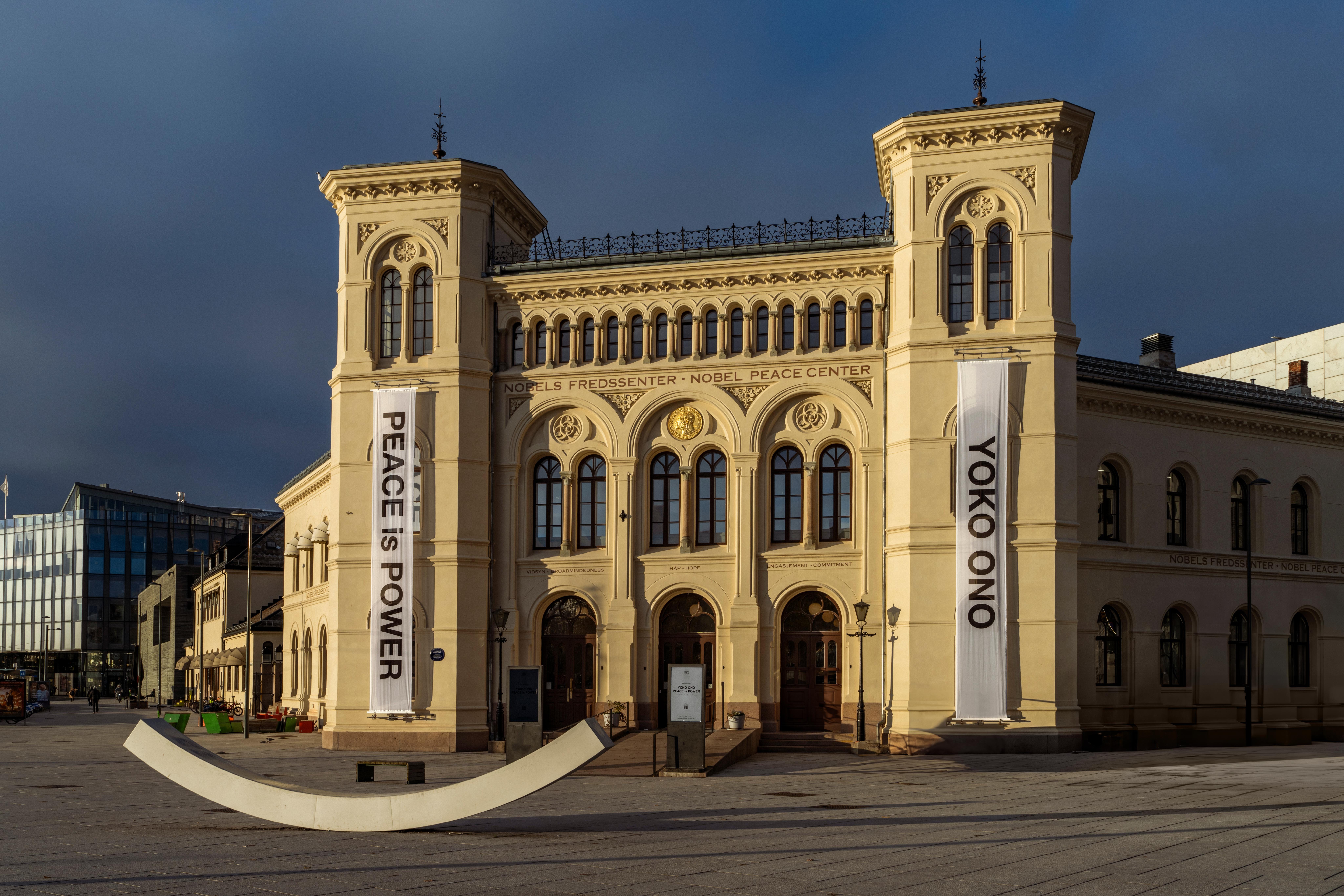
The announcement of this year’s Nobel Peace Prize—awarded to Venezuelan opposition leader María Corina Machado—has once again landed it where it’s often been before in the eye of a storm of controversy. Her recognition arrives amid Venezuela’s deepening electoral crisis, and a dark cloud of possible US military action against it. While many see Machado’s award as a moral stand against authoritarianism, others view it as an unmistakably political signal aimed at the Maduro regime. Especially so since this year's prize winner is openly supporting President Trump's policy of threatening Venezuela with military strikes, including invasion.
OSLO, Norway (AP) — Venezuelan opposition leader María Corina Machado ‘s daughter accepted the Nobel Peace Prize on her mother’s behalf Wednesday, hours after officials said Machado would miss the ceremony. Associated Press
Another year, another global dispute over what the Nobel Peace Prize really represents. Unlike the Nobel Prizes in physics, chemistry, medicine, literature, or economics—each grounded in relatively transparent peer evaluation—the Peace Prize has always rested on a more stilted foundation: the political judgment of a committee appointed by the Norwegian Parliament. That architecture virtually guarantees controversy, because the award reflects not only Alfred Nobel’s intentions but the political moment in which it is bestowed.
Something Old Something New
Woodrow Wilson received the 1919 prize for the League of Nations while the U.S. Senate was actively rejecting the very treaty he championed. Henry Kissinger’s 1973 award, shared with Lê Đức Thọ, triggered resignations within the Nobel committee itself. Aung San Suu Kyi’s 1991 prize transformed her into a global icon—only for her later silence on the Rohingya crisis to expose the risks of canonizing political figures too soon.
And then there is perhaps the most dramatic internal rupture of all: At a hiatus of the Cold War, Linus Pauling’s 1962 award, which the committee voted down before being overruled by its own chairman. The prize was withheld entirely that year, only to be granted the following year alongside a second award to the Red Cross. Few episodes better illustrate the prize’s susceptibility to political winds—and to selective reinterpretation after the fact.
This year’s Venezuelan award would already be contentious on its own. But the Peace Prize now faces something even more unusual: active, public lobbying by a U.S. president for the prize. Heads of state have openly nominated Donald J. Trump, and his supporters have treated the campaign much like Hollywood treats Oscar season. This raises a new question:
Will Norway come under political and diplomatic pressure to validate a candidate whose own pursuit of the prize blurs the line between international recognition and domestic political theater?
If so, the damage to the Nobel Foundation itself could be severe. The Peace Prize’s credibility is a historical demonstration of a delicate balancing; a decision widely perceived as capitulation—or as an overt political calculation—would push it further into the realm of symbolic geopolitics rather than in keeping with the intent of its founder, Alfred Nobel. Since the public rarely distinguishes between Oslo’s Peace Prize and Stockholm’s scientific Nobels, fallout in one domain risks contaminating them all.
The Nobel Foundation depends on a nomination process anchored by former laureates—meaning reputational erosion can echo across disciplines. A Peace Prize seen as politically captured could undermine trust in the entire Nobel system, from its scientific committees to its literary judgments.
The truth is simple, if uncomfortable: The Peace Prize has always been political. What is new is how visible the politics have become—and how brazen the lobbying now is.
Machado’s award shows how deeply global political crises shape the committee’s decisions. Trump’s campaign for recognition by the Norwegian Nobel Committee reveals how openly political actors now try to shape the committee itself. And together they highlight a core tension the Nobel system has never resolved: the Peace Prize seeks to rise above politics while being structurally too captive to it.
The question ahead is not whether the Peace Prize is politicized—it always has been. The question is whether it can survive the next round of political pressure without bringing down the rest of the Nobel legacy.
© 2025 Farooq Hussain