

This is the second Ariadne on the topic of the need for reform for NATO’so military command structure.
🔄 To see how these structural changes affect the role and possible retirement of NATO’s top military position, read an introduction of this topic in a previous issue of Ariadne: “The Supreme Allied Commander Europe — Is It Time for the Old Soldier to Fade Away?”
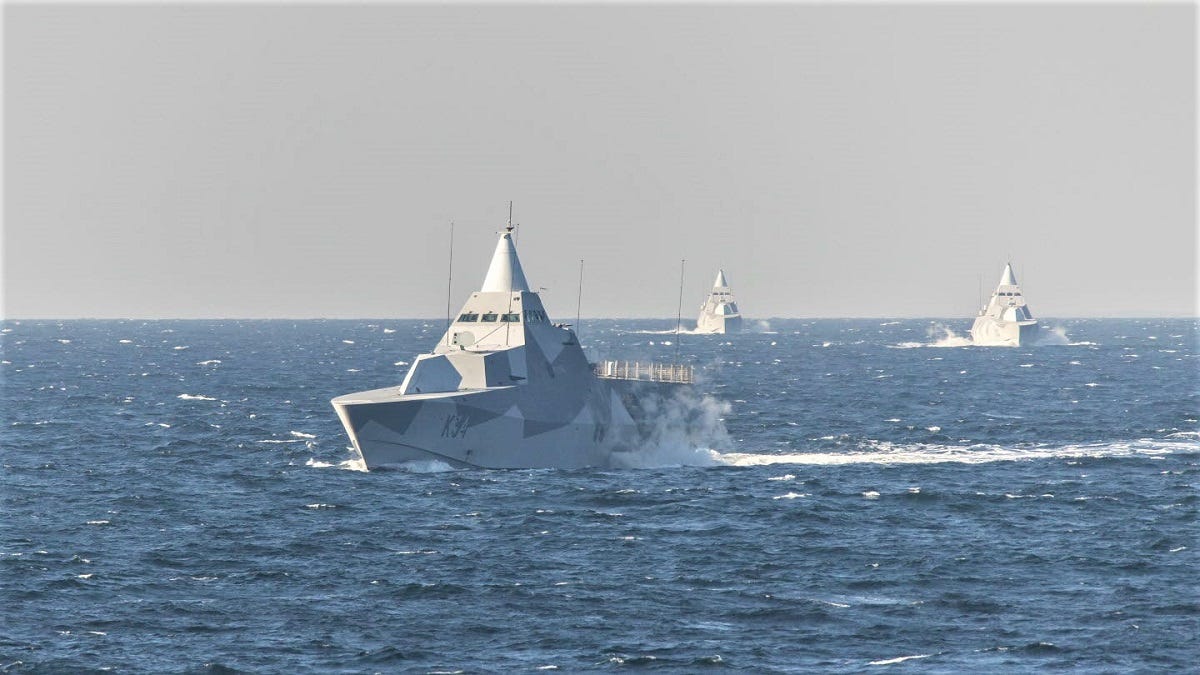
Since January, it’s become increasingly clear: Europe is no longer at the center of U.S. security strategy. U.S. leaders made it clear in their speeches at the NATO defense ministerial and the Munich Security Conference that troop deployments to Europe will now depend on allied financial commitments rather than just shared democratic values. America’s military presence in Europe is at a post–Cold War low and still shrinking. At the same time, Washington is pursuing a diplomatic reset with Moscow and scaling back its support for Ukraine, even as that country continues to fight for survival against an unprovoked invasion. Against this backdrop, NATO must confront a long-overdue question: if American leadership is no longer guaranteed, how should the alliance restructure its military command for the future?1
As NATO prepares to confront its most serious security challenge since the Cold War, the alliance’s command structure is under the greatest scrutiny since its founding—this time not for refinement, but potential removal. Reporting has confirmed that the US Department of Defense is considering either eliminating the position of Supreme Allied Commander Europe (SACEUR) entirely or merging it into a broader command that includes Central Command (CENTCOM), which may itself absorb another command, the Africa Command (AFRICOM). While such a move would mark the most significant change to NATO’s military structure since French President Charles de Gaulle’s withdrawal of France from the alliance’s military structure2, it also underscores a deeper recognition: the SACEUR model of an American commander of all military forces in Europe is outdated. Rather than seek to preserve a Cold War-era structure, NATO Europe should therefore use this moment to finally reorganize its military leadership to meet the contemporary threat from Russia and reduce its attention to out-of-area concerns that are primarily of American concern.
Although there appears to be no specific rule requiring that all Secretaries General of NATO must be retired European politicians, this has indeed been the case. Drawn largely from former prime ministers and foreign secretaries, none has been a woman. Only President Charles de Gaulle took offense that American General Eisenhower, a popular figure in Europe at the end of WWII, would be in command of all European military forces, and the frustration led to his withdrawing France from the alliance’s command structure. Over the years, France has increasingly contributed to military planning for the Alliance. But unlike the United Kingdom, its nuclear deterrent is independent of the United States, though some important levels of policy and technical cooperation exist between France and the US and separately with the UK. While there has been consultation and limited technical cooperation on nuclear weapons, it has been nothing to impact the true independence of the French nuclear forces.
The Strategic Context: An Unprecedented Security Shift
Does Europe still want, or more importantly need, another American general in command of all its forces in a war with Russia?
Since Russia's annexation of Crimea in 2014 and its full-scale invasion of Ukraine in 2022, the European security order has been upended. NATO's eastern flank is now the front line of European defense. New member states like Finland and Sweden bring significant capabilities, particularly in the Arctic and Baltic regions, while front-line countries such as Poland and the Baltic states have surged defense spending and readiness. Yet NATO's current command structure—optimized for expeditionary crisis management—is ill-suited to direct a major theater war against a peer adversary like Russia.
Fabian Hoffmann has rightly noted that a Russian war with NATO would look nothing like the invasion of Ukraine. A NATO-Russia conflict would involve rapid multi-domain escalation, likely beginning with cyber and space-based disruptions, followed by strikes on command nodes and logistics. In such a conflict, success would depend on highly coordinated regional responses, fast decision-making, and deep integration of national forces—not on a single centralized command post rooted in Cold War legacy thinking.
Why the role of a SACEUR No Longer Fits the Purpose
Since General Dwight D. Eisenhower became the first SACEUR in 1951, the role has served as both the military brain of NATO and a symbol of American leadership. But in today's environment, concentrating operational command in a single U.S. general is both politically and operationally risky. Politically, it reinforces an outdated dependence on the United States at a time when Washington has signaled—through statements at the Munich Security Conference and recent defense ministerial meetings—that its security guarantee is no longer unconditional. Operationally, it slows NATO's responsiveness and fails to reflect the regionalized nature of the threats.
Now, amid proposed Pentagon restructuring that could consolidate EUCOM with AFRICOM and shift CENTCOM to absorb SACEUR’s responsibilities, NATO’s very coherence as a military alliance is at risk. Such a merger would dilute the focus on Europe’s defense and signal a retreat from transatlantic leadership. It should not be accepted.
A Better Alternative: Regional Command Distribution
Instead of rearranging the wide-ranging demands on an American military commander in Europe and struggling to fit a new uniform for SACEUR on it, NATO should move toward a distributed regional command model. This is not a new idea. Having been examined, albeit from a different perspective, since the late 1990s, a more recent proposal has been put forward by Richard Hooker Jr. in the Atlantic Council.3 American approaches to command structure usually involve ‘carrot and stick’ approaches that apply pressure on European nations to aspire to greater defense expenditures. Historically, this approach proved not particularly effective and, in the circumstances of a US de-emphasis of European security priorities, is not likely to prove particularly persuasive. Regarding burden-sharing, the approach taken in the Atlantic Council discussion of the need for a restructuring of NATO military command seeks to recommend the need for command restructuring as "reinforcing burden-sharing." Though this represents a characteristically American perspective that treats European cooperation as something to be "sold" to reluctant allies. In reality, what's required is allowing natural areas of common interest—such as Swedish-Finnish naval interoperability, Polish-Ukrainian land defense cooperation, or Nordic Arctic security partnerships—to develop organically based on geographic realities and shared threats rather than imposed alliance structures. These partnerships emerge from genuine mutual interests, not external pressure to assume greater responsibilities.
Instead of doubling down on the continuing need for an American SACEUR or clinging to its symbolic legacy, NATO should move toward a distributed regional command model that reflects the natural security partnerships and shared defense interests that have already emerged among European allies and can be easily strengthened. Europe’s dependence on major munitions particularly in aircraft and surface-to-air missile systems, and the perpetual lack of interoperability are actually tractable challenges that require political compromises that have so far proved only slightly open to resolution. This article is not a place to immerse into detailed discussion of even a few of the major challenges facing a restructuring of the command structure of the alliance, but even a cursory glance shows that there are actually few technical obstacles to joint operations between the air, sea and land forces of Europe and that the industrial base is more than able to gear up to take a much greater load to reduce the present significant dependence on the US.
An Eastern Continental Command: The border area of Poland and Lithuania and Belarus and the Russian exclave of Kaliningrad Oblast is known as the Suwalki Corridor or the Suwalki Gap. It is considered a militarily vulnerable area for NATO due to its strategic location and potential for a rapid land invasion from Russia. A command area involving Poland and Ukraine would consolidate the nations facing the most direct land-based threat from Russia. Poland's central position and growing military capabilities, combined with Ukraine's battle-tested forces and territorial knowledge, create a natural defensive partnership. The Baltic states' forward positions and Finland's extensive Russian border experience would complete a coherent eastern defense structure built around shared vulnerability and complementary strengths.
A Nordic-Baltic Maritime Command4, based in Sweden or Denmark, would formalize the naval cooperation that has already developed between Sweden and Finland while incorporating Norway's North Atlantic expertise and Denmark's control of critical Baltic Sea exits. This partnership reflects the natural maritime geography of the region and the shared interest in controlling sea lanes essential to Nordic security. The UK, together with Iceland, would be able to provide protection to all Atlantic Ocean approaches as well as the UK’s presence in the North Sea and English Channel.
A Central European Command, centered in Germany, would coordinate the defense of traditional Central European approaches, drawing on the historical defensive partnerships between Germany, France, and their neighbors who share common exposure to eastern threats through established invasion routes. The UK
A Southern Command, based in Romania, would unite Black Sea nations around their shared interest in preventing Russian southern expansion, with Turkey's naval capabilities and Romania's strategic position forming the foundation of regional maritime security.
A scratchpad from which to speculate on what a new distributed command structure for NATO might look like see here
Rebuilding Conventional Deterrence
NATO has re-embraced conventional deterrence as the cornerstone of its defense posture. Nuclear guarantees remain essential, but the alliance must be able to fight and win below the nuclear threshold.5 That requires forward-deployed forces, interoperable logistics, credible battle staffs, and decentralized command capable of operating under duress. The current SACEUR model, which was never designed for this level of regional integration, increasingly appears obsolete.
A Soft Exit or a Strategic Recalibration?
If the United States does indeed eliminate or subsume the SACEUR role into CENTCOM, it will rightly be viewed by many allies as a symbolic departure from NATO leadership. But it need not be the beginning of a U.S. exit from Europe. Instead, it should be treated as a prompt for NATO to modernize its own structures—beginning with a command model6 that distributes operational authority across Europe and elevates the leadership of the most directly affected states.
What is crucial is that NATO’s European nations drive this change. A vacuum left by the United States must not be filled by confusion, competition, or institutional inertia. It must be filled with a new strategic model that reflects the alliance’s evolving geography, capabilities, and challenges.
Conclusion: The Command Structure Europe Now Needs
With the dual pressures of a revisionist Russia and a recalibrating US, Europe can no longer rely on outdated Cold War templates to ensure its security. The symbolic value of an American SACEUR no longer outweighs the operational limitations it imposes. A forward-looking NATO command structure—rooted in regional leadership, capable of rapid action, and better integrated with national forces—offers the best path to credible deterrence and collective defense.
The moment to act is now. NATO must evolve or risk becoming strategically incoherent just as the threats it was created to counter have returned in force.
Forthcoming issue of Ariadne: No Membership Required: Ukraine is NATO’s New Frontline is a two part issue further exploring NATO’s new geography, the urgent need to reduce European reliance on US, and the path ahead if Europe must now carry more of its regional security burden including independent nuclear deterrence:
As American attention moves away from Europe and towards other interests, as outlined by the US SecDef and VP in February7, the postwar security guarantees of Pax Americana are, it seems, entering their twilight.
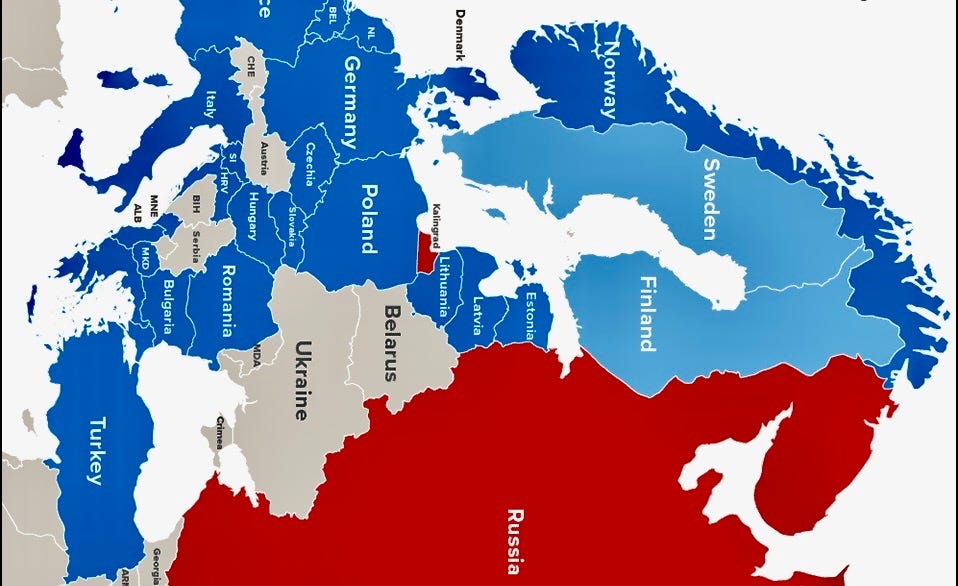
Regardless of a formal decision on Ukraine’s NATO membership—which the United States currently opposes—Ukraine’s border with Russia has effectively become NATO’s primary front line with its long-standing adversary. In contrast, the U.S. has signaled a desire to pursue a policy of rapprochement and diplomatic normalization with Russia while increasingly pressuring Ukraine to concede to ever-expanding and often hyperbolic demands presented as an unwavering precondition for ending hostilities.
Footnotes and Further Reading:
Deep dive into the issues of shifting US security guarantees towards Europe while accommodating a broader rapprochement towards Russia combined with a lenient approach to Russian aggression in Europe, see these sources:
1. Rand Corporation Report: Rethinking U.S. Policy toward Europe: Implications for NATO Summary: This report discusses various U.S. policy positions, including speeches given by high-level officials at NATO meetings and how these positions impact transatlantic relations.
2. The Atlantic Council Analysis: Title: The Future of NATO: Impacts of U.S. Leadership in Transatlantic Security Summary: This article or analysis reflects on U.S. leadership within NATO, discussing significant speeches and statements from U.S. officials, including implications for NATO's strategic priorities and member state unity.
3. Military Times Commentary: Analyzing Key Speeches from U.S. Officials at NATO Ministerial Meetings Summary: This article specifically reviews the speeches given by U.S. Secretary of Defense Hesketh and Vice President Vance at NATO ministerials, exploring their context, content, and subsequent influence on NATO policies.
4. The Brookings Institution Paper: U.S. Strategic Communications and the Role of High-Level Diplomacy Summary: This paper discusses the importance of high-level speeches and statements in shaping international relations and security policies, looking at specific cases like those of Hesketh and Vance.
The topic has been extensively discussed in specialist and academic journals such as Foreign Affairs and Foreign Policy, as well as in media coverage.
Charles de Gaulle announced France's withdrawal from NATO's military command structure on March 7, 1966. See: Kupchan, Charles A., France and NATO: A Complicated Relationship, Foreign Affairs, May/June 2009
Hooker Jr., Richard D., A New NATO Command Structure, Issue Brief, Atlantic Council, June 5, 2024.
Young, Thomas-Durell, Reforming NATO’s military structures: The long-term study and its implications for land forces. Strategic Studies Institute, US Army War College, May 15, 1998
In October 2024 the German Navy opened a NATO center in response to calls to establish a new maritime command specifically focused on the Baltic Sea. The command would improve coordination, readiness, and interoperability among NATO allies in the region. Russia's base in Kaliningrad is of specific concern as in recent years it has been significantly increasing its naval presence and capabilities in the Baltic, posing a direct threat to NATO's maritime operations and security. A Russian strategic hub, Kaliningrad, serves as a major base for its Baltic fleet and houses advanced missile systems, anti-ship capabilities, and electronic warfare assets, and air bases. Russia has been using its submarines to probe into the territorial waters of Sweden and other Baltic nations for many years.
The existing NATO maritime structure is inadequate to effectively protect vital sea lines of communication in the Baltic Sea against projected Russian capabilities. The new maritime command is initially focused on interoperability between NATO’s Baltic nations navies, including Denmark, Estonia, Finland, Latvia, Lithuania, Poland, Sweden and Germany
Hoffman, Fabian, A Russia-NATO War Would Look Nothing Like Ukraine Foreign Policy, May 19, 2025
A scratch pad from which to speculate on what a new distributed command structure for NATO might look like see here
NATO Ministerial, Munich Security Conference 2025