

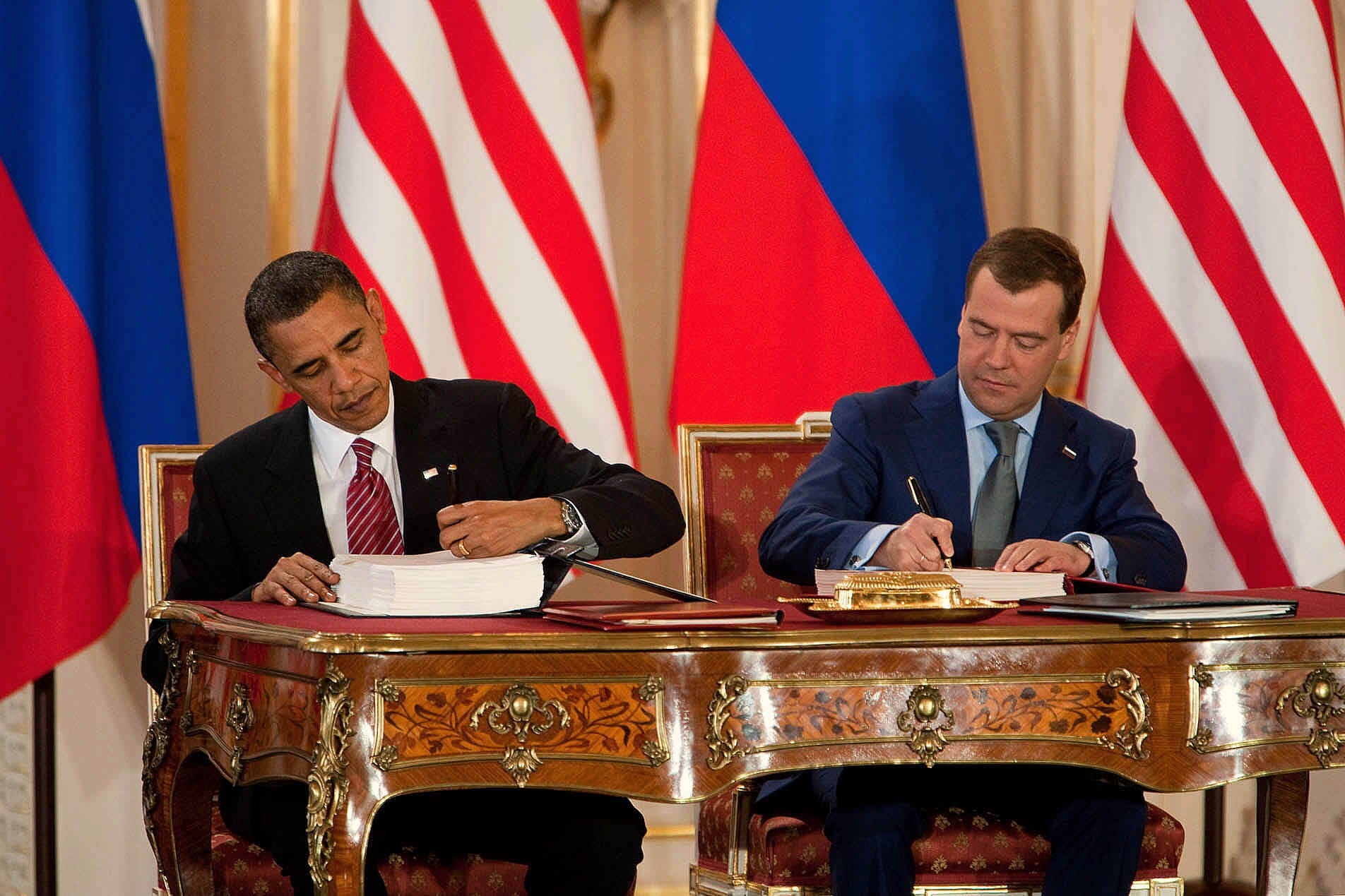
On February 5, 2026, the New START treaty will expire. At the time of its signing, it represented a dramatic reduction in the number of nuclear warheads and launchers to 1,550 deployed strategic warheads and 700 deployed delivery systems, respectively. Additional aspects of the agreement enabled data exchange and monitoring, allowing each side to verify compliance. Though Russia has stated that post expiration of New START, it intends to stay within the numerical limits on nuclear warheads and launchers, there has been no formal reciprocal acceptance from the United States. While it is widely believed the US will honor the numerical limits of the expired treaty, each side will depend exclusively on its own intelligence—national technical means—for verification that the limits are being observed. Important cooperation and data exchange for verification between Russia and the US have been suspended.
New START marks the end of a series of superpower treaties limiting nuclear arsenals and is likely the last of its kind, as there is no successor in negotiation and no inclination for either nation to engage in future agreements. For Russia, any future progress on strategic nuclear arms control is tied to concessions on its demands over its invasion of Ukraine in 2022. There’s no “holding pattern,” only the silence of a diplomatic channel that has gone dead.
But to view this moment in isolation—as merely the lapse of one arms control agreement—is to miss the forest for the trees. New START’s demise is the capstone of a systematic dismantling of America’s engagement with treaty-based solutions to include the full range of Global Risks. It is the last treaty to fall in what future historians may lament as a giant unraveling of US participation in meeting the challenges posed by a range of global risks, alongside other nations, and, in addition, calling these risks, though scientifically determined, hoaxes.
The Bonfire of the Treaties
In January 2025, the United States withdrew from the World Health Organization—again—even as the institutional memory of COVID-19’s devastation was still fresh. The pandemic preparedness offices painstakingly rebuilt were dismantled. The early warning systems were defunded. The message was clear: international cooperation on global health threats is not for America.
The Paris Climate Accord was re-abandoned, this time with even less ceremony than the first exit. As wildfires consumed larger swaths of the American West and “hundred-year floods” became annual events, the administration doubled down on its message: climate change science is a hoax, and any treaty limiting American sovereignty is a con.
The pattern is unmistakable. Every treaty requiring international scientific cooperation, every framework built on the expertise of epidemiologists, climatologists, and nuclear physicists, every institution that asks the US to accept limits in exchange for collective survival—all of it is being fed to the flames. New START is simply the nuclear log on this bonfire of Global Risk management.
The expiration of the last strategic arms control treaty next month isn’t an isolated failure of diplomacy. It’s the logical endpoint of a governing philosophy that treats scientific knowledge as dispensable and international agreements and cooperation for the benefit of all as a means to defraud the United States. The same administration that calls scientists liars and frauds places negligible value on those specialists who made treaties like New START possible.
When you systematically destroy the credibility of scientific institutions, when you train an entire political movement to hear “hoax” every time an expert warns of danger, you don’t get to carve out an exception for nuclear weapons policy. The distrust of science has spread everywhere.
Missed Chance at Reykjavik
To fully appreciate the disappointment and gravity of this moment, you have to look back to how the table that has been overturned was first built.
History records the “Four Horsemen of the Nuclear Apocalypse”—Henry Kissinger, William Perry, George Shultz, and Sam Nunn, titans of US nuclear weapons policy who, in January 2007, shattered orthodoxy by calling for a world free of nuclear weapons, briefly entertained by presidents Reagan and Gorbachev at their historic summit meeting in Reykjavik, Iceland, twenty years earlier. Their Wall Street Journal op-ed was the earthquake that eventually led to President Obama’s Prague speech in 2009.
The Fifth Horseman
But earthquakes have epicenters, and this one was located in the office of Stanford physicist Sid Drell. Occupying a special place in American intellectual life—a theoretical physicist of genuine distinction and a moral compass with regard to nuclear weapons policy—Drell bridged two worlds that rarely touch, and when he passed away in 2016 at the age of 90, the world lost not just a brilliant scientist but the steady hand that had guided much thinking about nuclear weapons policy for decades.
Sid’s genius lay in his ability to move seamlessly between theoretical physics and practical statecraft. His contributions to particle physics—including the Drell-Yan process, which helped confirm the Standard Model and paved the way for the discovery of the Higgs boson—established him as a scientist of the first rank. But he also used his intellect to address the threat to human survival presented by nuclear weapons.
It was Drell who orchestrated the “Four Horsemen” initiative. Following his retirement from the Directorship of the Stanford Linear Accelerator (SLAC), he convened meetings at the Hoover Institution, bringing together his close friend, George Shultz (Reagan’s Secretary of State), and William Perry (Clinton’s Secretary of Defense). Schulz and Drell convened many meetings at the Hoover Institution, leveraging their personal influence and their status as fellows. He helped bridge the gap to Henry Kissinger. He even leveraged his long-standing friendship with Russian physicist Andrei Sakharov to give the movement global legitimacy.

Yet when it came time to publish their groundbreaking manifesto in the Wall Street Journal, Drell made another crucial decision: he stepped away from having his name included in the byline so the op-ed would carry more weight, authored solely by Kissinger, Schulz, Perry, and Nunn. It wasn’t an oversight. It was a calculated strategic choice. He was the architect who agreed not to sign the plans to ensure the building was constructed.

The Betrayal
If scientists like Sid Drell represented the quiet integrity of the disarmament movement, what followed his death was its disheveled collapse.
In the wake of the “Four Horsemen” op-ed, a new organization called Global Zero1 emerged in 2008 to turn Drell’s vision into a global campaign. It was flashy, star-studded, and designed to mainstream the idea of nuclear abolition.
The movement was inherited by figures who lacked and carried conflicting baggage. The collapse of Global Zero—which suspended operations indefinitely in late 2023—is best understood through the scandal of its U.S. Chair, US Ambassador Richard Burt.
A former U.S. Chief Negotiator for the START treaty, Burt was the face of Global Zero’s diplomatic push. The initiative was financially backed by the Nuclear Threat Initiative, founded by media billionaire Ted Turner (CNN’s founder) and Senator Sam Nunn, lending it establishment credibility and deep pockets. But as Politico and others exposed in scathing reports, Burt was simultaneously representing several Russian government institutions and oligarchs as a partner at the Kissinger-founded lobbying firm McLarty Associates. The blatant conflict of interest was neither declared nor noticed at the luxurious Le Bristol Hotel in Paris, where the inaugural meeting of Global Zero was held with media fanfare resembling a Davos. While leading an organization dedicated to peace and disarmament with Russia, Burt was simultaneously lobbying for Nord Stream 2, the pipeline project owned by Gazprom and deeply tied to the Kremlin’s strategic leverage over Europe.
The contrast is repulsive. Sid Drell withdrew his authorship from a historic op-ed to protect the cause. Richard Burt was officially representing Russian state interests at the same time, leading a supposedly neutral initiative to rid the world of nuclear weapons.

When the scandal broke, it shattered any trust in the organization’s authority. It nurtured the growing cynicism that the “peace process” with accommodations at the most glamorous of Parisian hotels was just another venue for grift.
The Era of the Hoax
This betrayal left the genuine supporters defenseless against the psychological shift that followed. We entered the era of the “Hoax.”
Under the Trump administration, and continuing into the present political climate, existential threats—from pandemics to climate change—were systematically reframed as elite manipulations. The public, burned by the hypocrisy of figures like Burt, found it easy to tune out. If the experts were lying about the virus, and the lobbyists were representing one side while pretending to be neutral arbiters, why not the nuclear experts exaggerating the risk of war?
But this wasn’t just public cynicism. It was an active governmental policy. The dismantling of pandemic preparedness infrastructure, the withdrawal from climate agreements, the defunding of scientific agencies—these weren’t accidents. They were deliberate acts of institutional sabotage.
When you train a generation to hear “hoax” whenever scientists warn of danger, you create a permission structure to ignore every warning. The result is the apathy we see today toward New START’s expiration. After all, if COVID was a hoax and climate change is a hoax, why shouldn’t arms control be a hoax too?
ICAN (the International Campaign to Abolish Nuclear Weapons) sought to build grassroots support, winning a Nobel Peace Prize in 2017 for its efforts to secure the support of nations willing to sign the Treaty on the Prohibition of Nuclear Weapons. But without the engagement of the nuclear weapons nations, it was a moral victory in a strategic vacuum.
The China Syndrome
This brings us to the present void. Why, facing the expiration of New START next month, is the U.S. national security community not scrambling to save it?
Because they have contracted what might be called “The China Syndrome.”
In the 1979 film, the “China Syndrome” referred to a nuclear meltdown that melted all the way through the earth. Today, it refers to a different kind of meltdown: the U.S. defense establishment’s total fixation on Beijing’s nuclear modernization.
The accepted narrative is that China is “sprinting to parity.” It points to satellite photos of new silo fields and warnings that China’s arsenal will grow by two-thirds of its present size by 2035. This fear has become the all-consuming lens through which Washington views the world.
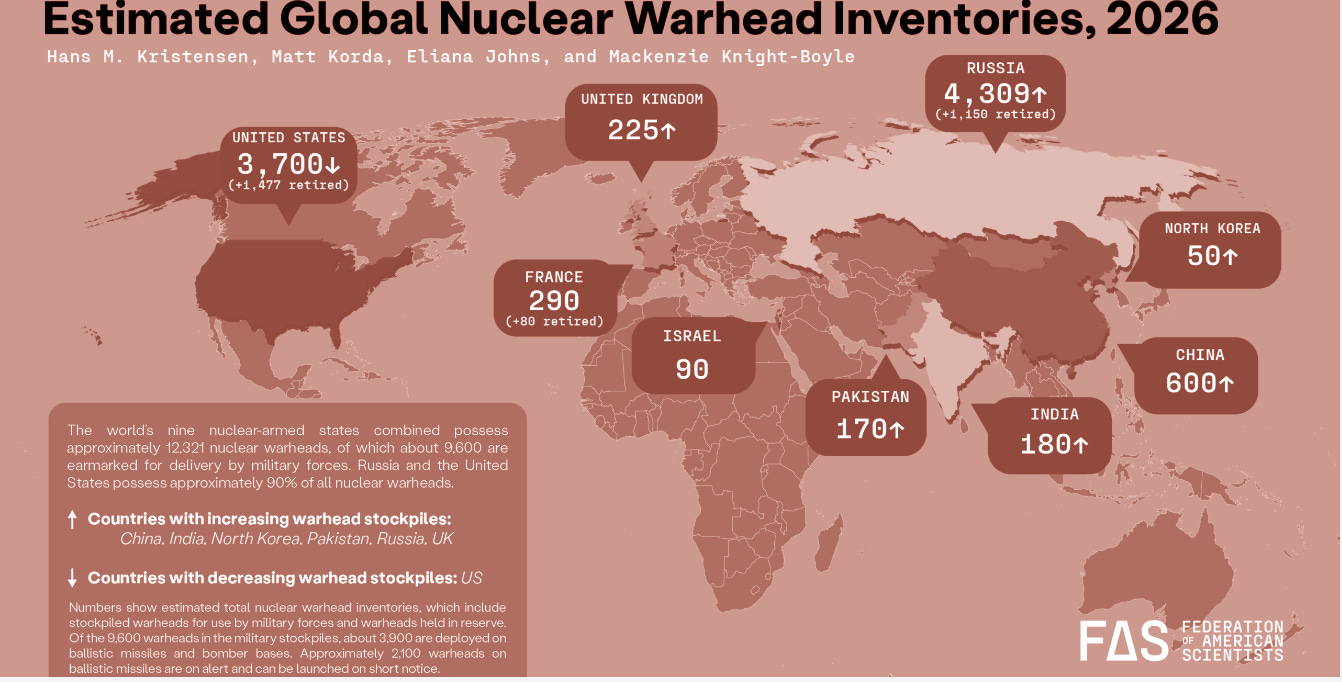
According to the Federation of American Scientists’ (FAS) authoritative Nuclear Notebook, China’s current arsenal stands at approximately 500 warheads - less than one-third of the 1,550 deployed strategic warheads permitted to both Russia and the United States under New START. While Pentagon projections suggest China’s arsenal could grow by two-thirds to 1,500 by 2035, SIPRI analysts note that much of the Chinese nuclear modernization reflects a shift from liquid-fueled to solid-fueled missiles - a technical modernization focused on survivability rathe2r than a sprint to numerical parity. Yet this nuance is lost in the appeal to the “China threat” as a rationale for not beginning new negotiations without China’s participation. For its part, China has declined to participate in a tripartite discussion. It fears no threat from Russia and is currently unequally matched with the US. The Trump administration seems interested only in the tripartite approach.
Empty Seats at the Table
And so, we arrive at February 2026.
Post the New START treaty, verification inspections have already stopped. The data exchanges have ceased. The “holding pattern” we hoped for has not materialized.
The current administration has stepped away from arms control, signaling no interest in even ensuring that the current limitations on launchers and warheads are maintained. The “tripartite negotiations” with China that were once promised are at best a faint prospect. We are left in a world where verification is no longer a mutual exchange of data. We are entering a new nuclear arms era—one marked by technological innovation - hypersonics, space-based weapons, and unconstrained warhead production—without a motivation to legislate restraint.
The upcoming Nuclear Non-Proliferation Treaty (NPT) Review Conference—traditionally the venue where the nuclear weapons states demonstrate their commitment to Article VI disarmament obligations—offers no lifeline.3 The United States has announced no specific plans for the conference and may not even attend. In a recent Arms Control Association discussion, former chief negotiator Rose Gottemoeller floated the idea of P-5 meetings (the five permanent members of the UN Security Council: the US, Russia, France, the UK, and China) as a potential path forward. The appeal is transparent: engage China multilaterally since bilateral US-Russia negotiations are politically impossible.
But this proposal founders on basic sovereignty issues and the current administration’s preference for working outside traditional multilateral frameworks. Russia’s long-standing position is that any future arms control must count British and French nuclear arsenals against the US side of the ledger—treating NATO allies as American proxies rather than independent nuclear powers. Neither France nor the UK would ever accept having Washington negotiate limits on their sovereign deterrents.
Further complicating any P-5 approach is the administration’s recent creation of the Board of Peace at Davos—a parallel diplomatic mechanism that signals the US preference for conducting international security discussions outside the UN framework. The P-5 framework, rather than opening new possibilities, simply relocates the impasse to venues that the current administration has already signaled it will bypass in favor of direct tripartite negotiations or its own alternative forums.
And that impasse now unfolds against an unprecedented backdrop: a US administration that has declared its intention to acquire Greenland—the territory of a NATO ally and sovereign nation, Denmark— ”one way or another.” The threat has accelerated what was already underway: European NATO members, including France and the UK, are actively pursuing security arrangements independent of the United States. The alliance structure that undergirded sixty years of arms control—the assumption that NATO spoke with one voice in negotiations with Moscow—is fracturing.
So while we bid a quiet farewell to New START, we are simultaneously sailing toward an iceberg large enough to sink a far bigger ship: the NPT itself. The UN treaty that has prevented nuclear proliferation for over half a century depends on the bargain that nuclear-weapon states will pursue disarmament. With New START’s expiration, that bargain is exposed as hollow. The Review Conference won’t settle things down or open new directions. It will instead reveal how completely the architecture has collapsed.
The Irrelevance of Arms Control
The recent Arms Control Association discussion on post-NEW START options reveals something more troubling than the lack of solutions: it reveals a community unable to confront the reality it faces.4
The conversation focused on procedural possibilities—P-5 meetings, NPT Review Conference preparations, tripartite frameworks—as if the problem were merely technical. As if the right diplomatic configuration could resurrect a negotiating process that one party has abandoned entirely.
But while arms control professionals debate whether to engage China through P-5 channels or bilateral talks, the current administration is:
Threatening to seize Greenland from NATO ally Denmark
Withdrawing from the WHO, the Paris Climate Accord, and every treaty requiring international scientific cooperation
Expanding plutonium pit production at Los Alamos and Savannah River
Pursuing advanced missile defense and hypersonic weapons with no consideration for strategic stability
Showing zero interest in verification, data exchange, or any of the transparency measures that made arms control possible
There is no staffing at NSC or the Departments of State and Defense developing plans that account for how “exotics”—hypersonics, space-based nuclear systems, comprehensive missile defense—will interact with arms control frameworks. Because there are no frameworks. And this administration has no interest in creating them.
The arms control community’s carefully reasoned proposals for P-5 engagement founder on a simple reality: you cannot negotiate with a party that views negotiation itself as weakness, that treats allied sovereignty as negotiable, and that has systematically dismantled every institution built on the premise that expertise matters.
Rose Gottemoeller’s P-5 suggestion—engage China multilaterally since US-Russia talks are impossible—assumes a United States interested in limits of any kind. That assumption is no longer valid.
The architecture of arms control was built on assumptions that no longer hold: that the United States would lead, that NATO would remain coherent, that scientific expertise would inform policy, and that existential threats would compel cooperation.
Every one of those assumptions is now void.
The Freefall
What does the world after New START look like?
No Inspections: We lose our eyes inside Russian bases. The on-site verification that provided confidence is no longer available.
No Data Exchange: We lose the biannual notifications that prevent accidents and miscalculation.
No Limits: Both Russia and the U.S. can now upload thousands of warheads held in reserve, potentially doubling their deployed forces in short order.
The Union of Concerned Scientists warns that the collapse of New START is occurring simultaneously with a massive expansion of US plutonium pit production at Los Alamos and Savannah River - the cores of new nuclear weapons. The arms race has already begun, even before the treaty formally expires.5

We are trading the predictable stability of verifiable limitations on the number of warheads and launchers for the unpredictable chaos of a three-way arms race with no rules, no referees, and no off-ramps.
The Pattern That Arms Control Cannot Acknowledge
But here’s what makes this moment worthy of both reflection and Zukunftsangst: New START’s expiration is not unique. It is part of a pattern the arms control community cannot seem to acknowledge.
The US withdrew from the Intermediate-Range Nuclear Forces (INF) Treaty in 2019 rather than insist on Russian compliance with its concerns about treaty violations. We have withdrawn from the WHO as new pandemics loom. We have abandoned climate agreements as the planet continues to warm. We have dismantled pandemic preparedness infrastructure as novel viruses continue to emerge. We have defunded the scientific agencies that provide early warning of catastrophic risks. We have threatened to seize the territory of allied nations.
The Bulletin of the Atomic Scientists, which has tracked existential risk since 1947, moved its Doomsday Clock to 90 seconds to midnight in 2023 - the closest to catastrophe in its history. The organization cited the war in Ukraine, climate change, and the breakdown of arms control. The expiration of New START pushes humanity closer still.

At every turn, when faced with threats that require international cooperation, scientific expertise, and long-term thinking, we have chosen immediate gratification, national posturing, and willful ignorance.
The dream of the Four Horsemen hasn’t just remained unfulfilled; it has been systematically unraveled. We are back to the day before the Wall Street Journal op-ed, but without the wisdom of those who wrote it—and with far more dangerous weapons, far more nuclear-armed states, and far less institutional capacity to manage the risks.
Sidney Drell spent his life building the intellectual and moral foundation for a world that could step back from the nuclear brink. He understood that existential threats require something rare and difficult: the willingness to accept limits, to trust verification over suspicion, to value expertise over ideology.
We are not just losing a treaty next month. We are losing the very idea that expertise matters, that international cooperation is achievable, that existential threats require collective action.
In the absence of American leadership, it’s hard to see who would step forward. European NATO is pursuing security arrangements independent of Washington—a rational response to threats against Greenland, but hardly a foundation for global arms control. China has declined trilateral negotiations. Russia ties any progress to Ukraine concessions.
The NPT Review Conference offers no path forward because there is no forward. There is only uncertainty about US participation and a void.
We have learned to stop worrying and embrace the void.
© 2026 Farooq Hussain
My e-book ‘The Last Treaty,’ published on Amazon this month, examines how the architecture of nuclear arms control was built, corrupted, and finally abandoned. It also explores what strategic stability might look like in a world without treaties - where practical, reciprocal limits must somehow keep pace with nuclear innovation without the legal frameworks that once made verification possible.
Available from Amazon:
The Last Treaty: Innovation, Nuclear Risk, and the End of Arms Control by Farooq Hussain
Notes:
2025 Worldwide Threat Assessment DEFENSE INTELLIGENCE AGENCY https://armedservices.house.gov/uploadedfiles/2025_dia_statement_for_the_record.pdf
Nuclear Non-Proliferation Treaty NPT Review Conference, 27 April - 22 May 2026, New York, United States
New Challenges and Next Steps After Next START: A Virtual Briefing Arms Control Association, January 22, 2026
Plutonium Pit Production: The Risks and Costs of US Plans to Build New Nuclear Weapons UCS Plutonium Pit Production