


Sidney Drell occupied a special place in American intellectual life—a theoretical physicist of genuine distinction who became one of the most trusted voices in nuclear weapons policy.1 When he passed away in 2016 at the age of 90, the world lost not just a brilliant scientist but a moral compass on matters of international security policy who helped navigate some of the most dangerous decades of the nuclear age. Many people of diverse views and political persuasions remember him with fondness and favor, making him a unique individual.
The Physicist’s Physicist
Within the high-energy physics community, Sid Drell was revered as both a rigorous theorist and an exceptional teacher. His collaboration with research associate Tung-Mow Yan led to the creation of the Drell-Yan process, which describes how a quark from one particle and an antiquark from another particle can combine to produce an electron and a positron, and this became essential to particle physics. This process would later prove crucial in the discovery of the Higgs boson—a testament to the enduring impact of his theoretical contributions.
He made important contributions to the study of the theory of quantum electrodynamics, attracting many young physicists to study under him. His textbooks with James Bjorken became essential references for generations of physicists. At Stanford, where he served as deputy director of the linear accelerator for nearly three decades (1969-1998), Sid was known for his ability to bridge the theoretical and experimental worlds. He understood that great physics required both visionary thinking and practical implementation—a skill that would serve him well when he turned his attention to nuclear policy.
The Trusted Advisor
What made Sid Drell truly exceptional was how he translated his scientific expertise into public policy. His expertise on the technical aspects of nuclear weapons was widely respected on both sides of the political aisle. This bipartisan respect was especially remarkable during an era of polarization around issues related to national security and US-Soviet/Russia relations. As an original member of the JASONs, the elite group of scientists who advised the government on technical matters related to national security, Drell brought scientific rigor to some of the most consequential policy debates of the Cold War era. Of particular note has been his advice on the safety, reliability, and performance of the US nuclear weapons stockpile and their long-term stewardship. His approach to nuclear policy was nuanced and evolved with his understanding. An advocate of nuclear deterrence during the Cold War, he simultaneously worked tirelessly for arms control and reduction. This was less a contradiction and more a demonstration of a sophisticated thinker who understood that deterrence and disarmament could be philosophically complementary rather than opposing approaches. Drell’s influence extended far beyond the American policy establishment. His close relationship with Andrei Sakharov, the brilliant Russian physicist and Nobel Peace Prize winner, provided a unique bridge to international supporters. Through this connection and others, Drell helped expand the Four Horsemen’s initiative into a truly global movement, bringing in voices from around the world to support their vision of nuclear disarmament.
A World without Nuclear Weapons
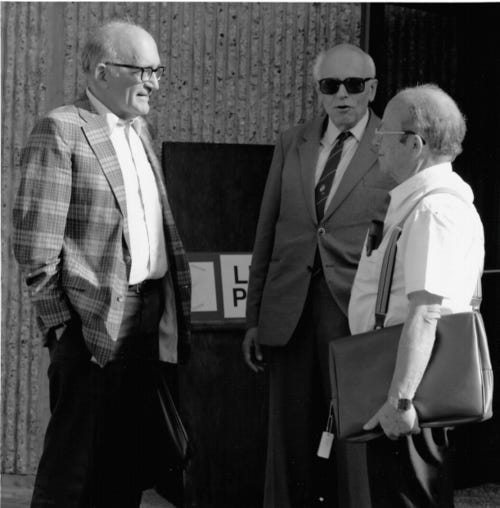
Sometimes superficially characterized as a left-wing liberal, Sid Drell liked to say that he was a registered Republican, and he probably never registered a change in his political affiliation on his electoral registration. Stanford, of course, is also home to the conservative-leaning Hoover Institution, where Sid was always welcome, and after his retirement from SLAC, he became a senior fellow. Sid and former president Ronald Reagan’s Secretary of State George Schulz were close friends, and in October 2006, they collaborated to develop an idea to revive that moment twenty years earlier at the 1986 summit meeting in Reykjavik, at which presidents during the historic Reagan-Gorbachev era came very close to agreeing on the elimination of all nuclear weapons.
Upon leaving government service, former Secretary of Defense William Perry joined Stanford University, and it is no surprise that both Sid and Bill Perry held each other in high regard for many years. Perry soon became part of the group; together with Drell and Schulz's meeting at Hoover, former Secretary of State Henry Kissinger and Senator Sam Nunn also joined as like-minded members. What emerged from this meeting would reshape the global conversation about nuclear policy. With broad appeal and deeply thought-out arguments, it caught the attention of then-President Barack Obama, as well as the support of leading former Soviet nuclear weapons scientist Andrei Sakharov, with whom Sid had developed a strong, long-standing friendship that first began as Sakharov became persona non grata and eventually, under Gorbachev, was allowed to travel to the US.
Drell’s genius lay not just in his intellectual contributions but in his ability to identify and bring together the right voices for maximum impact. He understood that the message needed to come from figures with unassailable credentials in national security and foreign policy. The addition of Sam Nunn, the former Georgia senator with deep expertise in U.S.-Soviet relations and nuclear arms control, brought crucial legislative gravitas and bipartisan credibility to the effort. Schulz’s relationship with Henry Kissinger likely first drew him into the Hoover conference organized by Drell and Schulz.
They made a crucial decision when it came time to publish their groundbreaking manifesto as an editorial opinion in The Wall Street Journal in January 2007. Drell, the intellectual impresario who had orchestrated the entire initiative, deliberately omitted his name from the byline. This absence wasn’t an oversight or slight—it was a calculated strategic choice designed to maximize the political impact of their message.
The four names that appeared—George Shultz, William Perry, Henry Kissinger, and Sam Nunn—represented an extraordinary concentration of foreign policy gravitas: two former Secretaries of State spanning different eras and political parties, a former Defense Secretary, and a respected Senator known for his expertise in nuclear matters. This “super heavyweight” lineup was designed to make the piece impossible to dismiss as the work of liberal academics or partisan activists, and the group was soon known as the “Four Horsemen of the Nuclear Apocalypse.”
Sid Drell accepted the rationalization that concealed his otherwise highly visible association with the notion of a world free of nuclear weapons in the Wall Street Journal; though his seminal contribution would be recognized in other ways, the public face of the movement, it was considered, needed to be unassailably establishment-oriented to break through decades of nuclear orthodoxy.
Drell, however, was co-author with Schulz of the supporting books and deeper policy papers, which provided the detailed intellectual framework that gave substance to the more accessible public arguments. His scientific background and his profound understanding of both the technical and strategic aspects of nuclear weapons made him an indispensable contributor to the policy prescriptions that emerged from the group.
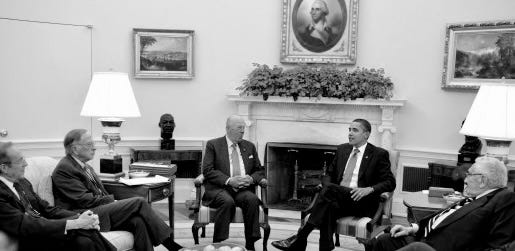
The Four Horsemen’s public campaign succeeded in ways that might have seemed impossible just years earlier. Their work helped create the intellectual and political foundation for President Obama’s 2009 Prague speech calling for the abolition of nuclear weapons, influenced arms control negotiations between the superpowers, and sparked a global conversation about the continuing relevance of nuclear weapons in the 21st century.
None of these events would have happened without Sid Drell’s initial vision, his patient work in bringing together the right coalition, and his willingness to step back from public recognition to ensure the message would have maximum impact. In the annals of arms control, Drell deserves recognition not just as a brilliant physicist and policy expert, but as a master strategist who understood that sometimes the most important contributions happen behind the scenes. His legacy reminds us that transformational change often requires individuals willing to sacrifice personal credit for the greater good—and that the most effective advocates are sometimes those whose names never appear in the headlines.
In the arms control community, Sid was considered a uniquely valuable ally—a scientist who could speak authoritatively about technical details while never losing sight of the human stakes involved. His work supporting the SALT I and II treaties wasn’t just policy advocacy; it was grounded in a deep technical understanding of what was actually possible and verifiable. At the Stanford Linear Accelerator, together with Wolfgang Panofsky, he became a prominent voice against the development of new nuclear weapons systems, particularly those that seemed to introduce greater instability while offering small strategic advantages. Their opposition carried weight precisely because it came from scientists who understood the technology intimately.
A Bridge Between Worlds
Most impressive about Sid Drell’s work in physics and public policy is how he held credibility across communities that often viewed each other with suspicion. Physicists often saw policy work as a distraction from the pursuit of fundamental research. The national security establishment often viewed academic scientists as unrealistic idealists, and the arms control community was likely to regard anyone who worked on weapons as part of the problem.
Drell transcended these divisions through the sheer quality of his work and the evident sincerity of his commitment to human welfare. Sidney Drell was a groundbreaking researcher and outstanding leader who wanted to make the world a better place. His commitment to humanity wasn’t just rhetoric—it was evident in how he lived his professional life, moving seamlessly between theoretical calculations and policy briefings, between the laboratory and the halls of government.
I first met Sid when he was a visiting fellow at All Souls College, Oxford. It was 1979, and I was a research associate at the International Institute for Strategic Studies. I was working on issues related to using test restrictions on ballistic missile and nuclear weapons testing as a means of managing the pace of destabilizing technological innovation in these strategic weapon systems. The institute’s director at the time, Christoph Bertram, stopped by to see me and mentioned that he had received a phone call from Professor Drell, asking me to get in touch with him and go to Oxford, as he was keen to learn more about my research. Sid was easy to contact; he likely had an impressive office with a direct phone line instead of an extension. He made me feel comfortable and invited me to visit for a lengthy discussion on the topic of test restrictions. At All Souls, Sid explained to me that he found all the rules a bit irritating at Oxford colleges, and I found him to be kind, generous, and deeply committed to nuclear weapons reductions. He asked many questions. I had no intention of holding back, but I would rather not speculate on specific hunches because I did not have access to classified information that I knew was already in his head. It was a kind of quiz, but the way Sid does it, it was not an unpleasant experience. At one point, he got up and said, ‘I want to introduce you to another fellow of the college we’ve become friends with. Maurice, this is Farooq. He’s come up from the IISS for the day. He’s at King’s London with Laurie Martin.’ After a short exchange of words, we returned to our places and continued our conversation. The Maurice we had just met was Sir Maurice Oldfield, who was a former head of MI6 and is said to be the person on whom John le Carré based his spy character George Smiley. A couple of weeks later, Christoph came by again and said to me that Sid was considering offering me a post-doctoral fellowship at Stanford, but that I had to first successfully defend my thesis in a couple of months and finish the paper I was writing for him, or I wouldn’t get to go. I was able to do both and spent the following year learning from the master.
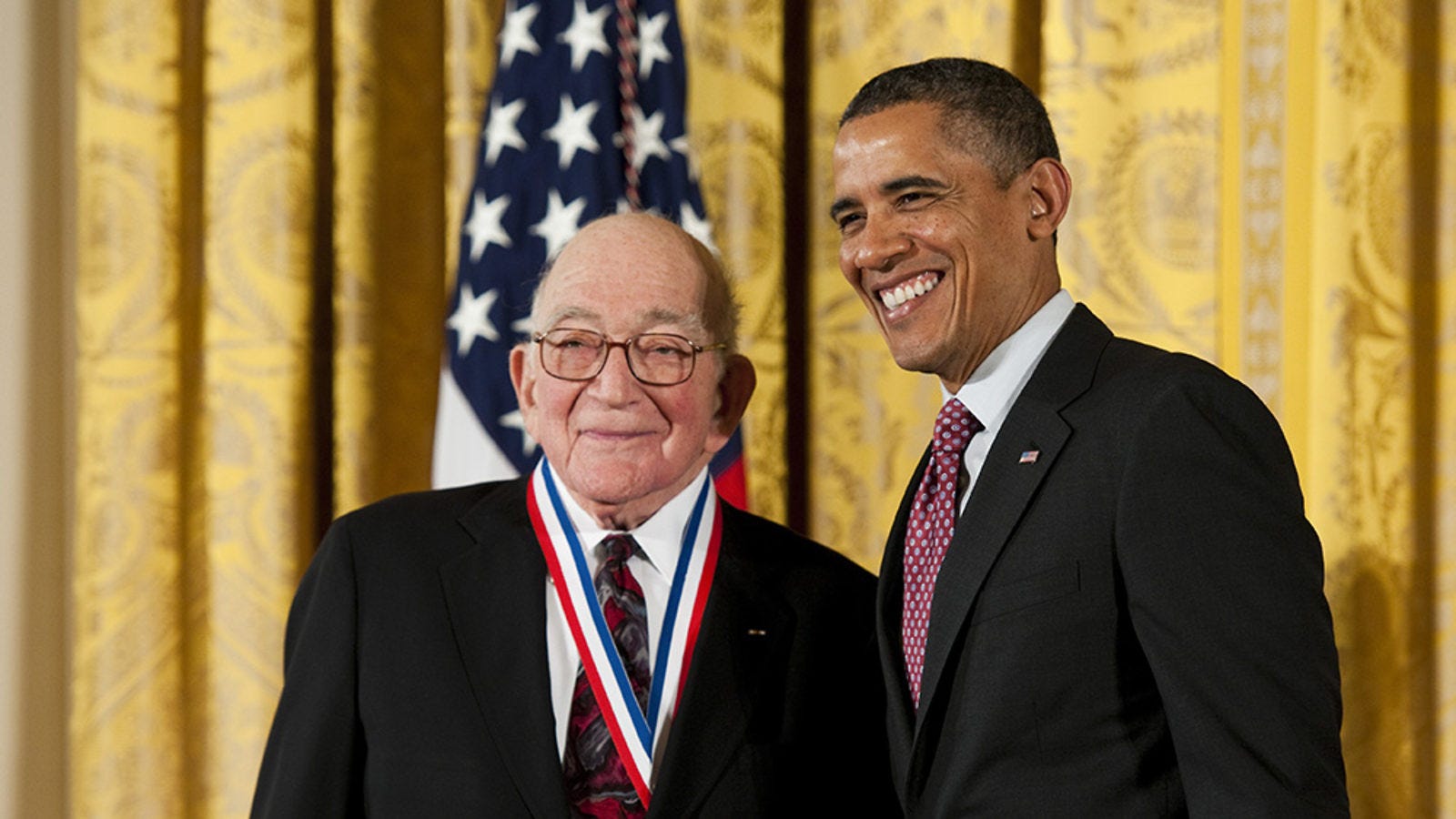
After Stanford, I only met Sid a few times; at each, I knew I disappointed him. I had ended up on the scientific staff within the military division of NATO, and I could see that Sid felt I had drifted. I no longer felt that arms control was a valuable path to maintaining peace and security during our final meeting on the Capitol's steps, where he had just concluded his testimony that morning. Sid believed that I had strayed towards the darker side. I no longer felt that arms control was a successful pathway forward, though I still thought that the danger of the presence of nuclear weapons remained to be solved. Lastly, and perhaps worst of all, I had abandoned the field and was transitioning to a new career. In the last few years, I’ve returned to paying attention to developments in strategic arms control, but I am also disappointed that I’m no less pessimistic than before that the outcome of former treaties will hold and that new ones will advance Sid’s vision of a world free of the horrible threat to the planet posed by the presence of nuclear weapons.
Sid Drell’s life reminds us that the boundaries between pure science and public engagement need not be impermeable. In an age when expertise is often dismissed and technical complexity is considered an excuse for democratic exclusion, his example suggests a different path—one where profound knowledge becomes the foundation for deeper responsibility to society. He showed that being a “physicist’s physicist” and a trusted public servant weren’t competing identities, but complementary facets of life lived on behalf of advancing both human welfare and the pursuit of knowledge.
The Unfulfilled Dream of the Elimination of Nuclear Weapons
Two decades ago, Henry Kissinger, William Perry, George Shultz, and Sam Nunn emerged as a formidable coalition, raising alarms about the imminent danger of nuclear catastrophe. Their strategy combined urgent diplomacy with pragmatic security policy, urging the global community to reduce proliferation risks and pursue nuclear abolition. Their efforts fueled a wave of optimism that nuclear disarmament could become a manageable, achievable goal.
As the years progressed, however, the geopolitical landscape shifted dramatically. The hoped-for momentum waned, and strategic tensions flared anew. The post-Cold War optimism was replaced by the realities of modernization, regional conflicts, and mistrust among nuclear states. Still, the disarmament movement persisted—most notably through the work of the Nuclear Threat Initiative (NTI), founded in 2001 by Ted Turner and Sam Nunn. NTI became a beacon of practical efforts: securing fissile materials, supporting verification programs, and keeping the dialogue alive. Despite its ongoing importance, NTI, like other disarmament advocates, struggled to maintain the attention and political will necessary to turn lofty goals into tangible policy.
Parallel to these efforts, a more ambitious and contentious idea led by prominent diplomats and security experts, the movement advocated for the complete abolition of nuclear weapons through negotiated treaties and international agreements. But the vision was short-lived; geopolitical realities, strategic autonomy, and mutual mistrust prevented any comprehensive agreement. The obstacles proved too formidable, and the dream of a nuclear-free world remained just that: a dream.
Meanwhile, the landscape shifted again with the first US administration of President Donald Trump, who publicly invoked the goal of "denuclearization," suggesting the possibility of tripartite negotiations involving the United States, Russia, and China—an idea that appeared more aspirational than pragmatic. China, for its part, made clear it would not participate in such talks. **** nuclear no first use, the complexity of the global nuclear order. Even more troubling was the uncoordinated, often unstaffed nature of U.S. diplomatic efforts; key agencies like the State Department, the Department of Defense, the National Security Council, and even the Executive Office of the President appeared ill-prepared to lead substantive negotiations.
Compounding the challenges, the United States unilaterally withdrew from the Joint Comprehensive Plan of Action (JCPOA) in 2018, destabilizing one of the few nuclear proliferation controls on Iran. The collapse of the New START treaty—the last remaining arms control agreement limiting U.S. and Russian nuclear arsenals—further signaled the retreat from strategic stability. With the absence of revitalized treaties and reliable verification mechanisms, the potential for space arms races and nuclear modernization initiatives is significant.
In today's fractured disarmament landscape, the rhetoric of "denuclearization" seems hollow in the face of strategic stagnation and diplomatic breakdowns. Ideas championed by the legendary "Four Horsemen" and the advocates of "Nuclear Zero" now seem distant, disconnected from the current geopolitical climate. Meanwhile, global powers are investing billions in nuclear modernization—upgrading existing arsenals, developing new weapon systems, and exploring space-based nuclear capabilities—raising fears of a new arms race.
The path forward appears bleak. Not only are the unreachable goals of a nuclear-free world slipping further away, but there is also an alarming absence of leadership and concrete policies to arrest this slide. The U.S. leadership remains fragmented, with no serious plans or comprehensive strategies in place. In Russia and China, skepticism about U.S. intentions persists, making meaningful negotiations even less likely. The international community seems to be moving towards a future marked by proliferation, technological advancement, and the potential for nuclear conflicts, which are significantly different from the outcomes that the early disarmament pioneers had in mind.
In the end, the dream of a world free of nuclear weapons remains in limbo, overshadowed by geopolitical rivalries and strategic imperatives that dominate the discourse. The potential collapse of key arms control treaties, coupled with the looming prospect of an arms race, both on Earth and in space, poses an existential threat to the world. Through renewed leadership, genuine diplomacy, and a collective commitment to disarmament, the future is set on a perilous course, leaving us all vulnerable to the very catastrophe these visionary leaders once sought to prevent.
While history remembers the “Four Horsemen of the Nuclear Apocalypse” as the public faces of the modern nuclear disarmament movement, the true architect of this influential initiative was Sid Drell, the Stanford physicist whose vision and organizing genius brought together one of the most powerful coalitions in arms control history.
Legacy of a vision of a nuclear weapons-free world
The Four Horsemen’s public campaign succeeded in ways that seemed impossible just years earlier. Their work helped create the intellectual and political foundation for President Obama’s 2009 Prague speech calling for nuclear abolition, influenced arms control negotiations between the superpowers, and sparked a global conversation about the continuing relevance of nuclear weapons in the 21st century. But none of this would have happened without Sidney Drell’s initial vision, his patient work in bringing together the right coalition, and his willingness to step back from public recognition to ensure the message would have maximum impact. In the annals of arms control, Drell deserves recognition not just as a brilliant physicist and policy expert, but as a master strategist who understood that sometimes the most important contributions happen behind the scenes. His legacy reminds us that transformational change often requires individuals willing to sacrifice personal credit for the greater good—and that the most effective advocates are sometimes those whose names never appear in the headlines.
In recent years, the landscape of acute geopolitical tensions and shifting priorities has challenged the hopeful visions of the "Four Horsemen," the dreams of “Nuclear Zero,” and the ongoing efforts of NTI. The enduring challenge remains: how to secure a world free of nuclear threats when strategic interests and mistrust dominate global relations.
Most notably, the rhetoric of the former U.S. administration under President Donald Trump introduced new ambiguity into disarmament efforts. Trump frequently declared the goal of achieving "denuclearization," yet his approach was characterized by inconsistent policies and unconventional proposals. Trump suggested the possibility of "tripartite negotiations" involving the United States, Russia, and China—a concept that has yet to attain acceptance, even among themselves.
These statements reflect a disconnect from the realities of international diplomacy. China, for instance, has publicly stated its reluctance to participate in such bilateral or trilateral negotiations, emphasizing that the United States and Russia are the primary nuclear-armed states with the most significant arsenals. Meanwhile, other key nuclear states—including the United Kingdom, France, India, Pakistan, North Korea, and Israel—remain outside these dialogues, each with its own strategic motives and security concerns. Any approach toward clear disarmament must thus embrace nuclear proliferation issues and the motivations of these other considerably smaller nuclear weapons states.
Further complicating the picture is the U.S. withdrawal from the Joint Comprehensive Plan of Action (JCPOA)—the Iran nuclear deal—in 2018, under the Trump administration. Since then, negotiations to revive or replace the JCPOA have been intermittent and often fragile, with Iran’s nuclear program remaining a persistent regional and global risk. The broader goal of comprehensive non-proliferation and disarmament thus remains elusive amid a landscape of nuclear modernization, proliferation, and regional conflicts. In the end, the promise of achieving “denuclearization” remains a lofty but distant ideal. Past disarmament initiatives, championed by visionary leaders and dedicated organizations, have been stymied by geopolitical realities. The hope and the challenge lie in transforming these rhetoric-filled ambitions into concrete actions—a task made all the more urgent by the threats that nuclear proliferation and regional conflicts pose today.
While history remembers the “Four Horsemen of the Nuclear Apocalypse” as the public faces of the modern nuclear disarmament movement, the true architect of this influential initiative was Sidney Drell, whose vision and organizing genius brought together one of the most powerful coalitions in arms control history. The situation demands new leadership, genuine diplomacy, and global solidarity. Without renewed leadership, genuine diplomacy, and global solidarity, the risk persists that nuclear weapons could further entrench themselves in the fabric of international security—endangering the goal of reducing the risks posed by their presence and achieving a world truly free from the dangers they pose to humanity and all life on the planet.
© 2025 Farooq Hussain

The above Ariadne reviews arms control agreements that are likely to lapse or otherwise be forgone in the absence of a substantial initiative to revive negotiations to renew past agreements, as well as move forward with new ones.
Holloway, David, The Friendship of Sidney Drell and Andrei Sakharov, All CISAC News Commentary March 8, 201
Sid Drell Symposium. https://www.slac.stanford.edu/conf/drell98/
https://www.hoover.org/news/qa-scholars-talk-about-legacy-late-hoover-senior-fellow-nuclear-physicist-and-human-rights
Interview with Sid Drell, 50th Anniversary of SLAC: https://inmenlo.com/2012/08/23/slac-theoretical-physicist-sidney-drell-reflects-on-his-public-policy-work-involving-nuclear-disarmament/
https://stanfordmag.org/contents/key-change
https://news.stanford.edu/stories/2016/12/sidney-drell-theoretical-physicist-national-security-expert-stanford-dies-90