

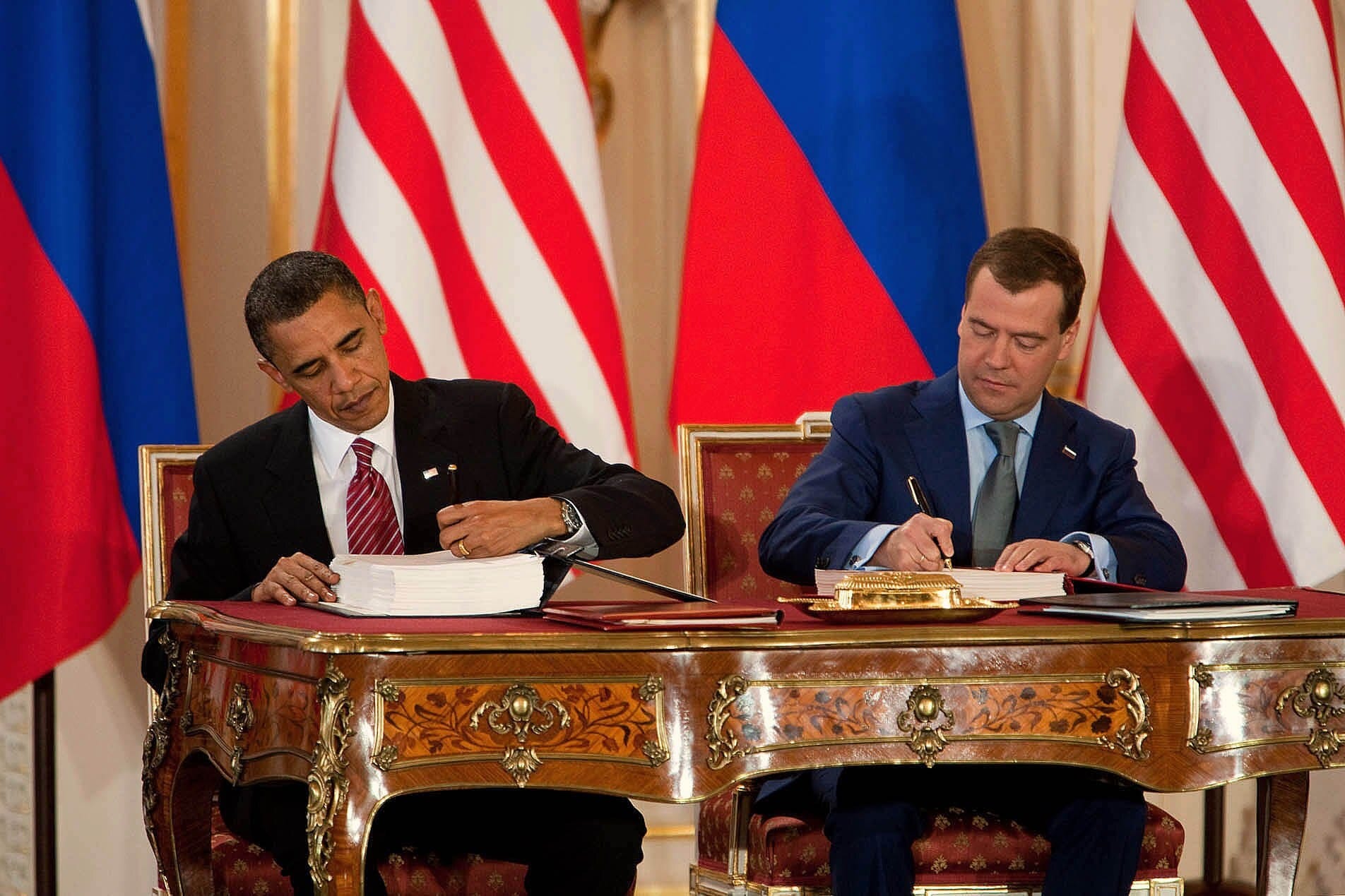
A Critical Crossroads Ahead
The smoke has barely cleared from the recent Israeli-US strikes on Iranian nuclear facilities, as the prospect of further military action to have Iran concede to negotiations regarding it’s apprarent determination to acquire nuclear weapons capacity. Yet the bigger picture remains frustratingly unclear. Were Iran's nuclear scientists truly on the verge of a breakthrough that would have given Tehran the bomb? Or have pinpoint targeted bomb strikes, assassinations, and facility attacks merely delayed the inevitable?
What we do know is this: the former era of negotiated arms control between the US and Russia is disappearing before our eyes.
The New START Treaty expires tomorrow. What happens next?
This week marks the end of an era. On February 5th, the New START treaty—the last remaining guardrail on U.S. and Russian strategic nuclear forces—will expire. For the first time in decades, there will be no treaty enforcing mutual constraint between the world’s two largest nuclear arsenals.
We are entering a new age of nuclear competition, driven not by diplomatic agreements but by the relentless pace of technological innovation.
My Amazon eBook, released for free download on Kindle Unlimited today,
The Last Treaty: Innovation, Nuclear Risk, and the End of Arms Control,
It is available for free to Kindle Unlimited subscribers. In it, I argue that the old arms-control model crafted between nuclear superpowers is dead. Strategic stability will not come from signing new treaties that take years to negotiate and leave technological innovation unregulated. It will depend on building practical, reciprocal limits that can actually keep pace with the innovation being implemented in nuclear weapons systems.
We cannot rely on the diplomatic frameworks of the past to solve future challenges. It is time to look at what comes next.
Get your $0 copy on Amazon today:
Amazon Kindle Unlimited
When Diplomacy Fails, Bombs Follow
The Iranian case perfectly illustrates our current predicament. After years of painstaking negotiations—from the 2015 Joint Comprehensive Plan of Action (JCPOA) to its subsequent collapse—the international community has essentially given up on diplomatic solutions. The recent military strikes represent a fundamental shift: when negotiation fails, destruction becomes the default option.
This isn't an isolated incident. North Korea's withdrawal from the Nuclear Non-Proliferation Treaty in 2003 marked another diplomatic failure, leaving Pyongyang to join Israel, India, and Pakistan as nuclear-armed states operating outside the NPT framework. Each failure deepens the fissure between the non-nuclear and nuclear weapons states as we approach the UN NPT review conference in April. The foundation of the post-World War II nuclear order - comprising the US, Russia, the UK, and France, lately followed by China, and now including Israel, India, Pakistan, and North Korea - has ended
The Numbers Don't Lie
Despite the high-profile proliferation cases of North Korea and Iran, the real nuclear danger remains concentrated in just two nations. Russia and the United States still control over 90 percent of the world's nuclear weapons—a staggering reminder that the Cold War's nuclear legacy continues to dominate global security calculations. This concentration of nuclear power makes the upco
ming diplomatic calendar all the more critical.
Two Dates That Will Define the Decade
Mark your calendars: February 5, 2026, and April 27, 2026. These dates will likely determine whether the nuclear age enters a new chapter of restraint or spirals into unchecked competition.
The first date marks the expiration of New START, the last remaining nuclear arms control agreement between Washington and Moscow. Unlike previous treaties, New START cannot simply be renewed—it must be replaced entirely. The second date opens the NPT Review Conference in New York, where diplomats will attempt to patch together a non-proliferation regime already strained by multiple crises.
Here's the problem: there are currently no negotiations underway to replace New START. Not much prospect either, if they were to be opened, it would most likely take place through the President’s special advisors, Steve Witkoff and son-in-law Jared Kushner. Their preoccupations are with the war in Ukraine and Gaza, and Russia has stated that it is not interested in discussing further strategic nuclear weapons limitation without first addressing its demands over Ukraine. The international climate, poisoned by war in Ukraine and rising US-China tensions, offers little hope for breakthrough diplomacy, particularly as China has expressed no intention of joining any US-Russia negotiations or, for that matter, direct US-China discussions.
The Changing Nuclear Landscape
The traditional bilateral model of US-Russian arms control increasingly feels like a relic. China's rapidly expanding nuclear arsenal means any future agreement must be trilateral—a complexity that makes negotiations exponentially more difficult. Beijing has shown little interest in constraining its nuclear modernization, viewing parity with the superpowers as a legitimate goal.
Meanwhile, the role of non-nuclear but nuclear-capable states is growing. Japan's advanced nuclear technology and Ukraine's wartime experience have demonstrated how quickly the nuclear equation can shift. As American extended deterrence faces new challenges, these states may reconsider their non-nuclear status.
A New Model or No Model?
The question isn't just whether traditional arms control can survive—it's whether we need an entirely new approach. The International Atomic Energy Agency (IAEA) has proven more durable than bilateral treaties, suggesting that multilateral institutions might offer a path forward. But can international agencies fill the verification and transparency gaps left by expiring bilateral agreements?
The Iranian strikes highlight another troubling trend: the normalization of preventive military action against nuclear programs. If diplomacy consistently fails and military strikes become routine, we risk creating a world where nuclear crises are resolved through force rather than negotiation.
What's Next for Nuclear Diplomacy
The next eighteen months will reveal whether the post-Cold War nuclear order can adapt or will simply collapse under its own contradictions. The stakes couldn't be higher: failure to replace New START while managing Iranian and North Korean proliferation could unleash the very arms race that decades of diplomacy sought to prevent.
In upcoming posts, I'll examine:
How Cold War-era verification measures are becoming obsolete
The potential for IAEA-centered international monitoring
China's nuclear ambitions and their impact on US-Russian negotiations
The growing influence of nuclear-capable states in a multipolar world
Whether military strikes can actually succeed where diplomacy has failed
The nuclear age began with the promise that international cooperation could prevent catastrophe. Whether that promise survives the next decade depends on decisions being made right now in Washington, Moscow, Beijing—and in the smoking ruins of Iranian nuclear facilities.
The question isn't whether we can return to the golden age of arms control. It's whether we can invent something better before it's too late.
© 2026 Farooq Hussain
What do you think? Can negotiated arms control survive in an age of great power competition and persistent proliferation? Share your thoughts in the comments below.