

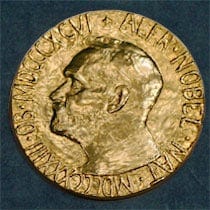
Above: The Nobel Peace Prize medal - Prix Nobel de la Paix. “For the peace and brotherhood of men”. President Trump wrote to the Prime Minister of Norway that, having been overlooked for this year's prize by the Norwegian Nobel committee, he was no longer interested in peace. He had, in any case, accepted the 2025 medal awarded to someone else - Maria Corina Machado, who in turn dedicated the award to Trump.
Domestic Collapse and the Manufacture of Foreign Adventure
In the 24 hours following tense communications with the Norwegian and Finnish Prime Ministers, President Trump publicly complained about being denied the Nobel Peace Prize—a grievance apparently nursed since his first term when Norwegian recognition went to other world leaders. The non-sequitur was jarring: in the midst of threatening a NATO ally’s territorial integrity, the president’s concern was personal validation from Swedish arbiters of international peace.
The outburst was inadvertently revealing. It exposed that foreign policy was being conducted not for strategic advantage but for domestic political consumption and personal vindication. The Greenland crisis, properly understood, is not primarily about acquiring an Arctic island. It is about distracting from a midterm election catastrophe.
The Midterm Mathematics: Republican Collapse
By January 2026, the political fundamentals for Republicans were dire. The generic congressional ballot showed Democrats leading by 6-8 points nationally—enough for a 35-45 seat House majority. Swing state Senate races were tilting Democratic: Wisconsin, Pennsylvania, and Arizona all showed Republicans in retreat. The 2024 Republican House majority, narrow at 222-213, rested on members representing Biden-won suburban districts. These members were extremely vulnerable.
The underlying causes were structural:
Economic deterioration: Inflation remained elevated. Recession warnings multiplied from the Federal Reserve and major banks. Labor markets softened in key swing states. Agricultural commodity prices collapsed, devastating Republican base voters in the Midwest. Stock market volatility created anxiety among the suburban professionals who had abandoned Democrats in 2016 but remained persuadable.
Policy failures: Immigration reform stalled despite aggressive rhetoric. Repeated attempts to repeal ACA protections are polling catastrophically with seniors. Social Security and Medicare “reform” proposals were electoral poison. Infrastructure projects funded by the Biden era were delivering visible results in Democratic districts, reinforcing the perception of Democratic competence and Republican obstruction.
The enthusiasm gap: Democratic base was energized by threats to democracy, reproductive rights, and climate action. The Republican base was fractured between MAGA loyalists demanding escalation and traditional conservatives alarmed by norm-breaking and chaos. The low-propensity Republican voters, critical to midterm success, were not motivated by either camp.
The map problem: Republicans were defending seats in districts Biden had won. The 2024 election had delivered a narrow majority resting on a fundamentally fragile coalition. By January 2026, that coalition was visibly splintering.
The Diversionary Logic: Wag the Dog in the Arctic
The political science literature on “diversionary war theory” identifies a consistent pattern: leaders facing domestic political crises manufacture foreign conflicts to rally nationalist sentiment, dominate media coverage, and defer accountability for policy failures. The Greenland crisis fits this template precisely.
The timing was suspicious. The crisis escalated in January 2026—exactly 10 months before midterms, just as damaging economic data was being released. Q4 2025 GDP revisions came in below expectations. The Congressional Budget Office projected that deficits would expand. A Hunter Biden investigation that had promised explosive findings found none. Domestic news cycles were growing unfavorable.
The escalation pattern was transparent. Each time domestic bad news broke, Greenland rhetoric intensified:
January 7: Inflation report worse than expected → January 8: “One way or the other” threat issued
January 14: Immigration bill talks collapse → VP Vance meets Danish Foreign Minister, talks fail publicly
January 20: Stock market correction begins → Tariffs announced on seven European nations
Late January: Nobel Prize complaint emerges → Simultaneously inviting Russia to Gaza peace board
Each crisis served as a circuit breaker for previous bad news. CNN, MSNBC, and Fox News ran 24/7 coverage of Greenland. Discussion of Republican midterm vulnerabilities, economic policy failures, and domestic dysfunction disappeared from cable news.
The diversionary strategy was textbook: when domestic politics threaten to dominate headlines, manufacture an international crisis to redirect attention. For a few weeks, it worked—the news cycle did focus on Greenland rather than Republican failure.
But traditional diversionary crises produce “rally-round-the-flag” polling bumps. The Greenland crisis did not. Presidential approval remained stuck at 41%. Opposition to military action was overwhelming: 68% opposed in swing states. Anxiety about alliance stability rose to 72%. Plurality blamed Trump for “creating unnecessary crisis” (52-38%).
The diversionary strategy was failing at its core objective—improving political positioning—while succeeding catastrophically at its unintended consequence: rupturing alliances and cascading strategic damage.
Europe’s Diagnosis: Not Taking the Bait
European leaders quickly diagnosed the diversionary motive, which fundamentally shaped their strategic response. The initial reaction to U.S. tariffs revealed the calculation.
Multiple EU heads of state and the European Commission President described tariffs as “regrettable” and warned against “escalatory spirals to the bottom.” This language was carefully chosen. It signaled reluctance to engage in tit-for-tat economic warfare that would keep the crisis theatrically alive and Trump in the headlines through spring.
Europe’s actual response was calibrated patience:
Announce counter-tariff retaliation is “being evaluated” (no immediate response)
Set implementation timeline of 45-60 days “to allow negotiation windows.”
Privately communicate to Congressional leaders that European counter-tariffs will be surgical and electorally targeted
Publicly emphasize “alliance values” and “shared democratic principles” (appeal to American constituencies over Trump’s head)
The strategy was explicit: wait out the American electoral cycle rather than provide the dramatic escalation Trump needed. By delaying the implementation of European tariffs, they denied Trump the crisis intensification that would have dominated spring headlines. By April-May, when pain actually hit American producers, the novelty would have worn off, and domestic economic issues would reassert themselves in midterm campaign messaging.
European chancelleries were counting down to November 5, 2026. The working assumption was that Republican midterm losses would force Trump to de-escalate or that a Democratic House would use budget authority and oversight to constrain foreign adventurism.
The Nobel Prize Obsession: Foreign Policy as Theater
Trump’s complaint about the Nobel Peace Prize—raised with Norwegian and Finnish leaders in the midst of a territorial crisis—was inadvertently revelatory. It exposed that foreign policy was being conducted for domestic political consumption and personal validation rather than genuine strategic objectives.
The comment also demonstrated something more alarming: profound ignorance of basic geography and institutional structures. Norway awards the Peace Prize; Finland does not. Complaining to the Finnish Prime Minister about Norwegian decisions suggested the Nordic countries were interchangeable in the president’s mental map—not encouraging for a policy supposedly driven by careful Arctic strategic analysis.
The obsession with the Nobel Prize revealed the underlying pathology: foreign policy had become personal grievance management. The president was not thinking about rare earth supply chains or Arctic security. He was thinking about validation, recognition, and the humiliation of not being honored by Swedish or Norwegian institutions when he believed he deserved to be.
This is not a strategic calculation. This is narcissistic injury translating into foreign policy consequences.
The Russia Gambit: Crisis Upon Crisis
Simultaneously with the Greenland escalation, Trump announced Russia’s inclusion on his appointed “Peace Board” for the Gaza resolution. Russia has no meaningful role in Gaza. It maintains relations with Hamas but possesses negligible leverage. The invitation appeared designed purely to generate controversy and headlines—a successful tactic, as it immediately dominated news cycles alongside Greenland.
European leaders read this as confirmation that Trump’s foreign policy was performative rather than strategic. Russia—currently waging a war of aggression against Ukraine that Europe was actively countering with military aid—was being elevated to peace broker status. The cognitive dissonance was intentional: it kept everyone off balance and talking about Trump rather than Republican electoral vulnerabilities.
The pattern was unmistakable:
Threaten Greenland (distraction from domestic problems)
Complain about the Nobel Peace Prize (personalize foreign policy)
Invite Russia to the Gaza peace process (generate additional controversy)
Announce tariffs on European allies (create an enemy for the nationalist rally)
None of these actions advanced coherent strategic goals. All of them dominated news coverage. That was the entire point.
Why American Commentary Failed to Recognize the Pattern
Remarkably, mainstream American political commentary largely failed to identify the diversionary crisis dynamic. Coverage focused on:
The strategic merits/demerits of Greenland acquisition (treating it as genuine policy)
Alliance implications (treating rupture as an unintended consequence)
Economic impacts of tariffs (treating trade war as an ideological commitment)
What was almost entirely absent was recognition that this was not primarily about Greenland. It was about changing the subject from midterm disaster to foreign crisis, from economic failure to nationalist grievance, from domestic chaos to external conflict.
Several factors explained this analytical failure:
Taking statements literally rather than seriously: Analysts assumed stated justifications (rare earths, Arctic security) represented actual motives rather than post-hoc rationalizations for decisions made for entirely different reasons.
Institutional bias: Foreign policy establishment treats presidential foreign policy as inherently strategic, worthy of serious analysis, and driven by national interest. The possibility that it might be pure theater for electoral advantage contradicts professional presuppositions.
Recency bias: Coverage focused on the immediate crisis rather than situating it within the electoral calendar context. What explains the January-February timing if not the midterm campaign cycle?
Access journalism: White House correspondents relay administration talking points without contextualizing them within the political timeline or examining inconsistencies.
Geographic ignorance: American media consumers didn’t understand why Greenland mattered, so they trusted expert frameworks claiming it did. Few questioned whether rare-earth deposits that take 10 years to develop could justify risking NATO.
The failure to recognize a diversionary motive led to catastrophic strategic misanalysis. If Greenland acquisition were a genuine strategic priority, then European resistance and economic costs might deter. But if Greenland were primarily domestic political theater, then rational cost-benefit analysis didn’t apply—the point was controversy itself, regardless of outcome.
The Trap Trump Built: Escalation Impossible, Retreat Humiliating
By February-March 2026, Trump faced the classic diversionary crisis trap:
Escalation was blocked: European forces in Greenland made military action impossible without killing NATO allies. Domestic and international opinion would collapse instantly. Congress would not authorize force. The military would resist illegal orders. The logistics were impossible—Pituffik base was 1,200 kilometers from Nuuk with no viable supply route. Special operations from there could not seize and hold the capital.
Retreat was politically humiliating: Backing down after “one way or the other” threats and tariffs would be portrayed as weakness. The MAGA base would be furious. The diversionary strategy would be revealed as empty bluster that worked for a news cycle before collapsing.
The status quo was deteriorating: European counter-tariffs began hitting F-35 production. Semiconductor equipment export licensing reviews blocked ASML supplies. Pharmaceutical shortages made headlines. Every day of the standoff strengthened Democratic positioning for November while weakening Trump’s.
The dilemma was complete. The crisis successfully distracted from domestic problems in January-February, but by March-April, it became a domestic problem—economic pain, alliance rupture, and international humiliation all became midterm campaign issues against Republicans.
The diversionary war intended to help incumbents became the issue that defeated them.
The Democratic Campaign Writes Itself
By April-May 2026, attack ads in swing districts practically wrote themselves:
“Congressman X voted to support Trump’s Greenland takeover. Now your factory is shut down because Europe won’t buy our products. You can’t get your prescriptions because shipments are blocked. Your kids’ school can’t afford the tech upgrades because computer costs have gone up. All for an island that doesn’t want to be American. Is this putting America first?”
Republican candidates in Biden-won suburban districts faced an impossible choice:
Support Trump on Greenland → lose moderate voters appalled by alliance rupture and economic damage
Oppose Trump on Greenland → lose primary to MAGA challenger
The diversionary crisis became a self-inflicted wound.
The Permanent Damage: Crisis Succeeds at Unintended Consequences
The diversionary crisis ultimately fails at its political objective (approval doesn’t improve, midterm losses persist) while succeeding catastrophically at unintended consequences.
NATO’s functional architecture collapses. Franco-British nuclear integration becomes institutionalized. European rare earth processing decouples from U.S. supply chains. Russian freedom of action in the Arctic increases. Chinese inroads into European markets expand. Dollar hegemony begins to erode through Treasury diversification.
These are real, permanent consequences regardless of whether Republicans lose 35 or 45 House seats in November. The diversionary tactic produces both political failure (it doesn’t help electorally) and strategic catastrophe (it destroys the alliance system). It is perhaps the worst possible outcome: the crisis doesn’t work for its intended purpose while succeeding in all its destructive unintended effects.
Conclusion: Democracy and the Two-Year Curse
The Greenland crisis reveals something more disturbing than poor strategic judgment. It demonstrates that American foreign policy is entirely subordinated to domestic political survival calculations within a two-year electoral cycle.
NATO’s potential collapse, rare earth supply chain disruption, Russian freedom of action, and Chinese gains in Europe—all become acceptable costs if they marginally improve electoral positioning or distract from domestic failure.
The Nobel Prize complaint, the Russia Peace Board invitation, the tariffs timed to economic data releases—these are not strategic decisions but theatrical productions. Foreign policy has become reality television, with allies as props and crises as plot devices.
Europe’s response—patient, calibrated, clock-watching—reflects recognition that they are not dealing with a strategic adversary but a domestic politician using international crisis for electoral advantage. The counter-strategy is therefore not traditional alliance diplomacy but electoral interference by other means: inflict enough economic pain in swing states to ensure Trump’s party loses Congress, at which point the crisis becomes unsustainable.
What makes this particularly dangerous is that diversionary crises, even when cynically manufactured, escape control. Economic decoupling has momentum. Alliance ruptures are hard to reverse. Institutions, once broken, do not spontaneously repair.
Trump may have started the Greenland crisis to distract from midterm vulnerabilities, but the consequences are real and permanent regardless of electoral outcomes. The system that sustained American leadership for 80 years is being dismantled for tactical advantage in a single election cycle.
European leaders watch the calendar and wonder whether democracies can conduct coherent foreign policy when politicians face voters every 24 months and will sacrifice any alliance, principle, or long-term interest for marginal advantage before the next election.
The answer the Greenland crisis provides is stark: No. Not when the crisis is the point. Not when foreign policy is theater. Not when the question is never “what serves the national interest” but always “what plays in Peoria before November.”
© 2026 Farooq Hussain
The New START treaty expired on February 5, 2026, with no successor in sight. Future strategic stability now depends less on negotiating new treaties than on building practical, reciprocal limits that keep pace with nuclear innovation.
Available from Amazon:
The Last Treaty: Innovation, Nuclear Risk, and the End of Arms Control
by Farooq Hussain