

Updated June 20, 2026.
Following outrage and outcry the OMB dictating NSF decisions has authorized a reversal of its earlier plans to scrap the system, but the fight against political interference in science policy is far from over. See AP News
“What’s happening with the US Ocean Observatories Initiative (OOI) is not unique, this is just one of a number of science facilities that is being dismantled at the present time. It seems to really mark the end of a commitment to basic scientific research — a commitment that has served this nation very well for the last 70 years.”
— Ed Dever, Oregon State University
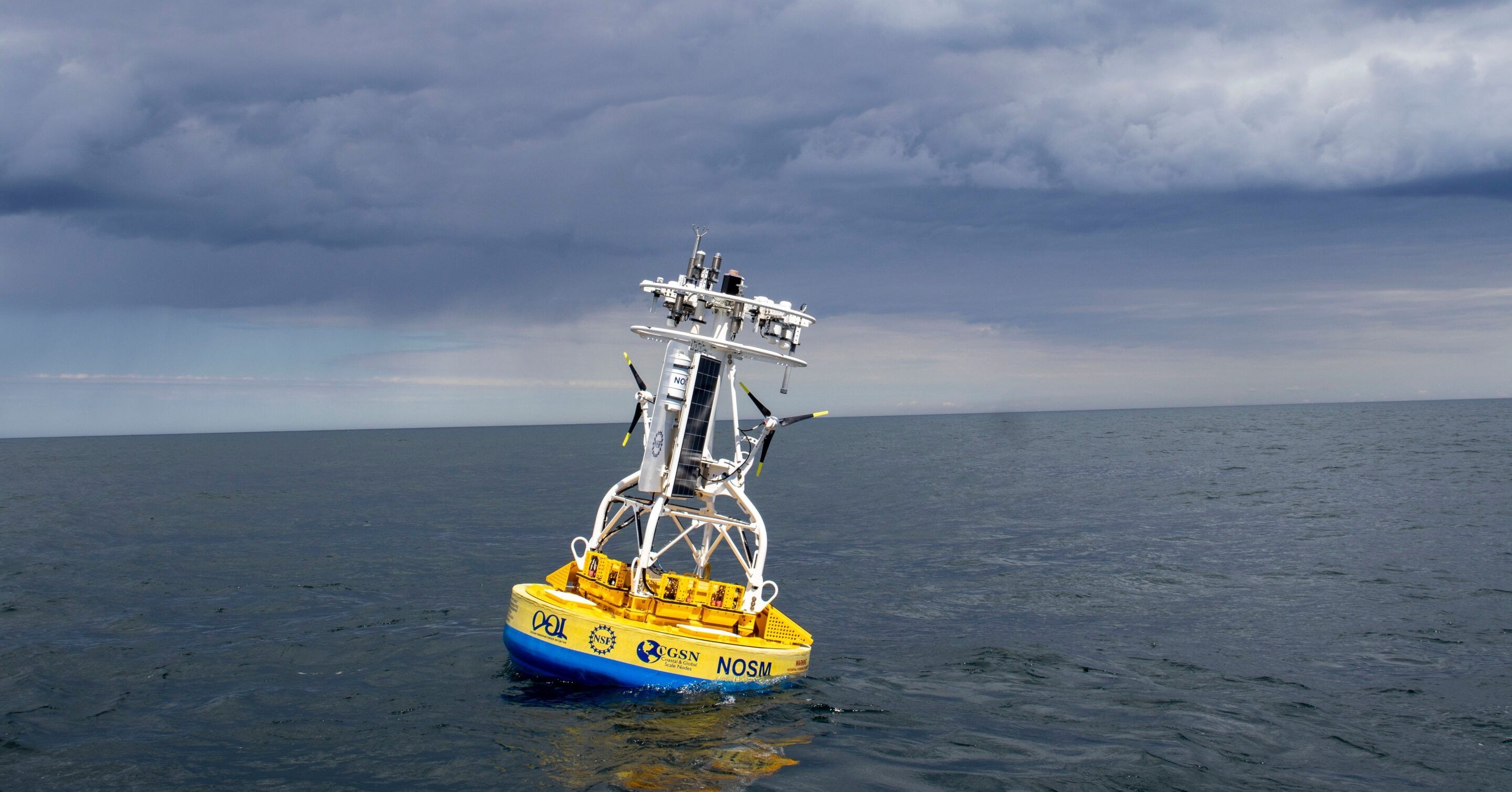
Starting this month the National Science Foundation (NSF) will begin the dismantling of an autonomous ocean monitoring network
The NSF has initiated a “descoping” plan to dismantle all but one of the OOI, a 386 million network composed of nearly 1,000 advanced autonomous deep-sea instruments, buoys, gliders, and seafloor sensors and which cost roughly $39 million a year to operate. The network has provided continuous, real-time biological, chemical, geological, and physical ocean data since it went fully live in 2016. Originally engineered and funded to capture a continuous, 25-year baseline data series to track long-term global climate trends, it’s being prematurely shut down just a decade into its operation.
Infrastructure Slated for Extraction
According to an internal NSF framework and field updates from the Woods Hole Oceanographic Institution, the shutdown covers almost all geographical nodes of the facility, barring a single exception. The timeline for removal is aggressive:
The Endurance Array (Pacific Northwest): Deployed off the coasts of Oregon and Washington to monitor the critical California Current ecosystem, upwelling, and hypoxia. Ships are entering the water this month (June 2026) to begin pulling major instruments.
The Global Irminger Sea Array (North Atlantic): Situated between Greenland and Iceland, this array is universally considered one of the most vital scientific tools on Earth for tracking the slowing of the Atlantic Meridional Overturning Current (AMOC) and measuring deep-ocean carbon dioxide absorption. It is scheduled for complete extraction by summer 2027.
The Global Station Papa Array (Gulf of Alaska / Northeast Pacific): Essential for tracking extreme weather patterns, marine heatwaves, and North Pacific ecosystem changes. Slated for complete removal by summer 2027.
The Coastal Pioneer Array (Mid-Atlantic Bight): Recently relocated off the coast of North Carolina to monitor cross-shelf heat and nutrient transport. It will be completely fished out of the Atlantic by mid-2027.
The Sole Survivor:
The OOI Regional Cabled Array—a fiber-optic seafloor network off the Pacific Northwest coast—is the only major asset scheduled to remain operational for the foreseeable future.
The Financial and Administrative Mechanism
While the NSF’s public statements use heavily buffered language—calling the move a “deliberate approach to smart life-cycle management” and a shift toward “nimbler, evolving scientific priorities”—the underlying mechanism is entirely financial.
The Trump administration’s Fiscal Year 2026 budget request proposed a staggering 80% funding cut to the OOI, choking its annual operating budget from $39 million down to roughly $8 million. Because the NSF must manage its portfolio within these strict executive constraints, the agency preemptively triggered the physical decommissioning of the arrays in late May 2026, executing the structural rollbacks before Congress has even finalized formal appropriations bills.
Immediate and Broad-Scale Scientific Tipping Points
The scientific community has expressed profound alarm, viewing this as a catastrophic interruption of the historical climate record. Oceanographers emphasize several immediate consequences:
Permanent Data Gaps: As oceanographers note, long-term environmental time series are valuable precisely because they are continuous. Once a data stream is interrupted, the gap is permanent; you cannot retrospectively go back and measure the water temperature or carbon absorption of a year you skipped.
Blinding Climate Forecasts: The removal of the Irminger Sea array directly undermines international efforts to calculate how close the global climate is to major tipping points, such as a full collapse of the AMOC.
Institutional Brain Drain: The arrays rely on highly specialized engineering and maintenance teams housed at premier oceanographic institutions (such as Woods Hole and Oregon State University). Defunding the infrastructure means dissolving these unique teams. If a future administration decides to rebuild the network, the specialized human capital will already be gone.
Collateral Damage to Other Agencies: The OOI network provides foundational field-verification data used by NASA to calibrate its advanced environmental satellites (such as the PACE and SWOT missions) and supports maritime domain modeling for the U.S. Navy.
Societal Impact and Political Pushback
The fallout has quickly spilled beyond academic circles into public commerce and legislative policy:
Impact on Fisheries: Local commercial fishing fleets have already begun logging formal complaints. Operators utilize real-time data from the arrays to track changes in salinity, temperature, and hypoxia zones to safely navigate and manage catch locations. Principal investigators reported receiving direct, worried inquiries from commercial fishermen when early array components went offline.
Political Condemnation: Key lawmakers have begun pushing back against the executive branch’s strategy. Maryland Senator Chris Van Hollen publicly lambasted the closure as a “shortsighted move” that severely damages scientific integrity while ultimately costing American taxpayers significantly more money in unmitigated climate damage down the road.
Climate Censorship Framework: Advocacy groups, such as End Climate Silence, are framing the OOI shutdown as a deliberate political effort to “blind the public.” This shutdown occurs concurrently with other highly controversial environmental policies enacted during this administration, including the EPA’s formal repeal of the landmark “Endangerment Finding” and the parallel closure of the National Center for Atmospheric Research (NCAR). Historians and advocates argue the administration’s policy operates under a clear, unscientific directive: if you prevent scientists from measuring climate change, you can claim it isn’t happening.
Last month the entire National Science Board was fired by the White House without reason. This follows decisions by the Office of Management and Budget to dramatically cut funding for the NSF and to relocate its headquarters to smaller facilities in Washington DC. The planning behind the dramatic retrenchment of American scientific research originates mostly from the Heritage Foundation’s infamous Project 2025. While the acronym “OOI” doesn’t appear explicitly in the Heritage’s 900-page Mandate for Leadership, the blueprint laid the exact policy tracks for its dismantling. Under Chapter 21, the document takes direct aim at the National Oceanic and Atmospheric Administration (NOAA), explicitly calling to “Break Up NOAA” and label its operations as a primary driver of the “climate change alarm industry.” Crucially, the text demands that the administration “downsize the Office of Oceanic and Atmospheric Research” and mandates that the “preponderance of its climate-change research should be disbanded.” By zeroing in on the exact institutional frameworks, data clients, and funding streams that sustained the OOI, these directives provided the incoming administration with the explicit political mandate to pull the plug on the network—transforming a conservative policy proposal into the actual, physical decommissioning of our nation’s most vital deep-sea climate sensors.
© 2026 Farooq Hussain
Author’s note: The following piece describes unfolding events as of June 2026, based on current policy trajectories, budget proposals, and reporting from sources including The New York Times, The Real News Network, Phys.Org, and the AIP. The claims regarding the National Science Board firing are drawn from Jacob Taylor’s May 1, 2026, reporting in AIP and are presented as reported, not as independently verified by this author.
For further reading:
The New York Times – Trump Administration to Dismantle Ocean Monitoring System
Ocean Observatories Initiative (OOI)
Hammerschlag, Annika, Scientists lose critical climate record as ocean observatory will go dark under Trump funding cuts, Phys.Org, Andrew Zinin editor, June 3, 2026
Taylor, Jacob, Administration Explains National Science Board Firing as Criticism Grows, AIP May 01, 2026