In October 2025, President Trump announced the United States would resume nuclear testing “on an equal basis” with Russia and China. As I argued in my recent analysis, there is no technical case for this policy—the Stockpile Stewardship Program has proven more successful than anticipated, and no current modernization requirement demands beyond sub-critical explosive testing. On February 6, 2026, the administration provided its justification.
At the UN Conference on Disarmament in Geneva, Under Secretary of State Thomas DiNanno accused China of conducting a secret, yield-producing nuclear test on June 22, 2020, at the Lop Nur site. He claimed China used “decoupling”—detonating a device in a large underground cavity to muffle its seismic signature—to evade the Comprehensive Nuclear-Test-Ban Treaty Organization’s International Monitoring System.1
The accusation is both politically convenient and technically implausible. It arrived one day after the New START Treaty expired with no successor in sight, providing simultaneous justification for resumed U.S. testing and another impossible condition for Chinese participation in nuclear arms control negotiations with the United States. More fundamentally, it resurrects a 67-year-old theoretical argument that has never been technically validated—and relies on monitoring capabilities that were far more primitive than they are now.
I first wrote about decoupling theory and CTBT verification in 1978, in Adelphi Paper 165 for the International Institute for Strategic Studies.2 The physics problems that made “big hole” decoupling implausible remain unchanged. What has changed—dramatically—is our ability to detect nuclear explosions. The Geneva accusation ignores both realities.
The Political Economy of a Six-Year-Old Allegation
The timing demands scrutiny. Why surface an allegation about an event from June 2020 in February 2026? The answer lies in the convergence of failed diplomatic initiatives and escalating competition.
With New START’s expiration on February 5, 2026, the last legal constraint on U.S. and Russian strategic arsenals disappeared. The administration’s demand for a trilateral treaty including China faces insurmountable obstacles—as detailed in my analysis “Set Up to Fail,” China has no rational incentive to accept constraints that would lock it into permanent subordination, Russia insists on including the UK and French arsenals, and the timeline for negotiation extends well beyond this presidential term.
The testing accusation serves multiple purposes:
Provides justification for the “equal basis” testing doctrine announced in October 2025
Creates another impossible condition for Chinese arms control participation (”prove you haven’t been cheating”)
Shifts responsibility for the collapse of nuclear restraint onto Beijing
Offers domestic political cover for policies that undermine U.S. security interests
Like the demand for a trilateral treaty that cannot be negotiated, the testing accusation is a diplomatic weapon disguised as a verification concern.
The Decoupling Theory: From RAND to Geneva
The technical claim rests on an old argument. In 1959, physicist Albert Latter of the RAND Corporation, working at the urging of Edward Teller, proposed that a nuclear explosion could be “muffled” by detonating it in a sufficiently large underground cavity. The theory held that the cavity’s volume would absorb the explosion’s energy before it reached the surrounding rock, preventing the massive seismic waves typically used to detect nuclear tests.
Latter calculated a theoretical “decoupling factor” of 70 to 300, suggesting a 5-kiloton test could be made to appear as a 70-ton conventional explosion—or disappear entirely into seismic background noise.
This wasn’t merely a physics paper. It was a strategic argument deployed to delay the Eisenhower-era test ban negotiations by claiming any treaty would be “unverifiable.” The theory has served this political function repeatedly over seven decades, despite never being validated at relevant scales.3
The Validation That Never Came
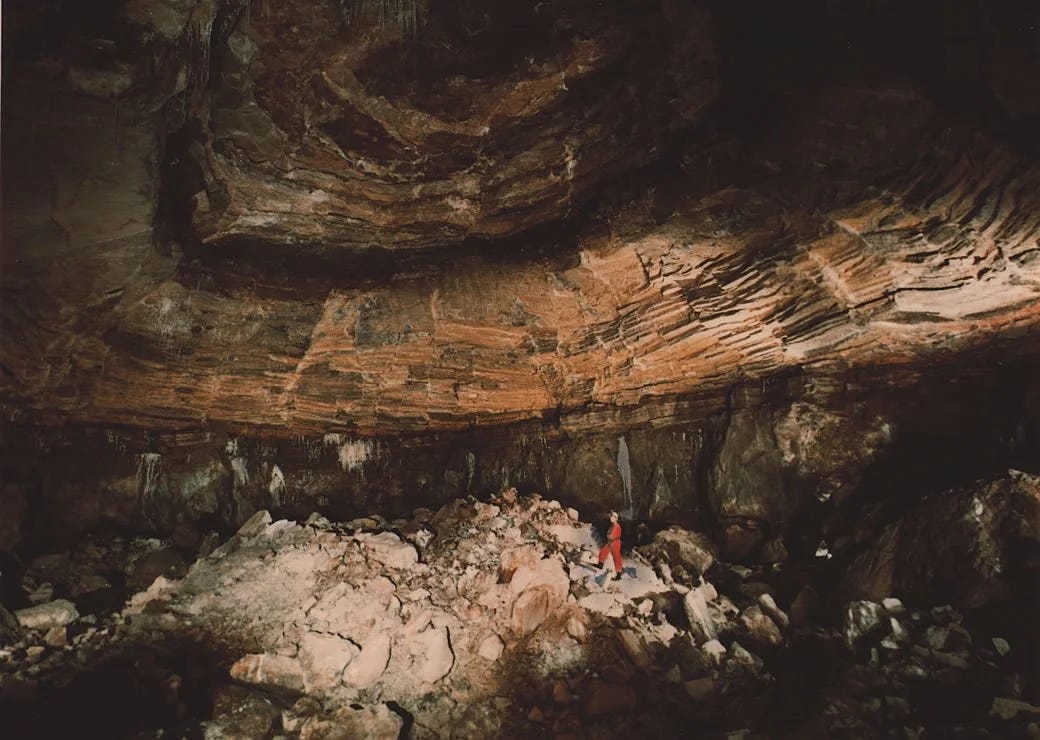
In 1966, Project Sterling attempted to prove Latter’s theory by detonating a 0.38-kiloton device inside a cavity created by a previous explosion. The experiment showed some decoupling—an observed factor around 70, at the lower end of theoretical predictions. But this tiny test is the only attempt to validate decoupling at any scale. No one has ever demonstrated that a test in the “hundreds of tons” range—the yield DiNanno attributes to China—could be successfully muffled.
The engineering requirements make the theory even more suspect. To fully decouple a test weighing hundreds of tons would require excavating a stable, roughly spherical cavity hundreds of feet deep underground. This cavity would need to survive long enough to be instrumented and used—a massive construction project that would be nearly impossible to conceal from modern satellite surveillance.
The U.S. accusation imagines China accomplished this feat at Lop Nur, executed a nuclear test, and left no traces detectable by the most sophisticated monitoring system ever deployed. This strains credibility.4
The Monitoring Revolution
When Latter proposed his theory in 1959, seismic monitoring was sparse and analog. The International Monitoring System that exists today would have seemed like science fiction. The CTBTO’s network now includes 337 facilities worldwide using four verification technologies: seismic, hydroacoustic, infrasound, and radionuclide detection.
The system’s capabilities have improved by orders of magnitude:
Regional monitoring: High-frequency seismic stations can distinguish the sharp “p-wave” signature of an explosion from the more complex patterns of earthquakes, even at very low yields.
Multi-phenomenal verification: Seismic data cross-reference with infrasound sensors that detect low-frequency atmospheric pressure waves and radionuclide “sniffers” that detect trace amounts of xenon gas escaping from underground cavities.
Network density: The IMS doesn’t rely solely on remote monitoring. Regional stations located around potential test sites provide detection capabilities far exceeding those available in the 1960s.
CTBTO Executive Secretary Robert Floyd’s statement about the alleged June 22, 2020, test was unambiguous: the International Monitoring System detected no evidence of a nuclear explosion on that date.5 This isn’t an admission of technical limitations—it’s a statement that, within the system’s demonstrated capabilities, nothing occurred that resembled a nuclear test.
Could China have conducted a test that evaded this network? In theory, partial decoupling might reduce seismic signals. But a yield-producing test large enough to be militarily useful—hundreds of tons—would be highly unlikely to escape detection entirely, particularly given the multiple independent monitoring methods now deployed.
The Diagnostic Overmatch: Why Testing Helps Adversaries
Even if we accepted—for argument’s sake—that China successfully conducted a low-yield test in 2020, the strategic case for U.S. testing in response remains catastrophically flawed. The United States possesses a diagnostic advantage so substantial that moving from modern subcritical experiments to explosive testing represents a technical step backward.
The Scorpius accelerator, currently being completed 1,000 feet underground at the Nevada National Security Site, represents the cutting edge of nuclear weapons verification without explosive testing. This facility uses high-energy electron beams to generate penetrating X-rays that can image plutonium behavior under extreme conditions at microscopic resolution. It provides what weapons designers call “X-ray movies”—dynamic visualization of nuclear materials under pressure that far exceeds what 1990s-era underground tests could achieve.
For the United States, explosive testing is trading a 4K camera for a 1950s Polaroid—abandoning precision diagnostics for crude “pass/fail” results.
For Russia and China, the calculus is reversed. Neither possesses facilities comparable to Scorpius. They lack the diagnostic tools that allow American weapons designers to validate new warhead configurations through subcritical experiments. Explosive testing is their only path to gaining data that the United States already obtains without crossing the zero-yield threshold.
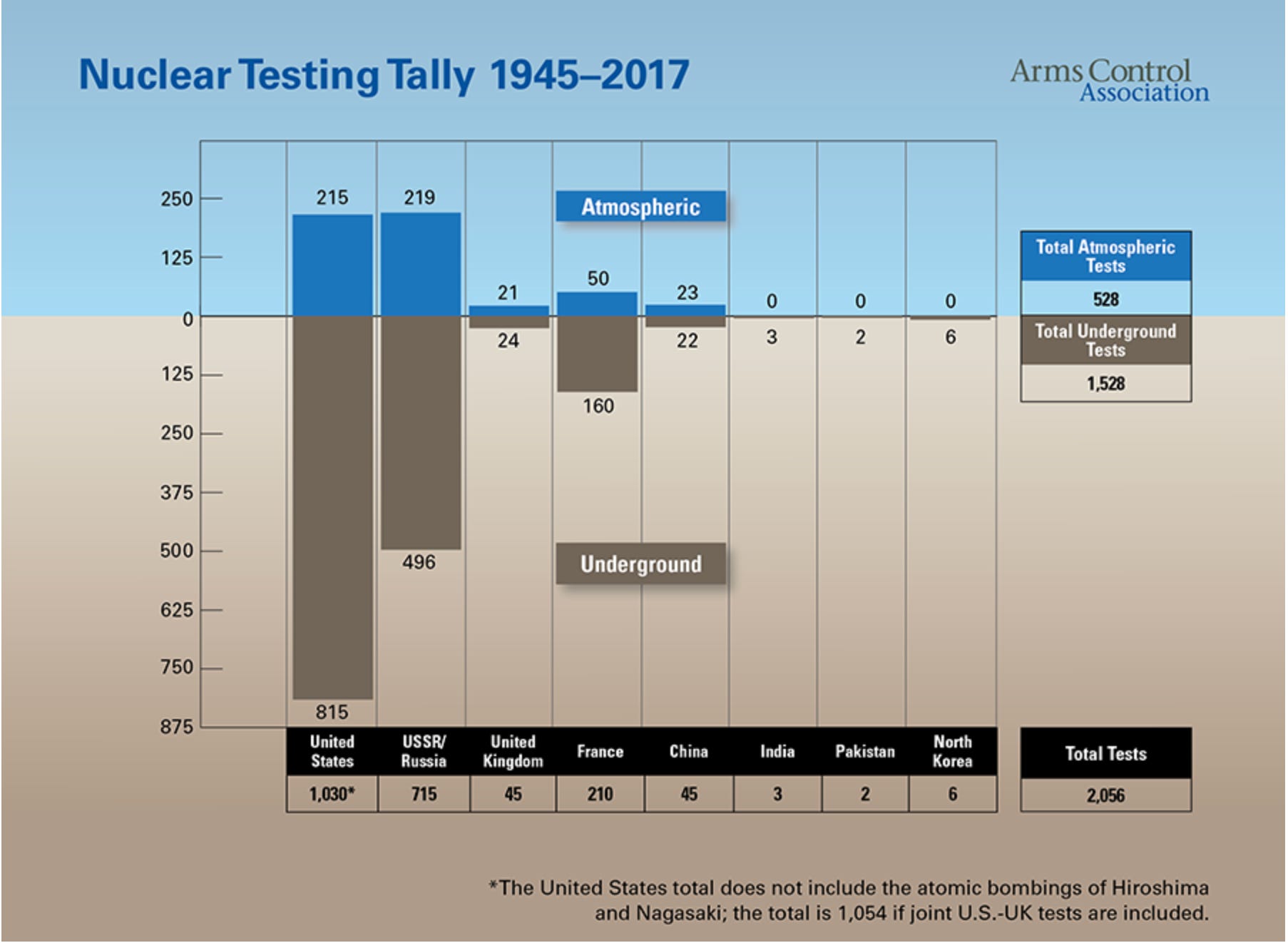
The United States conducted 1,054 nuclear tests before the 1992 moratorium. China conducted 45. This disparity in accumulated data is not merely quantitative—it represents an exhaustive “physics library” that underpins every aspect of U.S. weapons design. American designers can predict the performance of new weapons with extraordinary confidence because they draw on this unmatched database.
If the United States resumes testing, it effectively gives Russia and China permission to use the only tool they have to close this data gap. A single new test for China provides exponentially more new knowledge than test number 1,055 would provide the United States. We would be handing our adversaries a lifeline while gaining nothing we don’t already possess through superior diagnostic capabilities.
The Theater Nuclear Red Herring
The administration’s case also conflates different types of weapons systems. Much of the evidence cited as “Chinese testing” appears to involve the development and deployment of new delivery systems—missiles, bombers, submarines—not nuclear explosive testing of warheads. This distinction matters enormously.
China is expanding its nuclear arsenal. This expansion is observable, concerning, and requires a strategic response. But building more missiles and testing nuclear weapons are fundamentally different activities. The confusion seems deliberate, serving to justify a testing resumption that has no technical necessity.
The claim that low-yield or “tactical” nuclear weapons require explosive validation is particularly misleading. The United States already possesses extensive data on tactical weapon designs from the 1960s and 1970s, when dial-a-yield and low-kiloton devices were tested exhaustively. Modern tactical warhead development—like the W76-2 submarine-launched weapon—draws on this existing knowledge base and requires no new explosive testing for validation.
A Pattern of Circular Impossibilities
The Geneva accusation fits a larger pattern. The administration has constructed a framework of mutually reinforcing impossibilities:
Trilateral arms control: Demands China join negotiations while refusing the reductions that would make Chinese participation rational. Insists on Chinese inclusion while ignoring Russia’s demand for UK and French participation. Promises a “better deal” on a timeline that makes serious negotiation impossible.
Testing resumption: Claims U.S. testing is necessary to match adversary activities that cannot be confirmed. Ignores the technical consensus that testing provides no benefit to U.S. arsenal maintenance or modernization. Threatens action that would accelerate the very competition it claims to deter.
NPT obligations: Approaching the April 2026 Review Conference, having let New START expire, announced testing resumption, and demanded arms control conditions that no adversary can accept. Then positions itself as the responsible party seeking “realistic” agreements.
Each element serves the same function: creating conditions that justify escalation while appearing to pursue restraint. The result is not policy but performance—a framework designed to avoid accountability for the collapse of nuclear arms control while maintaining the appearance of principled negotiation.
Technical Authority vs. Political Convenience
The weapons laboratories have been clear. NNSA Administrator Brandon Williams testified to Congress: “We collected more [nuclear test] data than anyone else. And it is precisely that data that has underpinned our scientific basis for confirming the stockpile. I would not advise testing.” Energy Secretary Christopher Wright attempted to walk back Trump’s testing announcement, suggesting the President meant subcritical tests—an interpretation the White House never confirmed.
The scientific community that built these weapons, maintains them, and understands their physics at the most fundamental level sees no technical case for explosive testing. The administration proceeded anyway, and now justifies this decision with an allegation about an event six years ago that the international monitoring system—specifically designed to detect such events—recorded nothing about.
This is not a verification failure. It is a political accusation dressed in technical language, deployed precisely when it serves multiple diplomatic purposes. The timing, the lack of corroborating evidence, the reliance on a theoretical framework that has never been validated at relevant scales—all point to a justification constructed backward from a predetermined policy.
What Happens Next
The administration has set several processes in motion. The “equal basis” testing doctrine has been announced. The Geneva accusation has been made. The NPT Review Conference approaches in April. Each of these creates pressure toward outcomes that undermine American security:
If the United States conducts an explosive nuclear test—even a small one—the 34-year global moratorium collapses. Russia and China gain political cover to resume their own testing programs. The CTBT, already unratified by the United States but serving as a powerful norm, loses whatever remaining influence it retains. Non-nuclear states at the NPT Review Conference gain justification for their argument that the nuclear powers have abandoned Article VI disarmament commitments.
If China responds to the Geneva accusation by resuming testing—to prove it can, to match U.S. actions, or simply because the constraints have dissolved—we enter an environment where verification becomes exponentially more difficult and dangerous. The absence of agreed monitoring, the loss of data exchanges, and the collapse of inspection regimes all make future nuclear competition less predictable and more prone to miscalculation.
The administration appears to believe it can use these threats as leverage to force better terms in future negotiations. But leverage requires credible alternatives. There is no technical alternative to the Stockpile Stewardship Program that wouldn’t actively harm U.S. interests. There is no diplomatic alternative to negotiated arms control that doesn’t lead to unconstrained competition. And there is no alternative timeline that would allow a trilateral treaty to be negotiated, signed, and ratified within this presidential term.
Conclusion: Distortion in the Service of Escalation
I have spent more than four decades working on nuclear weapons policy and verification. The technical arguments being used to justify resuming testing are not new—they are recycled claims that were unconvincing in 1981 and remain unconvincing today, despite enormous advances in monitoring capabilities.
The “big hole” theory was always more political than physical. It served to delay arms control negotiations during the Cold War by suggesting that verification would be impossible. It is serving the same function now, with one crucial difference: we built the verification system anyway, and it works. The International Monitoring System can detect nuclear tests at yields far below military utility. Modern diagnostic facilities can validate warhead designs without explosive testing. The accumulated U.S. test database dwarfs that of any potential adversary.
The Geneva accusation is not based on technical necessity or verification failure. It is a diplomatic weapon, deployed to justify policies that serve political goals while undermining strategic interests. It fits the pattern established by the demand for impossible arms control conditions and the abandonment of treaties without credible successors.
The door to nuclear testing should remain closed because opening it serves no legitimate purpose while guaranteeing serious harm. The fact that this must be stated again—that arguments discredited decades ago are being resurrected to justify dangerous policies—suggests we have learned less from the Cold War’s end than we believed.
The testing moratorium holds not because of a treaty the United States never ratified, but because all parties recognized that the alternative served no one’s interests. That recognition appears to be fading, replaced by the belief that demonstrating resolve requires abandoning restraint. This is not a strength. It is the abandonment of strategy in favor of gesture—and it risks consequences no one can fully predict or control.
© 2026 Farooq Hussain
DiNanno, Thomas G. "Statement to the Conference on Disarmament." U.S. Department of State, 6 Feb. 2026, https://www.state.gov/releases/under-secretary-for-arms-control-and-international-security-affairs/2026/02/statement-to-the-conference-on-disarmament. Accessed 11 Feb. 2026.
The Future of Arms Control Part IV: The impact of weapons test restrictions: Nuclear weapons and ballistic missile testing, a means for Arms Control? by Farooq Hussain. Adelphi Paper 165, International Institute for Strategic Studies, London, 1978.
Latter, Albert L. Concealment of Underground Explosions. Research Memorandum RM-2562-AEC, RAND Corporation, 16 Mar. 1960, www.rand.org/pubs/research_memoranda/RM2562.html
See Albert L. Latter, Concealment of Underground Explosions, RAND Corporation Research Memorandum RM-2562-AEC (March 16, 1960). While Latter’s “decoupling theory” suggested that seismic signals could be reduced by a factor of 300, later rebuttals by the National Academy of Sciences and physicists like Hans Bethe emphasized the immense engineering impracticality of excavating the million-cubic-meter cavities required for high-yield tests. For a modern analysis of these limitations, see National Research Council, The Comprehensive Nuclear Test Ban Treaty: Technical Issues for the United States (Washington, DC: National Academies Press, 2012), 115–120.
Statement by Robert Floyd, Executive Secretary of the CTBTO
Project Sterling was a 0.38-kiloton underground nuclear test conducted by the U.S. Atomic Energy Commission on December 3, 1966, in the Tatum Salt Dome near Hattiesburg, Mississippi. It was part of the Vela Uniform ( program to test whether explosions in underground cavities could muffle seismic signals, reducing the blast’s impact by more than 100 times.
The Tatum Salt Dome is the location of the only nuclear weapons test detonations known to have been performed in the eastern United States. Two underground detonations, a joint effort by the United States Atomic Energy Commission and the United States Department of Defense, were conducted to assess remote detonation detection capabilities. The first test, known as the Salmon Event, took place on October 22, 1964. It involved detonation of a 5.3 kiloton device at a depth of 2,700 feet (820 m). The second test, known as the Sterling Event, took place on December 3, 1966, and involved detonating a 380-ton device suspended in the cavity left by the previous test. Further non-nuclear explosive tests were later conducted in the remaining cavity as part of the related Project Miracle Play.
Scorpius technical specs
Read my new book, The Last Treaty, download from Amazon Kindle unlimited for free use this link Amazon Kindle