

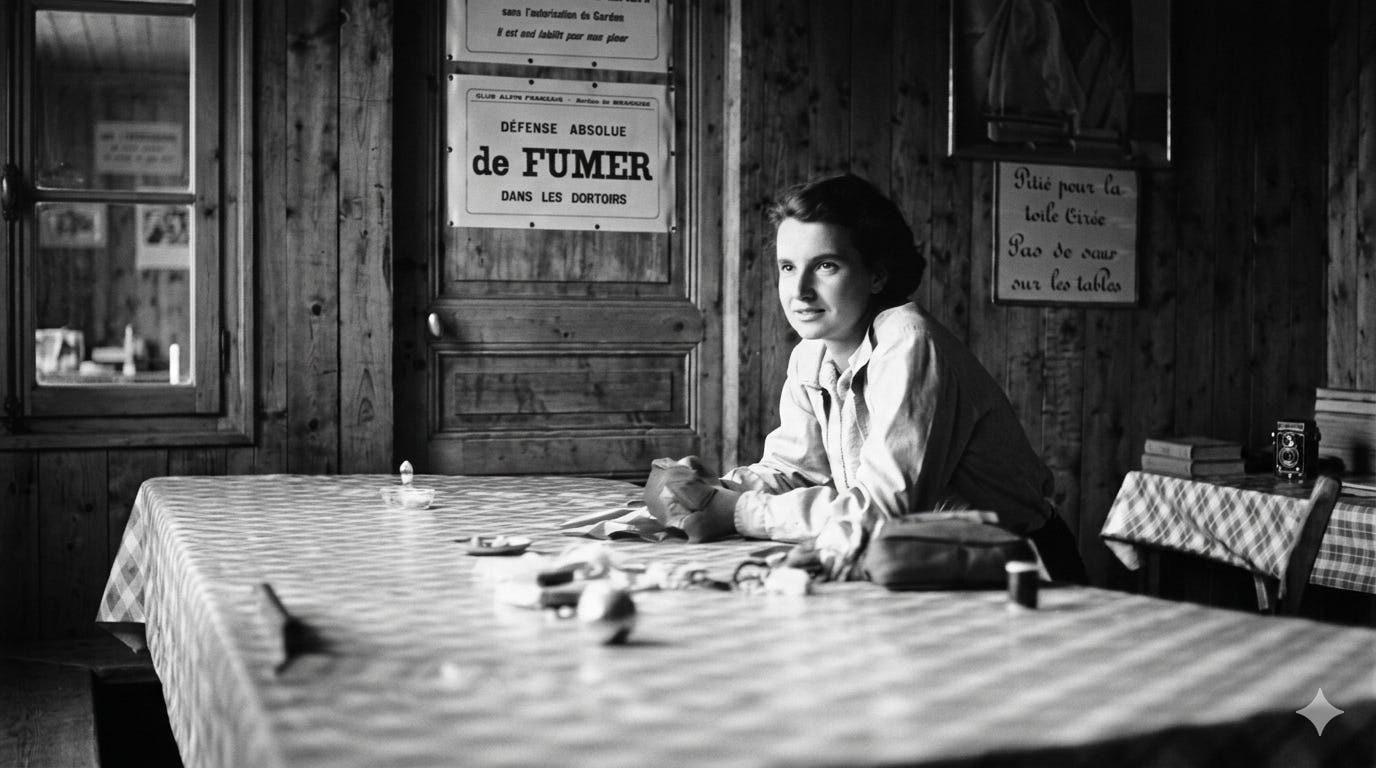
April 25th marks the anniversary of the publication in Nature of the proposed double helical structure of DNA by James Watson and Francis Crick. The picture that made it happen, Photo 51, was taken a year earlier by the doctoral candidate, Raymond Gosling, whose supervisor was Rosalind Franklin, and has become emblematic of misogyny in science. The legend, like so many Western movies, has gripped the public perception and narrative throughout history. Though at this point, both are well known. What would Rosalind Franklin have named “The Dark Lady of DNA’ by her most important biographer, Brenda Maddox, made of her veneration?
In the pantheon of scientific injustices, few stories have captured the public imagination quite like that of Rosalind Franklin and the discovery of DNA’s double helical structure. The narrative has become almost liturgical in its repetition: the brilliant woman scientist, her crucial X-ray crystallography work stolen by an ambitious male colleague, her character besmirched, and her contributions erased from history until a friend’s biography of her rescued her legacy from a horrible and untrue misogynistic portrait of her by scientific colleague James Watson.1 It is a story that satisfies our contemporary hunger for historical villains and victims, for clear moral lines in the messy business of scientific discovery.
Yet something curious has happened in the nearly seventy years since Franklin died in 1958. What began as a necessary correction to the historical record has evolved into something far more complex—and perhaps more problematic. Franklin has been transformed from a meticulous, pragmatic scientist into a symbol, her actual contributions simultaneously inflated and reduced to a single, dramatic moment of scientific theft. Franklin has become so emblematic of bias against women in science that she was portrayed on Broadway by Oscar-winning Nicole Kidman — and the woman who valued precision above all else has herself become the subject of the kind of myth-making John Ford immortalized in 'The Man Who Shot Liberty Valance.'2
This phenomenon raises uncomfortable questions that extend far beyond the specifics of the particular discovery. Why has Franklin, among all the women scientists denied proper recognition for their important contributions to twentieth-century science, become the singular focus of such intense posthumous advocacy? What does our collective need to sanctify her memory above all others reveal about how we process both scientific history and sexual bias? And perhaps most importantly, what would Franklin herself, a woman who prized accuracy and detested sentimentality, make of the beatification that has grown around her name as the wronged woman scientist of the twentieth century?3
When the legend becomes fact, print the legend
Having worked at the Biophysics Lab at King’s College, London, where Franklin conducted her crystallography work, I have had the unique opportunity to know many of the participants in this historical drama. Their recollections, gathered over years of casual conversations and formal interviews on this topic,4 paint a picture far more subtle and nuanced than the narrative that has taken hold in popular consciousness. They describe a Franklin who was indeed widely thought of as brilliant —a woman scientist in the early 1950’s — underappreciated, but also pragmatic, direct, and—crucially—likely to be deeply uncomfortable with the mythological status she acquired posthumously for the part she played in the discovery of the structure of DNA.
The Dark Lady of DNA
Acclaimed science writer and Franklin biographer Brenda Maddox coined the phrase "The Dark Lady of DNA"5 for her seminal work, which was broadcast by the BBC Horizon as a documentary about Franklin in 2003. In the US, NOVA used the title “Photo 51”. The irony is profound: in our eagerness to honor Franklin’s memory, we may have committed the very sin her critics accused her male colleagues of—we have appropriated her identity for our own purposes. James Watson’s unflattering, inaccurate portrayal of Franklin in his best-selling book “The Double Helix” was criticized for its dismissive and cruel characterization of her. This, however, was lost in the torrent of critical acclaim it received upon publication, despite the huge efforts of Crick, Wilkins, and Pauling, in particular, to prevent it from appearing. Francis Crick and Maurice Wilkins pressured Jim Watson to remove his falsely portraying Franklin, who had passed before Watson began circulating his personal account of the discovery.
But have we by now, in our corrective zeal, created an equally distorted portrait, one that may serve our contemporary needs rather than historical truth? It seems we have turned the story of the discovery of the double helix into a false myth, favoring it over historical accuracy.
Two Wrongs
This examination is not in any way intended to diminish Franklin’s legitimate scientific contributions or to excuse the very real barriers she and other women faced in mid-twentieth-century science. Instead, it seeks to understand how the pendulum of historical interpretation can swing so far in the opposite direction that it loses sight of the actual person at its center. It asks why Franklin, specifically, has become the sole vessel for our collective guilt over the treatment of women in science, and what this reveals about how we construct scientific heroes and martyrs.
The stakes of this inquiry extend beyond historical accuracy. The Franklin mythology, however well-intentioned, has reduced her to a symbol rather than acknowledging her as a complex individual and a highly successful scientist. It also obscures the stories of countless other women scientists whose contributions remain genuinely overlooked, overshadowed by the bright light of Franklin’s posthumous fame. In our rush to canonize one woman scientist, have we inadvertently reinforced the very tokenism that limited women’s opportunities in the first place?
Through the voices of those who knew Franklin personally—her colleagues, friends, and family members—a different portrait emerges. This Franklin is no less remarkable, but she is more human, more complete, and ultimately more deserving of our respect than the mythological figure presented in the popular narrative. Though now part of the historical record, it has failed to make much of an impression on the popular myth.
Rosalind Franklin was a scientist who would likely have found our contemporary obsession with her story both puzzling and deeply troubling, a woman who valued her work above her symbolic value, and who might well have asked us to focus less on avenging her memory and more on understanding the science she helped create.
I believe the time has come to separate the woman we know as the scientist from Rosalind Franklin, the symbol, to examine how posthumous advocacy can itself become a horrible form of historical distortion, and to ask what we owe the memory of those we claim to champion. In doing so, we might discover that the most respectful tribute to Franklin is not unquestioned veneration, but the kind of clear-eyed, unsentimental analysis she herself would have applied to any problem placed before her—including, perhaps especially, the problem of her own posthumous characterization.
Should Watson have written a Double Helix less hurtful to Franklin?
On January 7, 1962, Russian Physicist Lev Landau was so severely injured in a car crash that he was unable to travel to Stockholm to collect his Nobel Prize for Physics. He would have joined Britons Max Perutz, John Kendrew, Francis Crick, and Maurice Wilkins, as well as Americans James Watson, and, for literature, the novelist John Steinbeck.
Perutz and Kendrew, who received the chemistry prize, were recognized for their pathfinding work on the structure of proteins, including the shape and functioning of the hemoglobin molecule. Watson, Crick, and Wilkins received the prize for Physiology or Medicine for their work on determining the structure of DNA.
A year later, Linus Pauling received the Nobel Peace Prize for his campaigning against atmospheric nuclear weapons testing. The prize had been withheld the previous year because the Norwegian Nobel Committee was deadlocked over the chairman's insistence that it be awarded to Pauling, even though he had not received a majority of nominations. At the time, it was reported that the Peace Prize had not been awarded because the Cuban Missile Crisis occurred around the time the prize announcement would usually be made.
Between the six years that passed since 1962, when they received their prize, and the publication of Watson's book "The Double Helix" in 19686, A cascade of molecular biologists received awards, including Dorothy Hodgkin, Francois Jacob, Andre Michel Lowff, Jacques Monod, Robert Holley, Har Gobind Khorana, and Marshall Warren Nirenberg.
However, the double helix and DNA did not enter popular culture until after the spectacular success of Watson's book. Moreover, little was yet publicly known about the legal tussle between Watson and Crick, Wilkins, and, later, Pauling and others, over every aspect of the book. When he first shared his manuscript with Crick and Wilkins, Watson had called his book "Honest Jim," which he was soon persuaded to drop. The protestations from Crick and Wilkins that the veracity of Watson's narrative was questionable, and that one of the central characters, in particular Rosalind Franklin, was cruelly misrepresented, fell into the category of being ignored. Franklin had died ten years prior and four years before the trio was awarded the Nobel prize. Crick and Wilkins pressured Harvard University Press, which backed out of the agreement to publish. With the future of the book hanging in the balance, Watson requested Lady Alice Bragg, the wife of the head of the Cavendish laboratory at Cambridge, to ask her husband, Sir Lawrence, to agree to write the foreword. Bragg and his father, Sir William, both won the Nobel Prize in Physics.
Over the years, I’ve observed with dismay how the myth surrounding the discovery and sharing of Photo 51 gripped the popular narrative, particularly victimizing Maurice Wilkins. This campaign to redeem Franklin began because of her ill treatment in Watson’s personal account of the discovery. Crick and Wilkins were deeply opposed to the manuscript because, amongst many others, it was so personally hurtful to Franklin, who was dead. Watson was even able, through Bragg’s wife, to appeal to the grandee of the Cavendish Lab to write a foreword to the book, knowing as he did from Crick the awful falsehoods that filled the book.
Wilkins himself could have addressed the facts surrounding his awkward professional relationship with Franklin and the circumstances in which he showed Photo 51 to Watson — but he chose not to, and the silence cost him his scientific reputation. The irony is almost too bitter to contemplate: Watson, who believed women had no place in the laboratory and were a distraction to their male colleagues, continues to be celebrated in the very accounts that erased Wilkins from the discovery and replaced him with Franklin alone. The man who wronged Franklin most has been the principal beneficiary of her canonization. In response to Anne Sayre’s article about her book in the Sunday Times, I wrote a letter which, though published, seemed only to attract the attention of Aaron Klug, whom I later knew better. I also wrote an article about the Nobel Prize issue for New Scientist, but this train had left the station. Maurice, for his part, took it head-on only in his biography published just a few years before he died, by which time the myth that had stolen Franklin’s data and given it illicitly to Watson to solve the structure of DNA had been indelibly tattooed on his forehead.
What was so difficult about X-ray imaging DNA in 1950
“Why was it so hard to get a good X-ray diffraction picture of DNA? Who else took X-ray diffraction pictures of DNA?” It’s not often recalled that the earliest attempts to apply X-ray diffraction crystallography to image biological molecules required specialized equipment designed and built from scratch. Maurice Wilkins designed the cameras used at King’s, and they were constructed by techs under his supervision. He located X-ray source tubes from war surplus stores and so on. Similar efforts went on at other labs. Linus Pauling’s brilliant collaborator, Robert Corey, was a similarly talented builder. He and Pauling developed the space-filling molecular models that became ubiquitous during the ‘50’s. William Astbury at the University of Leeds was similarly known to be extremely talented at building cameras capable of X-ray imaging biological molecules. Jim Watson famously explains his first attraction to Maurice Wilkins for Wilkins’s ability to image DNA, and that Wilkins had obtained a sample of Calf Thymus DNA from Sigfried Signer, from which very promising images of the molecule were possible. The King’s lab was well ahead of others because they had identified that DNA yielded images in two distinct forms. The crystalline A form and the hydrated B form that provided the famous photo 51, revealing the double helical structure. The camera needed to obtain images of the molecule, which was a drawn fine fiber of the sample material, would be exposed for periods of around fifty to one hundred hours for an image to form on the photographic plate, which was a square form 600mm used frequently in photography. To maintain the hydration level to image the B form, the sample chamber had to be continually flushed with hydrogen to prevent it from drying out during exposure. By the time Franklin joined King’s Biophysics, which was still only four years since its formation, Wilkins had already established a world leadership position in imaging DNA. At this time, there was still no consensus on the molecule’s central importance in its role as the keeper of the genetic code.
Why did Wilkins show Photo 51 to Jim Watson?
Gosling’s image of the B form was taken in May 1952, a full year ahead of Watson’s visit to King’s, during which, in his recounting, he met with both Franklin and Wilkins. Alec Stokes and Herbert Wilson. The diffraction images were shared within the group, not least because interpreting the molecular structure required collaborative calculations. Within the group, Wilkins was heavily in favor of a helical structure. Franklin could not be convinced of this, and the differences between the A and B forms left room for doubt.
In post-war Britain, the Medical Research Council funded three main centers for X-ray diffraction studies of biological molecules. King's focused on DNA and RNA, the Cavendish on hemoglobin. These labs were competitive but explicitly mandated to share progress through regular coordinated meetings. Watson and Crick had a well-communicated interest in DNA. It would only have been surprising if they had not been invited to Franklin's seminar. The portrayal in The Double Helix of these routine professional exchanges as conspiratorial is precisely that — a portrayal, shaped by narrative convenience rather than the institutional reality of how British post-war science actually functioned.
Would Watson and Crick have been able to solve the structure of DNA without Watson having seen Photo 51?
Crick has been reported to have claimed that the information from photo 51 was not as central to the discovery of the double-helical structure of DNA as suggested, at least by Watson’s account in his book The Double Helix. Wilkins’ account of his meeting with Watson provides a contrasting view of Watson’s reaction to Franklin’s resistance to accepting a helical structure for DNA, which is corroborated by what Franklin herself told Aaron Klug years later. The photo provided critical information about the molecule's double-helical structure and was sufficient to attempt a model.
By this time, both Wilkins and Watson and Crick knew that helical phosphate chains were on the outside of the bases, and because of Chagaff’s work, Linus Pauling, together with Robert Corey, would likely have made another attempt at the structure as soon as they had better X-ray diffraction data than they had received from Astbury.
It’s less likely, I believe, that the Wilkins group would have resolved the model structure within a year because, other than Wilkins, there was no one to provide the intellectual foil to figure out the bond pairing of the Pyrimidine and Purine bases. In this task, Jerry Donahue was a critical help to Watson. There was a lot of intuitive brilliance in the solution proposed by Watson and Crick, and the second one that the King’s team (Randall, Wilkins, Franklin, and Stokes) traveled to Cambridge to review. By resolving the base pairing, Watson and Crick determined that the sugar-phosphate chains wrapped around the outside. Watson and Crick synthesized information based on the studies of Erwin Chargaff and others, in a manner only previously successfully demonstrated by Linus Pauling, by guessing it - a technique to which he gave the prosaic label of “stochastic.”
The End is Only the Beginning
The facts could have been addressed by Wilkins himself, who could have addressed the falsehoods about Franklin and his awkward professional relationship with her, for which Randall's mishandling is perhaps the most consequential and least recounted aspect. Randall was impressed with Franklin. She interviewed for the position, which by no means was the only opportunity open to her, but was a sound career move. But Franklin left friends and Paris, where she was very happy, for London, which was still rebuilding five years after the war. Paris was not struck by bombardment during the war and did not face the same recovery challenges. In accepting the King’s position, Randall never told Franklin that Wilkins was leading the whole DNA effort in assigning Gosling and Wilkin’s DNA and camera to Franklin; Randall did not anticipate that Franklin would be protective and turf-minded. Another aspect that will have affected Franklin is that all the members of the lab deferred to Wilkins as the DNA team leader, though there were no titles to make this clear, and no intervention by Randall to clarify things. Wilkins was much more focused on DNA and long committed to the likelihood of a helical structure for the molecule, which led her to pursue research that Franklin could have interpreted as encroaching on her turf. Lastly, Wilkins knew Francis Crick, whose French wife, Odile, and Rosalind Franklin also hit it off, so the Cricks and Franklin became close friends after the discovery of DNA. Wilkins also knew Jim Watson, whom Franklin found intrusive and brusque. In spite of all this, if there had been any passion for DNA in Rosalind Franklin, she would not have abandoned it to move to work on viruses at Birkbeck.
In response to Anne Sayre’s article about her book in the Sunday Times, I wrote a letter which, though published, seemed only to attract the attention of Aaron Klug, whom I later knew better. I also wrote an article about the Nobel Prize issue for New Scientist, but this train had already left the station. Maurice, for his part, took it head-on only in his biography, published just a few years before he died, by which time the myth that had stolen Franklin’s data and shared it illicitly with Watson to solve the structure of DNA had been indelibly tattooed on his forehead.
Would Franklin have solved the structure by herself?
Francis Crick is reported to have said that if he and Watson had not successfully modeled the structure of DNA in April 1953 (which had been completely derived from the experimental work of others), the double-helical structure would not likely have been proposed by others for another decade. This view perhaps reflects more on the opinion that Watson and Crick held for their competitors than the documented evidence.
If Watson and Crick had not obtained the information they derived from Watson’s viewing of photo 51 and from her colloquium presentation and research report, would Franklin have solved the structure by herself? The closest competitor by far was Linus Pauling. Had Pauling not been denied a passport by the State Department and been unable to travel, he would have almost certainly shown up on the doorstep of King’s Biophysics Department, where Wilkins, with the support of Randall, was not ready to send him the pictures through the mail.
The evidence suggests that Linus Pauling, having made one unsuccessful attempt, built on the poor X-ray diffraction pictures he was able to get from Astbury, would certainly have closed in on the base pairs in the middle and sugar-phosphate chains on the outside approach sooner rather than later, and certainly within months rather than years.
My own connection to the physical history of the discovery was the result of a fortunate introduction to Professor Herman Watson, a former doctoral student of John Kendrew at the Cavendish. I learned that the original Watson-Crick molecular model had survived as component pieces among the tea chests of bits and pieces that Herman Watson had taken with him when he moved to the University of Bristol. I was able to reconstruct it, and it has been on display at the Science Museum in London since the late 1970s. [I have written about that experience in detail elsewhere.]
Rosalind Franklin decided to leave her DNA work behind when she sought to transfer to J.D. Bernal’s group at Birkbeck College, which focuses on viral structure. This, in my view, is the greatest single indicator that she was not, as Aaron Klug concluded from studying her papers and diaries after her death, that she had almost solved it.” She had agreed to continue to supervise Gosling as her doctoral student, and had she been close to something big and determined to finish the job, it’s unlikely in my view that Bernal and Randall, eminent British scientists and lab directors at the time, would not have worked out some sort of compromise. We have not found any historical record that Franklin regretted leaving the DNA work behind. 7
She had recently moved when Watson and Crick assembled their second model, which Franklin traveled with the King’s team to view. Sir John Randall, Maurice Wilkins, and Franklin were accompanied by Ray Gosling and Alec Stokes. After it was agreed that Crick and Watson would publish their proposed structure in Nature, it was also agreed that Wilkins and Franklin would submit supporting papers based on the work at King’s. Franklin had consented to continue supervising Gosling’s doctoral thesis despite her move to Birkbeck; aside from that, her research interests were elsewhere. There’s no evidence that she had a desire to return to work on DNA, so it’s difficult to speculate how she would regain her attention. Mostly, it’s been suggested by Aaron Klug, her colleague at Birkbeck and life advocate, that Franklin’s various notes could be interpreted as indicating that she was close to solving the molecule’s structural configuration. In an interview, Klug quotes Franklin as having said to him on more than one occasion that she could “kick myself for not having given in to a helical structure sooner, for both the A and B forms.
Franklin went on to complete work on the structure of viruses at Birkbeck, where she worked until her death. She never raised concerns over the use of the data derived from her presentation at King’s attended by Watson, or that he had seen Photo 51 with the distinct X pattern of the B form of DNA. She was an extremely intelligent woman, and it’s unlikely that she did not know, either through Gosling or as a result of the discussion over viewing the model in the Cavendish Laboratory, that data from her work had been incorporated into the model. This data was valuable but not absolutely essential for the proposed Watson-Crick double-helical structure.
However, Linus Pauling and Robert Corey had proposed a triple helical structure for DNA comparable to Watson and Crick’s first attempt, without the benefit of any diffraction images from King’s. Pauling had unsuccessfully written to Wilkins, asking to see the X-ray diffraction studies. Once Pauling’s travel restriction had been lifted by the State Department, and he would have been free to visit King’s or for them to share their data, it’s very likely that Pauling and Corey would have succeeded in constructing a double helical model.
What makes Photo 51 an iconic image?
Beyond its purely scientific impact, photo 51 has come to represent a portrayal of Rosalind Franklin as a mistreated Jewish woman scientist at a time when such discrimination was commonplace. Her contributions towards the discovery of DNA have been argued to have been under-recognized or maliciously ignored at the expense of her male colleagues. Specifically, James Watson’s writing of his personal account of the discovery of DNA, some ten years after her death, provided a misogynistic and denigrating portrayal of Franklin, with only Wilkins and Crick to defend her. Following the highly successful publication of his book “The Double Helix,” Anne Sayre, a close friend of Franklin, particularly towards the end of her life, wrote a book whose purpose was to counter the picture of her that Watson’s account presented. In 1975, “Rosalind Franklin and DNA” was published, launching Franklin as a cause celebre and Wilkins as the villain for feminist scientists. ln her book Sayre misrepresented Franklin’s difficulties at King’s created a false caricature of Wilkins as a thief of Franklins data and creating a myth that exploded into women scientist movement vilifying Wilkin’s and elevating Franklin as a feminist icon robbed of fair accreditation for her scientific work to the point of removing Wilkins from the discovery for which he shared the Nobel Prize with Watson and Crick. At this moment, the discovery is commonly attributed to Watson and Crick, using Franklin's data illicitly obtained by Wilkins, who did not have Franklin’s consent. Though Crick and Wilkins published their own accounts of the discovery and the necessary historical research that countered the false narrative created by Sayre’s book, that narrative persists.
The Nobel Prize
“Had she lived, would Franklin have shared the Nobel Prize?” A question many accounts of her role have answered definitely in her favor posthumously. They’ve gone further in characterizing Maurice Wilkins as the villain and, in their revisionist history, have denied him any mention in accounts of the discovery of DNA, casting Franklin as a wronged woman while leaving the reputations of Watson and Crick intact. In her life, she never acted or stated that she should be any more part of the discovery than she was. She did, according to her scientific champion, Aaron Klug, tell him on more than one occasion that she regretted not appreciating the helical structure of the molecule as indicated by the images from the B form much sooner. The truth is, she had forcefully resisted being more open to the idea. Franklin was diagnosed with ovarian cancer in September 1956, just three years after the publication of the collected papers by Watson-Crick, Franklin-Gosling, and Wilkins, Wilson, and Stokes papers announcing the double helical structure of DNA in the journal Nature. She had hoped that she would be elected to the Royal Society, a goal so clearly within her grasp as she continued her pioneering research on viruses and RNA at Birkbeck College for the remaining months of her life. Her friend Ann Sayre came to England from the United States to help care for her during the final months. Rosalind Franklin died at the age of 37 on April 16, 1958, about a year and a half following her initial diagnosis.
First raised by Anne Sayre in her biography of Franklin, the question of whether Franklin deserved the Nobel Prize was soon transformed into a corollary: that Wilkins did not. And so, as a result, so much in the way of ordinary textbooks and web searches has been purged of Wilkin’s contribution to the discovery despite the facts and the part he played in its discovery. Even Wikipedia acknowledges that, at the time, the Nobel Committee had not definitively ruled against a posthumous award. This despite the fact that they had never done so until and since the 1962 award. My own opinion then - I wrote about it in New Scientist in response to the suggestion made in Sayre’s Book, is that had she lived, Franklin would have been first elected to the Royal Society and that Sir Lawrence Bragg and Sir John Randall would have nominated Franklin along with Wilkins and of course Watson and Crick for the prize would have likely been divided between the Phsyiology or Medicine and Chemistry categories. Whether Perutz and Kendrew would have had to wait another year for theirs is a different question. As history has turned out, Franklin, because she had died, was never nominated. Wilkins was opposed by Pauling,8 who never forgave him for sharing the image of the B form with Watson and deferred to Randall’s backing of sending early research images to Pauling in Pasadena. An open question remains. Had Pauling not been denied a passport by the State Department, he would have visited King’s and would have learned that from their review of the first Watson-Crick model, which Franklin had demolished as impossible at first sight, that the sugar phosphate chains of the molecule would not be on the inside. He was a superbly intuitive scientist, perhaps unmatched in the 20th century, so the mere sight of even a foggy image of the B-form would have given him the clue that he lacked when he assembled his model ahead of the successful Watson-Crick one.
Many great scientists do not win a Nobel Prize. It is uniquely a mark of recognition, particularly in the 20th century, that has been sometimes despoiled by Nobel Prize syndrome, in particular by Jim Watson himself, to espouse unfounded, unscientific racist views of white superiority. He keeps company with a large number of Nobelists who, upon winning the prize, have used it as a platform to espouse their long-held controversial views with the weight of the Nobel Prize behind them.
History, it’s often thought, will eventually right injustices. In that vein, Rosalind Franklin, who has had history rewritten for her, has been portrayed in film and on stage, and a coin of the realm struck in her honor continues to be the occasional subject of some seeking to right a wrong on her behalf, as if enough has not been accomplished. What I find regrettable and offensive is that so much of this effort has taken place at the expense of Wilkins, whose post-war disillusionment with the development of nuclear weapons, in which he participated, caused him to turn earlier than most to apply physics to the greatest scientific problem of biology of his day. With two-thirds of a century passing, I ask myself why the Franklin myth has persisted to the wrong and unnecessary detriment of Wilkins? I accept that a good part of the blame falls on Maurice, who declined to tell at least a sufficient part of his story to defend himself until his 2003 autobiography. The other, and more significant, part, I believe, is in the history of science, which has taken the view that, as in “Who Shot Liberty Valance,” the legend is more amenable than the fact.
Amongst so many important contributions to 20th-century science by women, I’m always reminded of Lise Meitner, who did not share the 1944 Nobel Prize in Chemistry for the discovery of nuclear fission, which was awarded instead exclusively to her long-time collaborator, Otto Hahn. Several scientists and journalists have called her exclusion “unjust”. According to the Nobel Prize archive, she was nominated 19 times for the Nobel Prize in Chemistry between 1924 and 1948, and 30 times for the Nobel Prize in Physics between 1937 and 1967. Where’s the justice in that? Franklin herself, before her diagnosis, told friends and family that her ambition was election to the Fellowship of the Royal Society — a goal that was well within her reach and that would have represented the recognition she actually sought from her peers. Instead, she has a Broadway play, a commemorative coin, buildings, and awards named after her. She would have preferred the FRS; sadly, it, too, is not offered posthumously.
© 2026 Farooq Hussain
Sayre, Anne, Rosalind Franklin and DNA: The first full account of Rosalind Franklin’s role in The Discovery of the Double Helix Structure of DNA, W.W. Norton, 1975
The Man Who Shot Liberty Valance. Directed by John Ford, Paramount Pictures, 1962. In John Ford’s 1962 western, an ambitious young lawyer, Ransom Stoddard (James Stewart), builds a legendary political career on his reputation for having shot the outlaw, Liberty Valance. The truth, known only to a handful, is that it was the taciturn rancher Tom Doniphon (John Wayne) who fired the fatal shot — and who chose silence over credit, watching the legend grow while his own life diminished. When a reporter finally learns the truth decades later, he throws away his notes: “This is the West, sir. When the legend becomes fact, print the legend.” The parallel to the DNA story is uncomfortably close, with Watson playing the unlikely Jimmy Stewart — the beneficiary of a narrative he largely authored himself — and Wilkins the still more unlikely John Wayne, a gentle, self-effacing man who chose silence over self-defense and paid for it with his place in history. Ford’s film at least has the grace to show us Doniphon’s sacrifice.
"Now a sometimes almost unrecognisable Rosalind has been put on an unrealistic pedestal. She is no longer a warning, but has become “the forgotten heroine”. Her story has been adopted by feminists as a symbol of a woman struggling and unacknowledged in a man's world. This would, I think, have embarrassed her almost as much as Watson's account would have upset her."
— Jenifer Glynn (Rosalind Franklin’s Sister) The Lancet, “Remembering my sister Rosalind Franklin” (March 24, 2012)
Interviewed by the BBC on the premiere of Nicole Kidman’s portrayal of her sister in the West-End play Photo 51, Glynn commented, “But all her career, my sister thought that as a woman scientist she had to try a bit harder. Undoubtedly, she could be hard to get on with at times. Perhaps she suffered because Crick and Watson were prepared to go out on a limb - Rosalind wanted to be terribly sure of her facts before going public. I suspect that, as a woman, she was given less room to experiment and fail. But Rosalind never saw herself as a victim. People want her to be a feminist icon, but one has to accept that when she died in 1958, there were still only the first stirrings of feminism. You can’t rewrite the history of a whole era. But now Rosalind has become a public figure, in the way we could never have imagined.” Remembering Rosalind: Sister recalls DNA pioneer brought to stage in Kidman play, Vincent Dowd, Arts reporter, BBC, 14 September 2015
Hussain, Farooq. “Did Rosalind Franklin Deserve the Nobel Prize?” New Scientist, vol. 69, no. 990, 11 Feb. 1975, pp. 336-337
Maddox, Brenda. Rosalind Franklin: The Dark Lady of DNA. HarperCollins, 2002
Watson, James, The Double Helix. W.W.Norton & Company, 1968
Klug, A. Rosalind Franklin and the double helix, Nature volume 248, pages 787–788 (1974)
Cobb, Matthew, and Nathaniel Comfort. “What Rosalind Franklin Truly Contributed to the Discovery of DNA’s Structure.” Nature, vol. 616, no. 7958, 27 Apr. 2023, pp. 657-660. It is worth noting that this article is an opinion piece published in the commentary section of Nature and is therefore highly contestable. The authors fails to provide any substantive evidence beyond the existence of a note that other advocates did not comment on. This includes Sir Aaron Klug, a personal friend of Franklin and a Nobel Prize winner himself in the same scientific area. Furthermore, the article is one of a number of misleading, tendentious writings that constitute a “cottage industry” suggesting that Rosalind Franklin was wronged. This narrative largely arose from the publication of Watson’s portrayal of her in The Double Helix and Anne Sayre’s biography of Franklin.
Letter from Linus Pauling to the Nobel Committee for Chemistry, 15 March 1960. Correspondence - Linus Pauling and the Race for DNA: A Documentary History, Oregon State University Libraries. sci9.001.47-lp-nobelcommittee-19600315-transcript.html Oregon State University Special Collections