

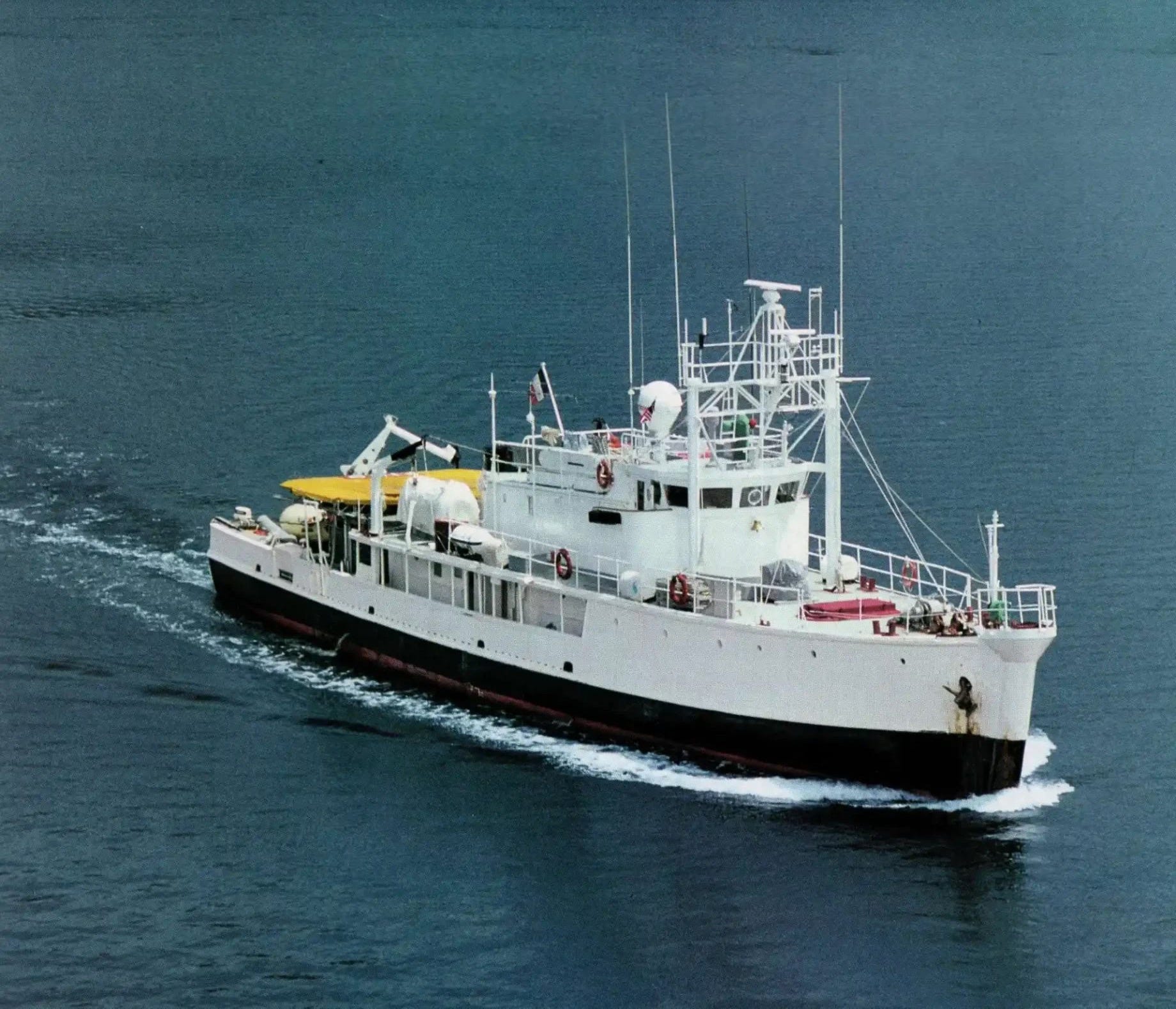
The sea is awash with fantastic stories — apparitions whispered by sailors of phantom ships whose fate has been to wander endlessly, never reaching port. Today, a ship still adored by millions seems caught in a twilight zone — trapped between its legend and reality. The Calypso, once the beating heart of undersea exploration for literally millions of TV viewers worldwide, now drifts between its iconic past and an opaque future. Its fate is neither of a wreck nor of painstaking restoration, but something more unnerving - the perpetual mystery of when, or if she will ever sail again. As John Denver once sang:
“Aye, Calypso, the places you’ve been to, the things that you’ve shown us, the stories you tell…”
A chorus that now echoes less as a celebration than an elegy, reminding us that the ship’s spirit endures even as knowledge of its prospective restoration echoes faintly across the sea.
Yours for 1 Franc
The legend of Calypso is anchored at the dinner table in the Prince’s Palace, Monaco, where a dream was brought to life by a classy blend of generosity, discretion, and wealth. In 1950, Jacques-Yves Cousteau and his wife, Simone Melchior, discovered a decommissioned Royal Navy minesweeper on the island of Malta. This wooden-hulled vessel, built in Seattle, Washington, and launched in 1942 as HMS J-826, had briefly served as a ferry between Malta and its neighboring island of Gozo. The ship had been renamed Calypso-G by its ferry operator after the nymph who detained Odysseus for seven years on the isle of Ogygia, considered by some to be modern-day Gozo. Calypso’s route was to ferry passengers between Gozo and Malta.1
The Cousteaus needed financial backing to purchase it, and found it in Thomas Loel Guinness, an heir to the Irish brewery fortune.2 Jacques Cousteau and his wife Simone Melchoir were seeking ways to own a ship dedicated to undersea exploration. What they envisaged didn’t yet exist, yet in this 42-meter ocean sailing yacht, they saw an opportunity to bring their vision to life. Over a dinner with Prince Albert and Princess Grace, Guinness offered the Cousteaus a deal. He would purchase the vessel and lease it to them in perpetuity for 1 French Franc per year. And by July 1950, he had bought and leased the ship to the Cousteaus, imposing just two conditions. First, Guinness’s identity would never be revealed; second, he would never be asked for more money. With this arrangement in place, the Calypso was sailed to a shipyard in Antibes, where it was refitted into the fully equipped oceanographic research platform that would become a global symbol of the conservation movement for the last half of the 20th century. While still only eight years old, the ship needed a substantial refit to be ready for its new role. And Simone, the Calypso's chief operating officer throughout its sailing life, spent a significant part of her inherited fortune, including family heirloom jewelry, to get the Calypso ship-shape and ready for its rise to world fame.
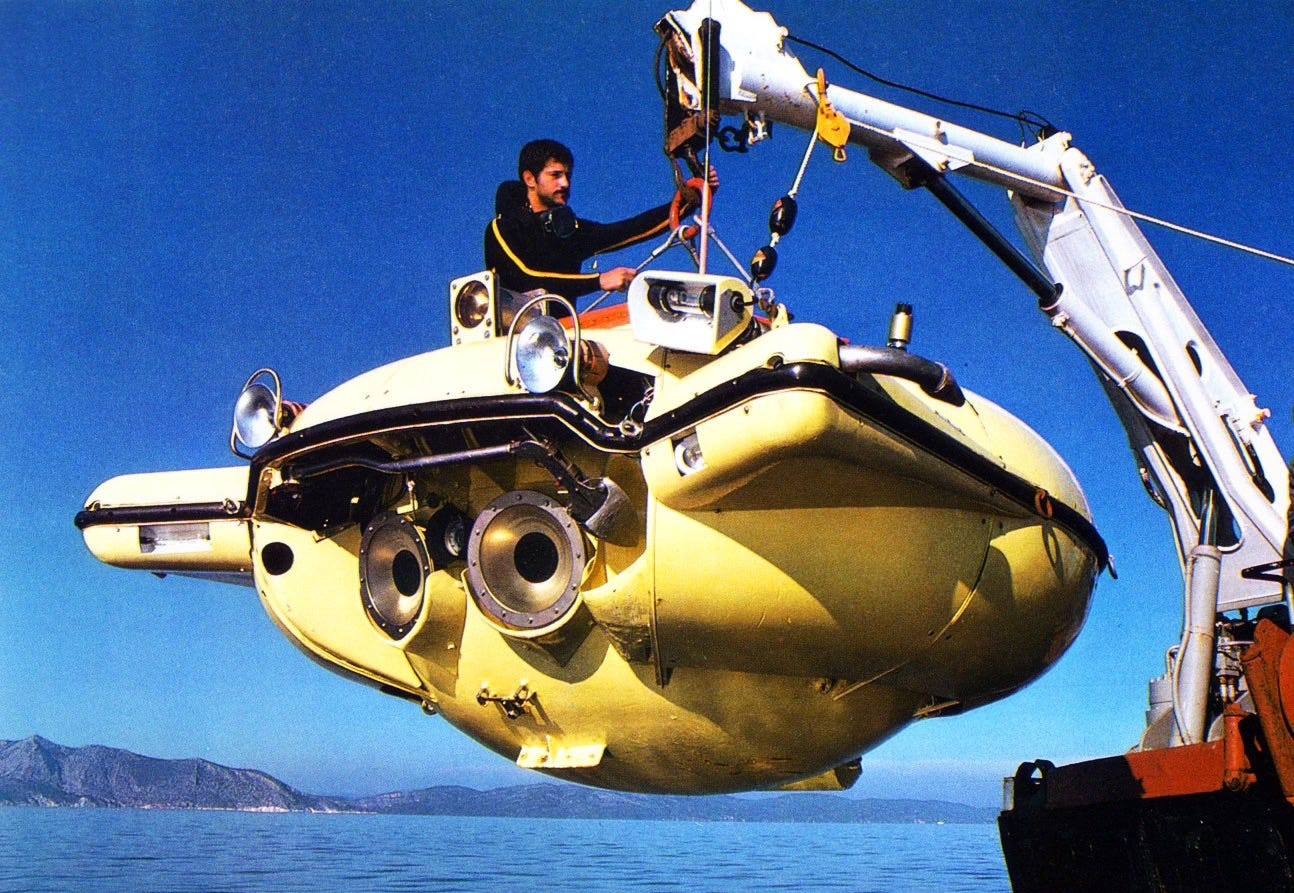
At this time, they were persuaded to hire a young diver whose left hand had been severely injured from an explosion while defusing a mine. Albert Falco remained with the Cousteaus for another 37 years until his retirement at the rank of ship’s captain, Chief Diver, and chief pilot of its famous submersible saucer Denise.3
The Shepherdess and the Fish-man
The Calypso was a magnet for celebrities. John Denver, a friend of Cousteau’s favorite son, Phillipe, had been invited to sail on her and began writing his famous song about her from the moment he stepped on board.4
Whilst she was everyone’s soft spot, Calypso was mainly a community of divers sustained by Simone Melchior, known as La Bergère , the shepherdess, and Albert Falco, a pioneering scuba diver who also sailed the ship and piloted the submersible for Cousteau. His diving skills were so impressive that he was called Fish-man by the ship's divers. La Bergerie not only planned voyages and kept morale high on board, but also battled bureaucracy, such as that with the French maritime administration, to have Falco recognized as captain of the ship and the submersible. At that time, Falco’s severe injuries to his left hand precluded his certification. Falco would go on to successfully captain the Calypso and pilot Denise for nearly four decades, embodying the operational soul of the Calypso. Later, Simone Melchoir was elected posthumously to the Women Divers Hall of Fame in 2013. She had died from cancer in 1990.
Together, La Bergère and the Fish-man reveal the ship’s authentic architecture of authority: Simone as its shepherd, Falco as its day-to-day helmsman, and Jacques-Yves Cousteau as the figurehead. Their partnership ensured that the Calypso was not just a vessel of exploration but a floating world, one whose spirit now haunts us in its silence.
The Forgotten Mousquemers
At Calypso’s beginning, the ship’s chief diver was Frédéric Dumas, one of the original three ‘mousquemers’ — the musketeers of the sea — who, with Cousteau and naval officer Philippe Taillez, pioneered compressed‑air diving using regulator valves and cylinders. Dumas co‑authored The Silent World with Cousteau, but the two later parted ways: Cousteau pursued cinema, while Dumas laid the foundations of modern scuba technique. Taillez remained in the French Navy, developing diving doctrine and retiring as an admiral. Their contributions were equal in stature to Cousteau’s, yet history has largely forgotten them, just as Louis Malle’s role in shaping The Silent World is often overlooked. Cousteau himself did little to correct this imbalance, and the myth of the solitary genius grew at the expense of his collaborators.”
L’Palme d’Or
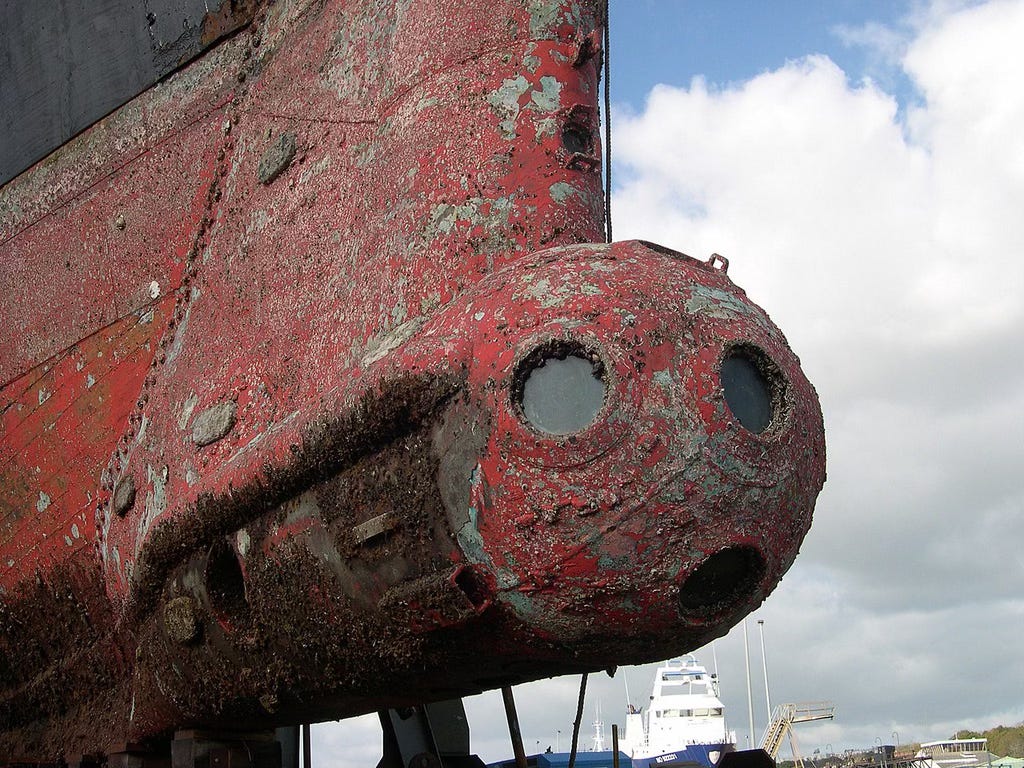
For over 40 years (1950–1997), Calypso served as the mothership for Cousteau's captivating and internationally popular movies and TV series. The vessel was equipped with mini-submarines now known as submersibles, a wide range of innovative diver and underwater cinematographic equipment, and a helicopter pad, supported by a Catalina flying boat. Her most famous physical modification was the initial addition of a “false nose,” an underwater observation chamber fitted on her bow with eight portholes that offered unprecedented direct views of the marine environment. 5
The Calypso carried Cousteau’s team across the globe, inspiring the world to fall in love with the ocean. She embarked on expeditions to the Red Sea, travelled up the Amazon River, surveyed the Persian Gulf, and explored Antarctica and the Indian Ocean. Aboard her, Cousteau tested innovative housings for cine and still cameras and lighting that allowed the colors that otherwise look dull in natural light to appear entrancing on film. These breakthroughs, while not exclusive to Cousteau, allowed the making of the cinematic legacy that includes Le Monde du Silence (The Silent World), which won both the Palme d’Or and an Academy Award. To make this documentary, Cousteau had persuaded rising star Louis Malle to direct.6
The results were dramatic and novel: with Louis Malle’s talented direction, the Calypso divers’ camerawork, the movie became the first documentary to win the Palme d’Or at the Cannes Film Festival in 1956, and later won an Academy Award. Years later, the methods behind these triumphs were found to have been unethical in their treatment of marine life. Scenes staged or manipulated for cinematic effect cast an indelible shadow over Cousteau’s documentaries, raising questions that continue to complicate his legacy to this day.7 It is here, in the tension between innovation and ethics, that the next chapter of Calypso’s story begins.
A Not So Silent World
By the early 1970s, Cousteau’s ventures had grown from equipment royalties and television documentaries into the creation of the Cousteau Society in 1973 — an institution that, upon his death in 1996, passed exclusively to his second wife, Francine Triplet, igniting a furious struggle within the Cousteau family over his legacy that was to last over a decade. A period during which Calypso literally rotted into dilapidation. The disputes between Triplet, Cousteau’s mistress, with whom he fathered two children and married after the death from cancer in 1990, of Simone Melchior, were present at his funeral at Notre Dame Cathedral. A nationally televised event in France, packed with dignitaries, including President Pompidou, but only representatives of his second marriage.
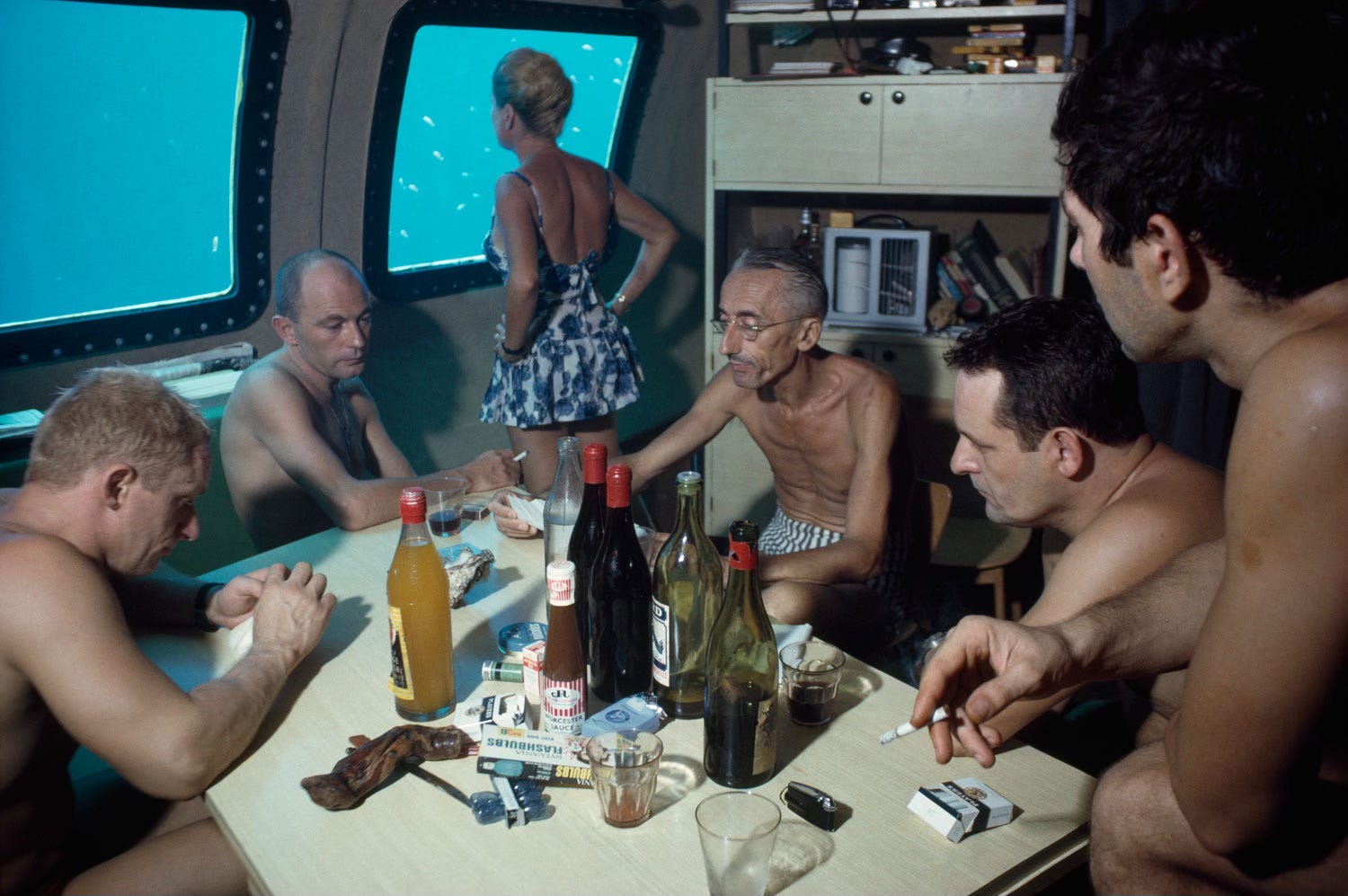
The Calypso became a powerful and beneficent symbol of ocean conservation and remains an endearing memory for millions who watched her voyages on TV. However, in the wake of Cousteau’s death in 1997, several sources extensively detail the alleged routine, unethical treatment of marine life during filmmaking, creating such controversy that Le Monde du Silence cannot be screened for present-day audiences. Other instances, such as the use of trained multiple sea lions to represent a single animal, natural ones in the wild, together with their negligent treatment on board the Calypso, are amongst several instances of mistreatment of marine life that forced the National Geographic magazine to withdraw its sponsorship of his TV series.
If Calypso was the prototype — a wooden minesweeper transformed into an integrated platform of sea, sky, and sub‑sea exploration — then today’s oceanographic fleet is her descendant. What began as an ad hoc improvisation has evolved into vessels that seamlessly combine diver decompression and medical suites, advanced laboratories, submersibles, remotely operated vehicles, and aerial drones. From the sleek OceanXplorer to China’s deep‑diving Fendouzhe, these craft embody the evolution of Calypso’s vision: surface, sub‑surface, and air working together to probe the ocean’s mysteries. Future issues of Ariadne will investigate the scientific, technological, and policy challenges at the heart of keeping the planet’s pumping heart safe and healthy.
Establishing the Cousteau Society to protect the oceans attracted wide attention, with its membership peaking at around 300,000. What followed Cousteau’s passing, in 1996, however, was a painful and public family dispute over Cousteau’s estate and ownership of the ship.
The vessel’s active life had already ended abruptly when she was accidentally rammed by a barge while docked in Singapore harbor on January 8, 1996. However, she was successfully raised a couple of weeks later, though the damage to the wooden hull was severe. Calypso had arrived in Singapore in 1994 after completing a research and filming mission in China and Vietnam, including work along the Yangtze and Mekong Delta. She remained in the harbor for refitting and preparation for a new expedition. Cousteau was in ill health and died on June 25, 1997, in Paris at the age of 87. He wrote of his hopes for the restoration of the ship that made him famous, requesting shortly before his death that: “I want Calypso to remain at the service of science and education.”
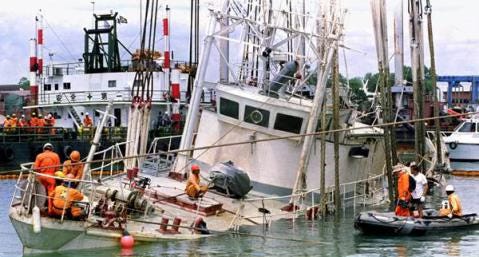
Who Owns Calypso?: A Family Feud
After Cousteau died in June 1996, the question of who owned Calypso ignited a bitter feud between Francine Triplet and Jean‑Michel Cousteau, his son from his first marriage. Jean-Michel had a problematic relationship with his father, beginning with his younger brother, Philippe, being chosen as the successor to the entire enterprise. When Phillipe died in a plane crash in 1979, it is known that the effect on the father was devastating—a period described by Cousteau’s biographer Bernard Violet as Mort d’un Dauphin.8 The dispute between Francine Triplet and Jean-Michel played out in French courts and in full public view, entangling the ship’s fate for decades. Pursuit of the fulfillment of Cousteau’s last wish began a tedious, drawn-out saga of litigation and internal family disputes. After being transported back to France, the Calypso was first housed in La Rochelle, intended as an exhibit at its maritime museum. A significant point of contention arose between Cousteau’s widow, who controlled the Cousteau Society, and his family from his first marriage. Cousteau’s granddaughter, Alexandra Cousteau, and her brother Phillipe Jr (children of Cousteau’s second son, Philippe) tried to help with the restoration. Still, Francine Triplet, as head of the Cousteau Society, reportedly spent hundreds of thousands of dollars defending her exclusive use of the name and thus preventing Alexandra’s involvement. During this contentious time, it emerged that the rightful owner of the ship was the son of Lord Guinness, who had inherited the 1 Franc-per-year lease from his father. Alexandra Cousteau had worked to create a group of former Calypso divers to purchase the ship from Lord Guinness (the grandson of the peer who bought Calypso for the Cousteaus. Still, they were unable to raise sufficient funds to ensure its restoration. Consequently, Guinness transferred ownership to Francine Triplet for an undisclosed sum. The amount is presumed to be 1 Euro because the ship was an enormous liability. As a result, Triplet would not agree to any urgent restoration work on the ship while these complex matters were being settled.
The restoration attempt in France quickly became a sad story of decay. In 2007, the vessel was moved from La Rochelle, where she was no longer welcome, to the Piriou Shipyard in Concarneau, but work halted in 2009 due to another legal deadlock. The shipyard sued, claiming Francine Cousteau owed hundreds of thousands of euros (€850,000), while the Cousteau Society counter-sued, citing poor workmanship. Frustration was palpable; one museum director noted in 2003 that, given the ship's sad condition, he would prefer to see the vessel scuttled than accept it back at the La Rochelle maritime museum.
The ship’s legacy is far broader: it belongs to everyone now, not just an object of French maritime history. Calypso has captured hearts worldwide — so much so that record-breaking American astronaut Sunita Williams named her NASA Starliner Calypso, honoring the vessel that first nurtured her dream of exploration.
A Shared Treasure For Millions
Calypso's living compass, Albert Falco, following years of neglect of his beloved ship during the legal battle over ownership, by the time of the final settlement in 2006, when she was taken to La Rochelle to be restored as part of the maritime museum, saw that the ship was in desperate condition. Hence his now-famous lament: “Everything that’s not broken is rotten, and everything that’s not rotten is broken.” Later, Falco recounted his experiences as Captain of the ship in his posthumously published biography. It is too frequently an overlooked account of the boat and the Fish-man that made her tick.9
Understanding why the Calypso languished to the point of being beyond restoration requires knowledge of the tangled web of organizations claiming pieces of Cousteau’s legacy. The Cousteau Society, the nonprofit organization founded for ocean conservation and education based in the United States, became the legal custodian of Calypso after Cousteau died in 1996. Controlled by Francine Triplet, Cousteau’s second wife, the Society’s communications devolved largely into fundraising appeals with little operational detail about the ship’s actual restoration. Meanwhile, the separate Cousteau Foundation handled agreements with museums—including a 2019 arrangement with Malta’s Maritime Museum in Birgu to display a decayed hull rib from Calypso—and oversaw intellectual property and some vessel holdings.
Adding to the complexity, Jean-Michel Cousteau, Jacques’s son from his first marriage, had created his own Ocean Futures Society, focused on education, documentaries, and advocacy, but with no legal connection to Calypso itself. The organization’s very existence reflected the bitter family split, with Francine controlling the Society and the ship, while Jean-Michel built his conservation work independently.
If Calypso was the prototype — a wooden minesweeper transformed into an integrated platform of sea, sky, and sub‑sea exploration — then today’s oceanographic fleet is her descendant. What began as an ad hoc improvisation has evolved into vessels that seamlessly combine diver decompression and medical suites, advanced laboratories, submersibles, remotely operated vehicles, and aerial drones. From the sleek OceanXplorer to China’s deep‑diving Fendouzhe, these craft embody the evolution of Calypso’s vision: surface, sub‑surface, and air working together to probe the ocean’s mysteries.
Future issues of Ariadne will investigate the scientific, technological, and policy challenges at the heart of keeping the planet’s pumping heart safe and healthy.
The ship’s legacy, however, proved far broader than any single organization could contain. It’s part of the world’s cultural heritage now—an artifact of maritime history that has captured hearts worldwide. Astronaut Sunita Williams demonstrated this when she named her NASA Starliner Calypso, in honor of the vessel.
The legal impasse was finally broken by a French court order in 2015, forcing the vessel’s removal from Concarneau. Francine Cousteau remained adamant that, per Jacques Cousteau’s wishes, the Calypso must be fully seaworthy, not merely a static museum exhibit as had originally been planned at the time of her move from Singapore to La Rochelle. This commitment to operational status raised serious concerns, as almost nothing of the original ship would remain after an extensive refit sufficient to return her to seaworthiness. Adding to the sadness, souvenir hunters had raided the boat during her years in legal limbo—even her name plaque was stolen.
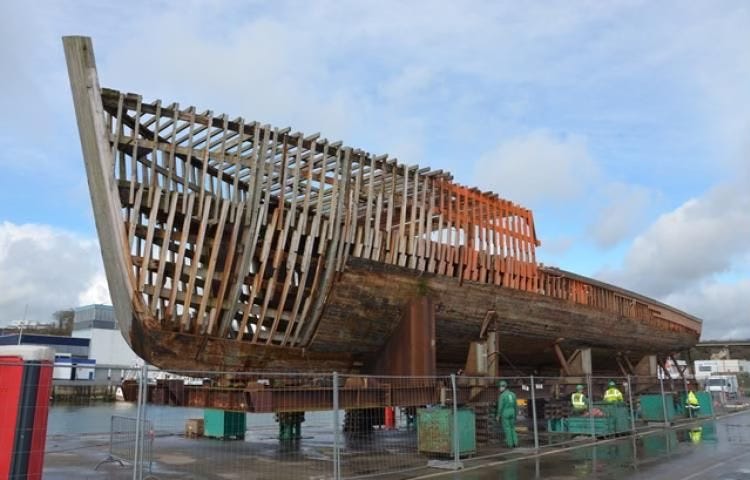
The Longest Refit
Two Volvo Penta D16 marine engines were purchased in 2009 for the ship’s refit. They were new models at the time of purchase, as Volvo Penta only released the D16 for marine use in 2005, following the Volvo Group’s original launch of the D16 in 2004.
After the Calypso was moved from La Rochelle to a shipyard in Concarneau, France, in 2013, complete dismantling and hull repairs began. She was then transferred to a shipyard in Turkey in 2016 for the main restoration work on the wooden hull. But tragically, a fire at the Turkish shipyard in 2017 caused extensive damage to the hull, leading to further delays and more extensive repairs. She was moved to a different yard in Turkey - Fryco's Istanbul shipyard in 2019.
The restoration project focuses on structural reconstruction and historical authenticity, even though very little of the original ship remains. Initially projected to take about 2 years, the deteriorated state of the wooden hull, combined with the 2017 fire damage, significantly extended the timeline. The engines purchased in 2009 remain in storage, awaiting installation when the ship is finally ready for sea.
Since 2019, only two updates have suggested Calypso might sail again. Yet the scale of work required—installing engines, propellers, and shafts; rebuilding the superstructure (some of these components are reportedly stored in Norfolk, Virginia); and fitting modern navigation, electrical, and fire control systems along with a fully equipped laboratory—suggests completion remains some way off. Neither the Cousteau Society nor the shipyard has issued progress updates for the past 6 years.10
Despite the ongoing restoration and uncertainty surrounding her completion date, Calypso’s real fate lies in her indelible place in popular culture. She is formally recognized in France as a “Boat of Heritage Interest.” Her legacy is celebrated not just by sailors and scientists but by artists and explorers. Whether she sets sail again in 2026, remains dry-docked, or her condition remains uncertain, the Calypso lives forever as a worldwide symbol of ocean exploration and environmental protection—a ghost ship perhaps of discovery never to be forgotten, even if never seen again at sea.
© 2025 Farooq Hussain
The name “Calypso” did not originate with Jacques‑Yves Cousteau. The vessel was purchased from the Royal Navy by Maltese ferry operator Joseph Gasan in 1949 and renamed Calypso‑G for its short service ferrying passengers between Malta and Gozo. The choice reflected Gozo’s association with Homer’s Ogygia, where the nymph Calypso detained Odysseus. Cousteau inherited the name when he leased the ship in 1950, and it was only later that the vessel became synonymous with his oceanographic work. Misattribution of the name to Cousteau persists, but the ship’s mythic resonance predates his involvement.
Built in 1942 at the Ballard shipyards in Seattle, Washington, as HMS J‑826, the vessel’s unlikely journey carried her from the Pacific Northwest to Malta, where she was rechristened Calypso-G by Joseph Gasan for service between Malta and Gozo — the island long identified with Homer’s Ogygia. It was from Malta that Jacques‑Yves Cousteau acquired her in 1950, transforming the minesweeper into his legendary research ship. In 2019, the Cousteau Foundation signed an agreement with the Maritime Museum of Malta in Birgu to display a decayed hull rib and other artifacts, symbolically returning Calypso to the island of her naming. The museum’s renovation, initially slated for 2025, has been delayed due to funding constraints.
The One-Franc Curse: How a Generous Gesture Became a Legal Nightmare
Francine Triplet, Jacques Cousteau’s longtime mistress, whom he married in 1990 after Simone’s death, had a rude awakening after he died in 1997. More than three decades younger than Cousteau, she inherited the rights to hundreds of films and images, control over the Cousteau Society, and the business operations of Équipe Cousteau. What she did not inherit was the Calypso itself—because Jacques Cousteau had never owned it.
It turned out that some 50 years earlier, Thomas Loel Guinness, scion of the Irish brewing family, had purchased the vessel and leased it to Cousteau for the nominal sum of one franc per year, with the stipulation that his identity remain secret. This generous arrangement, which made Cousteau’s career possible, now created a legal quagmire.
In the early 2000s, after nine months of negotiation, the Guinness family reached an undisclosed agreement to transfer ownership to Francine’s French entity, Équipe Cousteau. But when her ownership was challenged by the Campagne Océanographique Français (COF), headed by Jean-Michel Cousteau—the commander’s son from his first marriage—the case wound its way from local courts in La Rochelle to the Paris Appeals Court, which in March 2006 ruled in Francine’s favor.
Yet owning the Calypso didn’t resolve the fundamental question: what to do with it? Plans to convert the ship into an oceanographic museum in La Rochelle were abandoned due to financial constraints. In 2007, Francine announced plans to transform Calypso into a scientific education center in the Bahamas. Jean-Michel’s COF moved to block this, arguing the vessel should remain in France. “This is a historic vessel that should have been classified as part of the French national heritage a long time ago,” Jean-Michel told the Cyber Diver News Network.
The claim about returning to sea was about as seaworthy as the Calypso itself. A maritime official in La Rochelle was blunt: “We had an expert’s report done recently, and they said it was no longer a question of repairing the boat, but rebuilding it.”
Whether Francine had the resources for such an undertaking was unclear. The Cousteau Society, which once boasted 250,000 to 300,000 members in the United States alone, saw membership decline to around 150,000 by 2007-2008 and now stands at approximately 30,000.
The Final Irony
The legal victory proved pyrrhic. Francine’s control extends beyond the ship to the Cousteau name itself, which she guards fiercely. Jean-Michel’s children, Céline and Fabien, along with Philippe Jr.’s children, Alexandra and Philippe, and Francine’s own children, Pierre-Yves and Diane—all of whom have chosen ocean-related careers in the manner of their father or grandfather—cannot use their own family name without her consent, which she does not give.
Further complicating matters, French and American inheritance laws diverge on critical aspects of how Cousteau’s estate can be settled. Simone Melchior’s children and grandchildren argued that Cousteau became an international celebrity primarily through the United States and was not particularly well recognized in France beforehand. But this argument did not affect the legal outcome.
The result is a bitter stalemate. Francine’s Cousteau Society lacks the financial resources to restore Calypso. The ship cannot be saved as a piece of French national heritage—it was never officially classified as such. Nor can it be saved as the instantly recognizable icon of global popular culture it became. The very control that was fought over so bitterly has ensured that no one can marshal the resources needed for restoration.
The one-franc lease that launched a legend became its curse. Guinness’s generous gesture, designed to free Cousteau from financial burdens, ultimately trapped the vessel in decades of legal disputes. At the same time, it rotted away—a phantom ship caught between competing heirs, none of whom could save it, and one of whom could prevent all the others from trying.
Albert Falco, quote about the dismal condition of the Calypso in 2007
John Denver wrote his 1975 hit song “Calypso” as a tribute, donating the copyright income to the Cousteau Society. YouTube
The false nose attached to the bow of the ship was created to house an all-around underwater view from the bow of Calypso. This view was used extensively to film the shark feeding frenzy on the carcass of a young whale that had been rammed by the Calypso and killed for the purpose. One scene depicts the Calypso crew, after killing a baby whale with the ship’s propeller (which was struck while Cousteau steered into a pod for close-up footage), a large group of sharks that were drawn to the injured whale’s blood.
Jacques‑Yves Cousteau persuaded the young filmmaker Louis Malle (then 23) to co‑direct Le Monde du silence (The Silent World, 1956), the first documentary to win the Palme d’Or at Cannes and later the Academy Award for Best Documentary. Cousteau provided the expeditions, storyline, and underwater footage. At the same time, Malle shaped the film in the studio through editing and narrative construction — he later remarked that he never entered the water himself. Their collaboration was brief; Malle did not work with Cousteau again, and in later years recalled not having seen him since the film’s release. The documentary’s pioneering use of underwater color cinematography was groundbreaking, but its methods — including staged scenes and the controversial treatment of marine life — have since drawn criticism, complicating Cousteau’s legacy. Yet the film remains a milestone in both cinema and oceanography, emblematic of the tension between innovation and ethics that runs through Calypso’s story.
The techniques used in the making of Jacques Cousteau’s 1956 film, Le Monde du Silence (The Silent World), co-directed with Louis Malle, drew significant criticism later in his life, primarily concerning the treatment of marine life and the authenticity of the documentary narrative. Cousteau himself later adopted a more explicit conservationist stance.
The main points of controversy in the film’s production techniques include:
Mistreatment and Killing of Marine Life: The most criticized scenes involve the deliberate harm to animals.
Shark Massacre: One scene depicts the Calypso crew fatally injuring a baby whale with the ship’s propeller as a result of Cousteau steering into a pod. A large group of sharks was drawn to the newly killed baby whale’s blood, and the feeding frenzy that resulted was filmed by divers in submerged cages for safety.
Dynamiting a Reef: Another criticized technique was the use of dynamite near a coral reef to kill fish, allowing the crew to conduct a more “complete census” of the marine life in the vicinity by collecting the carcasses.
Harpooning Fish: The film also included scenes of harpooning fish.
Fictionalization/Staging: Some critics also questioned the authenticity and staging of certain scenes, suggesting that elements were recreated or edited to create a more thrilling, anthropomorphic storyline, reportedly under pressure from Hollywood distributors. Cousteau himself is quoted as having said the film was “a scripted film.”
While Le Monde du Silence was a pioneering work in underwater cinematography—being one of the first films to show the ocean depths in color—and helped popularize the underwater world, the techniques used reflect a time with a very different view of wildlife conservation and documentary ethics.
Cousteau’s reputation as a cinematographer is inseparable from the films that brought the ocean to millions, even though the methods used in works such as Le Monde du silence (The Silent World, 1956) — the first documentary to win the Palme d’Or at Cannes and later an Academy Award — have permanently tarnished his legacy to the extent that the film is rarely screened today. The resonance of his imagery continues in later cultural tributes: Wes Anderson’s The Life Aquatic with Steve Zissou (2004), for which Anderson purchased a ship identical to Calypso and renamed it Belafonte after the calypso singer Harry Belafonte; Jérôme Salle’s L’Odyssée (The Odyssey, 2016), a dramatization of Cousteau’s life; and National Geographic’s Becoming Cousteau (2021), a documentary that revisits his career with fresh perspective. Beyond these, YouTube hosts a wide array of archival and derivative material on Calypso and Cousteau, of uneven quality but significant for understanding how his cinematic vision continues to circulate in popular culture.
Violet, Bernard, Cousteau, une biographie, Fayard, 1993. Violet’s book remains the main biographical work on Cousteau, researched in detail by an experienced investigative reporter.
Albert Falco (1927–2012) Capitaine de La Calypso, published posthumously in 2013 and later in English with the title Calypso: Captain Cousteau’s Diver and Friend. Calypso’s longtime chief diver, captain, and chief pilot of its submersible was often imagined returning to assess the vessel after her 1996 sinking — a rumor born of his deep association with the ship. However, no evidence confirms he was formally dispatched. Falco’s reflection on his life and experiences on board the boat he is associated with from its very beginning with the Cousteaus is preserved in his memoir, published posthumously in 2013, which is not a tell‑all about Cousteau but a lyrical account of his own life at sea and the ship that defined it.
At age 18, on 9 May 1946, Falco suffered a severe injury while assisting deminers in Sormiou, near Marseilles, to clear World War II explosives. A pen-shaped device detonated, severing four finger segments on his left hand. This injury later complicated his pursuit of formal maritime credentials, but did not deter his diving career, as he adapted with remarkable resilience.
Falco’s hand injury initially barred him from formal maritime command under French regulations. In 1984, after advocacy from Simone Cousteau, he gained ship and submarine certification, assuming captaincy on 20 September 1984 in Norfolk, Virginia. Leading the Rediscovery of the World expedition, Falco oversaw the Calypso's 1984 refit in Florida, retiring in 1990 after 37 years aboard.
As Chief Pilot of the SP-350submersible (“Denise”), Falco conducted over 300 dives in the 1960s across North America, the Antilles, and Cape Verde, advancing Cousteau’s deep-sea research. His technical expertise and on-screen presence made him a cornerstone of the team’s operations.
The Calypso’s hull was last confirmed at FryCo Yachts in Istanbul, under the coordination of America’s Cup sailor Patrice Quesnel. Yet since 2021, no fresh word has emerged — not from Quesnel, not from Fry, and not from the Cousteau Society, whose newsletters remain focused on fundraising rather than updates. The ship’s fate now drifts in obscurity, suspended between rumor and reality, as if the vessel itself has become a ghost of maritime bureaucracy.
An unusual volume titled Calypso, credited to Jacques‑Yves Cousteau, offers one of the most detailed accounts of the ship’s voyages and the technical modifications that transformed her from a wartime minesweeper into a research vessel. Lavishly illustrated, it functions as both a narrative and a design record, with schematics and descriptions so precise that model makers continue to rely on it decades after publication. Though produced in the style of a coffee‑table book, it remains out of print and difficult to obtain, and it is unclear whether a French edition was ever issued. As such, the book stands as a rare artifact of Cousteau’s dual identity as explorer and cinematographer — a tribute to Calypso not only as a symbol but as a meticulously engineered platform for discovery.
Cousteau, Jacques‑Yves, and A. Sivirine. Jacques Cousteau’s Calypso. Harry N. Abrams, Inc./Brown & Bigelow, 1983.
The author reached out to the Cousteau Society, Patrice Quinell, the Admiral’s Cup yachtsman who is the named coordinator of the Calypso restoration project, and Ed Fry, at whose Istanbul shipyard the Calypso's hull is believed to be located. They have not responded by the time of this publication.
Once a beloved French symbol, a ship now rusts into oblivion, New York Times, June 28, 2015; Calypso FAQs Cousteau Society; RV Calypso, Military History Fandom
Author’s note: I’ve tried to recount the story of Calypso as accurately as possible but I would have liked to have found more information for the period from Calypso’s arrival at La Rochelle to the present. There has been no official release regarding it's status from either the Cousteau Society of the Fryco Shipyard so it's can only guessed that following the fire litigation. Is preventing the release of information. I’ll continue to look for answers for the whereabouts of the ships parts and for any planned resolution to her fate.
Fascinating read!
An amazing article indeed, thanks and congrats for it! However, I must take issue with the continued "politically correct" attacks on Cousteau and his legacy based on the perceived "ethical issues" related to his manipulation of marine animals for his filming. Trying to measure a deceased person who lived and worked in the past with current morals and perceptions is never fair, much less in this case.
Cousteau has brought awareness about the Ocean and its conservation needs for hundreds of millions of people around the globe, and inspired millions to take up careers in Ocean science and conservation. There's no "dichotomy" in that: his legacy is immensely positive and all the yapping about what he did in the 1950's and 60's with precious few animals to achieve these results is, in most cases, just preposterous holier-than-thou yapping.