
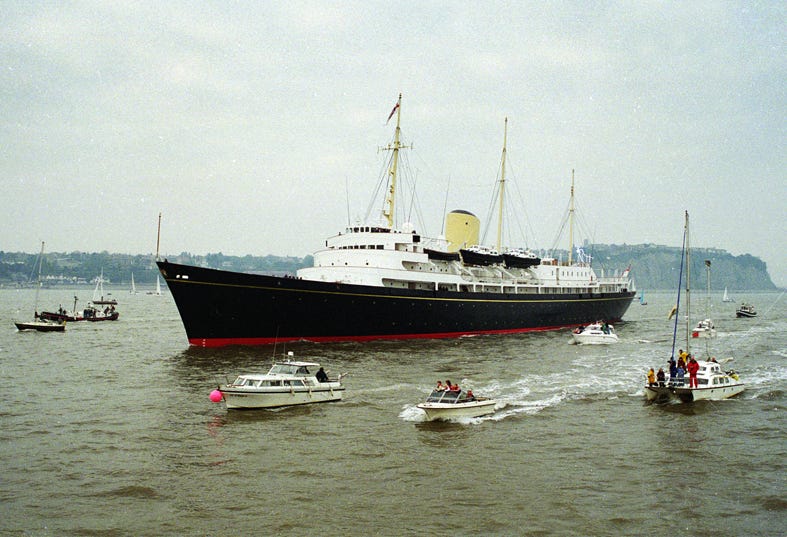
The Royal Yacht Britannia was Queen Elizabeth II’s favorite retreat from the world — a floating palace kept in service long past her time, until she was finally decommissioned on 20 October 1997. That day, the clocks aboard were stopped at 15:01, memorializing the moment Her Majesty was piped ashore for the last time. Britannia’s farewell voyage left Portsmouth harbor on a clockwise circumnavigation of Britain, calling at six major ports including Glasgow, where she had been built. As she passed the John Brown shipyard, she gave a last long blast on her sirens — a nautical taps.
It was a sad day for the Queen and Prince Philip. A year earlier, Prime Minister John Major had notified them that the nation could no longer afford the £250 million refit and that the monarchy would henceforth manage without a personal yacht. In bidding farewell to a ship that had served them for over forty years, the Queen publicly shed a tear as the Royal Marines band played the lament Highland Cathedral on the bagpipes.
Over four decades, Britannia had logged more than a million nautical miles. Since 1998, she has been permanently moored at the Port of Leith in Edinburgh, drawing roughly 300,000 visitors annually — a figure that, remarkably, exceeds the annual number of tourists to the very Galápagos Islands she once visited on one of her more consequential diplomatic voyages.
Are They Enchanted or Bewitched?
This remote, uninhabited, inhospitable archipelago had earned a prominent place in the public imagination long before diplomats arrived to protect it. Its first champion was not a scientist but a literary giant, Herman Melville. His visit to the islands aboard the whaler Acushnet followed Darwin by just six years, and his series of ten articles — The Encantadas, or Enchanted Isles — appeared in Putnam’s Magazine in 1854, reaching a vast popular readership. Melville used encantadas to mean bewitched rather than charming. The only superlative visiting sailors held for the place was for the tortoises, which required neither food nor water for up to a year and could be stacked alive in a ship’s hold and consumed at leisure on long voyages. Taken in their tens of thousands, several of the fifteen distinct species unique to the islands were driven to extinction. Melville described the archipelago itself as:
“Take five-and-twenty heaps of cinders dumped here and there in an outside city lot; imagine some of them magnified into mountains, and the vacant lot the sea; and you will have a fit idea of the general aspect of the Encantadas.”
After the whalers came the yachts. William Beebe of the New York Zoological Society arrived in 1923 aboard a leased Roosevelt vessel, combining scientific inquiry with wealthy socialite passengers. His book Galápagos: World’s End was an immediate international bestseller, and the beautifully illustrated early editions are prized today. Beebe was the first to observe the underwater life of the islands using a hard-hat diving suit — a foretaste of the marine biology that would later define the archipelago’s scientific reputation.1
Today, it’s often neglected that the surge of scientific interest in the Galapagos Islands did not follow Charles Darwin, but rather that the most important specimen collection and research followed the interest of a wealthy American who, in the case of Californian George Alan Hancock, sailed routine scientific expeditions to the archipelago during the first half of the 20th century. Also, the association of the beak of the island’s unique finches with adaptation as the mechanism of evolution by natural selection was made by Lark in 1947 in his historic work “Darwin’s Finches.” Thus, by the time of the internationally celebrated Darwin centennial in 1959, a popular misconception held that Darwin had arrived in the Galápagos and had been inspired by the shape of the Finches’ beaks, providing the clue he needed to substantiate his yet-to-be-formed theory.
Contrary to the popular narrative, Darwin did not specifically identify these birds as unique to his theory during his actual visit; rather, they were later identified and given his name to represent the findings. Darwin’s finches were so named to highlight the birds’ key role in providing confirming evidence supporting the theory of evolution by natural selection. While the term was coined by ornithologist Percy Lowe in 1936, it was popularized by David Lack’s 1947 book, Darwin’s Finches, which highlighted their varied beak adaptations.
Darwin himself had visited just four of the archipelago’s islands over five weeks in 1835, his collecting hurried and often delegated to sailors. The significance of the finches — their specialized beaks adapted to distinct food sources on distinct islands — would not become apparent until after his return to England, and even then only partially, because island-of-origin records had not been carefully kept. The birds he collected were so various in appearance that he initially classified them as a mix of blackbirds, grosbeaks, and finches. It was the ornithologist John Gould who, examining Darwin’s specimens in 1837, recognized them as twelve closely related new species all descended from a common ancestor. Perhaps somewhat ironically, Lack’s research was conducted not with specimen birds collected by the HMS Beagle, but from the extensive and meticulously catalogued collection of the California Academy of Sciences. He had visited the Galapagos independently on commercial cruise ships using his own collection and that of the CAS to complete his study.2 Lack’s study formed the jumping-off point for the most important modern work on these birds, described in Jonathan Weiner’s The Beak of the Finch.3
And in a final twist, as modern taxonomy has it, these tiny, fragile birds are no longer considered relatives of finches. Today, there is no conclusive evidence of the first finches’ appearance on the Galapagos Islands. In the absence of fossil or other evidence, it seems most likely that their origin is equally likely to be South America or the Caribbean.
The Three Bird Men
So how did this remote, ash-heap archipelago become a shrine to Darwin and natural selection? One answer lies in the passion of three pre-eminent British birders and a set of circumstances — some accidental, some engineered — that focused the world’s attention on the islands at a critical moment.
Sir Peter Scott was the son of the ill-fated Antarctic explorer Robert Falcon Scott. Where his father had lost the race to the South Pole and paid for it with his life, the son built a different kind of legacy — as an artist, broadcaster, and conservationist. His popular BBC birdwatching program Look made wildlife observation a household activity in postwar Britain. Knighted for his contributions to conservation, Scott co-founded the World Wildlife Fund and brought a rare combination of public reach and scientific credibility to whatever cause he championed.
Sir Julian Huxley was the grandson of Thomas Henry Huxley — “Darwin’s Bulldog,” who had famously debated Bishop Samuel Wilberforce in 1860. Sir Julian served as the first Director-General of UNESCO and possessed the institutional leverage to match his grandfather’s ferocity in debate. Prince Philip, for his part, was not merely lending the royal seal of approval to this cause. He was a serious naturalist and a committed birder, and his friendship with Scott gave the conservation campaign access to corridors of power that scientists, no matter how prominent, could not reach on their own.
Beginning in the late 1950s, this trio mounted a sustained lobbying effort — through UNESCO, the Ecuadorian government, and the international scientific community — to establish a protected national park and a dedicated research station in the Galápagos. The centenary of On the Origin of Species in 1959 provided the occasion. Ecuador declared the great majority of the islands a national park that year, and the Charles Darwin Foundation was established, leading to the opening of the Charles Darwin Research Station on Santa Cruz Island. In recognition of Prince Philip’s role, the dramatic cliffside steps providing access to the bird-rich island of Genovesa were renamed in his honor. Today, they are more commonly known by their original name, El Barranco, as the gesture's colonial associations have faded. But the naming was not an empty compliment — it marked a genuine diplomatic achievement in the closing chapter of British imperial influence.
What Conservation Actually Looks Like
The national park designation and research station were the beginning, not the end. Conservation in the Galápagos has never been a matter of drawing a boundary on a map and declaring the wildlife safe. It has been — and remains — a continuous, technically demanding, and sometimes brutal struggle against forces that no legislation can simply prohibit.
The most dramatic success story is also the one most visitors don’t hear about when they walk among the iguanas on Santa Cruz. The archipelago’s tortoise populations were decimated not only by sailors but by the animals those sailors left behind: feral goats, pigs, dogs, and rats, all of which preyed on eggs, hatchlings, and vegetation. Project Isabela, launched in 2001, became one of the most ambitious invasive species eradication programs ever attempted — systematically eliminating more than 140,000 feral goats from Isabela Island using aerial hunters and Judas goats fitted with radio transmitters to locate the last holdout groups. The vegetation recovered within a few years.
But the tortoise story goes deeper than eradication. The Floreana tortoise — the species Melville’s sailors ate with such enthusiasm — was declared functionally extinct in the wild. Then, in a discovery that reads like something from a detective novel, genetic analysis of tortoises living in the remote highlands of Volcán Wolf on Isabela revealed that some individuals carried significant Floreana tortoise ancestry. Sailors, it appears, had done what conservation scientists could not: they had accidentally transported surplus tortoises between islands by throwing them overboard because they may have taken too many on board, and the Floreana lineage had survived in a kind of genetic diaspora.
The Tortoise Restoration Program at the Giant Tortoise Restoration Initiative has since been selectively breeding these Volcán Wolf individuals to recover the Floreana genetic line — identifying animals with the highest proportion of Floreana ancestry, pairing them to concentrate the target genome across generations, and working toward a population that can eventually be reintroduced to Floreana itself. Last month, the first cohort of hybrid tortoises was reintroduced to Floreana Island in a ceremony that brought together Ecuadorian authorities, the Galápagos National Park, and the international conservation community. Visiting the Charles Darwin Foundation Research Center on Santa Cruz last month, I saw the hybrid breeding program, with pens of tortoises raised from eggs whose shells were carefully inscribed with data that would later be updated and transcribed onto the shells of the young hatchlings. This year, for the first time in a century, the Floriana tortoises were transported as treasure, carried on the backs of rangers and returned to GPS-mapped release points on the island in an event that would have been unthinkable a couple of decades ago
The invasive species challenge, however, extends well beyond the animals anyone would think to worry about. The European honeybee that was introduced to the Galapagos is not an obvious villain. Yet they have hybridized, spread throughout the archipelago, now compete with the islands’ native bee species, and are disrupting the pollination networks that native plants depend on. The damage is subtle, cumulative, and will be challenging to manage; it may never be completely reversed. Rats remain a persistent threat to ground-nesting birds, while great progress has been made on some islands, eradication efforts are ongoing. The parasitic fly Philornis downsi, accidentally introduced in the 1990s, lays its eggs in the nests of land birds; its larvae feed on nestlings, and it is currently devastating populations of several Darwin’s finch species — some of which are now critically endangered. Invasive plants — introduced guava, blackberry, and quinine tree — have transformed the vegetation structure of the highland zones, altering habitats for native species throughout the food web.
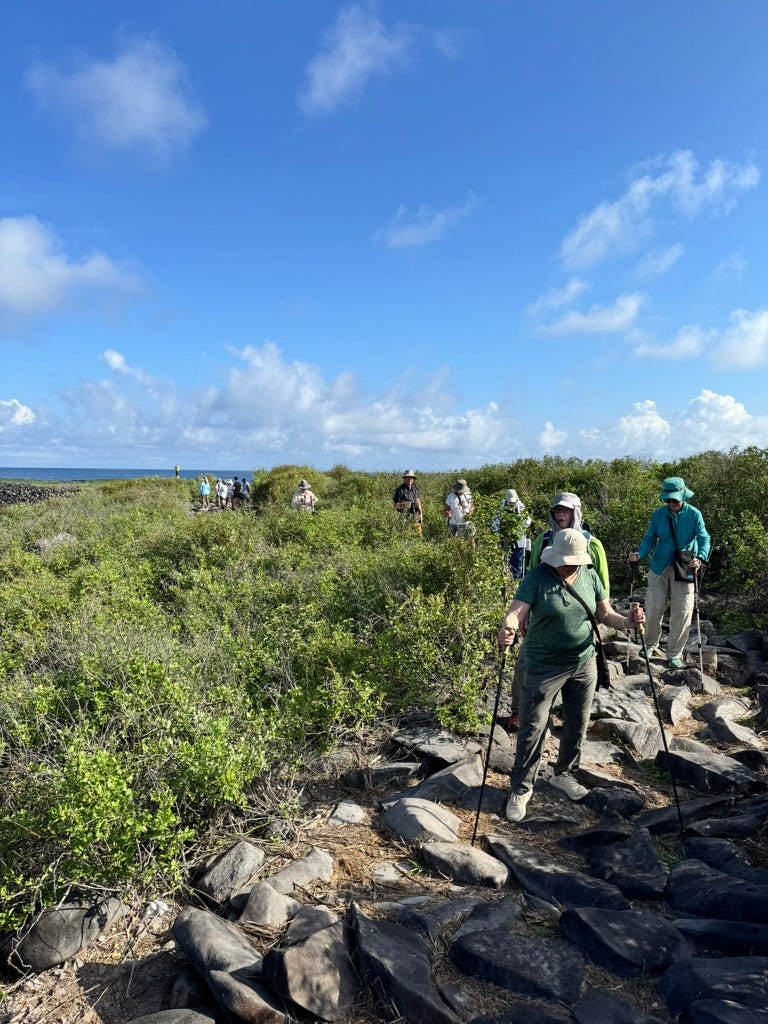
Tourism is not the enemy of this story, but it is a vector. Every flight, every arriving yacht, every piece of cargo is a potential introduction event. The management challenge is not to stop people from coming — the park’s income, and the livelihoods of the three inhabited islands, depend on visitors — but to ensure that the infrastructure of arrival and movement across the archipelago is tightly enough controlled to prevent the next Philornis from arriving unnoticed. That is harder than it sounds, and it requires sustained political will, funding, and international cooperation of the kind that Prince Philip, Peter Scott, and Julian Huxley had to argue for from scratch.
The El Barranco steps on Genovesa lead up to an island where a visitor today can stand surrounded by red-footed boobies, frigatebirds, and storm petrels in densities that exist almost nowhere else on earth. That experience is the direct product of sixty years of deliberate, difficult, and ongoing work. The tortoises being walked back onto Floreana are its most visible emblem.
Whether the native bees, the finches, and the vegetation will follow depends on choices being made right now — by park rangers, by invasive species teams, by researchers from across the world who apply each year to work on the islands’ most intractable problems, and by visitors who arrive as tourists and sometimes leave as something closer to volunteers. Conservation here is not a condition to be achieved but a practice to be sustained.
It helps that the Galápagos matter for reasons that extend beyond their famous birds and tortoises. The archipelago sits at the confluence of five major ocean currents — the Humboldt, the Cromwell, the Panama, and others — whose interactions create one of the most biologically productive marine environments on Earth. The deep-sea coral reefs nourished by these currents are among the most extensive in the Pacific. The islands are, in this sense, not just a living laboratory for evolutionary biology but a monitoring station for the health of the planet itself. Their geophysical position, as much as Darwin’s visit, justifies their status.
Kurt Vonnegut understood this intuitively, if darkly. The extravagant scientific cruises that had become a fixture of Galápagos tourism by the mid-twentieth century lodged in his imagination and eventually surfaced in his 1985 novel Galápagos — a sardonic meditation on human evolution in which the islands outlast a civilization that has destroyed itself, observed from the vantage point of a luxury cruise ship whose passengers become, against their will, the ancestors of the species that survives. It is not a cheerful book. But it is a serious one, and its premise — that the Galápagos might endure when everything else has not — says something about the hold the archipelago has on the human imagination.4
Today, the islands are encircled by one of the largest marine protected areas in the world, and cruises remain the most popular way to experience them. The most famous vessel ever to call here was, of course, HMS Beagle. But perhaps the Royal Yacht Britannia will be remembered for something equally consequential: that port of call in February 1964 that helped secure the archipelago’s future as a protected treasure of the world. The clocks on Britannia stopped at 15:01 on the day she was decommissioned. The work she made possible keeps on ticking.
© 2026 Farooq Hussain
This is the first in a series of Ariadane’s Dispatches related to the Galapagos Archipelago. Soon to follow are a detailed look at the species under threat, such as the Mangrove Finch, and another on the challenges ahead in maintaining one of the world's largest marine reserves.
earlier Ariadne’s Dispatches on closely related topics you may like:


Beebe, William. Galápagos: World's End. G.P. Putnam's Sons, 1924
Burnett, Thomas, David Lack: Evolutionary Biologist and Devout Christian, Biologos, on August 07, 2012
Weiner, Jonathan. The Beak of the Finch: A Story of Evolution in Our Time. 1st ed., Knopf, 1994
Vonnegut, Kurt. Galápagos. Dial Press Trade Paperbacks, 2009