

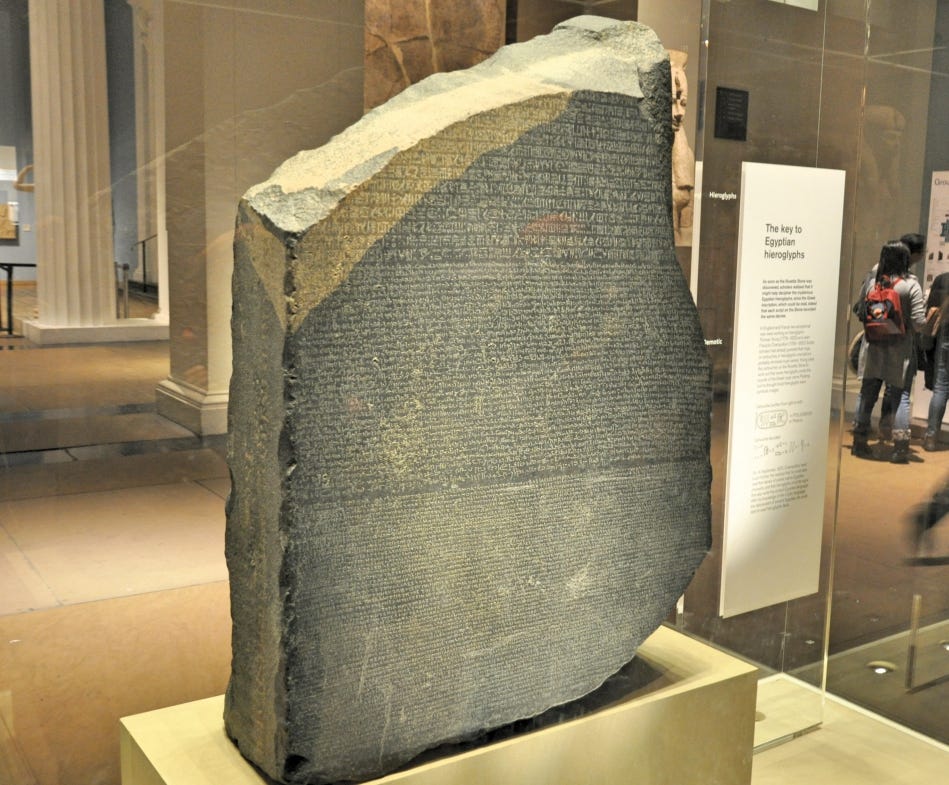
1. Was the Rosetta Stone legitimately taken by Britain as a spoil of war?
Yes, but it’s complicated. The stone was legally transferred to Britain under the Treaty of Alexandria (1801) after Napoleon's defeat (specifically the sinking of the French fleet by Nelson which left the French Army in Egypt stranded without any prospect of resupply).
The French discovered it, but neither the Ottoman authorities (Egypt wasn't an independent state at the time) nor the local populations had any involvement in or knowledge of its significance. Importantly, while the British insisted on taking the physical stone because its potential to unlock hieroglyphs was already recognized, they seemed to miss that you didn't actually need the stone itself—just accurate copies of the text. Multiple rubbings and casts had already been made, which proved sufficient for the eventual decipherment by French linguist Jean-François Champollion in 1822.
2. Did other artifacts contribute more to deciphering hieroglyphs than the Rosetta Stone?
Absolutely. The Bankes Obelisk (taken from Philae to Kingston Lacy, the stately home of William Bankes) was crucial in helping identify the cartouches of Cleopatra and Ptolemy, providing key phonetic elements that Champollion needed. Both Thomas Young and Jean-François Champollion used this information from the Philae Obelisk in their work. Critically, they were able to verify the cartouches for Ptolemy and Cleopatra on the Rosetta Stone. Various papyri, stelae, and temple inscriptions also contributed. Since the discovery of the original stela fragment, roughly twenty comparable stela fragments with proclamations inscribed in Hieroglyphs, Demotic, and Ancient Greek have been discovered, each significantly contributing to the improved knowledge of Hieroglphs. The Rosetta Stone's fame often overshadows the collaborative nature of the decipherment process.
About the author
The subject of this month's Ariadne and the author’s name might lead the reader to misplaced perceptions about who wrote it and why. To clear things up, I'm not an Egyptian.
Salman Rushdie, the author of Midnight's Children, the best-selling biographical novel about Indian Independence, was born some years before me, on Indian Independence Day. I was born years later, shortly after India's partition, in Hyderabad, home to the legendary Golconda diamond mines that produced the Kohinoor now embedded in the British Crown. The brainchild of Lord Mountbatten of Burma, this partition brought on enormous sectarian bloodshed. Thirty-two years later, the Earl himself was killed along with members of his family by Irish revolutionaries who blew up the boat on which the retired admiral was vacationing off the Irish coast with his grandson and family. Many sub-continental citizens still fondly remember King Charles III's favorite uncle; I'm not amongst them. Lady Mountbatten was in an affair with India's new Prime Minister and old Harrovian Jawaharlal Nehru, who, some say, influenced the partition's architecture. Though raised and partially imprinted British, European, I can never find a redeeming feature of colonialism that remotely counterbalances its negative consequences on global civilization. However, my views on the repatriation of museum artifacts are nuanced. I've cherished my visits to the museums of London, especially the British Museum and the Natural History Museum. As a boy, it never occurred to me that the acquisition process of the objects was a matter for any consideration. However, I now recognize that the treasures within have been the objects of theft and sometimes brutality within and outside the institutions themselves. Born in the city of Hyderabad, whose mines of Golconda produced one of Britain's most prized crown jewels - the Kohinoor diamond or Star of India, I have a particular appreciation for how colonial "acquisitions" feel to those from whom treasures were taken. India wants the Kohinoor back—and they can't have it.
3. Why didn't the French ever ask for the stone back when they later controlled Egyptian antiquities?
A fascinating historical irony. Auguste Mariette, who founded the Egyptian Department of Antiquities in 1858, was French but believed strongly that Egyptian antiquities should remain in Egypt. Mariette was responsible for curbing the widespread plundering of ancient sites in Egypt. Mariette played a major role in ensuring that treasures, such as those from Tutankhamun's tomb, remained in Egypt. The French administration never suggested the stone be returned to France or encouraged Egypt to request it back—a stance that undermines arguments about "cultural patrimony" being a 19th-century concern.
4. Does Egypt have a stronger legal claim to the stone than Britain?
The legal argument is weak. The stone was acquired legally in accordance with the international law of the time. Egypt wasn't an independent state when it was found (1799) or transferred (1801), and no Egyptian authority was involved in its discovery or initial custody. Modern Egypt's claim rests wholly on cultural heritage arguments rather than legal precedent.
5. What makes the Rosetta Stone's case different from other disputed artifacts?
The context of discovery and scholarly contribution. Unlike artifacts removed from tombs or temples by private collectors, the Rosetta Stone was found by chance during military engineering work, recognized immediately for its scholarly potential, and has been continuously on public display for over 200 years. Its fame comes from its role in scholarship rather than its artistic or religious significance to ancient Egyptians.
6. How important was the stone to the actual decipherment breakthrough?
Essential but not decisive. Jean-Francois Champollion's breakthrough came after studying multiple sources. The trilingual nature of the Rosetta Stone provided the conceptual framework. Still, the Philae Obelisk, stolen by William Bankes, who recognized its importance for having ancient Greek and hieroglyphs and decided to take it home to Kingston Lacey, was integral in helping Champollion accurately decipher the hieroglyphic writing system by confirming that hieroglyphs represented sounds. Without the constellation of artifacts and texts, decipherment would have been impossible. I’m not certain, but the Philae obelisk, which stands in the gardens of Kingston Lacey today, exposed to and deteriorating under the British climate, has never been requested to be properly conserved in the UK or to be repatriated to Egypt.
7. Would returning the stone significantly enhance Egypt's new Grand Egyptian Museum?
It would be symbolically powerful but practically limited. The GEM already houses spectacular collections that dwarf the Rosetta Stone in artistic and cultural significance. The stone's principal value is historical and scholarly rather than aesthetic. Its impact would be more about rectifying historical grievances than enhancing Egypt's artistic narrative.
8. What precedent would returning the stone set for other contested artifacts?
A complex one. The Rosetta Stone's case has unique elements: legal acquisition, continuous public display, and primary significance to scholarship rather than religious/cultural practice. However, any return would inevitably encourage other repatriation claims, including those with weaker legal or ethical foundations.
9. Could a compromise solution work better than an outright return?
Several options exist. Long-term loans, joint custody arrangements, or high-quality digital exhibitions could address Egyptian cultural claims while maintaining the stone's accessibility in London. The British Museum could lend the stone to other institutions, although this raises conservation concerns due to its age and previous damage. The option I favor most is for a facsimile to be on display at the GEM. Many people are not aware that a replica of Tutunkenhamun’s tomb is visitable, located some twenty minutes from the real thing in the Valley of the Kings near the house of Howard Carter, which has been wonderfully restored. The idea for the facsimile King Tut tomb was to alleviate pressure on the actual tomb, for which there are huge waiting lines, and to limit the time it can be opened to the public due to conservation reasons.
10. What do public opinion and scholarship favor?
They are divided. Polls suggest growing public support for repatriation, particularly among younger generations. However, many scholars emphasize the stone's role in creating universal access to ancient Egyptian knowledge—ironically, the opposite of keeping cultural heritage locked within modern national boundaries. The scholarly community remains split between respecting contemporary Egyptian claims and maintaining international accessibility to foundational research materials.
The Bottom Line: Unlike clear-cut cases of looting or grave robbing, the Rosetta Stone exists in a gray area where legal acquisition, scholarly contribution, and modern cultural patrimony claims intersect. The debate ultimately reflects broader questions about who owns the past and how we balance historical redress with contemporary accessibility to human knowledge. And beginning with a much more detailed look at the question of the Rosetta Stone itself, Adriadne begins a broad exporation of this complex and topical subject next month
© 2025 Farooq Hussain
updated: 16 September 2025