

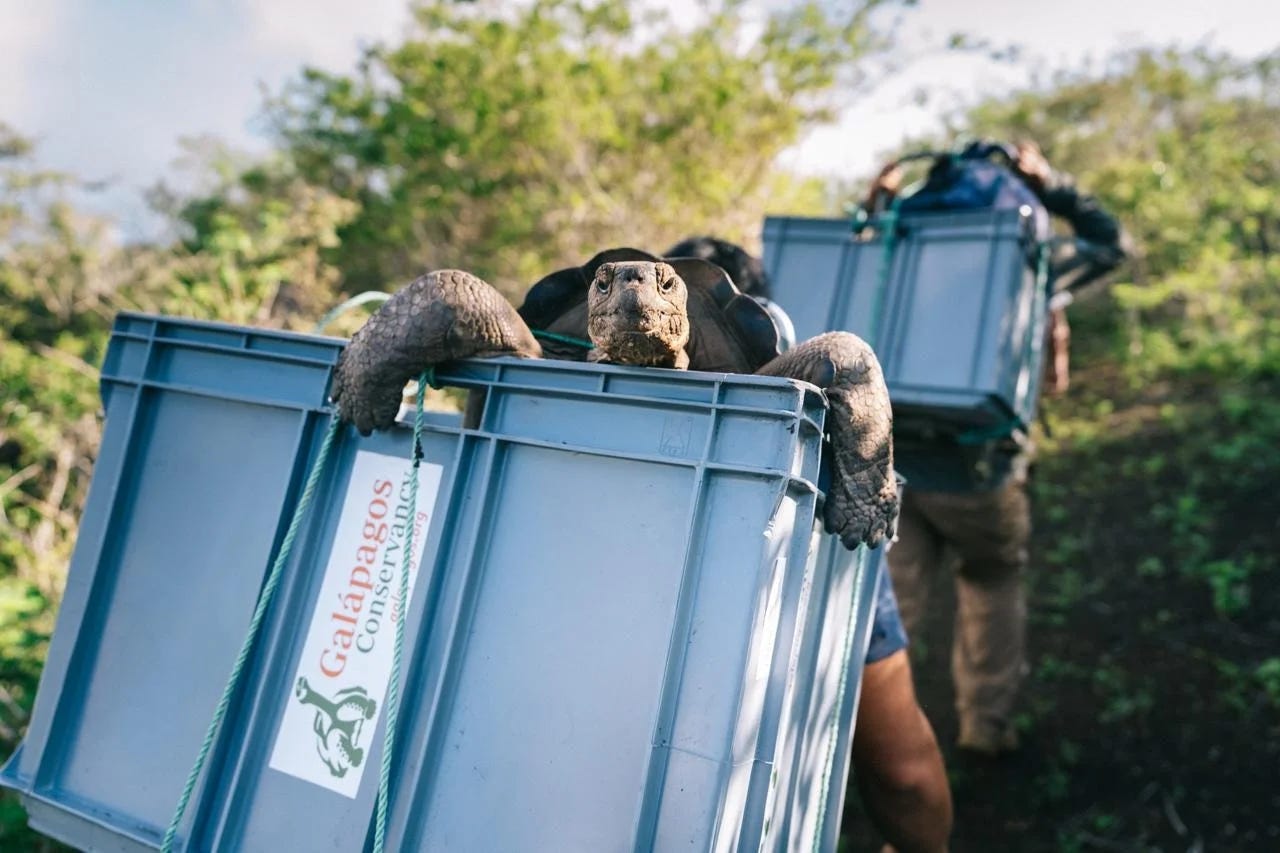
Scattered across nearly 60,000 square kilometres of the eastern Pacific — some 1,000 kilometres off the coast of Ecuador — the Galápagos Archipelago is among the most remote and inhospitable island groups on earth. Fifteen principal islands, roughly 360 in total, all of volcanic origin: bare rock, lava fields, under equatorial sun. The remoteness made the islands attractive to pirates and whalers on voyage, who found in them a refuge and a larder. One island in particular, Floriana, was favored as a source for spring water and food, most fatally for them, in the form of giant tortoises, whose flesh was considered a delicacy by and whose extraordinary ability to survive for up to a year without food or water made them the ideal living provisions for the long Pacific voyages of whalers. Several species were hunted to extinction. [1]
Professor Mary K. Bercaw Edwards, an authority on Herman Melville, examines his visit to the islands six years after Darwin. Melville, as is well known, was a whaler; on this voyage, he was aboard the Acushnet. He’d signed onto the New Bedford ship in January 1841, visiting the Galapagos, where it spent time anchored off San Cristobal Island, and this is the visit that inspired his work The Encantadas. Here, Melville was referring more to islands that were bewitched than enchanting in the way we use the word today. In the series of articles he wrote about the islands, collectively published as Encantadas, he used the title of the essay series to mean “under a spell,” more superstitious than beatific.
Bercaw Edwards, both a scholar of literature and a former US Coast Guard captain, offers vivid insights into the perspectives of whalers visiting the Isles during that time. She describes the brutal task of hunting giant tortoises, noting that Melville describes the tortoises thus:
“Hideous and disgusting as is their appearance, no animal can possibly afford a more wholesome, luscious, and delicate food than they do; the finest green turtle is no more to be compared to them, in point of excellence, than the coarsest beef is to the finest veal; and after once tasting the Gallapagos tortoises, every other animal food fell greatly in our estimation.”
In her account of Melville’s visit to the archipelago, Bercaw Edwards writes: “Fresh meat of any kind was indeed a wondrous change for sailors restricted to a diet of salt meat. It is hard to imagine how unpalatable and disgusting salt meat truly was. Beef and pork—and occasionally horse—were chopped up, with no attempt to separate the bones and fat, and then thrown into wooden casks of salt brine where the meat would turn green with age.”
But collecting giant tortoises was very brutal, arduous work. Sailors needed to clamber over long trails of volcanic rock surfaces, carrying animals weighing hundreds of pounds. “The sailors first turned the tortoises on their backs, then placed a large stone on their shells to keep them from drawing their legs in. They then bound the tortoises’ legs with strips of canvas and slung them onto their backs. The average weight was about eighty pounds, but could be much more.” She adds that Thomas Nickerson aboard the whaleship Essex recorded that:
“The tortoise’s constant uneasiness whilst being carried and the challenging terrain with the footing constantly giving way beneath their feet makes it, I have often thought, the hardest labour that can be given to man.”
The number of tortoises captured by visiting vessels, especially whaleships, is astounding. Historian Victor Wolfgang von Hagen recorded, “We have estimated that whalers alone, in a period of seventy-five years, removed more than 250,000.” Later historical research by Bercaw Edwards and others confirms this estimate.
Bercaw Edwards continues, “In Journal of a Cruise, it’s recorded that a crew ashore for approximately five days in 1813, during which they succeeded in getting on board between four and five hundred tortoises. When the whaleship Essex visited in 1820, the crew collected a hundred and eighty tortoises on Española Island in four days. Then, on Charles Island (Española), they collected another hundred tortoises, including a six-hundred-pounder that took six men to carry. Between October 13, 1832, and August 30, 1833, thirty-one whaleships called at Floreana Island. If each took two hundred tortoises, that would be six thousand in less than a year.”
When Darwin arrived in 1835, the number of tortoises was already significantly depleted and fast declining. He wrote in Voyage of the Beagle, “Their numbers have, of course, been greatly reduced. It is said that formerly single vessels have taken away as many as seven hundred, and that the ship’s company of a frigate, some years since, brought down in one day two hundred tortoises to the beach.” According to Bercaw Edwards, a search of the logbooks of whaleships found that in the thirty-seven years between 1831 and 1868, seventy-nine vessels visited the Galápagos and carried off 13,013 tortoises. Based on this study and further research, more accurate estimates of 100,000 to 300,000 have been projected.
If the Galápagos had been less remote and inhospitable, the tortoise supply would hardly have lasted as long as it did. Somehow, eleven of the fifteen subspecies of Galápagos tortoise have survived, though in comparatively tiny numbers, despite the onslaught of the whalers.
Ecuador annexed the islands in the early nineteenth century, establishing a penal colony on Floreana and imposing a semblance of administration on what had been an ungoverned waystation. Today, the archipelago is a shrine to Charles Darwin, the theory of evolution, and a fixture on the modern traveller’s itinerary — some 270,000 visitors a year, with an aggressively growing popularity. The islands and their surrounding waters are a UNESCO World Heritage Site, and the Galápagos Marine Reserve, one of the largest in the world, extends that protected zone far out to sea. Yet the reserve remains under pressure: illegal fishing continues to erode its boundaries, and regulations governing the size and conduct of tourist vessels have struggled to keep pace with the industry they are meant to both encourage and contain.
As we know, the Spanish discoverers of the archipelago named them after the giant tortoises unique to them; roughly eleven species once roamed many of the islands in tens of thousands, like some laconic Jurassic herds. Were it not for a brief visit by Charles Darwin, the archipelago’s unique species and its current status as ecotourism’s pre-eminent pilgrimage site might instead have been lost forever. Yet the association of the Galápagos with Darwin’s theory of evolution is itself a kind of creation myth — compelling, convenient, and only partially true.[2] Darwin spent five weeks in the archipelago in September and October of 1835, collecting specimens with the systematic enthusiasm of a young naturalist on his first great voyage. But he did not sail away with his theory formed. He had not even labelled his finch specimens by island with any consistency. It was John Gould, the ornithologist who examined those specimens in London two years later, who recognised them as separate species and redirected Darwin’s thinking. The Galápagos did not reveal evolution to Darwin; it provided raw material that others helped him interpret.
The myth of the islands as Darwin’s laboratory of revelation took hold gradually, reaching its modern form largely through the efforts of those who wanted to protect the archipelago rather than those who had studied it. The process began in the 1920s, when the American naturalist William Beebe visited the islands and published Galapagos: World’s End in 1924.[3] The book became an international bestseller, conjuring for a mass readership an image of the islands as a living remnant of primordial time — strange, austere, and magnificent. Cruise ships began calling at the archipelago in the 1930s, and with tourism came a new kind of attention: not so scientific, rather reverential.
By the 1950s, that reverence had acquired institutional ambitions. A constellation of prominent British figures — the ornithologist and conservationist Sir Peter Scott, the biologist Sir Julian Huxley, and Prince Philip — began coordinating an international campaign to secure formal protection for the islands. Huxley, as the first Director-General of UNESCO, was particularly well placed to apply diplomatic leverage. Their efforts bore fruit in 1959, when Ecuador designated 97 per cent of the Galápagos' land area as a National Park and the Charles Darwin Foundation was established under international auspices. The date was chosen deliberately: it was the centenary of the publication of On the Origin of Species. Darwin, who, contrary to popular lore, did not have the revelation of the mechanism of natural selection nor particularly notice the beaks of the islands, now celebrity finches, had found the islands disagreeable and moved on after five weeks, was posthumously installed as their patron saint
The Whiskey Barrel Mailbox of Post Office Bay
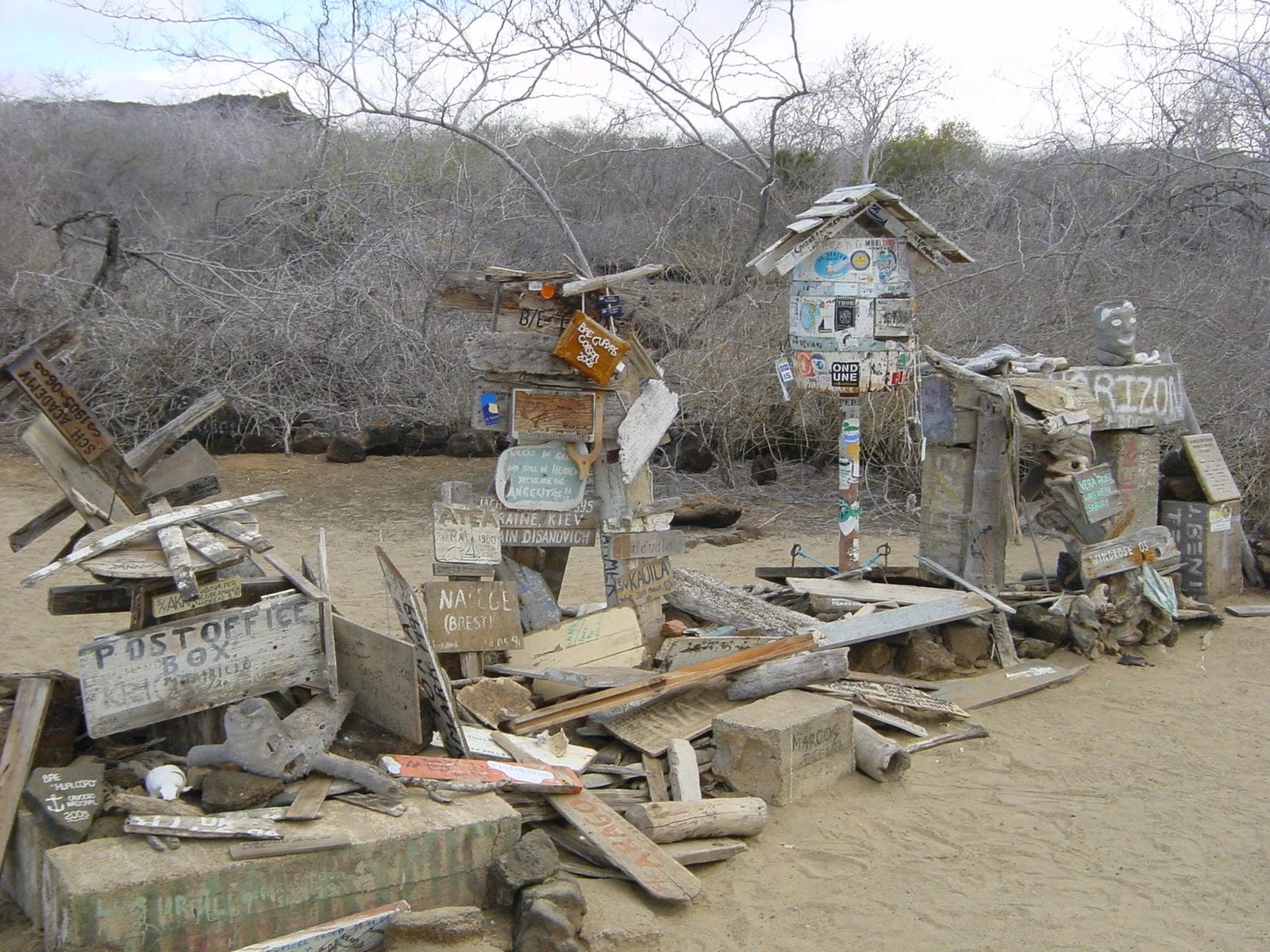
On the western shore of Floreana, a few minutes’ walk from a black sand beach where sea lions arrange themselves with the casual authority of permanent residents, stands a wooden barrel on a post. Weathered to a photogenic grey and festooned with postcards and stickers from visiting cruise ships, it draws passengers ashore at every calling. The ritual is the same each time: leave a postcard, take one addressed somewhere near your home, and deliver it by hand when you return. No stamps, no postage, no intermediary. The honour system. A charming remnant of another age.
Except that it is not quite what it appears to be, and Floreana’s relationship with romantic mythology runs considerably deeper than a whiskey barrel.
The original barrel — the first recorded to be placed there in 1793 by the British whaling captain James Colnett — was a practical necessity born of hardship, not sentiment. Whaling voyages in the Pacific ran for years. A barrel on a known waystation offered the only realistic chance of sending word to home port or collecting letters left by ships heading in the other direction. Messages went with specific ships to specific ports; there was nothing generalised or whimsical about it. The Galápagos were valued for fresh water, for shelter, and above all for the giant tortoises that could be loaded live into a ship’s hold and slaughtered as needed across the months ahead — a self-stocking larder requiring no refrigeration and consuming no provisions of its own. Herman Melville, who passed through as a young sailor in 1841, was under no romantic illusions about the place. “Take five and twenty heaps of cinders dumped here and there in an outside city lot,” he wrote in his Encantadas sketches; “imagine some of them magnified into mountains, and the vacant lot the sea; and you will have a fit idea of the general aspect of the Encantadas.” The barrel was a lifeline between that desolation and home. Nothing more. [4]
The Galapagos Affair
Its second life was stranger and more consequential. In 1929, in the aftermath of the Wall Street Crash and the gathering despair of the Depression years, a German physician named Friedrich Ritter arrived on Floreana with his companion Dora Strauch, having extracted and replaced all his teeth with a single set of steel dentures to eliminate the need for dental care on a remote island. He intended to strip his life to its Nietzschean essentials, to live by self-sufficient philosophy on a volcanic island at the edge of the world, and — crucially — to tell people about it. His accounts of this experiment in radical self-reliance were dispatched via the old whalers’ barrel, collected by passing cruise ships, and published in magazines across Europe and North America. They found an audience that was hungry for exactly this: a story of escape, of deliberate primitivism, of a man who had rejected the civilization that had just destroyed itself financially and was bafflingly thriving on cinders and philosophy.
The Wittmer family followed — Heinz, his pregnant wife Margret, and his son from a previous marriage, along with their two German Shepherd dogs — seeking a fresh start in the same remote solitude. Then, in 1932, came the polyamorous Baroness Eloise von Wagner Bousquet, an affluent Austrian who arrived with two German lovers, Rolf Lorenz and Robert Phillipson, and a vision of building a luxury hotel “Haicinda Paradiso” on Floreana to receive the cruise passengers she had read about in Ritter’s dispatches. She wore a loaded pistol and was apt to use it, randomly killing animals on a whim. She declared herself the ruler of the island and made enemies with practiced efficiency.
What followed has occupied cold case analysts ever since. In March 1934, the Baroness and Phillipson disappeared without explanation — Margret Wittmer claimed they had departed on a passing yacht headed to Tahiti, though no such yacht was ever identified. Rolf Lorenz, dispossessed and apparently broken by his treatment at the Baroness’s hands, and a Norwegian fisherman named Nuggerud, attempted to sail to the mainland and were found dead of thirst and exposure on the island of Marchena, victims of catastrophically poor navigation. Friedrich Ritter died shortly after, officially of food poisoning from improperly prepared chicken — though the suspicion that Dora Strauch had poisoned him has never been entirely dismissed. She returned to Germany and published her memoir, Satan Came to Eden, as the Third Reich consolidated its power. Margret Wittmer, the shrewdest survivor of the entire episode, waited until every other living witness was dead before publishing her own account, Floreana — a detail explored with some relish in the 2013 documentary The Galápagos Affair: Satan Came to Eden. Her family inherited what remained, including the hotel the Baroness had dreamed of building, which still operates on the island today. Ron Howard’s dramatisation Eden, available on Netflix, has brought the story to a new generation, adding a further layer of bewitchment to an island that has never quite needed the help.
The barrel on the beach, then, has lived three lives: maritime utility, vehicle for Nietzschean self-promotion, and, finally, today’s kitsch ceremonial postcard swap with the barrel, though most, on returning home, resort to placing a stamp on the picked-up card to forward it to its destination. The ritual has, for some, a whimsical charm. But the tourists who perform the ritual are, without necessarily knowing it, enacting a performance whose props were assembled by whalers, whose mythology was founded in the imagination of a few settlers seeking attention, and whose meaning has been mostly washed away by repetition. A fantastic tale constructed by a posturing philosopher and the bodacious self-proclaimed Baroness, though the island itself remembers more than the barrel does.[5]
The Giant Tortoise Returns
The giant tortoise of Floreana — Chelonoidis niger, to give it the name science assigned before the whalers finished their work — was considered extinct by the mid-nineteenth century. The last confirmed sightings on the island date to the 1850s. What the whalers had begun, the early settlers and their introduced predators completed: rats, dogs, pigs, and goats systematically destroying nests and hatchlings long after the adults had been taken. By the time conservation attention arrived, there was nothing left to conserve. Or so it appeared.
The first complication to that assumption arose in 1971, when a single tortoise was found on the island of Pinta by a Hungarian malacologist, József Vágvölgyi, who had gone there to study snails. The tortoise — an elderly male, the last of his kind — was brought to the Charles Darwin Research Station, where he was named Lonesome George and spent the next four decades as the world's most famous tortoise and the living symbol of irreversible loss. Every attempt to breed him failed. When he died in June 2012, his subspecies was declared extinct, and the world registered something between a news story and a small grief.
But the story had already grown more complicated than George’s solitary end suggested. DNA surveys of the tortoise population at Wolf Volcano, on the remote northern tip of Isabela, had been quietly rewriting the narrative. Among the mixed population there, geneticists found individuals carrying ancestry that could have come only from Floreana and Pinta. The explanation, once proposed, was almost elegant in its historical logic: whalers loading tortoises at one island and, finding themselves overstocked or facing rough weather, throwing the surplus overboard. Some of those animals, extraordinarily hardy even by tortoise standards, had survived the sea and made landfall on the volcanic shores of Wolf. Their descendants were still there, carrying the genomes of islands their ancestors had left involuntarily two centuries earlier.
This discovery transformed what had seemed like an epitaph into a scientific opportunity. The Floreana tortoise was not gone — it was diluted, dispersed, and recoverable. A back-breeding programme was established, selecting Wolf Volcano individuals with the highest proportion of Floreana ancestry and breeding them deliberately toward the original genetic profile. It is slow work measured in tortoise generations, but it is work that is actually proceeding. George’s genome, fully sequenced and now held in scientific archives, provides a molecular reference point against which progress can be measured and, in time, more precisely directed.
The parallel work being done in the Seychelles offers both inspiration and a useful philosophical counterpoint. There, the giant tortoises that once dominated the ecology of the Mascarene and Seychelles islands — seed dispersers, grazers, and engineers of the vegetation — were hunted to extinction by the eighteenth century. Their ecological role was vacant for generations. The restoration approach taken was pragmatic rather than purist: Aldabra giant tortoises, the closest living relatives, were introduced as functional proxies to islands including Île aux Aigrettes off Mauritius. The rewilded ecosystems responded — seed dispersal recovered, vegetation structure shifted, and other species benefited. The tortoises were not the original species, but they performed the original function, and the island did not much care about the distinction.
The purist objection is not trivial. There is a genuine argument that ecological restoration using substitute species papers over an extinction rather than reversing it, and that the acceptance of proxies reduces the moral and scientific urgency of recovering the original genome. The working compromise that has emerged in both Galápagos and Seychelles conservation circles is a both/and rather than either/or position: deploy functional proxies to restore ecosystem processes now, while continuing the longer genetic work in parallel. Conservation, operating always against time and budget, cannot afford to wait for the perfect while the achievable deteriorates.
The harder ethical frontier lies a step further along. George’s sequenced genome, combined with the CRISPR-based gene editing tools that have transformed biological science in the decade since his death, raises a question that is no longer purely speculative: could the Pinta Island tortoise be reconstructed, not merely approximated through back-breeding, but genetically recovered to a high degree of fidelity from living hybrid animals? Organisations such as Revive & Restore, which have pursued analogous programmes for the passenger pigeon and the black-footed ferret, believe this is achievable within the foreseeable future. It is important to be precise about what this means and does not mean. It is not the resurrection of an individual animal from ancient DNA, the fantasy that a certain film franchise has made it difficult to discuss soberly. It is the progressive editing of a living genome toward a documented ancestral form — painstaking, probabilistic, and constrained at every step by what science can actually deliver. The Jurassic Park objection, which reliably arrives in any conversation about de-extinction, is a category error: no one is proposing to reconstruct extinct predators from degraded fossil DNA and release them into the wild. The tortoise programme involves living animals, intact genomes, and a conservation purpose that is specific, measured, and accountable.
The more serious ethical questions are the ones that receive less popular attention. Gene drive technology — which can propagate a modified genetic trait through a wild population within a few generations — is being actively discussed as a tool for managing the invasive species that conventional methods have failed to control in the Galápagos. The African honey bees introduced to some islands, which have displaced native pollinators and disrupted the finely evolved networks of plant and pollinator that the archipelago’s endemic species depend on, are one candidate. The theoretical appeal is clear: a gene drive targeting reproductive capacity could, in principle, collapse an invasive population without the years of labour and expense that trapping and poisoning require. The practical and ethical concerns are equally clear. A self-propagating genetic modification released into a wild island ecosystem is, by definition, not fully controllable. The Galápagos, which has suffered so much from the introduction of species that behaved differently in the wild than anyone predicted, is not an obvious location for complacency about unintended consequences.
These are the questions that will define the next chapter of Galápagos conservation — harder, slower, and less photogenic than the drama of the whalers and the romance of Darwin, which brings us back to Floreana.
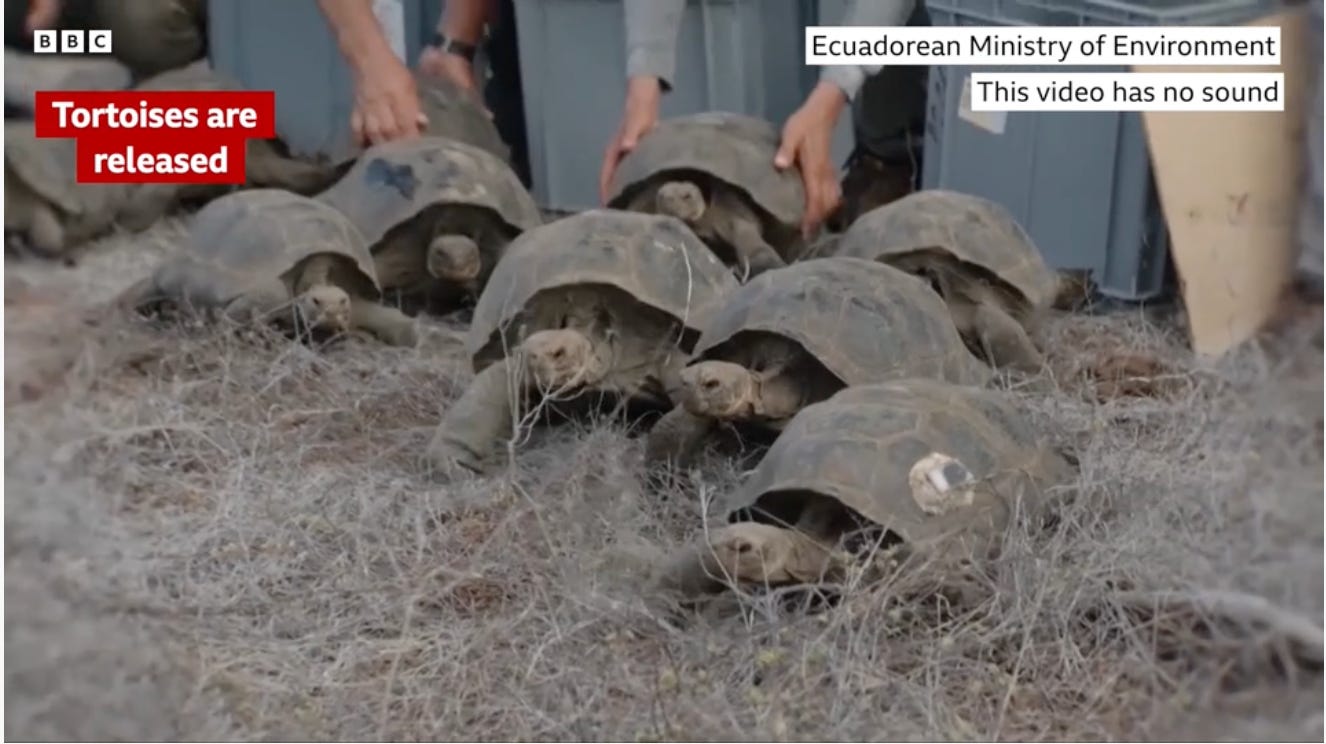
While I was on the island, rangers from the Galápagos National Park Directorate carried tortoises — hybrid animals bred from Wolf Volcano stock, selected for their high proportion of Floreana ancestry — on their backs up through the volcanic terrain to release them on location.[6] It was, in the most literal sense, a reversal: the same island from which the tortoises had been taken, live and stacked, into the holds of whaling ships, was receiving them back, carried carefully by human hands, to begin the slow work of becoming home again. The barrel on the beach was a few kilometres away, festooned with its postcards. The tortoises, indifferent to the symbolism, moved off into the scrub.
© 2026 Farooq Hussain
Notes and Further Reading:
[1] H. Bruce Franklin, THE ISLAND WORLDS OF DARWIN AND MELVILLE, The Centennial Review, Vol. 11, No. 3 (SUMMER 1967), pp. 353-370 (18 pages)
[2] The voyage of HMS Beagle to the Galápagos in the autumn of 1835 has been so thoroughly mythologised that the reality is almost startling in its modesty. Darwin was twenty-six years old, seasick for much of the five-year voyage, and in the Galápagos for just five weeks, of which he spent approximately nineteen days actually ashore. The Beagle was on a surveying mission; the islands were a navigational and scientific waystation, not a destination. While the ship passed or conducted minor surveys of several islands, including Marchena, Genovesa, and Pinta, Darwin made landfall on only four: San Cristóbal, Floreana, Isabela, and Santiago.
What he did on those islands was the work of a conscientious but not yet exceptional naturalist — collecting, observing, and noting differences between species with the disciplined curiosity his training had given him. He remarked on the tortoises and the mockingbirds, and he noticed that both seemed to vary from island to island. But he did not grasp the theoretical significance of what he was seeing. He collected finch specimens so carelessly — failing to label consistently which bird had come from which island — that the ornithologist John Gould, working through Darwin’s boxes back in London in 1837, had to piece together the picture that Darwin himself had missed. It was Gould who identified the birds as distinct yet related species and handed Darwin, in effect, one of the master keys to his theory.
None of this diminishes what Darwin eventually built from such raw material. But there is a significant difference between a twenty-six-year-old collecting beetles and mockingbirds on a volcanic island in 1835, and the beatified figure of popular imagination — the solitary genius reading the secrets of life from the rocks and creatures of the Galápagos. The islands did not give Darwin his theory. They gave him specimens, and time gave him Gould, and Gould gave him a question he spent the next twenty years answering.
[3] Beebe, William. Galápagos: World’s End. G.P. Putnam’s Sons, 1924.
[4] Melville, Herman. “The Encantadas.” Project Gutenberg, www.gutenberg.org/ebooks/12301rtoises, and the Galapagos
Bercaw Edwards, Mary K. B, Of Melville, Tortoises, and the Galapagos, Nantucket Historical Association, Historic Nantucket, Fall 2014 issue. Professor Mary K. Bercaw Edwards describes the brutal task of hunting giant tortoises in this excellent article.
[5] The Galápagos Affair has been extensively covered. The most frequently referred to sources are the account of Dore Strauch, who some believe poisoned her partner, Dr. Friedrich Ritter, before returning to Germany in 1937. Her account is:
Strauch, Dore. Satan Came to Eden: A Survivor’s Account of the “Galapagos Affair”. Edited by Walter Brockmann, Harper and Brothers, 1936.
The Wittmers made a success of their lives on Floreana, adopting the “Baroness” idea to establish a hotel on the island, which they still run today. Her account of events was published after all other witnesses had died:
Wittmer, Margret. Floreana: A Woman’s Pilgrimage to the Galápagos. Translated by Anthony Nelson, The Bath Press, 1989.
John Treherne published The Galápagos Affair in 1983, having thoroughly researched the story, including extensive interviews with many who were closely associated with the characters and with those with firsthand knowledge of the events. It is, in my view, the only balanced “cold case” analysis of the events.
The documentary The Galápagos Affair: Satan Came to Eden, directed by Dan Geller and Dayna Goldfine and released in 2013, is an outstanding investigative report that interviews many of the most knowledgeable people from the time of the events.
The film Eden, directed by Ron Howard and released on Netflix in 2024, stars Jude Law, Ana de Armas, and Vanessa Kirby and is based on the Galápagos Affair, a fictional, entertaining account with few factual connections. A very engaging novel by Midge Raymond, titled Floreana, weaves the story of the Galápagos Affair into the plot, seen from the perspective of Dore Strauch, whose secret diary is discovered by the main character. I enjoyed it and would recommend it. Needless to add, there is a swamp of other material about this on YouTube and online publications, all of which is covered by the above. I’m told by Galápagos guides that there are as many versions and variations of the story of the Baroness, Ritter, Strauch, and the Wittmers as there are guides.
[6] Nuwer, Rachel, 180 years after disappearing, a tortoise returns to its Galápagos home: The release of 158 specially bred Floreana giant tortoises is a win for both the animal and its long-lost island ecosystem, Scientific American, 27 February, 2026
Rawnsley, Jessica, Giant tortoises return to Galápagos island after nearly 200 years, BBC, 21 February 2026
A related Ariadne’s Dispatch that may also be of interest:

If you want to know more
The conservation framework protecting the Galápagos is multilayered, involving Ecuadorian government agencies, international scientific bodies, and a number of NGOs whose work ranges from field research to policy advocacy. For readers who want to explore further, the following are the principal organisations involved:
The Galápagos National Park Directorate is the Ecuadorian government body that administers the protected land area — some 97 per cent of the archipelago — and leads all official conservation and restoration programmes, including the February 2026 tortoise reintroduction on Floreana. Its official site, available in English, is galapagos.gob.ec.
The Charles Darwin Foundation, established in 1959 and operating the Charles Darwin Research Station on Santa Cruz, is the archipelago’s primary scientific institution and the oldest conservation organisation in the islands. Its research spans terrestrial and marine programmes, invasive species management, and tortoise conservation. The station is open to visitors. Website: darwinfoundation.org
The Galápagos Conservancy, based in Washington D.C., is the principal US nonprofit dedicated exclusively to the islands, with over forty years of field and policy work. It co-led the Floreana tortoise reintroduction programme. Website: galapagos.org
The Galápagos Conservation Trust is the UK equivalent—a small, focused charity that has been instrumental in translating field science into international conservation policy. Website: galapagosconservation.org.uk
WWF has been engaged with Galápagos conservation for over fifty years, with a particular focus on the Marine Reserve — supporting surveillance technology to combat illegal fishing and working on sustainable fisheries and ecotourism policy. Website: worldwildlife.org/places/the-galapagos
Really interesting read, and excellent telling of the back story. Well worth the effort of pursuing to the end!