

Fly Past
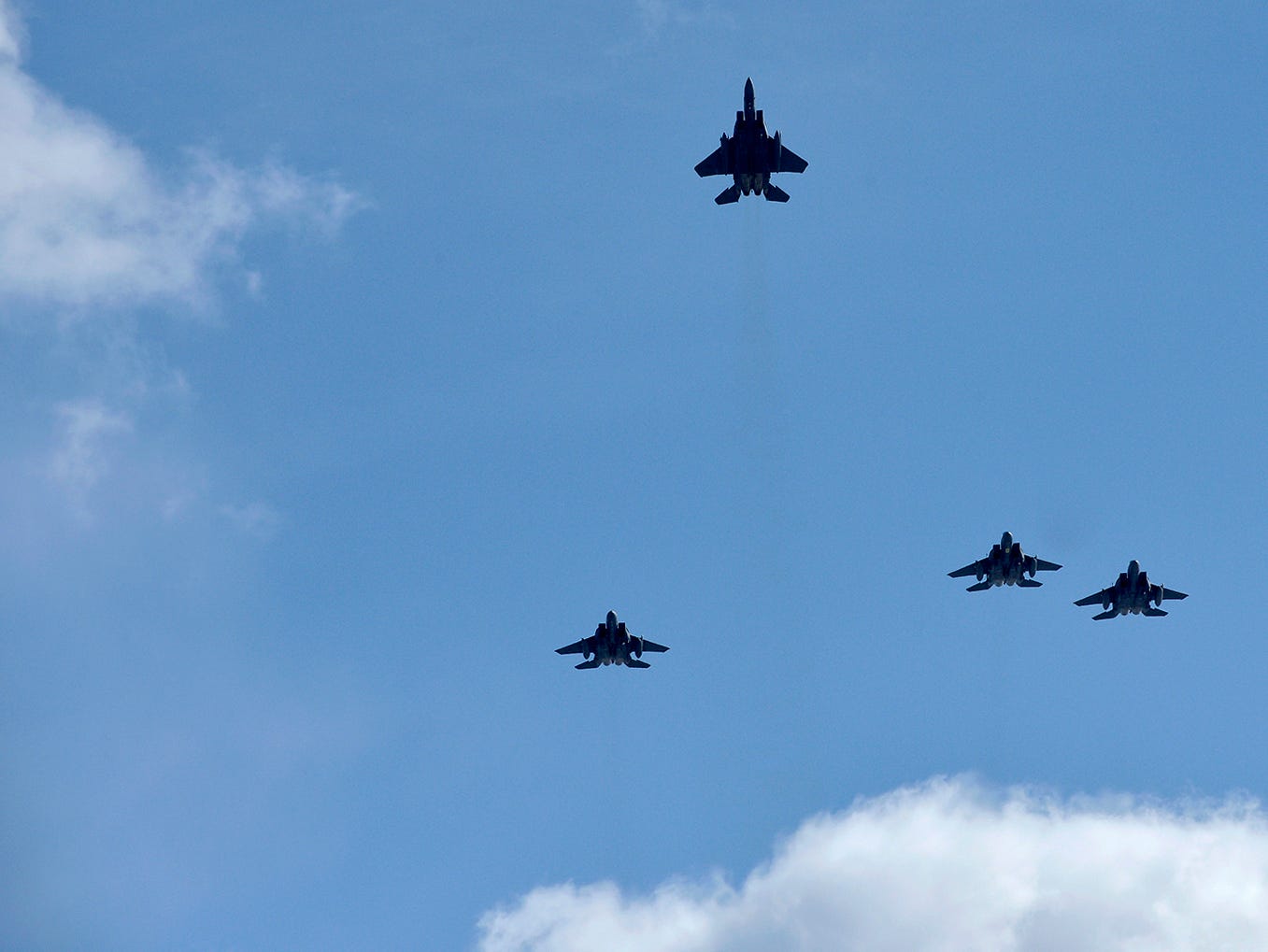
The first time I saw a Missing Man formation fly-past was on a Pearl Harbor Day when I was in Hawaii. I’ve always gone crazy for air displays, aerobatic or fly-past, but this was something especially poignant, and I felt a pit in my stomach as one aircraft climbed vertically out of the formation to represent the missing man — tribute to the pilots who did not return. Every Memorial Day since, I try to catch a fly-past in honor of those who sacrificed their lives on our behalf. With binoculars in open fields, in sports bars with super-wide screens — it’s become a thing for me. I’ve been an American citizen for a quarter century now, and it’s moments like the Blue Angels’ Missing Man fly-past that fill me with pride for a nation that has freely sacrificed so much for everyone’s freedom. Memorial Day is mostly a barbecue and a long weekend of leisure, and that’s to be appreciated too, though it will never quite stand in for the fly-past, which embraces the occasion so completely in such a short moment.
The Man with the Insulting Guns
Arriving in Hawaii from New Zealand, where he had inaugurated the FBI’s first standalone office in Wellington, Director Kash Patel had already accomplished a small diplomatic feat. On July 31, in a series of meetings with the country’s top security officials, he presented 3-D-printed pistols mounted on challenge-coin display stands as ceremonial gifts. The recipients were Police Commissioner Richard Chambers, Andrew Hampton, director-general of the New Zealand Security Intelligence Service, and Andrew Clark, director-general of the Government Communications Security Bureau — the three most senior law-enforcement and intelligence figures in the country, handed plastic guns at a ribbon-cutting.
New Zealand classifies pistols as restricted weapons. Possessing one requires a special permit beyond a standard firearms license, and the country’s gun laws were tightened in the aftermath of the March 2019 attacks on two Christchurch mosques, in which a lone gunman shot fifty-one Muslim worshippers to death during Friday prayers, having legally amassed his arsenal of semi-automatic weapons in the months before. The country’s response to the massacre was swift and bipartisan: within weeks, Parliament had banned most semi-automatics and instituted a national buyback. New Zealand does not have a culture in which a firearm in everyday public space is normal; if anyone were seen carrying one, the police would be called. Front-line officers there, by long tradition, don’t carry sidearms on patrol — they leave them locked in their vehicles.
A Melt Down
Commissioner Chambers sought legal advice the day after receiving his. The Firearms Safety Authority and the Police Armoury examined the replicas and determined that, although inoperable as presented, they could be made functional with what an armoury team leader described in an internal email as “minimal skills and common ‘handyperson’ tools.” The model, police documents later revealed, was the Maverick PG22 — a working revolver designed by 3-D-printing hobbyists, modeled on a brightly colored Nerf toy of the same name, and identified by New Zealand’s police union earlier in the year as among the most common 3-D-printed guns being seized from criminals on the street.
The FBI Director’s commemorative offering to the security chiefs of an allied nation was, in essence, a homemade firearm derived from a children’s toy, of a kind New Zealand police had been confiscating from gangs.
On Chambers’s instruction, the guns were retained and then destroyed. The destruction took place on September 25. Patel’s spokesperson declined to comment.
Odd behavior from a visiting American official doesn’t cause much of a stir in New Zealand, where people are polite about that sort of thing, and the public statements from Wellington were measured. But things were to turn out differently in the domain of Kīlauea.
Sacred Geography
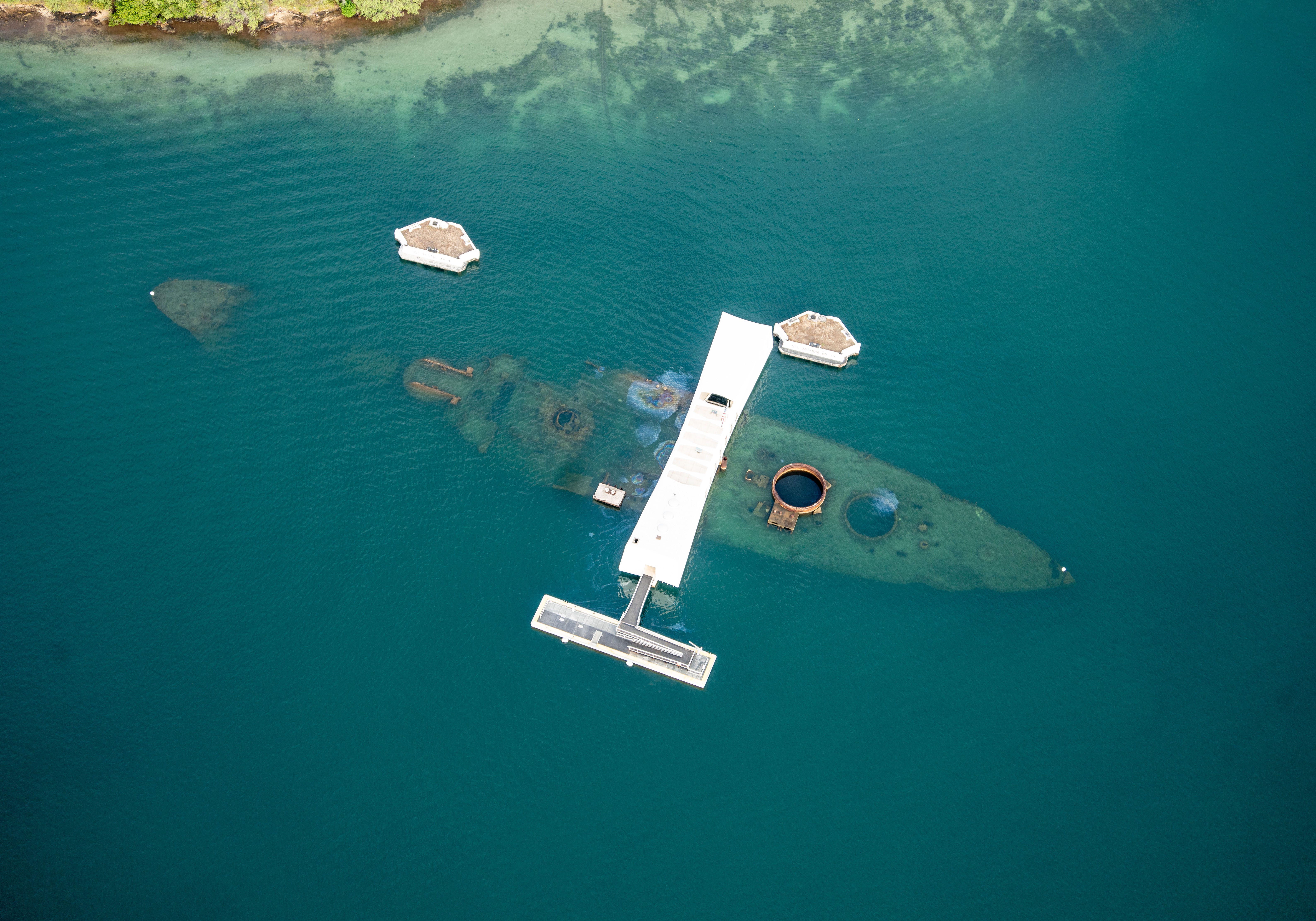
The wreck of the USS Arizona occupies a unique place in American memory, serving not simply as a monument to the attack on Pearl Harbor but as a living cemetery that continues to bridge past and present. Resting where it sank in the shallow waters of Pearl Harbor, the battleship remains an immediate and visceral connection to December 7, 1941 — the “date which will live in infamy.”
From time to time, traces of engine oil still seep up from its interior — “black tears” that give the haunting impression that the ship itself continues to grieve for its crew more than eighty years after the attack. Its meaning deepened further in 1982, when surviving crew members were permitted to have their cremated remains placed within the hull by Navy divers, reuniting shipmates across generations and transforming the wreck into an active sanctuary of remembrance. In this way, the Arizona stands at the intersection of two distinct forms of national commemoration. Pearl Harbor Day recalls the shock and vulnerability that forced President Roosevelt’s hand and brought the United States into a global war that would cost millions of lives.
The wreck of this battleship, together with its accessible location in the shallows of the harbor, forms a tomb honoring those killed in a single catastrophic morning. Memorial Day, by contrast, honors all Americans lost in military service across the nation’s history, from the Revolutionary War to modern conflicts. The Arizona embodies both memories at once: on December 7 it symbolizes the catalyst that changed the world, while on Memorial Day it becomes one sacred coordinate within the wider landscape of American sacrifice for everyone’s freedom. The shallow water does not conceal the tragedy; rather, it preserves it in plain sight, keeping the memory immediate, personal, and enduring.
The VIP Snorkel
Into these waters the FBI Director arrived bearing snorkel and fins.
The Associated Press reported on May 14 that Director Patel had taken what government emails described as a “VIP snorkel” around the USS Arizona during his Hawaii visit the previous August. The outing was coordinated by the military, was not on Patel’s public schedule, and was unmentioned in the FBI’s news releases at the time. The Navy confirmed the swim only after the AP obtained the emails through a public records request. A Navy spokesperson, Capt. Jodie Cornell, told reporters that participants had been briefed not to touch the wreck and reminded of its status as “the final resting place / tomb for hundreds of service members.” That a brief was felt necessary is its own kind of testimony: the men who needed reminding included the head of the FBI.
According to a former government diver who spoke to AP on condition of anonymity, no FBI director going back to at least 1993 had ever snorkeled at the memorial. Marine archaeologists dive there to survey the wreck’s condition. National Park Service crews dive there for the same reason. A select group from the Paralyzed Veterans of America, including the Marine veteran Hack Albertson, dives there annually to check on the ship’s structural integrity. These are the people who know the Arizona. They were not the people in the water with Director Patel.
The military divers and security personnel who accompanied him into the water were there to protect the Director, not to interpret the wreck. The composition of the escort told you what the outing was, whatever the FBI’s spokesman would later call it. A genuinely historical tour, led by the people who actually study the ship, would have looked different. This outing was named in the government’s own emails: a VIP snorkel.
Hack Albertson told the AP that VIP snorkeling at the memorial was inappropriate. “It’s like having a bachelor party at a church,” he said. “It’s hallowed ground. It needs to be treated with the solemnity it deserves.”
The institutional response was to call the criticism “stupid.” Ben Williamson, the FBI’s assistant director for public affairs, wrote on X that the AP was attempting to spin an invitation from the Commanding General of Indo-Pacom “as a party or vacation, which is so stupid.” It was, Williamson added, “a historical tour to honor heroes who died on the USS Arizona — not a party.” The Navy, for its part, described Patel’s outing as “not an anomaly.”
The defense was bolstered by Christopher Miller, the former acting Secretary of Defense, who had himself snorkeled the Arizona during the first Trump administration. Miller told AP that when he was invited to swim, regional military officials had told him the tour was reserved for “special occasions and for special visitors, of which you’re one.” He found the experience meaningful. “It was a very somber and meaningful event,” Miller said. “It was a historical tour. It wasn’t a recreational thing.” The defense, in other words, came from a man defending his own past swim alongside Patel’s — an institutional flattery passing forward across administrations, each special visitor confirming the next one’s specialness.
Stacey Young, founder of Justice Connection — a network of former federal prosecutors and agents who advocate for the Department of Justice’s independence — placed the swim inside the larger pattern. “It fits a pattern of Director Patel getting tangled up in unseemly distractions — this time at a site commemorating the second deadliest attack in U.S. history — instead of staying laser-focused on keeping Americans safe.”
The March of Folly
Barbara Tuchman, in The March of Folly, defined the term with care. To qualify, conduct had to be contrary to the self-interest of the actor, an available alternative had to have been identified at the time, and the conduct had to have been undertaken by a group rather than an individual. Patel’s swim meets all three tests. The Navy’s safety briefing was the alternative, spelled out in writing before he got in the water — a written reminder that this was a tomb, that the dead were beneath him, that he was not to touch them. The institutional response — the FBI calling the criticism “stupid,” Miller’s recursive defense of his own privilege, the Navy’s bland “not an anomaly” — is the doubling-down Tuchman documented across centuries of state behavior.
The folly here is not that one man made a poor judgment in the water. The folly is that the institutions around him made the swim possible, named it a “VIP snorkel” in writing, briefed him not to touch the dead, and then insisted afterward that this was somber and meaningful and historical and not at all a party.
The Missing Man
Taps asks only that a single bugler strike the notes truly; the Missing Man formation asks no aerobatic virtuosity. Yet both, by the simplicity of means, have become universally emblematic of loss. Both are brief, leaving an enduring sense of something lost that need not have been. As the four aircraft approach in tight formation, one pulls up and climbs steeply away, directly above the place of commemoration, leaving a gap in the sky as the others continue past the people below. It is over in seconds, but the empty space stays with each observer — which is why the formation has become so fitting a goodbye to those who deserve to be remembered. I have visited the Arizona, and I have watched the Missing Man climb out of the sky. I will look up for it again this Memorial Day as I do each year.
© 2026 Farooq Hussain