

In Part I of Living Underwater, we reviewed the contributions that led to the development of the scuba regulator valve, the actual ancestor of the design currently in use. A tale of multiple inventors, intellectual property theft, and a proliferation of knock-offs used by amateurs, professionals, and navy divers alike, all driven by a mad pursuit to discover a way to breathe compressed air underwater and swim freely like a true creature of the sea. Here, we try to answer the question of why, if there were so many exciting contributors to this development, many, including perhaps the most important, are mostly unrecognized in favor of Jacques-Yves Cousteau, whose own design with Emile Gagnan is not the one on which modern regulators are based.

Inner Space
In 1969, I was working as a research assistant to Keith Critchlow, a prominent collaborator with Buckminster Fuller and a lecturer at the Architectural Association School in London. Bucky Fuller’s vision of “Spaceship Earth”—a fragile planet whose life support system required careful stewardship. Even more so than the spacecraft being developed to carry a man to the moon. President Kennedy’s project, pitted against the then-Soviet Union in a race, captured the imagination of a generation. At the same time, Jacques Cousteau was promoting an equally compelling idea, riding perhaps on the intoxicating glamor of space flight: that humans should also explore “inner space” with equal zeal. Establishing undersea communities, even colonies, to better utilize and protect the resources of the oceans. It seemed like the oceanic equivalent of the race to land a man on the moon—inner space, the yang to outer space.
I became an avid scuba diver, caught up in the romance of this vision. The idea that we might live and work beneath the waves, becoming true “menfish,” as Cousteau described those who had so committed themselves to the sea that they wanted to live underwater. Aquanauts as well as astronauts would explore humanity’s newest frontiers. But over a quite short period, ending with tragic accidents in these experimental habitats, that dream would collapse. And with it, my own engagement with diving would gradually fade as it became clear that the idea of location-based habitats lacked both scientific and economic sustainability. Scuba diving requires lugging heavy gear and frequent participation to maintain skills; snorkeling became an easier option on the few occasions I had the opportunity to dive, and often just as pleasurable. My certification lapsed, and I didn’t think much about returning to diving for nearly fifty years.
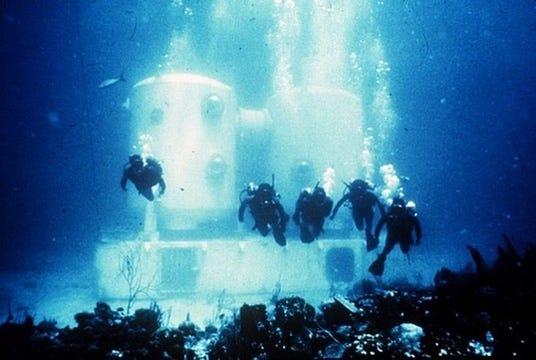
The Problem: Time and Pressure
Before we can understand why the dream of underwater colonies failed, we need to appreciate the fundamental challenge that drove it. By the 1950s, scuba diving had freed divers to move independently underwater, but the physics of decompression severely limited how long they could remain at depth.
Breathing air underwater— seventy-eight percent of which is nitrogen—presents problems when the surrounding pressure is greater than at the surface. Though an inert gas, nitrogen is absorbed into body tissue under pressure. Ascending to the surface requires calculated, staged stops to allow the absorbed gas to be safely released back into the bloodstream. Workers in tunnel construction were the first to be observed with this condition, which led to it being called caisson disease—or more commonly, “the bends” — due to the joint pain and muscle cramps it causes.
For divers, this meant that descent and ascent consumed large amounts of breathing gas, leaving them exposed and vulnerable during long decompression stops. The deeper the dive, the longer the required decompression. This severely limited the practical working time at depth.
The Less Remembered Innovators
The solution came not from Jacques Cousteau, despite his fame, but from three innovators whose names have largely faded from public memory.
George Bond, a brilliant U.S. Navy physician, theorized that if divers were saturated with a gas mixture—typically oxygen and helium1 —they could be pressurized to a specific depth, transported in a sealed chamber to the ocean floor, work there for extended durations, and then return to the surface in the same chamber for a single, controlled decompression under medical supervision. This would bypass the traditional, time-consuming staged ascents that left divers underwater, exposed, and vulnerable.
Bond’s insight was named “saturation diving”—the point at which a diver’s tissues are saturated with inert gas, meaning no additional time at depth increases decompression requirements. Once saturated, a diver could work for days or even weeks at depth, returning each shift to a pressurized chamber, with only one decompression needed at the mission’s end.
Meanwhile, American inventor Edwin Link—best known for creating the first flight simulator in the 1920s—turned his restless inventiveness toward the ocean depths in the late 1950s. Working alongside Belgian explorer-diver Robert Stenuit, Link recognized the same decompression problem. Their solution was elegantly simple: they reinvented the diving bell.
Rather than forcing divers to decompress in the water during ascent, their “personnel transfer capsule” allowed divers to enter a pressure chamber, be pressurized to depth—analogous to flying at high altitude in an airliner at atmospheric pressure—and return to the surface while still under pressure. Once back on the surface, decompression could be carefully monitored and controlled in a safe, relatively comfortable environment, or divers could be transferred to a more spacious chamber.
In 1962, Stenuit successfully spent 24 hours at 200 feet off the coast of France in Link’s chamber. This experiment, and Bond’s parallel theoretical work, became the foundation of all modern saturation diving systems. Today, virtually every deep-water operation—from offshore oil rig maintenance to submarine rescue—relies on descendants of the Link-Stenuit diving bell and Bond’s saturation protocols.
Bond’s work also revolutionized diving medicine more broadly. His research established the use of helium as a substitute for nitrogen to avoid nitrogen narcosis and its associated toxicity. The decompression tables he helped develop quickly gained international acceptance and continue to serve as the foundation for safe diving today. By the 1980s, wrist-worn dive computers had begun to replace manual tables, enabling real-time calculations of safe ascent profiles. These advances made diving accessible to both recreational and professional divers worldwide.
Two Competing Visions
But saturation diving developed along two very different paths, and this is where Cousteau enters—and ultimately distorts—the story.
Link and Stenuit’s approach was practical and mobile: treat the diving bell as a tool that could be lowered from a ship to wherever work was needed, then recovered. Divers would live aboard the surface vessel in pressurized chambers, descending each day to work, returning each night while remaining under pressure.
Cousteau’s vision was far more romantic. He imagined permanent communities on the seafloor itself: fixed habitats where “aquanauts” would live and work like settlers of an undersea frontier. His Conshelf projects placed divers in underwater habitats where they were filmed enjoying chess, wine, and smoking while schools of fish swam past their windows. These were essentially movie sets in perfect cinematic waters, designed for spectacle rather than science.
Cousteau’s iconic underwater cinematography resulted in acclaimed documentaries such as The Silent World—ironically titled, as the undersea world is full of sounds—and World Without Sun, which depicted brilliantly sunlit coral reefs of the Red Sea. Both films earned Academy Awards, with The Silent World also winning the Palme d’Or at Cannes—the first documentary ever to do so.
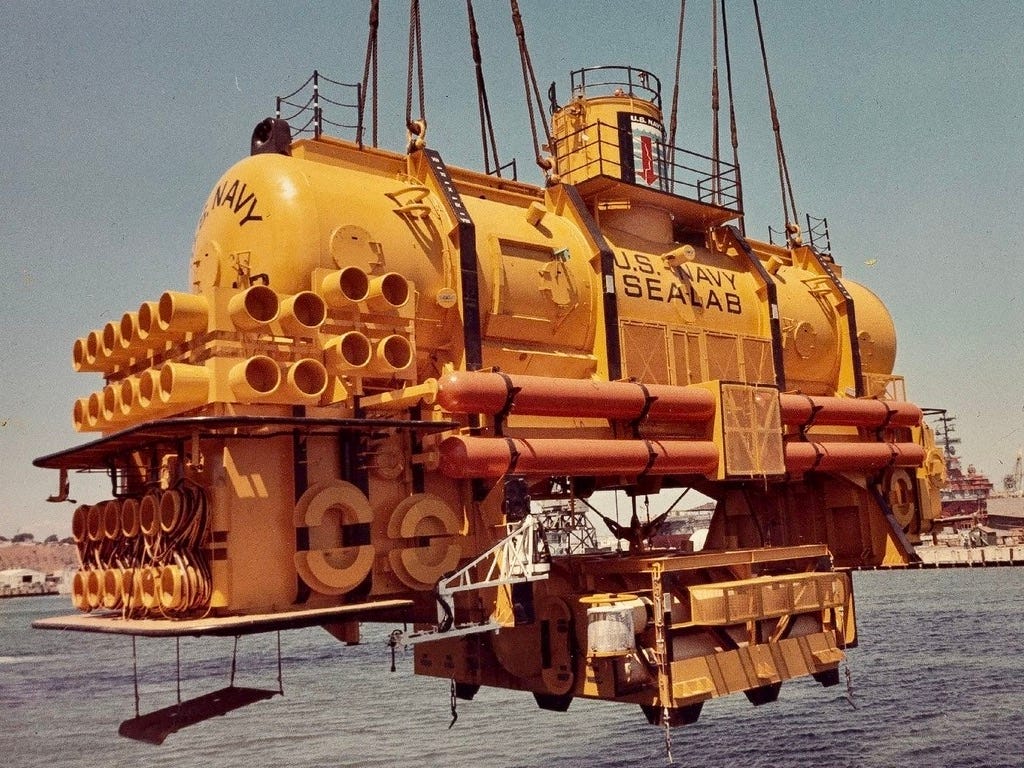
In the cultural imagination of the 1960s, saturation diving was frequently portrayed as the oceanic counterpart to the space race—a “moonshot” for inner space. If humans could establish outposts in space, why not beneath the sea? Throughout the 1960s and early 1970s, a series of ambitious underwater habitat programs emerged: Link’s Man-in-Sea project, the U.S. Navy’s SEALAB program, the Tektite missions, and Cousteau’s Conshelf series.
These experiments proved humans could survive extended periods at depth and produced valuable physiological data. But they also revealed something crucial: the two visions were not equally viable.
Why the Dream Failed
The seafloor habitat concept proved economically and operationally untenable. The fundamental problem was mobility—or rather, its absence.
A fixed habitat on the ocean floor can only serve the immediate surrounding area, while a surface vessel equipped with saturation diving systems can reposition freely wherever work is needed. The oil industry, which Cousteau courted for support, recognized this immediately. Why invest in maintaining a permanent seafloor installation requiring constant surface support when the same surface support could sustain mobile diving operations far more efficiently?
The comparison to space stations, so often invoked, ultimately highlights why undersea habitats failed. The International Space Station exists because there is no alternative—astronauts cannot return to Earth each night between experiments. But divers can return to surface vessels while remaining under pressure, enjoying far greater safety, logistical support, and operational flexibility.
Undersea habitats required all the infrastructure of surface support anyway—ships, supplies, communications, emergency backup—making the seafloor residence itself redundant rather than revolutionary. The Conshelf projects accomplished no significant scientific work. The one extended operation on a simulated oil drillhead yielded mixed results and was not pursued further.
Tragedy Ends the Dream
In 1969—the same year I was most captivated by the vision of underwater colonies—tragedy struck the U.S. Navy’s ambitious SEALAB III project. Aquanaut Berry Cannon died during a checkout dive of the newly submerged habitat before it could be occupied. The Navy, already facing budget pressures and waning executive support, terminated the program.2
Cousteau’s Conshelf projects, which were more focused on public engagement than science, failed to secure future funding. The dream of undersea cities was fading. For Cousteau, however, this marked the beginning of his hugely successful television series, which would fascinate millions of viewers worldwide with its portrayal of the undersea world—though his films, including the acclaimed Le Monde du Silence, would later be scrutinized for their harmful treatment of marine life during production—even as his fame continued to overshadow the contributions of others.
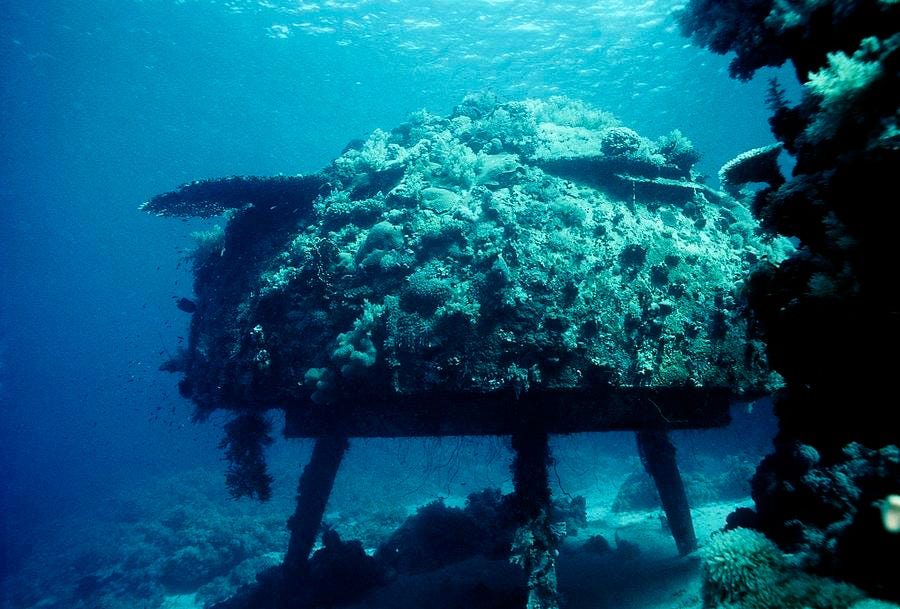
The encrusted remains of the Conshelf II habitat now sit at the Sha’ab Rumi reef off the Sudanese coast, approximately 48 km from Port Sudan, at a depth of just 10 meters. Visited occasionally by curious recreational divers, it stands as a monument to a vision that was perhaps never truly practical.
The Unglamorous Victory
While the romantic vision of underwater cities faded, saturation diving itself succeeded brilliantly—just not in the way Cousteau had imagined.
Link and Stenuit’s more prosaic approach vindicated itself: the diving bell as a tool, not a home. As ship-based saturation diving matured into standard commercial practice by the mid-1970s, fixed seafloor stations were superseded. Today’s commercial divers routinely spend full workdays at depths exceeding 200 meters using surface-supported systems, returning each night to pressurized chambers aboard dynamically positioned vessels that can relocate as needed.
Saturation diving remains integral to underwater operations today, particularly in offshore oil and gas industries, enabling complex tasks at depths previously deemed inaccessible. Technological advancements have enhanced safety and efficiency: self-propelled hyperbaric lifeboats for emergency evacuations, accelerated decompression protocols, and suits that maintain one-atmosphere environments, eliminating lengthy decompression times.
The 2019 documentary “Last Breath” captured both the capabilities and the dangers of modern saturation diving, recounting the true story of commercial diver Chris Lemons, who survived 35 minutes without oxygen after his umbilical cord snapped at 100 meters depth in the North Sea. His survival—against all medical expectations—highlighted both how far the technology has advanced and how unforgiving the ocean environment remains.
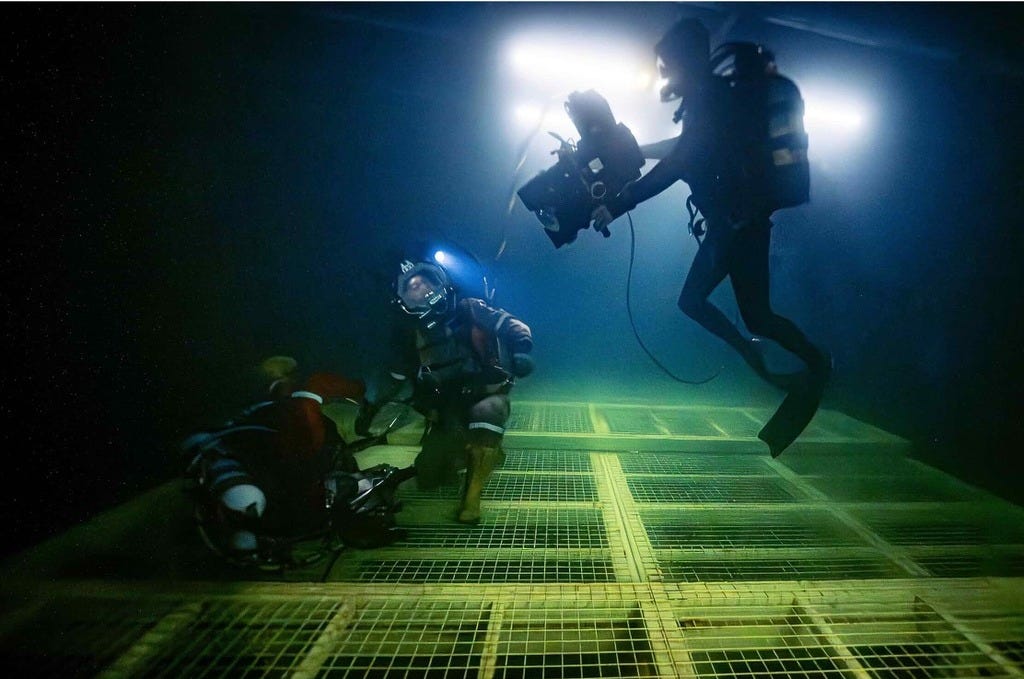
A handful of underwater habitats persist—most notably the Aquarius Reef Base, now operated by Florida International University—but they survive as research platforms for shallow-water marine biology and astronaut training, not as models for undersea colonization. Recent record-breaking underwater stays generate publicity but serve no operational purpose that couldn’t be accomplished more safely and cheaply through other means.
What I Learned
The dream of undersea cities was not so much disproven as rendered unnecessary. The ocean floor, unlike the moon or a space station, is immediately adjacent to a perfectly hospitable base of operations: the surface.
Cousteau’s vision inspired a generation of ocean explorers—including me. But in inspiring us, it also obscured the real story. The practical innovators—Link, Stenuit, Bond, and, before them, Ted Eldred (as we saw in Part I)—were overshadowed by Hollywood spectacle and the Academy Awards.
Though the underwater cities of my youthful imagination never materialized, I would eventually discover that the ocean had been “colonized” in an entirely different way. But that realization would take fifty years—and a return to diving I never expected to make.
Next: Part III - Fifty Years Later
In the final installment, we’ll explore what actually happened to the dream of living underwater: how recreational diving exploded into a global movement, how ocean science leadership has been shifting from American dominance to China and a much greater dependence on international collaboration without American participation, and what I discovered when I decided to train to re-certify for open water scuba diving after an absence of fifty years.
Helium replaced nitrogen in deep diving gas mixtures because nitrogen becomes toxic under pressure, causing nitrogen narcosis—a dangerous impairment of mental and physical function that begins around 100 feet (30 meters) and worsens with depth. Under increased pressure, whether underwater or in a pressurized chamber, nitrogen dissolves more readily into body tissues and affects the nervous system, producing symptoms ranging from euphoria and poor judgment to confusion and loss of consciousness. This condition, sometimes called “raptures of the deep,” effectively limits compressed-air diving to depths of no more than 100 feet (30 meters). Helium, an inert gas like Nitrogen, though less soluble in body tissues than nitrogen, does not produce adverse effects until much greater depths, making it a perfect substitute for deep saturation diving. Oxygen levels must also be carefully controlled in these mixtures, as oxygen itself becomes toxic at high partial pressures, potentially causing seizures and lung damage.
Hardy, Kevin, “SEALAB III (1969): The Divers’ Story,” In Depth Magazine, September 4, 2024. Historical Diving Society’s Journal of Diving History, Second Quarter 2024 edition (Vol. 32, #119)
Major underwater habitat programs included: Man-in-Sea (Link/Stenuit, 1962); Conshelf I, II, and III (Cousteau, 1962-1965); SEALAB I, II, and III (U.S. Navy, 1964-1969); Tektite I and II (1969-1970); La Chalupa (1972); and Aquarius Reef Base (1986-present).
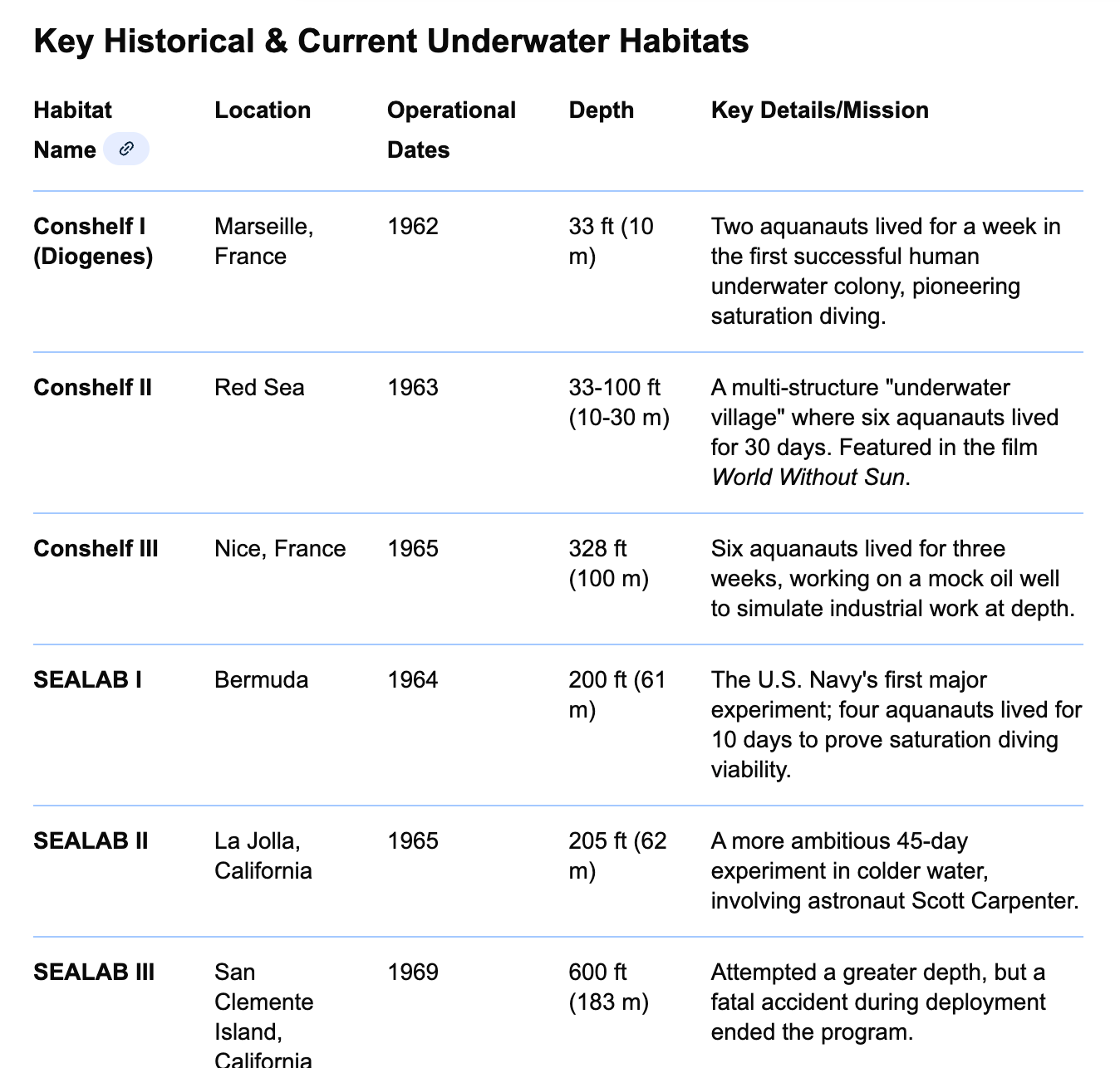
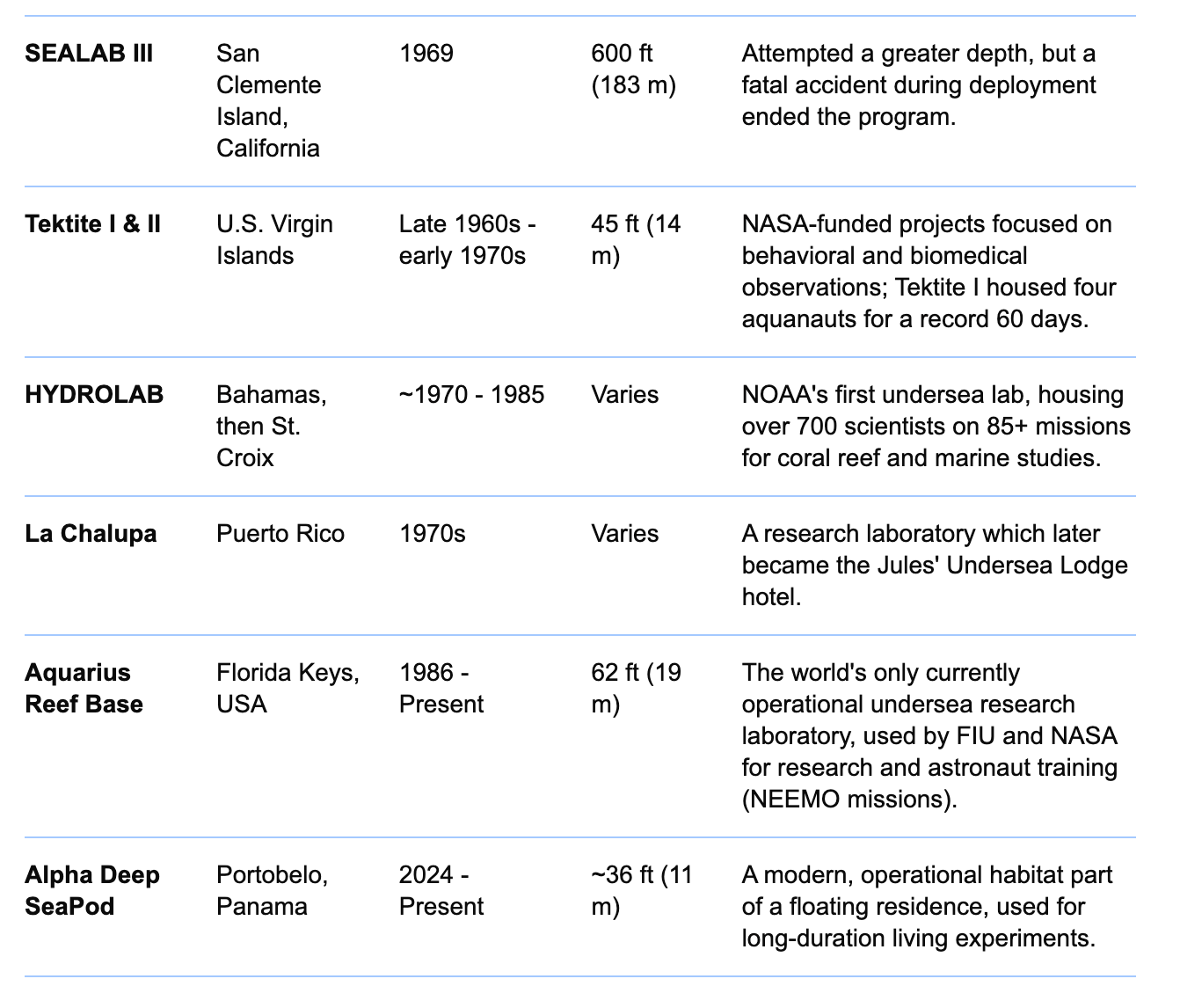
The Decline of Underwater Habitats: Why Surface Operations and Remote Systems Prevailed
The era of underwater habitats effectively ended not because the technology failed, but because it was rendered obsolete by more practical alternatives. While projects like Proteus and DEEP’s Sentinel continue to attract publicity and some funding, the fundamental economics and operational realities favor surface-based diving operations and remotely operated vehicles.
The Prohibitive Cost of Saturation Diving
Underwater habitats require saturation diving—a specialized mode where aquanauts live under pressure for extended periods. This demands extensive surface support infrastructure: pressurized living quarters, medical supervision, decompression chambers, and highly trained technical staff operating around the clock. The ratio of support personnel and equipment to each aquanaut is staggeringly disproportionate to any scientific benefit gained.
Moreover, saturation diving imposes stringent medical requirements that exclude the vast majority of scientists who would otherwise conduct the research themselves. Instead of a marine biologist executing their own experiments, habitats force reliance on a limited pool of medically qualified saturation divers—adding layers of cost, complexity, and communication barriers between the researcher and their work.
Surface-Based Diving: Efficient and Flexible
Modern surface-based scientific diving operations are carefully planned and remarkably efficient. Divers can conduct the necessary bottom time through daily operations without the massive infrastructure overhead of a habitat. Decompression, when needed, is managed through shipboard chambers under medical supervision—far more cost-effective than maintaining a permanent undersea station.
For the depths proposed by current habitat projects (typically 60-200 feet), standard diving protocols already provide adequate access. The notion that continuous 24/7 underwater presence is necessary overstates the actual time required for most marine research, which benefits more from repeated, well-planned visits than from expensive continuous occupation.
The Rise of Remote Systems
Perhaps most significantly, remotely operated vehicles (ROVs) and autonomous underwater vehicles (AUVs) have revolutionized ocean exploration. These systems allow multiple scientists to collaborate in real time from the surface, examining footage, directing operations, and analyzing data together—something impossible when research depends on a single diver’s perspective underwater. Remote systems eliminate human physiological limitations, operate at any depth, require no decompression, and can be deployed for extended periods at a fraction of the cost of supporting human aquanauts.
The Space Analog Argument Has Run Its Course
Proponents once justified habitats as analogs for space exploration, but this rationale has been exhausted by decades of International Space Station operations. The extensive experience of hundreds of astronauts with long-duration spaceflight has rendered underwater training largely redundant for this purpose.
The Verdict
While underwater habitats capture the imagination and generate occasional media attention, they remain what they have become: expensive novelties rather than practical scientific platforms. The rare operational habitat—like the now-defunct Aquarius—existed only through exceptional circumstances and dedicated funding. New proposals may secure initial investments and generate engineering studies, but the operational realities ensure they remain speculative ventures rather than sustainable scientific infrastructure. The ocean continues to be explored, but increasingly from the surface and through robots rather than from seafloor bases.
Known Future Projects
Three underwater habitat projects represent different approaches to living beneath the sea. Fabien Cousteau’s Proteus aims to become an “International Space Station of the sea”—a large research facility that would support long-term studies of climate change, ocean biodiversity, and medicine while also serving as a training ground for space missions. Still in its early stages, the project is working to secure $135 million in funding. DEEP’s Sentinel/Vanguard project is more advanced, having already built a full-scale prototype on land with backing from $100 million in private investment. This habitat is designed to give scientists and commercial divers extended access to the continental shelf, enabling them to live and work underwater for weeks at a time. Finally, Dr. Joseph Dituri’s Project 02 has already accomplished its goal. During the Neptune 100 mission, Dituri spent a record-breaking period underwater in a converted habitat to study how sustained high pressure affects the human body, with results still being analyzed for scientific publication.