

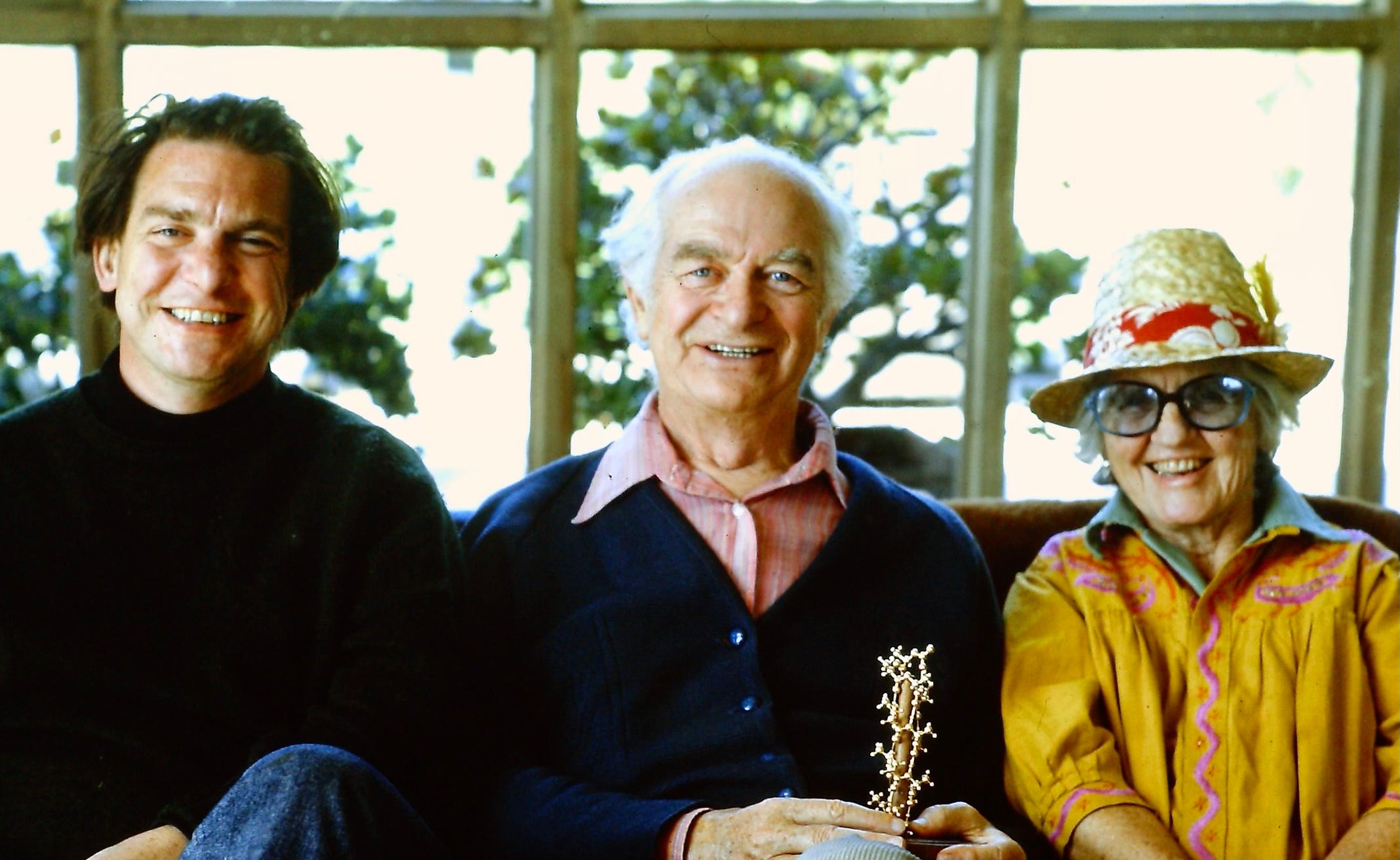
In 1975, I found myself circling a question: what was it about Linus Pauling that characterized him as one of the most influential scientists of the 20th century? At the time, I was working for Maurice Wilkins—the quiet, Third Man of DNA1 —and writing often for New Scientist, which was then edited by the renowned science journalist Bernard Dixon.
When meeting friends at The Lamb and Flag in Covent Garden, we would often discuss scientists who had stepped out of the lab to confront the moral implications of the discoveries of the day. At the time, Wilkins, who had been a Manhattan Project scientist, was the President of the British Society for Social Responsibility in Science, founded at the Royal Society amidst much publicity a couple of years before. In addition to the worldwide threat of nuclear weapons, the moral and social implications of genetic engineering were by now a recognizable storm gathering on the horizon. It was natural for me to be interested in both of these issues. Though at the time, I was only slightly familiar with Pauling’s campaign to halt atmospheric nuclear weapons testing. We were all familiar with his work on how atoms could bond to form molecules, particularly his gift for intuitively identifying important molecular structures, including the helical chain arrangement of ubiquitous protein polypeptides. A discovery that helped resolve the detailed structure of the hemoglobin molecule.2
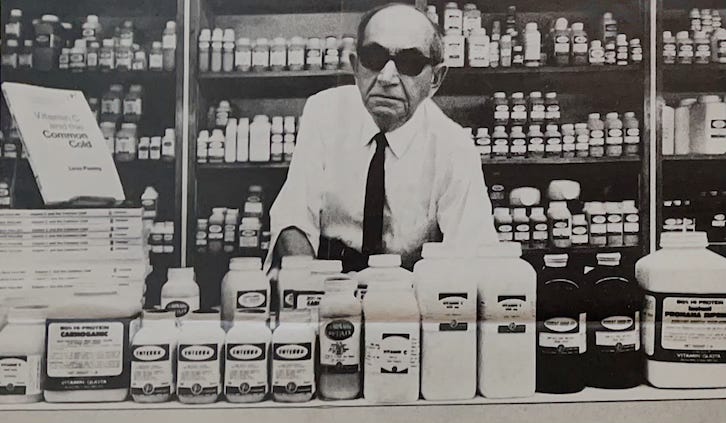
Pauling, with his public campaign against nuclear weapons testing, seemed the icon of a socially responsible scientist. He had used his extraordinary gift for connecting with the public to communicate the threat to future generations posed by exposure to radioactive fallout from atmospheric nuclear weapons testing. And now he was advocating taking massive daily doses of vitamin C to protect against the common cold. He’d recently written a book, “Vitamin C and the Common Cold,” addressed to the general public, advocating the consumption of very high doses of vitamin C, which had become an international best-seller.
My friends thought the idea was worth pursuing. Peter Pauling, whom I knew slightly, agreed. “Have Maurice write to him,” he said. “If Dad checks with me, I’ll back you up.” That was the start of a project that would also mark the beginning of an acrimonious end to Pauling’s association with Arthur Robinson, the director of research at his research institute. Robinson had been a graduate student of Pauling’s at Caltech and a one-time protege, moving to the University of California, San Diego after gaining his doctorate. Robinson and his wife, Lauralee, also a gifted scientist, became close, sharing an interest in Pauling’s ideas for establishing the molecular basis of diseases, an area of research Linus had labeled Orthomolecular, because he was fond of giving Greek names to his ideas, and it helped associate specific notions closely with his thinking. The basic concept that Pauling had been pursuing since 1949, when he and Harvey Itano had identified sickle cell anemia as due to a ‘faulty’ gene. The paper announcing the finding described sickle cell anemia as a ‘molecular disease.’
A decade earlier, in 1941, Pauling had fallen suddenly ill while visiting Cornell University and was diagnosed with a severe failure of kidney function, which was treatable but had no cure. Also, the treatments involved dietary restrictions and drugs, and were not always effective. Now known as Glomerulonephrititis3 was frequently fatal. It was during this period that the Paulings met a Stanford doctor, Thomas Addis, who was a pioneer in the study and treatment of nephrology. The prescribed regimen worked for Paulings, and his condition improved. It’s important to note that GN can go into remission, but is ever-present and can reappear. Thus, from this time forward, health through appropriate nutrition was the ability to manage the ever-present concerns for both husband and wife. They also became very close, becoming lifelong friends until he died in 1949. Towards the end of his career, Addis was ostracized for his radical left-wing views, which did not differ much from those of many other San Francisco Bay Area academics at the time, but in his case included the additional challenge of his being a professed communist.
It ain’t over till it’s over.
The endearing American baseball player’s famous quote has motivated many psychological and sociological studies on defining the characteristics of scientific genius, particularly during the periods of peak creativity and the decline that follows their most excellent work. Some of this is very insightful, but really tricky to apply individually. But it’s fair to say most have made their key contributions within the first half of their careers. By the time Pauling left Caltech for Santa Barbara in 1963, he was 62. Thus, a biographer or historian might assume his most important work was behind him. And regarding Pauling's scientific work, it’s fair to say that this holds. But in Linus’s mind, a new battle lay ahead, one into which it might be said he and his wife carried a longstanding grudge against the establishment medical profession.
Fight the Good Fight
That optimum health was maintained by the appropriate balance of micronutrients in the body. In its popular form, it was promoted by pharmacies as taking vitamin supplements, a profitable business both for the pharmaceutical industry and the pharmacies. The medical profession, however, found the evidential basis for vitamin supplements to be significantly below that required to prevent disease. And thus the foundation of Linus’s last great battle with the establishment - this time, the medical profession was laid.
From the time of his diagnosis with glomerulonephritis in 1941 forward, Pauling’s scientific preoccupations were human health, and this was advanced by the Rockefeller Foundation's research into what would emerge as biochemistry and molecular biology. In which he is a foundational figure. But while Pauling was discovering sickle cell anemia as an inherited disease and using X-ray diffraction to determine the structures of biological molecules, he was under pressure to address the challenges to his valence bond theory posed by the now more favored molecular orbital model. He, of course, refused. This might have been the case regardless, but an aspect of it was that the Molecular Orbital theory's leading proponent, Mulliken, was a close friend of Caltech’s Millikan, whom Pauling also detested. The feelings appear to have been mutual.
By 1963, and with the award of Pauling’s Nobel Peace Prize, relations between Pauling and the Caltech establishment were at breaking point, having been under severe strain for a few years prior. These had reached breaking point with the award of the Nobel Prize. The Caltech President, Lee Dubridge, reflected the collective suspicion that the award would anoint Pauling as administratively untouchable and that his long absences from campus on travel in pursuit of his causes would grow further with no limit. For a few years before the Chemistry Division of Caltech, the division had focused so much on Pauling’s favorite projects, such as anesthesia and sickle cell anemia, that faculty viewed it as impossible to do any chemistry there; the space was all taken up by them. Additionally, graduate students complained that ‘you couldn’t appeal to Linus because he was hardly here.’ Many of Pauling’s biographers have written about the hostile atmosphere on campus between the administration and the new Nobel Prize winner. But from my interviews, I’ve been led to believe that several problems existed. If Caltech openly congratulated Linus on his award, they would fall foul of the government - it wasn’t even clear that the State Department would give him a passport to go to Oslo to collect it. Secondly, having so many brilliant scientists and other Nobel Prize winners on campus created an intensely competitive atmosphere, and unsurprisingly, these glitterati didn’t always see eye to eye. Pauling’s relationship with Oppenheimer fell apart well ahead of the Manhattan Project, and house the Chemistry chief’s position was given to KistiKistakowsky was not invited to join it because Kistakowsky In my interviews with Linus and Peter about this, they both confirmed that by the time Oppenheimer was recruiting on the Caltech campus, Pauling had already committed to an armful of very senior and lucrative consultancy positions, which would require a lot of cross-country rail travel, which Linus loved and was able to use to think, read, and write. Most apparent was that neither Linus nor Ava Helen would want to live in total isolation on a New Mexico mesa, as neighbors of the Opeeheimers had never had the issue of an invitation come up. There’s the issue that Linus and Oppie had a falling out because the latter made a pass at his wife by inviting her to his New Mexico ranch. Before this incident, Pauling and Oppenheimer, who had briefly met in Munich while both were graduate students they became closer at Caltech, where Oppenheimer gave lectures to packed audiences of undergraduates. His appointment to Caltech was part-time and was a position on the Physics faculty that Pauling himself had sought. Oppenheimer’s life is so well recorded, and great movies have been made about him. He had a genuine generosity that would sometimes seem overwhelming. For instance, he gave Pauling his substantial mineral collection from boyhood because he knew Linus would appreciate it - not because of its worth. And such gestures from Oppenheimer often carried no more profound meaning.
It’s recorded that the Caltech administration gave no official reception or acknowledgment of the Peace Prize. The molecular biologists held a tea party for him, but the administration wanted a pound of flesh; they had long desired that Pauling relinquish the chairmanship of the Chemistry division so that it could, in a widely shared view, run more effectively. They were open to having Linus pursue whatever interests he wanted, even to the extent of creating a new department more explicitly aligned with his interests, but this was a power play that the administration would ultimately lose. In my view, it was also sad for Linus, who loved Caltech, and although they truly loved him back, the situation had become untenable and would take many years to heal.
Now missing the iron guardrails of a world-famous institution packed with brilliant scientists and Nobel Prize winners, Linus and Ava Helen took up positions at the Center for the Study of Democratic Institutions. Anyone who had met Linus and Ava Helen for five minutes would know that this was a doomed relationship. However, it was very close to their beloved ranch, and Linus left Caltech with not only his Nobel Prize money but also significant five-year grants from the NSF and others, as well as the stipend from the Santa Barbara center itself. The relationship with the Robinsons in San Diego developed to the point that Linus was persuaded to join UCSD and collaborate with Robinson on his research. Pauling soon discovered that the UCSD administration was unwilling to meet his needs for lab space and resources, and he left to join the chemistry faculty at Stanford through the auspices of his friend and fellow Nobel laureate (2006) Robert Kornberg. Pauling would stay associated with Stanford for the rest of his life, and Caltech would welcome him back for commemorative events. However, Linus could not be distracted from the idea that megadoses of vitamin C were likely to be effective against first the Common Cold, then Cancer, and later still Heart Disease. Stanford, a breeding ground for breathtaking dropouts and entrepreneurs, would not support the expanded lab space Paulings plans required, so they founded, in partnership with Art Robinson, a research institute off campus, first called the Institute for Orthomolecular Medicine, but since that failed to attract enough donors, the name changed to the Linus Pauling Institute for Science and Medicine.
I first met Linus around the time of this transition. It was not apparent to me, partly because the focus of my attention had been his work from 1945 to 1963, that I had arrived at a time when Pauling was at his most frustrated with institutional science, especially medicine, and that it also marked a slow, steady decline, culminating in its closure, relocation, and reopening at Oregon State University. He attended the former Oregon State Agricultural College, where he met his future wife. He was an instructor for her home economics class. He also chopped wood and did any other task he could fit in to help cover the costs of an education. He was, of course, immediately recognized as an extraordinarily talented individual and was being groomed to pursue a graduate education in chemistry, which was also his personal goal.
Following his departure from Caltech, Linus and Ava Helen carefully considered where they would donate their papers. They chose their alma mater, Oregon State University, and, over 20 years and three university presidents, Linus and his wife eventually successfully negotiated the donation of their collections to a purpose-built archive and research center.
Who’s Going To Right This Ship?
Pauling’s Institute in Palo Alto and his scientific legacy were successfully rescued before his death in 1994 by the efforts of his son, who joined Institute’s board and took on a key role from his ailing father to save the organization from bankruptcy and to enable the transfer of his papers and an endowment to set up the institutite in his fatheer’s name on a solid foundation for research into nutition and micronutrients. However, the institute's troubles with its attempts at cancer research, due to inadequate funding and resources, were widely known. A long time associate of Pauling Emile Zuckandl came back to from France to join Pauling in an effort to turn the institute away from clinical trials for which it was ill equipped to carry out and towards a center for the study of molecular disease and a more theoretical and scientifically and experimentally-based organization, Though Zuckndl headed Pauling’s institute for a while he could not pull him away from his by now obsession with proving through clinical trials, the efficacy of vitamin C in treating not only cancer but all manner of diseases. Zuckndl gave up the task and returned to France. All of these events left Linus Jr. with the task of settling lawsuits from Art Robinson, Mattias Rath4, and the only other collaborator, surgeon Ewan Cameron, who remained loyal to Pauling throughout his long battle with the Mayo Clinic, which ran “conclusive” trials showing that vitamin C had no beneficial effect for terminal cancer patients. Pauling complained bitterly that the protocols used by the Mayo trial were inappropriate for terminal cancer patients. This observation would take another twenty years to prove that he was right.
The Turning Point
Over two years, I came to know Linus and Ava Helen Pauling well enough to admire them and to visit the Institute he had recently founded near the Stanford University campus. It was intended as a haven for independent research and humanitarian science. But it was founded out of frustration. Since leaving Caltech in 1963 after receiving the Nobel Peace Prize, Pauling had first moved to the prestigious Santa Barbara think tank, but grew restless without the stimulation of interacting with scientific minds that would have surrounded him at Caltech. In 1977, whispers of disarray: funding shortfalls, blurred boundaries between research and advocacy, tensions between Pauling and his associate Art Robinson were swirling around the staff of the institute during my visits.
So desperate were the funding needs that Pauling wrote to Linus Jr.'s first wife (they were divorced by 1960), Anita Oser, an heiress who now lived in Paris with her children, to request financial support. She was very fond of Linus and frequently helped out.
The decision to write about the institute's problems was a complicated one. It was obvious that it would be problematic for my relationship with both Linus and Ava Helen. I talked to Peter about what he knew about the Institute, and he had very little. On hearing what I had learned he said “well, I guess I’m not surprised” And I asked if he would be upset with me if I went ahead as I was being encouraged to do by New Scientist and his response was “No, you know Dad is not the person you think he is” It was a familiar statemtent from Peter to people who complained to him about his father. He had his own challenges, and the fact that Linus Jr. and Peter chose to live far away to stay closely involved with their Dad was worth noting.
Bernard Dixon of New Scientist asked me to write an investigative story, not a tribute. It was a painful commission. I had wanted to write about the brilliance of Pauling’s intuition, not about his fragility. Still, when I began checking the information —speaking further with Institute staff, colleagues, and several of Pauling’s own board members—the pattern was undeniable. I told Wilkins that the story would likely cause trouble for him as he’d initially written my introduction to Linus. He said quietly that truth should not depend on personal convenience. “If it’s right, publish it.” Bernard Dixon promised rigorous editorial oversight and, true to form, insisted that every detail be verified.
The Decision
Before the article went to press, I spoke with Peter Pauling again. He was cautious but not surprised. “This happens to Dad,” he said. “He won’t listen to the people he needs to.” We knew then that whatever personal goodwill existed between me and his Mom and Dad, publishing the piece would end my contact with his father. We had considered the reaction to talking with Linus before the article and thought it would be the same either before or after publication.
The article appeared. The response was immediate. Pauling was furious— first at Maurice Wilkins, then at New Scientist. He was upset with the NIH Cancer Division for speaking with me, but he would not ask me to verify anything in the article, even the whole thing, for falsehoods. He wrote angry letters, publicly and privately. And of course, he sued New Scientist and, as was the pattern, lost. I received notes from several of his board members, most memorably from Sir Max Perutz, who told me he had joined the board out of respect for Linus but had long feared something like this would occur. “I hope,” he wrote, “that this shock makes him pause.”
Science, Faith, and Responsibility
It did not. Pauling doubled down—defending Robinson even as he was trying to remove him for financial mismanagement, and insisting that the vitamin C program would vindicate him. The Institute’s work on vitamin C as a cancer therapy had begun to slide from speculation into belief. Pauling’s conviction that megadoses could treat or prevent cancer attracted worldwide attention —and millions believed him. For a man whose career had been built on evidence, the turn toward unprovable biochemical salvation was bewildering.
I’ve always regretted making Linus mad at me, but not about publishing the article. By the time I published the article, Linus, known by his peers, had become very real to me. Writing the article was, for me, a boundary I could not ignore. The same conscience that had driven Pauling to oppose nuclear testing—a cause verifiable and morally unassailable—was now leading him into territory where hope had overtaken the need for proof. The harm was not theoretical: desperate patients were forgoing medical treatment in favor of faith in a great man’s certainty.
Aftermath and Perspective
The fallout ended any thought of the biography I had once planned. I remained on cordial terms with Peter Pauling, whose generosity never wavered. “You did what you had to,” he said. “Dad’s genius was real, but so is his stubbornness.”
Looking back, I realize that what interested me then—and still does—is not simply Pauling’s brilliance but the tension between his genius and his humanity. He believed science existed to improve the human condition. That conviction fueled both his most significant achievements and his most damaging errors.
The canon of Pauling’s biographers has, in my view, mostly failed to strike that balance. They have chronicled his discoveries and his crusades, but few have captured the moment when moral certainty began to eclipse scientific discipline. That was the turning point I witnessed, and the story I have tried to tell here.
Postscript
When Bernard Dixon later reviewed Anthony Serafini’s biography of Pauling, he noted that Linus, after the publication of my article, had demanded that New Scientist publish an equal-length retraction, defending Robinson at a time when he himself was preparing to oust him.5 The irony was not lost on anyone. Dixon did not agree to publish any retraction, but he did allow Pauling to defend Robinson and to reply to the article. Years later, Bernard wrote, “Pauling stoutly defended Robinson in a reply on 12 January 1978. But as we now know, just five months later, he stormed into Robinson’s office, demanded his resignation, plunging the institution into legal costs of up to $200 000 a year over five years. The legal battle lasted until 1983 and concluded with an out-of-court settlement in which the Linus Pauling Institute of Science and Medicine paid Robinson $575,000.
History will continue celebrating Pauling’s genius, as it should. But it should also be remembered that even the most outstanding scientists are vulnerable to the seductions of certainty. The line between faith and evidence is a bright one. Crossing it, for me, ended a friendship with Linus and Ava Helen that was always warm and kind. I continued to be in touch with Peter, who, some years later, moved to live in and restore an old mill house in Wales. Linus Jr. visited Peter there, but I never met the junior Linus, whose enormous commitment has saved a meaningful legacy.
© 2025 Farooq Hussain
Wilkins, Maurice. The Third Man of the Double Helix: The Autobiography of Maurice Wilkins. Oxford University Press, 2003
My activities at King’s are recorded in the papers of M H F Wilkins: Papers relating to the work of Farooq Hussain, chiefly in marine mammal communication, defence, and history of science. Wellcome Collection https://wellcomecollection.org/works/mbuky59c
The alpha helix structure, published by Pauling, Corey, and Branson in 1951, was among the earliest and most important discoveries in the emerging field of molecular biology. By correctly predicting the coiled-coil backbone structure that many polypeptide chains adopt, Pauling and his colleagues provided the essential framework for understanding protein architecture. Max Perutz’s subsequent determination of hemoglobin’s three-dimensional structure in 1960 confirmed that roughly 75% of the molecule consisted of alpha helices, directly validating Pauling’s theoretical prediction and demonstrating how this fundamental structural motif enables hemoglobin’s oxygen-binding function. The discovery added to the already iconic lustre of Pauling’s scientific genius.
Glomerulonephritis (GN) is not a single disease but a group of diseases characterized by inflammation of the glomeruli, the tiny filtering units of the kidneys.
At the end of his career, Stanford University took away Addis’s laboratory, perhaps on account of his leftist political views. He supported the loyalists in the Spanish Revolution and was chairman of the San Francisco chapter of the Spanish Refugee Appeal, an organization that aided refugees from Franco’s Spain. Addis toured the Soviet Union in 1935 and was impressed by the country’s medical accomplishments. He was friends with Harry Bridges and other left-wingers. Addis was chairman of the San Francisco chapter of the Physicians’ Forum, an organization that supported national health insurance. Shortly before his death, he was expelled from the American Medical Association for refusing to pay his annual membership fee, which he did to protest the AMA’s lack of support for President Truman’s national health insurance plan. Addis died at the age of 67 following surgery in Los Angeles.
Linus Pauling’s final decades were marked by costly internal turmoil and legal disputes that reflected his declining administrative control and personal vulnerability. The first conflict involved his former protégé, Art Robinson, whose 1978 dismissal as President of the Linus Pauling Institute of Science and Medicine (LPISM) led to a protracted lawsuit. This dispute was settled out of court in March 1983, with the LPISM paying Arthur and Laurelee Robinson a substantial $575,000 (including $425,000 for libel and slander claims); Pauling stated the resolution was “cheaper than to continue.” The second conflict with researcher Matthias Rath over intellectual property rights was settled in 1994. Although the LPISM won, receiving a $75,000 payment from Rath, the human cost was evident: Rath deposed the gravely ill Pauling at his Deer Flat Ranch just months before Pauling’s death on August 19, 1994, demonstrating the extent of his late-life exploitation.
Bernard Dixon, Review: Feet of clay / Review of ‘Linus Pauling: A Man and his Science’ by Anthony Serafini, New Scientist, 9 December 1989