

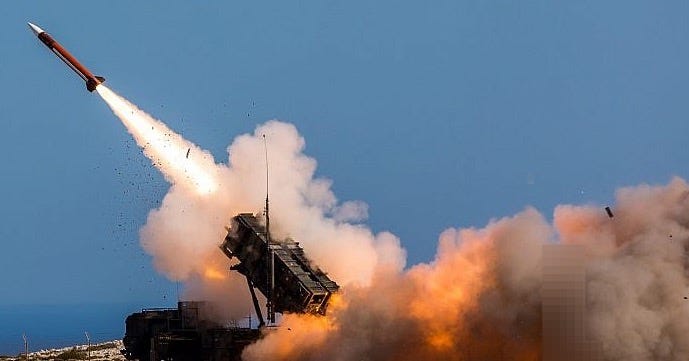
On July 8, at the NATO summit in Ankara, Donald Trump told Volodymyr Zelensky that the United States would grant Ukraine a license to build Patriot air-defense missiles. He called it “pretty cool.” It is considerably more than that. If it goes forward, Ukraine will become only the third country on earth — after Japan and Germany — permitted to manufacture America’s most capable air-defense system on its own soil. Poland, a NATO member for a quarter-century, has spent seven years and counting trying to qualify to build a single component of the same missile. Ukraine, mid-invasion, has apparently been offered the whole license outright.
That gap — between what a treaty ally has had to earn in years and what a non-member has been handed in a single afternoon — is the right place to start a series about NATO’s nuclear age, because it isn’t really a story about Patriot missiles at all. It’s a story about how the West decides who is trusted with its most sensitive technology, and about a country that once held that trust at the highest possible level, was made to give it up, and is only now beginning to get pieces of it back.
Ukraine’s inherited nuclear knowledge
Before it was a country invaded by a neighbor and in desperate need of munitions and economic support, Ukraine was, briefly, the third-largest nuclear power on the planet. At independence in 1991, it inherited roughly 1,900 strategic warheads and 176 ICBMs from the collapsing Soviet arsenal, along with strategic bomber fleets based at Priluki and Uzin — more warheads by count than Britain, France, and China combined. This wasn’t a peripheral Soviet holding. Ukraine sat at the core of Soviet strategic force planning, and its engineers, technicians, and military planners possessed operational knowledge of that architecture firsthand.
That knowledge didn’t evaporate when the warheads went back to Russia between 1992 and 1996. Ukraine retains, in its institutional memory and almost certainly in its ongoing intelligence collection, a depth of insight into Soviet-legacy nuclear planning and operations that very few states can claim — layered on top of decades of hands-on expertise running nuclear power reactors at Chornobyl and Zaporizhzhia, expertise that includes, uniquely, direct experience of what catastrophic reactor failure and battlefield seizure of live nuclear infrastructure actually look like. On the narrower question of whether Ukraine could, today, design and build a weapon independently, its technical capacity is no greater and no less than that of several other European states that have chosen not to. What sets Ukraine apart is not latent capability. It’s lived history with the thing itself, from the inside, at a scale no other European state can match.
The Budapest Memorandum
Ukraine gave up that arsenal in exchange for a specific written guarantee. The Budapest Memorandum, signed in December 1994, bound the United States, the United Kingdom, and Russia to respect Ukraine’s existing borders and refrain from the threat or use of force against it. France and China issued separate, weaker unilateral assurances rather than co-signing the memorandum itself — a distinction worth holding onto, because it means the failure that followed wasn’t a diffuse “Europe” failing to honor a vague promise. It was three specific capitals — Washington, London, Moscow — that owed Ukraine something concrete. One of them broke it outright in 2014, annexing Crimea. The other two did not enforce it.
Ukraine’s military performance and the NATO threat-assessment problem
Something else happened after 2022 that nobody in NATO planning circles had gamed as plausible: Ukraine held. For decades, NATO’s entire Cold War force posture assumed a Warsaw Pact armored thrust into Western Europe would be effectively unstoppable in its opening days — the alliance’s founding operational premise was to trade space for time until American reinforcement could cross the Atlantic. Ukraine, fighting with less and qualitatively inferior equipment against a numerically superior force employing the doctrinal descendant of that same Soviet armor, did what NATO’s own planners had never modeled as possible for NATO itself.
Lawrence Freedman has reviewed analysts’ assessments of the likely outcome of a Russian invasion of Ukraine. In his view, ‘analysts portrayed war as a matter of equipment and doctrine, something that could be planned and executed, more as a complex engineering project than as a contest of will, military skill, and personalities. Their misjudgment was not a case of normal error or exaggeration. The expert community grossly overestimated Russian military capabilities, dismissed the chances of Ukraine resisting effectively, and presented the likely outcome of the war as quick and decisive.’1
I have a personal stake in explaining why this surprised the alliance as much as it did. In the years I spent at SHAPE Technical Center, we supported the annual exercise by modeling a full Warsaw Pact invasion of Western Europe — and we were instructed — not left to our own judgment — on the capabilities of the Soviet and satellite forces provided to us. These were well beyond what any of us privately believed reflected the ground truth found in open sources. The result, every year, was the same: NATO overrun within days. I worked for an organization whose role was to provide scientific and technical advice to SACEUR, so assessments concluding that Warsaw Pact cohesion was fragile and its equipment mediocre were unlikely to be appreciated. That conclusion would have undercut the very case the alliance needed to make to skeptical parliaments about force levels and burden-sharing. The threat inflation wasn’t a modeling error. It was the product the institution required. I don’t claim any credit for saying so then or now — I wasn’t a whistleblower, more a dog whistle sounding within the register of a foghorn, audible mainly to myself. But I mention it because, in 2022, Ukraine did the empirical work that decades of NATO staff work had never been structured to do honestly: it tested the assumption, in the open, against the actual army it was built to model.
NATO’s “out of area” irony
There’s a further irony worth naming. This is an alliance that spent its first four decades refusing, on principle, to act “out of area” — its founding purpose confined strictly to collective defense within the treaty’s own boundaries — before being drawn into Afghanistan under Article 5’s only invocation to date. It has now spent going on four years wrangling internally over how to support a country defending exactly the kind of home territory NATO was built to defend, against exactly the kind of adversary it was built to deter — and doing so more effectively, with less, than the alliance’s own planning assumptions ever credited as possible.
The Patriot announcement and what it actually means
Which brings us back to Ankara. Patriot is a genuinely multinational weapon already — built nowhere entirely, assembled everywhere from an international supply chain: Lockheed Martin manufactures the PAC-3 interceptor in Arkansas, Raytheon builds the radar and command architecture, Japan’s Mitsubishi Heavy Industries has produced PAC-3 interceptors under license for years (and shipped some back to the US last November to help replenish stocks drawn down by Ukraine transfers), Germany is opening a new assembly line for the older PAC-2 variant this September. Eighteen countries beyond the United States operate the system, spanning Europe, the Gulf, and the Asia-Pacific. It is, by any measure, one of the most trusted pieces of American military technology in the world — trusted enough to be built, in pieces, by exactly two allies in seventy years of the program’s existence.
Ukraine would be the third. Not because it has spent decades qualifying for the license, the way Poland has spent seven years and counting certifying a single component. But because four years of demonstrated performance — against the very force NATO spent the Cold War failing to accurately assess — appears to have done what decades of alliance membership have yet to do for Warsaw: earned Kyiv, mid-war, a level of technological trust that the alliance extends to almost no one.
That asymmetry — a non-member trusted faster than a member — is where this series begins. It is also where Poland belongs in the story from the outset, not as a footnote to be added later: a state that has never been struck by Russia, negotiating carefully for coverage it may not get quickly, standing next to a state that was struck twice and is being offered, at least in promise, what Poland is still waiting for.
As we track these issues in the months ahead, we’ll trace how we got to a Europe where that asymmetry is possible — how American nuclear guarantees kept the continent from building its own weapons for seventy years, how that guarantee has frayed, and where Ukraine’s technical inheritance, once forfeited, might yet find a new role in whatever architecture replaces it.
© 2026 Farooq Hussain
Freedman, Lawrence, Assessing the Assessors, What did analysts get wrong about the Russian invasion?, Comment is Freed, Oct 16, 2024