

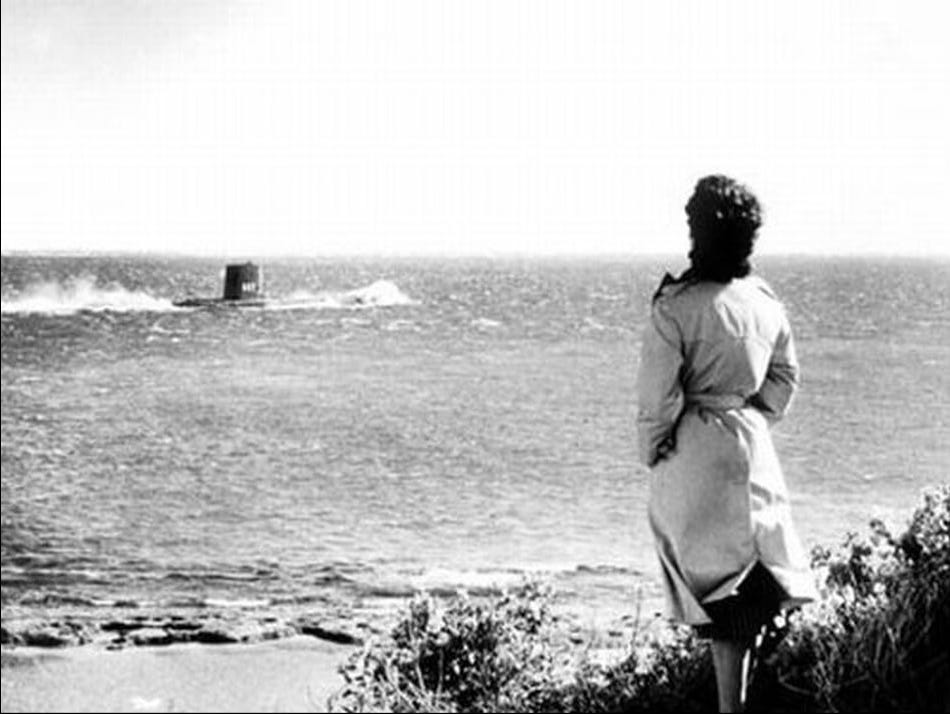
Australia is no stranger to being the center of attention when it comes to the topic of nuclear war. Neville Shute a Brit, who moved to Australia after WWII, wrote a dystopian novel about the outcome of such an American Soviet holocaust whose pervasive spread of death slowly but inevitably engulfs the Australian continent and finally strangulates the society of Melbourne where the novel’s characters are based. An enormously successful book, it was made into an equally successful movie, On the Beach. The movie starred Ava Gardner who when interviewed on a beautiful local beach is famously reported to have said that “Melbourne is a perfect place to make a movie about the end of the world.” On the Beach, and Neville Shute, are now embedded in the Oz ethos. Many years after the Hollywood film came an Australian produced TV mini-series, compulsive viewing in its own way, but not the classic made in 1959.1
When Idealism Met Reality in the Quest to Forgo Nuclear Weapons
After the first test of the atomic bomb in the New Mexico desert in July 1945, Robert Oppenheimer is supposed to have said “I have become death, destroyer of worlds” quoting from the Sanskrit scripture the Bhagavad Gita. But spoiler alert, Oppie as he was called, did not say this at the time but in a TV interview with NBC years later for a documentary being made about the Manhattan Project. No matter, everyone at the test felt the emotion of success, pride in the achievement, as well as struck with the dreadful importance of what they had done.
In the immediate aftermath of Hiroshima and Nagasaki, it was not just scientists and strategists, but also moral leaders, who sounded the alarm. The 1956 Einstein-Russell Manifesto stands as a towering testament to this early, profound awakening.2 A stark, chilling appeal drafted by Bertrand Russell and signed by eleven eminent scientists, including Albert Einstein just days before his death, it was a clarion call for humanity to choose between continued progress and universal death. It laid bare the terrifying new reality of the hydrogen bomb and implored nations to find peaceful means for the settlement of all disputes, arguing that nuclear weapons simply rendered war an impossibility. This was idealism, yes, but idealism rooted in a terrifying, existential truth – a foundational moment in the global movement to forgo nuclear weapons.
Fast forward four decades. The Cold War was over, the existential dread of a a nuclear war had lessened, but the weapons themselves remained. In 1996, the Australian PM Paul Keating, appointed Foreign Minister Gareth Evans, to set up an ambitious, high-profile initiative: the Canberra Commission on the Elimination of Nuclear Weapons.
A Missed Opportunity for Nuclear Disarmament
In the wake of the Soviet Union's 1992 collapse, a fleeting window appeared for significant strides in nuclear disarmament. Yet, even as this opportunity emerged, the nuclear club had expanded to include India, Pakistan, Israel, and North Korea, that would not test until 2006, but had an established a nuclear weapons program at this time and had threatened to withdraw from the Nuclear Non-Proliferation Treaty furthering suspicions that it planned to develop nuclear weapons. Disappointingly, the Commission avoided addressing directly the issues presented by “near nuclear” countries like North Korea and Iran. Though the full extent of the support provided to Iran by Pakistan’s A.Q. Khan network was not yet publicly known, Iran was indeed actively pursuing a nuclear weapons capability, significantly aided by the illicit transfers of technology and information through Pakistan’s lead nuclear weapons scientist. This made Iran in addition to North Korea, a country of serious proliferation concern at that time.
The Commission chose not to address how the impending the challenges of the prospect of North Korea and Iran emerging as nuclear weapons states choosing instead to tackle proliferation more obliquely. Plagued by fundamental flaws from its inception. The Commission struggled with a lack of international credibility and, crucially, failed to secure participation from any of the established nuclear weapons states.
There was a genuine chance for the Australian initiative to truly represent the concerns of non-nuclear nations, including those in the Americas and Africa. Unfortunately, this opportunity was squandered. The Commission's ranks were filled with celebrities and individuals possessing marginal credibility or technical expertise on the intricate issues of nuclear arms. This became glaringly evident in their final report, which contained a rather toothless appeal:
"The members of the Canberra Commission call upon the United States, Russia, the United Kingdom, France and China to give the lead by committing themselves, unequivocally, to the elimination of all nuclear weapons." This was a sentiment that hardly necessitated the convening of a special commission to articulate.
The Canberra Commission, then, stands as a poignant example in the long and often disheartening history of failed attempts to reduce or eliminate nuclear weapons. This is especially true for initiatives that might be characterized as ‘high level’ compared with the success of grass roots campaigns such as those that brought about the banning of atmospheric nuclear weapons testing and the extraordinary campaign of ICAN in support of the UN treaty to ban nuclear weapons for which it was recognized with the 2017 Nobel Prize for Peace.
With the hindsight of history the Canberra Commission is just another misfired attempt to bring threat of nuclear weapons and their proliferation under control - a chapter in disarmament history that is now, mostly forgotten. And perhaps, for good reason.
The core problem lay in its very composition. For an issue of such profound international significance, where Australia lacked the credentials to lead unilaterally, the Commission's membership appeared less like a body of direct stakeholders or deeply informed subject matter experts and more like an gathering of global celebrities at a film festival, including figures like undersea explorer turned environmentalist Jacques Cousteau. While such individuals undoubtedly possessed immense public appeal, their presence overshadowed, or indeed outright excluded, the voices that arguably should have been central. Pacific Islanders still suffering the devastating, intergenerational health consequences of nuclear testing, or representatives from non-nuclear nations who had actively considered, then judiciously decided against, pursuing nuclear weapons themselves.
Instead, what emerged from this effort was a "quasi-RAND from down under." It felt less like a pragmatic, politically astute body genuinely grappling with the somber mechanics and geopolitical realities of nuclear arsenals, and more like an academic exercise, a well-meaning but ultimately a detached policy prescription delivered from afar. The result? Despite its high profile and official promotion, the Canberra Commission struggled to be noticed by the very nuclear powers it sought to influence. It failed to gain the necessary traction, seen perhaps as more symbolic than substantive, lacking the deep, grounded credibility that only direct experience or unparalleled strategic insight could provide.
The Past as Prologue
The story of the Canberra Commission on the Elimination of Nuclear Weapons 3 serves as a powerful cautionary tale. It highlights that in the complex, perilous world of nuclear weapons, good intentions and public relations, while valuable for raising awareness, are not sufficient. Real change demands a different kind of engagement – one built on hard-nosed pragmatism, a profound understanding of the scientific and engineering challenges, and an unshakeable commitment to real-world solutions.
This brings us directly to the more effective, albeit less heralded, battles fought by figures who genuinely moved the needle. In an earlier Aridane "Dismantling the Big One," we've explored the practical, often painstaking work of strategic arms control between the United States and Russia. And in my tributes to giants like Dick Garwin and Sid Drell, we've seen how true scientific rigor, combined with an unwavering moral compass and a deep strategic understanding, can forge pathways to a safer world. These are the individuals who understood that the devil was not just in the details, but in the physics, the engineering, and the daunting political will required to turn abstract ideals into tangible progress.
Today the story of the Canberra Commission isn't one of outright failure, perhaps, but rather a crucial lesson in the evolving strategy of furthering nuclear arms reduction and their eventual elimination.4 It underscored that while the moral imperative articulated by Einstein-Russell Memorandum remains paramount, the path to a world free of nuclear weapons demands far more than just celebrity endorsement or academic theorizing. It requires the relentless, often unglamorous, work of those who truly understand the beast they seek to tame. And it is to their often-unsung efforts that we now turn our focus.
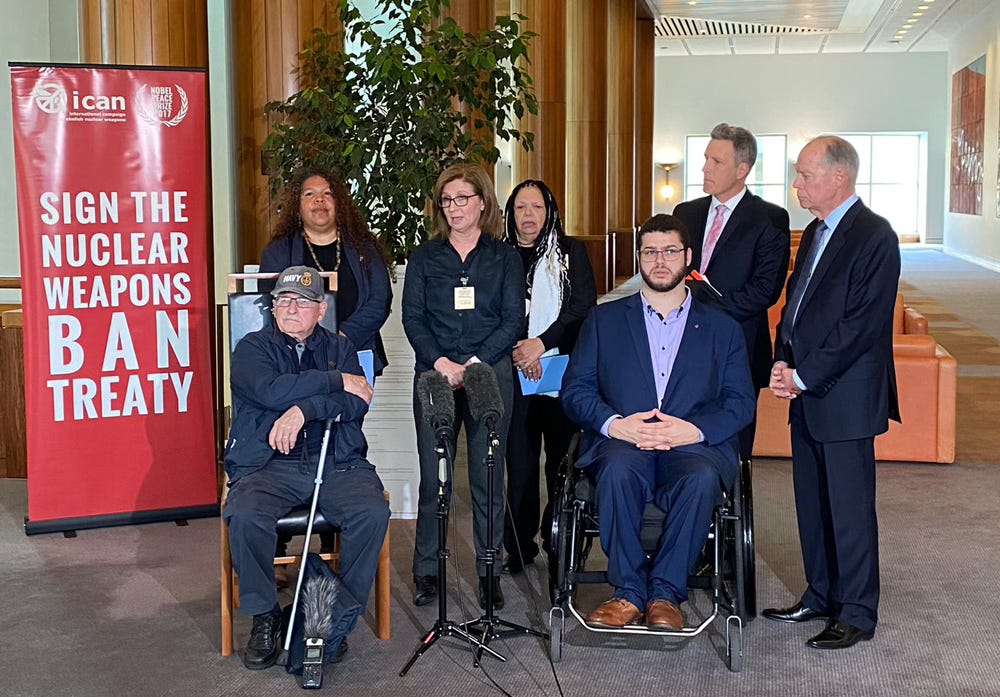
The picture above captures four remarkable individuals—Karina Lester, June Lennon, Doug Brooks, and Maxine Goodwin—who journeyed to Parliament House in Canberra in June 2023. Unlike the celebrity appointees of the 1996 Canberra Commission, these are real people who know intimately the devastating personal impacts of nuclear weapons testing: on physical health, mental health, and their ancestral lands. They brought their profound expertise and raw, personal testimonies, urgently pleading for Australia to sign and ratify the Treaty on the Prohibition of Nuclear Weapons.
They met with the Foreign Minister, representatives from the Prime Minister's office, Assistant Ministers, and parliamentarians from across the political spectrum. They conducted media and press interviews. Each delegate shared their lived experience: the shock of witnessing a nuclear test, the post-traumatic stress that followed, the oily black mist that coated and poisoned the land, the wide range of mental and physical health impacts, the tragic loss of loved ones, and the enduring pain of unrecognized suffering, unaccountability, and government deception. They passionately argued that Australia must join the ban to prevent such humanitarian harm from ever happening again. Furthermore, they emphasized Australia's obligation under Articles 6 & 7 of the TPNW to provide assistance to victims and remediate impacted environments. For them, this issue is profoundly about the past, the present, and the future.
Decades after the Canberra Commission's well-intentioned but ultimately ineffectual "appeal" for nuclear disarmament, its legacy as a high-level "junket" yielding little concrete change continues to haunt the conversation. Even with the International Campaign to Abolish Nuclear Weapons (ICAN)—a Melbourne-born group, echoing the powerful Australian setting of On the Beach—winning the 2017 Nobel Peace Prize for striving for the very goals the Commission articulated, Australia's Parliament still hasn't offered an honest explanation for being a persistent holdout and non-signatory to the TPNW. This is the very kernel of the 1996 Commission’s plea to the US, Russia, Britain, France, and China. Yet, despite such convincing evidence and the global recognition of the TPNW, Australia remains steadfastly outside the treaty. It's clear Australia is impacting the international discussion on the fate of nuclear weapons, but seemingly from the grass-roots up, not from the top down.
Neville Shute's dystopian novel On the Beach (1957) resonated profoundly worldwide, quickly becoming an international bestseller due to its chilling depiction of humanity's final days after a nuclear war. Its success was amplified by the highly acclaimed 1959 film adaptation starring Gregory Peck and Ava Gardner, which further cemented its place in public consciousness and fueled anti-nuclear sentiment. In Australia, where much of the story is set, the book and film held particular significance, exploring themes of isolation and the futility of escape from global catastrophe. The novel's enduring relevance was underscored by a 2000 Australian television mini-series, demonstrating its lasting cultural impact and its continued power to evoke discussions about nuclear proliferation and human survival.
Einstein died before the manifesto was published. But the collaboration between these intellectual giants remains a historic moment in the history of nuclear weapons. The manifesto begins “In the tragic situation which confronts humanity, we feel that scientists should assemble in conference to appraise the perils that have arisen as a result of the development of weapons of mass destruction, and to discuss a resolution..” The full manifesto can be read at the Atomic Heritage Foundation website here
The Canberra Commission on the Elimination of Nuclear Weapons was established in 1996 by the Australian government to assess the threat of nuclear weapons and recommend pathways towards their elimination. The final report can be read here
In 2017, over 120 states at the United Nations voted to adopt the United Nations Treaty on the Prohibition of Nuclear Weapons (TPNW), a landmark agreement that makes nuclear weapons illegal under international humanitarian law. The TPNW opened for signature on September 20, 2017, and officially entered into force on January 22, 2021. It now boasts 92 state signatures.
Interestingly, despite Australia not being a party to the treaty, the International Campaign to Abolish Nuclear Weapons (ICAN), the group awarded the 2017 Nobel Peace Prize for its tireless advocacy campaign for the TPNW, was actually founded in Melbourne. This marks the first and only time an Australian-born group has received the Nobel Peace Prize.
In future Ariadne’s we will be tracking the main initiatives that have attempted to advance nuclear arms control and the eventual elimination of nuclear weapons including the most iconic perhaps being the 1986 summit meeting between Presidents Reagan and Gorbachov in Reykjavik,Iceland. Also, of interest to readers would be the video released by Tulsi Gabbard, the US Director of National Intelligence that is focussed on the seriousness of the issue and the importance of giving it priority. This is viewable on YouTube here
As New START expires without a successor, strategic stability will depend less on new treaties than on practical, reciprocal limits that can keep pace with nuclear innovation.
The Last Treaty: Nuclear Weapons Innovation and What Comes Next — Farooq Hussain (Amazon, next month)