

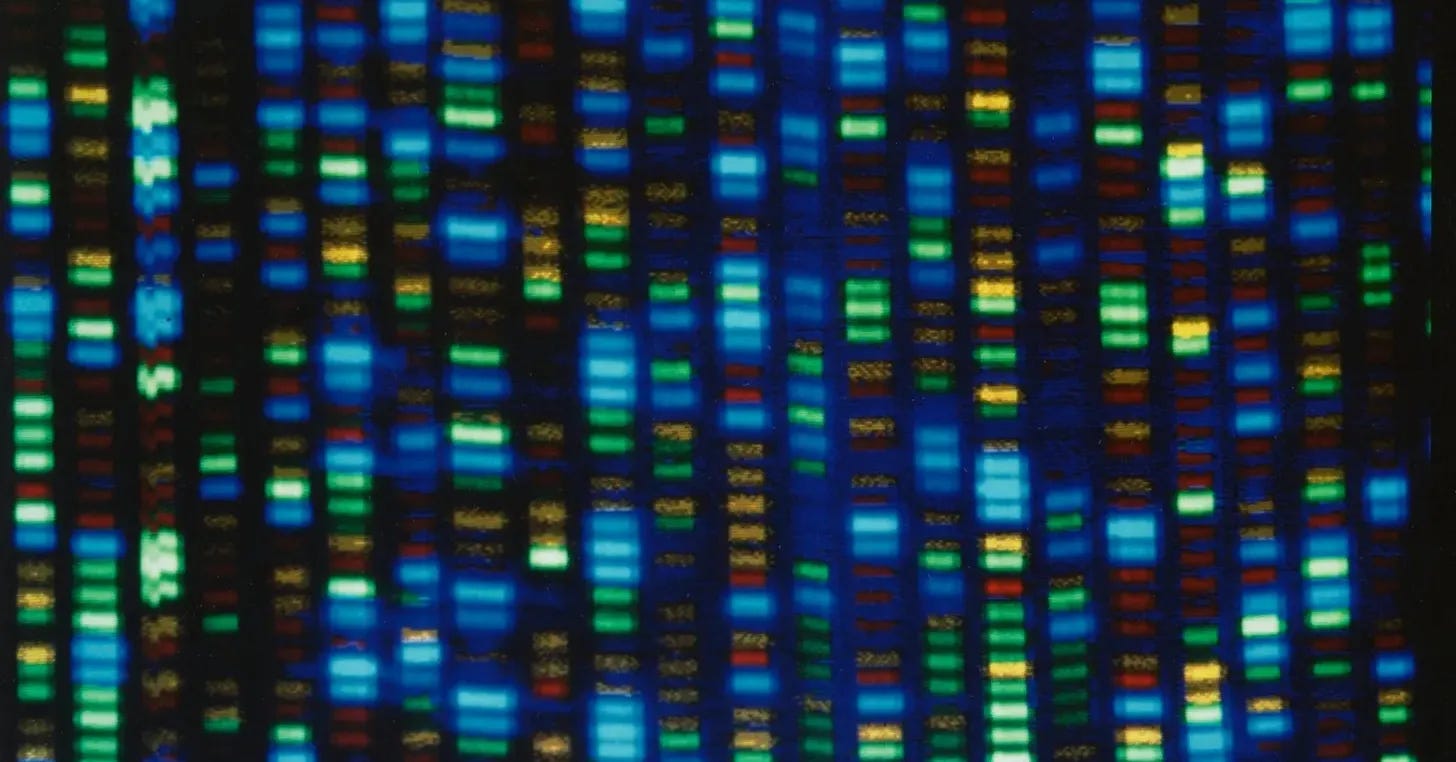
Oxford University Press has issued a 50th-anniversary edition of The Selfish Gene, with a new epilogue and an appendix — the latter a personal tribute to A.G. Lowndes, the schoolmaster who first taught Dawkins biology — alongside extracts from the book's original reviews. Richard Dawkins, now eighty-five, is drawing packed audiences across the UK and Australia, extending the "Final Bow" farewell tour he began in 2024
The making of a man of letters
The popular science press has greeted the fiftieth anniversary of The Selfish Gene with the retrospectives you would expect — celebratory, often fawning, a lap of honor for a book that has sold millions of copies and made its author famous. A closer look at the half-century tells a different story: a man who built an exquisite rhetorical cage, became trapped inside it, and spent the next fifty years mistaking his own echo for a conversation.
Evolution has never been received as biology alone. From the moment Darwin conceived it, natural selection was read for what it was held to imply — for human nature, morality, politics, religion, and the standing of the cultures that produced it. The biology has advanced in a steady stream of corroboration; the argument, from the beginning, has been about everything the science was thought to mean. The Selfish Gene is one episode in that long tradition, and Richard Dawkins has spent half a century insisting on the science while doing most of his actual work in precisely the cultural and moral arenas where evolution was always being read for something other than itself.
And unlike the theory it champions — absorbed, in the end, almost by stealth — The Selfish Gene arrived in a maelstrom of sensation. That was by design, and the design is the key to the man.
The Sorcerer’s Apprentice
When Dawkins first proposed his idea — not in a scientific paper but as a popular book — he suggested that genes, the basic functional units of heredity, displayed a characteristic he also chose for his title: they were selfish. He later recounted that a publisher had pressed him to consider “immortal” as a less downbeat alternative, one that still conveyed the relentless pursuit of replication the gene represented. Dawkins was convinced that “selfish” was the right choice. In personifying the gene, he did two things at once — he gave it agency, a deliberate and fertile anthropomorphism, and he lent the fundamental unit of life a human vice. The vice is what made the book readable. It is also what made it explode.
We are survival machines — robot vehicles blindly programmed to preserve the selfish molecules known as genes. … We are born selfish.
— Richard Dawkins, The Selfish Gene, 1976
The choice was not neutral, and it did not go unchallenged. When the book appeared in 1976, it triggered a historic feud with the philosopher Mary Midgley, who argued that Dawkins was not deploying a benign metaphor but smuggling an ideological worldview into evolutionary biology — “crude, cheap, blurred genetics,” she wrote, “propping up crude, cheap, blurred psychology.” Dawkins dismissed her as having achieved a “superhuman feat of misunderstanding.” Despite — perhaps because of — the elegance of his writing in these battles, he has largely escaped sustained scrutiny of the flaws in his account of evolutionary theory and, later, of the religious objections that have always shadowed it.
It is worth being precise about what Dawkins did and did not propose. The gene-centered view of evolution had been assembled over the preceding decade and a half by others. W. D. Hamilton’s 1964 papers on inclusive fitness gave kin selection its mathematical foundation. George C. Williams’s Adaptation and Natural Selection (1966) made the systematic case against group selection and for the gene as the unit on which selection acts — and had sat in the literature for ten years by the time Dawkins came to write his synthesis. Robert Trivers’s early-1970s papers on reciprocal altruism and parental investment supplied the social behavior. To these, Dawkins added John Maynard Smith and George Price’s evolutionarily stable strategies, then only three years old. None of the mathematics was his; indeed, those whose work he synthesized admired his gift for communicating it. Trivers’s 1976 foreword — dropped from the 1989 second edition, then restored by Dawkins in 2006 as “a source of particular joy” — is reprinted again in the fiftieth-anniversary edition. What was Dawkins’s own was the synthesis, gathering arguments scattered across journals into a single readable frame — and, decisively, the title. The science was already on the table. The act was rhetorical.
This is the structural fact of Dawkins’s career, and most retrospectives decline to take it seriously. What he produced from 1976 onward was the career of a man of letters in the British tradition — a writer whose authority derived from the cumulative weight of his writing on subjects that radiated outward from the original synthesis into culture, religion, and morality. The book has appeared in five editions across fifty years, each with a fresh foreword or epilogue longer than the last. But after his 1966 doctorate under Niko Tinbergen on selective pecking in the domestic chick, and a brief early run of ethology papers, his published research effectively ends with the publication of The Selfish Gene. There is no continuing laboratory, no field site, no long-running research question he returns to across decades. The closest thing to a sustained Dawkins research program is the body of his own popular books, each extending or defending the arguments of the last. He is best understood not as an evolutionary biologist who turned to public writing but as a man of letters whose original subject happened to be evolutionary biology. He emerged at a moment when popular books applying sociobiological ideas to human behavior — Desmond Morris’s The Naked Ape, Robert Ardrey’s The Territorial Imperative, both by Oxford acquaintances — were enjoying enormous success, and The Selfish Gene arrived as the most rigorous and most enduring of the wave.
This distinguishes him from almost every other scientifically trained public intellectual of his era. David Attenborough, fifteen years older, has spent seventy years presenting the diversity of life to a global audience and has consistently declined to turn that authority to religious polemic, saying that the natural world is wonder enough without it. Freeman Dyson used his standing as one of the great theoretical physicists of the century to think publicly about religion, ethics, and meaning, accepted the Templeton Prize in 2000, and described science and religion as two windows on the same world. Stephen Hawking and Richard Feynman, the most widely read scientists of their generations, both held the gentle agnosticism that has been the dominant register of working-scientist public writing. The figures who built a religious-opposition platform on their scientific reputations are a much smaller category — the Four Horsemen of New Atheism, of whom only Dawkins came from a scientific background, and the only one whose research career had ended thirty years before the platform was built.
I met both Dawkins and Hitchens socially, on separate occasions, in the early 2000s — briefly, and without serious debate with either. Both were strikingly different in person from the platforms they were then consolidating: gentler, more curious, and more willing to listen than the polemical personas they would spend the next decade hardening into. The men, by all accounts, did not change as much as their work suggested.
A Thatcherite Description of Evolutionary Theory
What concerned Midgley most was that the selfish gene looked remarkably like Thatcherite Britain — competitive, individualist, suspicious of collective action. She saw the metaphor as a mirror held up to the politics of its moment, not a neutral scientific description. Whether that was fair to Dawkins or not, it opens a door: if the metaphor carried unnecessary politico-cultural baggage, it is worth asking where that baggage came from.
The journalist Andrew Brown, writing in The Independent in 1998, saw something beneath the surface. He called Dawkins “the Calvin of the Darwinian reformation: a man with a vision like a laser beam — dazzling, unnaturally coherent, and ultimately too narrow to illuminate the world around us.” Brown noted the exquisite manners, the charm, and the brilliance as a teacher. But he also saw the fear. He described Dawkins waking his two-year-old daughter on a cold night in 1986 to show her Halley’s Comet — except that neither could see it. The problem, Dawkins wrote, was that the number of photons reaching their retinas was close to zero. Brown disagreed: the problem, he thought, had nothing to do with photons and everything to do with a man afraid of death and of losing touch with the child he loved, reduced to an inarticulate stoicism. That portrait — the brilliant but emotionally insulated Oxford don, replacing religion with science as the only permissible source of wonder — has not aged a day.
Dawkins was raised in colonial Kenya during the final years of British rule — a world of legal racial segregation, the White Highlands reserved for European ownership, and the largely Muslim Asian population brought from India classified, with Africans, as subordinate. From there, he moved, after English boarding school and a Balliol degree, into an Oxford career and eventually to a chair created specifically for him by a wealthy admirer, Charles Simonyi. He held the Simonyi Professorship for the Public Understanding of Science from 1995 until his retirement in 2008, and has held an emeritus fellowship at New College since. That double insulation — first by colonial class, then by sustained standing at Oxford — gave him a singular vantage. He has always presented his views as pure reason speaking truth to power. But Midgley sensed, correctly I think, something else underneath: a worldview in which hierarchy and competition are simply taken for granted as natural.
Darwin’s Long Shadow
Evolution occupies a unique place among scientific theories. Few people regard plate tectonics or high-energy physics as a threat to their faith or their morals. Evolution has always been different — and it was different before Darwin ever published.
Darwin did not arrive in an empty room. By the 1840s, the idea that species changed over time was already in the air in British intellectual life, and Darwin himself later admitted in his autobiography that the subject was “in the air.” Malthus had supplied, in his 1798 essay on population, the pitiless arithmetic of struggle that Darwin and Wallace would each seize on independently as the engine of selection. Herbert Spencer was assembling a whole philosophy of progressive development that would soon give the age its most durable slogan, “survival of the fittest” — a phrase Darwin himself adopted only later, and with misgivings. Transmutation was not a secret waiting to be revealed. It was a rumor everyone had already heard.
What it lacked was a mechanism and a respectable name — and what it carried, meanwhile, was danger. The clearest measure of that danger is a book almost no one reads now, but nearly everyone read then. In 1844, fifteen years before the Origin, an anonymous volume called Vestiges of the Natural History of Creation argued that the universe, life, and humanity included, had unfolded by natural law rather than by separate acts of creation. It became a sensation — Prince Albert read it aloud to Queen Victoria, and it outsold the Origin for decades — and it was savaged from every respectable quarter as blasphemy in scientific dress. Its author, the Scottish publisher Robert Chambers, was so certain of the ostracism that would follow that he concealed his identity for the rest of his life; the secret was not revealed until 1884, thirteen years after his death. Darwin, watching the mauling, drew the obvious lesson. He credited Vestiges with removing prejudice and “preparing the ground” for his own views — and then spent fifteen years not publishing them, refining his evidence behind closed doors while the controversy he dreaded played out on another man’s book. Only when Wallace independently arrived at the same theory in 1858 did Darwin finally move, and even then cautiously, offering in the first edition of the Origin nothing more than the famous hint that “light will be thrown on the origin of man and his history.”
That is the world into which the Origin arrived: a public already primed, the ideas already in circulation, and a shared awareness on all sides that what looked like a quarrel about barnacles and finches was really a quarrel about God, morality, and the standing of human beings in nature. The science was never received as science alone. It never has been since.
Is the Gene Still Selfish?
By the time The Selfish Gene appeared, evolutionary biology was entering a new era. The modern synthesis of Darwinian selection and Mendelian genetics had largely triumphed, and population genetics supplied a powerful mathematical framework. Yet molecular biology was still in its infancy — the first complete genome sequence, of a bacterial virus, would not appear until the following year, and the Human Genome Project was a distant dream. Dawkins’s central claim was elegantly simple. Genes are the fundamental units of selection; organisms, humans included, are temporary vehicles built by genes to ensure their own replication; and much apparently altruistic behavior can be understood as strategy in the service of genetic survival.
For a quarter-century, the argument’s most visible form was a duel between Dawkins and Stephen Jay Gould — gene’s-eye reductionism against historical contingency, gradual adaptation against punctuated change. It was one of the defining public arguments of late-twentieth-century science, and it was never actually settled. Molecular biology simply changed the terms beneath it.
At the time, those of us watching these fights up close tended to take sides less by argument than by affection — you backed whichever combatant you liked better, because everyone sensed the real quarrel was not biological at all. Beneath the disputes over adaptation and the levels of selection lay questions that were finally philosophical and religious, and no working scientist was comfortable saying so in public. That larger reckoning — Midgley, Gould, Wilson, and what they were really fighting about — deserves its own essay, and I mean to come back to it.
What overtook them all was not a theoretical paper but the sequencing of ever-increasing genome sizes. The Human Genome Project, completed in 2003, may prove one of the most consequential achievements in the history of science, and its first surprise was deflationary: humans carry roughly 20,000 protein-coding genes, not the 100,000 or more that had been expected. Complexity did not live in the gene count. It emerged from interactions — regulatory networks, developmental pathways, non-coding DNA, environmental and epigenetic influences. The genome revealed a biology both simpler and more complicated than anyone had imagined.
The revolution largely vindicated Dawkins’s insistence that genes matter: evolutionary change is ultimately recorded in DNA, and comparative genomics has confirmed common descent with overwhelming precision. But it also exposed the limits of simple gene-centered thinking. Genes do not operate as isolated agents pursuing private interests; they function within vast, interconnected systems in which regulatory context often matters as much as the protein-coding sequence. The emerging field of evolutionary developmental biology — “evo-devo” — showed that small changes in developmental regulation could produce large anatomical differences, quietly bridging the old Dawkins–Gould divide: big evolutionary changes could arise through ordinary genetic mechanisms acting on developmental systems. Some have called the broader framework an Extended Evolutionary Synthesis. Whether the label survives or not, the direction is clear. Evolutionary biology has become less reductionist and more integrative; genes remain indispensable, but they are now understood as components within larger systems of inheritance, development, and environment.
So, is the gene still selfish? Both yes and no. In claiming that genes remain central actors in evolution, Dawkins was fundamentally right. As a claim that genes alone explain the complexity of life, the answer is clearly no — and Dawkins himself now concedes that genes were never “selfish” in any literal sense. He has even admitted he could as easily have called the book The Cooperative Gene. That admission is telling because the choice of the other word was never neutral.
The point has a sharper, chemical form. In a 2018 essay for Chemistry World, the science writer Philip Ball asked a disarmingly simple question: do genes actually copy themselves? Dawkins had always insisted that the gene is special because it is a “replicator” that makes exact copies of itself. But no one has ever observed a gene, as an autonomous unit, copy itself — not in a test tube, not in a cell. Genes are copied only with the help of enzymes, inside the machinery of a whole cell, and what gets copied is not a solitary gene but an entire genome, useless without the cellular apparatus that reads it. Ball is careful: Dawkins was right that only the gene passes unchanged through the selective sieve. But the language — genes “swimming in a broth, competing with one another” — paints a picture chemistry does not support. Ball ends by quoting Steven Pinker’s line about a pitiless, ruthlessly competitive universe and asking, as one might of any author: so why this story? ” The question hangs over The Selfish Gene fifty years later. Not because the science was wrong, but because the story was never the only one available.
The Cultural Christian
There is a reason the argument left the public square, and it is not only that Gould died in 2002. By the time the dispute moved onto genomic terrain, it had moved beyond the reach of the audience that made Dawkins famous. Anyone can form a view about whether a baboon’s aggression is “selfish”; almost no one can adjudicate a quarrel about regulatory networks or epigenetic inheritance. The battlefield of intuition — animals behaving, and humans recognizing themselves in them — gave way to a battlefield of specialist expertise, where popular argument was simply impossible. And a public intellectual whose entire gift was for public argument needed a terrain the public could still enter. Religion was waiting: the one arena where everyone still feels entitled to an opinion. That, as much as anything, is why he moved there. (Chambers, castigating “the narrowness of specialist science” in 1845, had felt the same tension from the other side.)
The God Delusion (2006) has sold more than three million copies in over thirty languages, outselling The Selfish Gene within two decades, and the assault on religious belief has been the mainstay of Dawkins’s work ever since. Yet where the science had constrained him, the culture war did not. His public statements on Islam in particular have drawn sustained criticism. In 2013, he tweeted that the world’s Muslims together held fewer Nobel prizes than Trinity College, Cambridge — they had done great things in the Middle Ages, he allowed. He has called the burqa a “bin bag.” He has mocked the Prophet’s Night Journey as a story about a flying horse. Dawkins insists he criticizes ideas, not people, and that Islam deserves no more protection from ridicule than Christianity — a defensible position. But his critics note the tone of unearned superiority, the confidence in ranking whole populations by a single metric, the apparent inability to imagine that his own vantage might be shaped by where he came from. The colonial Kenya of his childhood placed its Muslim Asian population near the bottom of a hierarchy with Europeans at the top. Dawkins grew up in that world, left for Oxford, and has spoken ever since as if he occupies no social position at all — only reason, only science, only truth.
The pattern recurred elsewhere. In 2021, the American Humanist Association stripped him of the Humanist of the Year award it had given him in 1996, after a tweet comparing transgender identity to a white woman falsely claiming to be Black. The Association’s statement was blunt: Dawkins had accumulated a record of using the guise of scientific discourse to demean marginalized groups. His response was characteristic — the honor, he said, had not meant enough to him to merit recording on his CV.
The contrast with James Watson is instructive. In 2007 Watson — co-discoverer of the structure of DNA, as decorated as the century produced — told a British newspaper that he was gloomy about Africa because he took the intelligence of Black people to be lower than that of whites. The establishment’s long indulgence evaporated within days. Cold Spring Harbor Laboratory, which he had built into a powerhouse, suspended him and eased him out; he sold his Nobel medal in 2014, calling himself an “unperson”; by 2019, the lab had stripped his remaining honorary titles. Dawkins has said things not obviously milder and paid a fraction of the price: one humanist award withdrawn, waved off as beneath his CV, while his chair, his fellowship, his platform, and his standing remained intact. Why the asymmetry? It is the argument of this essay in miniature. Watson’s authority was institutional — the lab, the titles, the honors — and institutions can revoke what they confer. Dawkins’s never was. He built it book by book, in the literary marketplace, and a reputation you own outright is one no committee can take back. The man of letters has no laboratory to be removed from. That is how he gets away with it.
What makes his present position hardest to engage with is the country in which he holds it. The Britain of 2026 is not the Britain of 1976. The Conservative Party, historically the party of established-church England, is led by Kemi Badenoch, a Black woman of Nigerian heritage. The Prime Minister from 2022 to 2024 was Rishi Sunak, a practicing Hindu, in office, constitutionally charged with defending the Faith. The Mayor of London is a British Muslim of Pakistani descent. King Charles III, at his 2023 coronation, included representatives of all his realm’s major faiths for the first time and has described himself as a Defender of Faiths, in the plural. The 2021 census recorded Christianity as the religion of less than half the population for the first time. In lived political fact, the country has already answered the question Dawkins is still asking. His “Cultural Christian” positioning is not the defense of a settled order; it is a campaign against an actual settlement, and therefore reactionary rather than conservative in any traditional sense. That this has gone largely unremarked in the science media marking the anniversary is itself part of the story.
In 1998, Andrew Brown quoted the philosopher Jerry Fodor’s observation that science tells us there is a great deal of "because" in the world and very little "for". Dawkins, Brown concluded, has done more than any living writer to illuminate the because of natural selection — and more than almost anyone to muddy the question he most wants answered: what for?
What the fiftieth anniversary actually marks, then, is half a century of a particular kind of writer in the British tradition — a man of letters whose original subject was a brilliant, provocative synthesis of mathematics that others had already worked out, and whose later authority was spent not on the science but on the cultural and religious meaning the science was always, from Chambers onward, being made to carry. Attributing selfishness to the gene turned out to be wrong; our understanding of the gene has been transformed by genomics and epigenetics, unimaginable in 1976. And Dawkins, fifty years on, is best known not as a scientist but as a writer who developed a venomous animosity toward faith — and in that he stands apart from the great scientists who wrote about the questions to which science has no answer, and felt no need to pretend that it did.
Reader note: The author is neither a Muslim nor an atheist. He stands, intellectually, closer to Richard Feynman on the shore — humbled by what is not understood, and skeptical of those who claim to have settled it.
© 2026 Farooq Hussain
Further Reading
Philip Ball, “Revisiting Richard Dawkins’ Idea of Replication,” Chemistry World (2018) — A chemist’s challenge to the “replicator”: a gene is copied only by the machinery of the whole cell, never on its own.
Robert Chambers, Vestiges of the Natural History of Creation (1844; James Secord, ed., 1994) — The anonymous Victorian bestseller that made evolution a drawing-room controversy and prepared the public mind for Darwin.
Andrew Brown, profile of Richard Dawkins, The Independent (1998) — The portrait of Dawkins as “the Calvin of the Darwinian reformation” that still fits.