


From Awe to Apathy
Every January, a distinguished group of scientists—many of them Nobel laureates—convenes to deliberate about the setting of the Doomsday Clock.1 In recent years, the minute hand has been fractionally closer to midnight —closer than it’s ever been —now at 89 seconds—barely a minute and a half to symbolic global annihilation.
This diminishing authority is not a failure of the Bulletin of the Atomic Scientists itself. Founded in 1945 by Einstein, Oppenheimer, and the Chicago scientists who built the bomb, The Bulletin has survived the Cold War to become one of the few institutions that consistently examines the intersection of science, technology, and global security. Its coverage of nuclear policy, emerging technologies, and strategic stability remains essential. But the Doomsday Clock—the organization’s most visible symbol—has become trapped in its own ritual. Each fractional adjustment, no matter how carefully reasoned by superbly qualified scientists, generates less urgency than the last. The Clock’s twilight reflects not the quality of the Bulletin’s analysis, but rather our collective exhaustion with symbolic warnings about threats we’ve learned to live with.
The irony is sharp: at precisely the moment when expert analysis of nuclear danger matters most, the mechanism designed to focus public attention has lost its power to do so.
The Bulletin of the Atomic Scientists created its Doomsday Clock in 1947, when the physicists who had unleashed nuclear weapons still commanded a mix of reverence and fear. Manhattan Project Director J. Robert Oppenheimer’s haunting invocation—“Now I am become Death, the destroyer of worlds”—captured a moment when scientific authority on existential matters felt absolute. The Clock’s annual settings were world news, and the warnings of an elite group of scientists about the dangers of nuclear war were matters of broad public concern. That era can be said to have rapidly faded after the collapse of the Soviet Union in December 1991.
Today, as the Clock ticks its closest position to midnight in its 78-year history, public attention has never been more apathetic. A curious relic of a time when “atomic scientists” shaped public discourse, the Clock’s annual setting now generates diminishing returns with each fractional adjustment. The warnings have become background noise—a persistent but bearable distraction, like a smoke detector whose intermittent low battery beep to which we’ve become oblivious.
Nuclear weapons—despite their unparalleled destructive capacity—have been relegated to yesterday’s nightmare. The generation that grew up with the immediate terror of the Cold War has passed mainly from positions of power, replaced by those who never knew a world where nuclear exchange seemed imminent, as was once the case during the Korean War and in 1962 with the Cuban Missile Crisis.
While the actual nuclear danger has become both more complex and more immediate, the Clock, as a measure of the threat of global annihilation, has had to dilute nuclear issues with those such as climate change, pandemics, and artificial intelligence.
On February 5, 2026—just weeks away—New START2 expires. This last remaining constraint on U.S. and Russian nuclear arsenals will lapse without a successor agreement. After that date, the limit of 1,550 warheads that has been held since 2011 will become self-imposed, and Russia and the US may still stay within previously agreed levels. Still, they will no longer be treaty-bound to do so as the existing New START has exhausted the number of times that it can be extended.
It would be an understatement to say that the outlook for arms control is uncertain. The incoherence of US policy alone is remarkable. President Trump declared in February 2025 that “there’s no reason for us to be building brand new nuclear weapons… You could destroy the world 50 times over, 100 times over.” Yet by October, he had ordered preparations for the first US nuclear test in three decades. The past and present administrations’ defense guidance calls for the capability to deter two nuclear peers simultaneously, i.e., Russia and China. At the same time, influential policy documents advocate for nuclear expansion and potential forward deployment of tactical nuclear weapons in the Pacific.
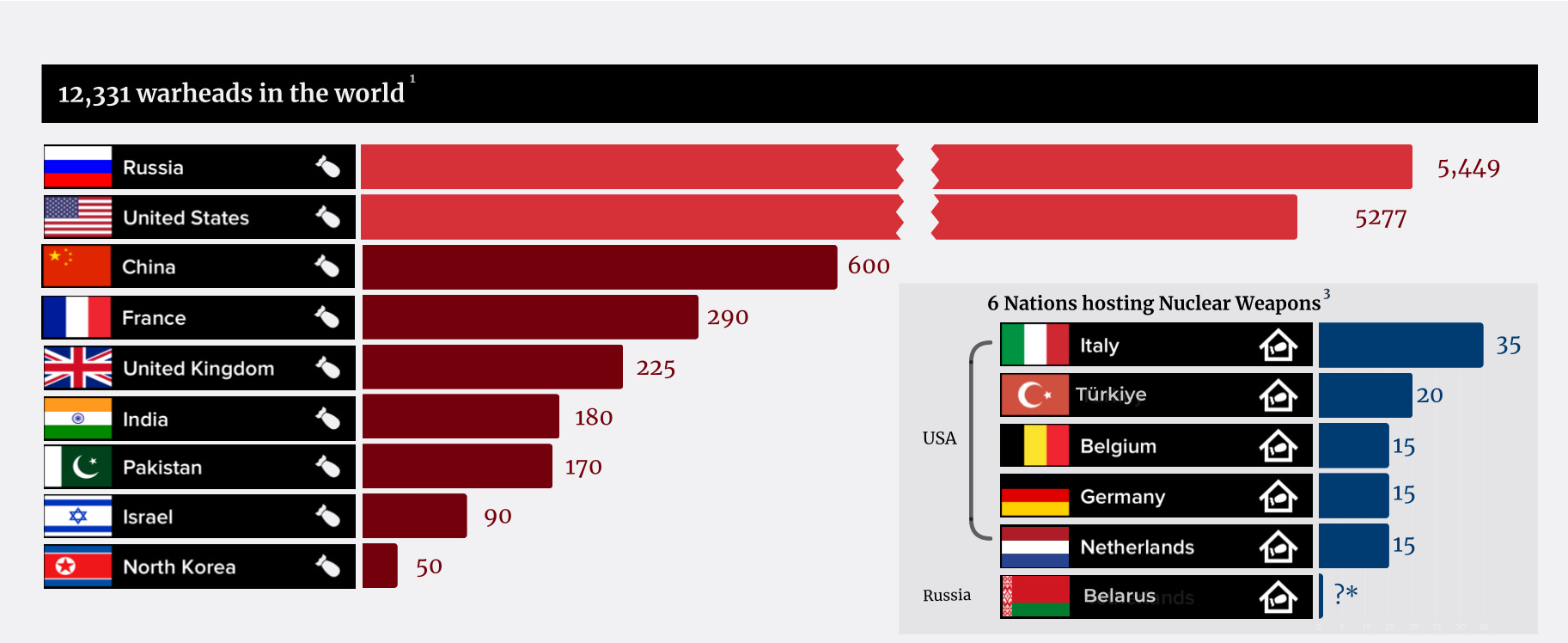
Russia insists any new talks must include British and French arsenals. China refuses trilateral negotiations, insisting Washington and Moscow must first make “drastic and substantive cuts.” Nine nations now possess nuclear weapons. Multi-billion-dollar modernization programs proceed. And somehow, we’ve convinced ourselves this is normal.
Over the coming months, this series will examine the February treaty expiration, Europe’s deterrence crisis, the spring NPT Review Conference, and the industrial reality behind the rhetoric. This would give readers a roadmap. We will look at how we arrived at this dangerous complacency, what the current nuclear landscape looks like, and whether there are remaining pathways back from the precipice. The Doomsday Clock keeps ticking. The question is whether anyone is still listening—and whether we can afford not to.
© 2025 Farooq Hussain
Founded by Albert Einstein, J. Robert Oppenheimer, and Manhattan Project scientists who developed the first atomic weapons, the Bulletin of the Atomic Scientists has set the hands of the Doomsday Clock since 1947. The Doomsday Clock is set once a year by the Bulletin of the Atomic Scientists. For the first several decades, Manhattan Project scientist and Bulletin editor Eugene Rabinowitch decided when, and how much, to move the Clock. His first decision: October 1949, when Russia exploded its first atomic bomb, and he changed the Clock from seven minutes to three minutes to midnight. Rabinowitch died in 1973; since then, the Clock has been set by members of the Bulletin’s Science and Security Board together with the Bulletin’s Board of Sponsors, which includes more than a dozen Nobel laureates and other international experts in key technologies.
Strategic arms control between the United States and Soviet Union/Russia began with the Strategic Arms Limitation Talks (SALT I, 1972; SALT II, 1979, never ratified but voluntarily observed). The Strategic Arms Reduction Treaties followed these: START I (1991, reducing arsenals to 6,000 warheads on 1,600 delivery systems), START II (1993, never entered into force), the Strategic Offensive Reductions Treaty/SORT (2002), and New START (2010, limiting each side to 1,550 deployed strategic warheads on 700 delivery systems). New START entered into force on February 5, 2011, was extended in 2021, and expires on February 5, 2026. Russia suspended its participation in treaty verification measures in February 2023, though both sides assert they remain within central limits. For the official US government position on treaty status, see US Department of State, “New START Treaty,” https://www.state.gov/new-start-treaty.
As New START expires without a successor, strategic stability will depend less on new treaties than on practical, reciprocal limits that can keep pace with nuclear innovation.
The Last Treaty: Nuclear Weapons Innovation and What Comes Next — Farooq Hussain (Amazon, next month)