

The US's efforts to coerce Europe into conceding its ambition to acquire the sovereign territory of an allied nation have escalated into a full-scale crisis at the time of this post.
Part II: NATO faces an existential threat from within
When the first French paratroopers landed at Nuuk Airport in mid-January 2026, accompanied by German KSK special forces and Swedish Arctic warfare specialists, they did not fire a shot. They didn’t need to. Their mere presence accomplished what decades of European calls for “strategic autonomy” could not: they made a US military seizure of Greenland operationally impossible without confronting fellow members of the North Atlantic alliance.
This is deterrence-by-tripwire, the same logic NATO used to defend West Berlin during the Cold War. A small, strategically positioned force deters escalation. It’s assumed that no US president would order American forces to engage fellow NATO members in combat without triggering a political firestorm that would end the alliance.
Thus, the deployment reveals why the remaining US options for “owning” Greenland all lead to strategic dead ends:
Negotiated acquisition remains possible under existing defense agreements—but requires Danish and Greenlandic consent, which is emphatically not forthcoming.
Economic coercion through tariffs might pressure Copenhagen, but Europe can counter-pressure, and Denmark shows no signs of buckling.
Military seizure of Nuuk is not deterred by the presence of European NATO forces.
Unilateral expansion of Pituffik Space Base is geographically meaningless—the base sits 1,200 kilometers from the capital on Greenland’s remote northwest coast, separated by impassable terrain and Arctic weather. You cannot govern Greenland from Pituffik any more than you could govern Alaska from a radar station on the Aleutian Islands.
This leaves backing down or TACO (Trump Always Chickens Out), which most American observers expect the President to eventually do. The crisis may fade through distraction, or conclude with a face-saving “Greenland Security Initiative” that expands the existing base under current agreements while European forces quietly withdraw after their “successful training exercise.”
But the damage is already done. Even if the immediate crisis resolves, the Atlantic alliance has crossed a threshold it cannot uncross. For the first time in NATO’s history, European militaries have deployed to defend an ally’s territory against the United States. The psychological break is complete.
The Rapid Unraveling: A 30-Day Scenario
If, contrary to expectations, the United States proceeds with military action, the institutional collapse accelerates along a predictable timeline:
Days 1-3: The Impossible Choice
U.S. forces engage European troops, or European troops withdraw under ultimatum. Either triggers Article 5 in reverse—does the treaty obligate collective defense against the United States? The legal paradox has no answer. The NATO headquarters in Brussels becomes irrelevant overnight as member states make unilateral decisions.
Days 4-7: Nuclear Sharing Ends
Germany, the Netherlands, Belgium, Italy, and Turkey demand the immediate removal of U.S. B61 tactical nuclear weapons from their soil. Hosting American nuclear weapons while America occupies European territory is politically untenable. The weapons are withdrawn to U.S. bases in Britain or removed from Europe entirely. Decades of nuclear burden-sharing evaporate in a week.
Days 8-15: Command Structure Fractures
The Supreme Allied Commander Europe (SACEUR) has always been an American general. With the U.S. in conflict with a member state, European officers refuse orders. The integrated military command—the operational heart of NATO—ceases to function. National militaries revert to independent operations.
Days 16-30: Treaty Suspension
European governments, under intense domestic pressure, formally suspend NATO treaty obligations “pending resolution of the Greenland crisis.” The suspension is theoretically temporary, but everyone understands: trust, once broken at this level, cannot be restored within a generation. The North Atlantic Treaty remains legally in force, but NATO as a functioning alliance is dead.
The Franco-British Nuclear Pivot: From Cooperation to European Deterrence
The collapse of NATO forces in Europe confronts a question it has avoided for decades: how do we defend ourselves without America? The answer emerges from an institutional foundation that was already in place, waiting for exactly this crisis.
The Lancaster House Legacy
The 2010 Lancaster House Treaties between Britain and France created the framework for nuclear cooperation through the Teutates Agreement—joint warhead research, shared hydrodynamic testing facilities at Valduc and Aldermaston, and collaborative simulation work. At the time, this was simply cost-sharing between two nuclear powers facing budget pressures and aging Cold War infrastructure.
But the treaties contained the seeds of something larger: an institutional architecture that could evolve from cooperation into genuine shared deterrence if American extended deterrence ever failed. The Greenland crisis is that moment of failure.
Britain’s Strategic Vise
The United Kingdom faces the most acute dilemma. Britain’s four Vanguard-class ballistic missile submarines carry Trident II D5 missiles leased from a common US-UK pool at Kings Bay, Georgia. The missiles depend on American guidance systems, maintenance, and targeting data. The next-generation warhead—the W93/Mark 7—is a joint US-UK development program under the 1958 Mutual Defence Agreement.
If US-UK relations fracture over Greenland, Britain’s nuclear deterrent becomes questionable within five to ten years. Parliament cannot support US military action against Greenland/Denmark—British public opinion would not tolerate it, even among Brexit voters who harbor no love for Brussels. But Britain also cannot afford to lose access to Trident technology.
This is a strategic vice with no comfortable escape. The solution perhaps lies in Paris.
The Emergency Élysée Summit (February 2026)
In late February 2026, the British Prime Minister and French President meet for emergency talks that produce the most significant shift in European nuclear posture since the Cold War. The resulting framework, carefully avoiding the politically toxic phrase “shared deterrent,” nonetheless achieves unprecedented integration:
Immediate Coordination:
Britain and France announce a “coordinated nuclear posture,” treating their forces as complementary rather than redundant. A secure communications link connects the UK Strategic Command at Northwood with the French Strategic Forces Command at Taverny. Joint threat assessment protocols are established. Submarine patrol schedules are synchronized to ensure continuous at-sea deterrence. The two nations stop short of unified command—that would be too politically sensitive—but operationally, they function as an integrated force.
Industrial Integration:
Britain begins contingency planning for a post-Trident future. France’s M51 submarine-launched ballistic missile, with its 8,000+ kilometer range, could be adapted for Britain’s new Dreadnought-class submarines within five to seven years at a cost of £5-8 billion—substantial, but far less than indigenous development and far less risky than continued dependence on an increasingly erratic Washington.
Joint warhead development replaces the now-suspended U.S.-UK W93 program. Britain brings compact design expertise; France contributes independent testing data from its pre-Comprehensive Test Ban Treaty era. The existing Teutates infrastructure at Valduc and Aldermaston expands to accommodate full-scale next-generation warhead development.
Submarine technology sharing deepens. France’s Barracuda-class attack submarine technology flows to Britain; British pump-jet propulsion advances flow to France. Discussions begin on joint next-generation ballistic missile submarine designs for the 2030s.
The German Question and the Birth of European Extended Deterrence
The withdrawal of American B61 tactical nuclear weapons from Büchel Air Base in Germany creates an immediate political crisis in Berlin. Germany faces three unpalatable options: accept non-nuclear status and vulnerability to Russian coercion, pursue indigenous nuclear weapons (politically toxic and historically unthinkable), or seek protection under a European nuclear umbrella.
In March 2027, France and Britain jointly extend deterrence to Germany through a carefully worded trilateral agreement. Germany does not acquire nuclear weapons. France and Britain commit to language about “vital interests” covering German security—deliberately ambiguous, like U.S. Cold War commitments, but clear enough to deter Russia. Germany provides €3-5 billion annually to the Franco-British nuclear modernization program, funding submarine construction, warhead development, and satellite reconnaissance systems.
The political trade is elegant: Germany accepts “protection” similar to old U.S. extended deterrence but retains consultation rights on nuclear policy. France gains the financial resources to expand its forces that it could never afford on its own. Britain maintains relevance as a nuclear power in a post-American Europe.
Poland follows immediately, the most threatened by Russia, demanding inclusion in the deterrence framework, offering basing for Franco-British conventional forces in exchange. By 2028, Italy, Spain, and the Benelux states will be incorporated. A de facto European Union nuclear umbrella emerges, though critically, it is controlled by the London-Paris axis, not Brussels. The distinction matters: this is intergovernmental cooperation between sovereign nuclear states, not supranational EU defense policy.
The Force Structure by 2030
France is expanding its ballistic missile submarine fleet from four Triomphant-class boats to seven, funded in part by German contributions, ensuring two to three submarines are always at sea rather than the current one. Warhead numbers increase from approximately 290 to 400, driven by extended deterrence commitments across multiple European states.
Britain’s four Dreadnought-class submarines enter service in the early 2030s. The critical decision point arrives in 2028: commit to M51 integration or continue the Trident lease. The likely outcome is a parallel track—continue Trident temporarily while U.S. relations remain uncertain, develop M51 capability as insurance, transition when politically feasible around 2032-2035. British warhead numbers increase modestly from 225 to roughly 260, with emphasis on reliability rather than quantity.
The combined Franco-British deterrent by 2030 comprises seven to eight operational ballistic missile submarines and approximately 660 deployed warheads. Compare this to Russia’s roughly 1,600 deployed strategic warheads or China’s estimated 500. This is a credible deterrent against Russian threats to core Europe—smaller than NATO’s Cold War posture, but sufficient given that the Ukraine war has revealed Russian conventional forces to be far less formidable than once believed.
The New Doctrine: “Vital Interests of Europe.”
The doctrinal shift is carefully calibrated. Traditional national doctrines—French *dissuasion* protecting French vital interests, British ultimate insurance against existential threats—evolve into something new without formal treaty obligations that neither London nor Paris is ready to accept.
The new “European Strategic Autonomy Deterrence” doctrine states: “France and the United Kingdom, as European nuclear powers, consider that an existential threat to European security constitutes a threat to their own vital interests.” Deliberately ambiguous about specific commitments, but the message to Moscow is clear: an attack on Germany or Poland risks nuclear response.
This ambiguity is strategic, not accidental. It preserves flexibility while deterring Russian adventurism through calculated uncertainty—exactly how American extended deterrence functioned during the Cold War.
The Arctic Resource Paradox: Seizing Worthless Treasure
The bitter irony of the Greenland crisis is that it destroys the value it seeks to capture. The rare earth deposits at Kvanefjeld that ostensibly justify annexation become worthless the moment sovereignty is seized by force.
The Ten-Year Gap
Greenland’s rare earth deposits—primarily light rare earth elements like neodymium, praseodymium, and dysprosium—are theoretically valuable for defense electronics and electric vehicle motors. But the transition from extraction to application requires a 10-year development timeline under optimal conditions, and the Greenland scenario is anything but optimal.
Mining hard rock deposits is relatively straightforward. The challenge is what comes next: mineral processing requires crushing, grinding, and flotation to separate ore from waste rock in an energy-intensive process. Greenland has no electrical grid capable of supporting industrial-scale processing. Power infrastructure alone would require years to build in the remote, harsh Arctic environment.
The critical bottleneck is chemical separation and refining, where China controls 87% of global capacity. Rare earths are chemically similar; separating them requires repeated cycling through organic solvents with precise pH control, generating toxic waste, including acids and radioactive byproducts from thorium and uranium content. Europe has limited capacity—Neo Performance Materials in Estonia, Solvay’s pilot facilities in France, and emerging REEtec operations in Norway. The United States has essentially none at commercial scale. Even MP Materials at Mountain Pass, California—America’s only operating rare earth mine—ships ore to China for processing.
Building US processing capacity requires $2-3 billion in capital investment and five to seven years for construction and commissioning. The technical workforce problem is acute: rare-earth refining expertise is concentrated in China, European experts won’t work on an operation based on seized territory, and training new workers takes a decade or more. Environmental permitting for facilities that handle toxic and radioactive waste has faced years of legal challenges.
The Investment Desert
International mining companies—Rio Tinto, Anglo American, BHP—cannot invest in territory seized by force. Shareholders would revolt over ESG concerns and political risk. Insurance is unavailable. Banks won’t provide financing due to reputational risk and European regulatory pressure. Chinese companies, despite US-China tensions, have no incentive to help America break China’s rare earth monopoly and would face domestic criticism for legitimizing the seizure.
The only option is US government-funded operations, which require Congressional appropriations of $3-5 billion. The political optics are catastrophic: funding a military occupation to extract resources from indigenous Arctic land while domestic infrastructure crumbles. Government-run mining operations rarely succeed commercially.
Even if mining proceeds, the ore has nowhere to go. Shipping to China for processing—after seizing Greenland specifically to reduce Chinese rare earth dependence—is absurd. China could set punitive processing fees or refuse entirely. European processors refuse to process under sanctions prohibiting the processing of illegally extracted materials. Building US processing capacity takes the better part of a decade.
The Counter-Factual Economics
Had the United States maintained its alliance cooperation, a very different scenario would have unfolded: US companies would have invested in Kvanefjeld with a 40% stake, Denmark would have provided political support for permitting, and Greenland would have received revenue-sharing and employment. Ore ships to Estonian or French refineries for processing under negotiated agreements. US defense contractors receive guaranteed allocations of refined oxides. European rare earth processing capacity expands with American investment. Allied purchasing power is used collectively to negotiate better terms with China and support alternative supply chains in Australia, Canada, and Vietnam.
By 2035, in the partnership scenario, the Greenland mine operates profitably, integrated into an allied rare earth supply chain, generating $2-3 billion annually in dividends from mining and processing operations, securing defense supply chains with allied-sourced materials, and reducing Chinese price manipulation leverage. Total value to the United States: substantial and strategic.
In the annexation scenario, the mine sits idle or operates at minimal capacity with ore stockpiled and nowhere to process it. Chinese rare earth monopoly remains intact. Infrastructure costs exceed $10 billion, with annual operating costs of $2 billion. Net result by 2035: massive financial loss, strategic goals unachieved, and European hostility permanent.
The Wrong Rare Earths
An additional irony: Kvanefjeld’s deposit is primarily light rare earth elements—cerium, lanthanum, neodymium, praseodymium. These are less scarce, more common in the Earth’s crust, and China has abundant supplies. The actual critical bottleneck for advanced magnets and defense electronics is the heavy rare-earth elements—dysprosium, terbium, and yttrium. Kvanefjeld has low levels of heavy rare earths.
If the goal were genuine resource security, better targets would include partnerships with Vietnam for ionic clay deposits rich in heavy rare earths, investment in Australian heavy rare earth projects like Browns Range, and technology development for heavy rare earth recovery from electronic waste recycling, both of which already have some level of US commitment. Indeed, comparable rare earth investment agreements are open to negotiation with Greenland and Denmark under the existing treaty.
The United States' ambition to seize Greenland for the wrong rare earths to solve the wrong problem, while destroying the alliances that made the rare earth supply chain security achievable.
The GIUK Gap: Losing Control by Taking Control
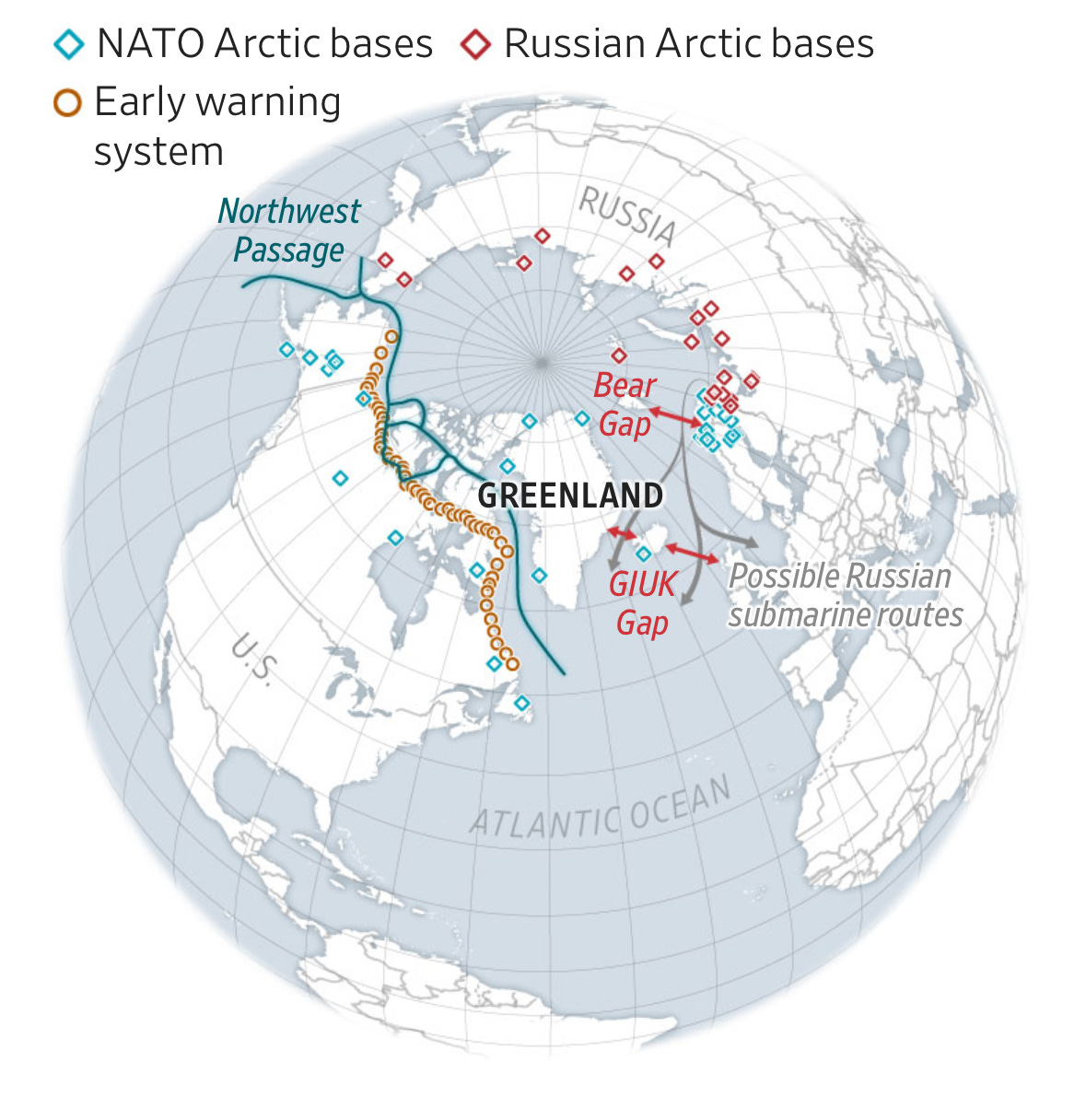
The strategic paradox reaches its fullest expression in the Greenland-Iceland-UK Gap, the naval chokepoint critical for monitoring Russian submarine activity and protecting transatlantic communications.
With the Russian Northern Fleet operating advanced Yasen-class submarines capable of launching cruise missiles at the US East Coast or cutting undersea data cables, the GIUK Gap is the only “gate” through which these vessels can enter the Atlantic. Controlling this gap requires seamless integration among sonar arrays, maritime patrol aircraft like the P-8 Poseidon, surface warships, and intelligence sharing, working in concert across three nations.
The United States cannot plug this gap alone. Iceland provides Keflavik Air Station, the central hub for submarine hunting operations. The United Kingdom provides Royal Navy patrols, intelligence assets, and sovereign control over critical waters. Denmark provides sovereignty over Greenlandic waters and maintains radar installations.
If the United States annexes Greenland by force, Iceland and the United Kingdom become politically unable to host American forces while the United States occupies a fellow NATO member’s territory. Without Keflavik, without British cooperation, the United States might own the “G” in GIUK, but it loses the “I” and the “UK,” leaving the Atlantic wide open to Russian submarine operations.
By 2028, in this scenario, Iceland has closed Keflavik to U.S. operations. Britain suspends Five Eyes intelligence sharing on North Atlantic submarine tracking. Russian Yasen-class boats operate with unprecedented freedom in the Atlantic. Undersea cables carrying transatlantic data traffic become vulnerable to interdiction. The United States has “secured” Greenland but lost control of the Atlantic approaches—the very thing Greenland’s geography was supposed to protect.
Conclusion: The Resource Curse Strikes the Hegemon
By 2030, the United States “controls” Greenland: 56,000 resentful Inuit under military occupation, a permanent garrison of 20,000 troops at an annual cost exceeding $2 billion, rare earth mines that cannot profitably operate, and radar stations no longer integrated into a functioning alliance network.
The cost of this “acquisition”: NATO’s institutional framework destroyed, the Nuclear Non-Proliferation Treaty’s credibility shattered as Japan and South Korea pursue independent deterrents, European strategic autonomy achieved through Franco-British nuclear integration, Russian freedom of action in the Arctic, Chinese inroads into European rare earth processing, and American credibility with every ally on Earth reduced to zero.
Europe adapts. The Franco-British deterrent emerging by 2030—660 warheads across seven to eight ballistic missile submarines, backed by German financing and extended to Poland and core European states—is smaller than NATO’s Cold War posture but sufficient to deter Russian aggression against Western Europe. European conventional forces, especially Poland’s rapidly expanding army and Franco-German cooperation, provide territorial defense capability without American ground troops.
But adaptation is not replacement. Europe loses the overwhelming credibility of 1,400 American nuclear warheads committed to its defense. The integrated command structure that made NATO the most effective military alliance in history is gone. Strategic airlift, aerial refueling, and satellite reconnaissance at American scale remain beyond European capability. Russia gains greater freedom of maneuver in the Baltic states and Eastern Europe than it had when NATO was intact.
The tragedy is that none of this was necessary. The strategic goals that supposedly justified Greenland’s seizure—rare-earth security, Arctic access, and denial of Chinese and Russian influence—were all achievable through the alliance cooperation that already existed. By pursuing 19th-century territorial acquisition with 21st-century military power, the United States discovers that empires cannot be sustained by force alone in an age of networked interdependence.
Russia does not need to fire a shot. China does not need to deploy a carrier battle group. They simply watch as the American century ends not with external conquest but with internal incoherence—the world’s most powerful nation destroying the institutional architecture that made its power meaningful in pursuit of an island whose value exists only within the framework of trust it has just shattered.
An Ice Curtain has been drawn between the United States and its NATO partners. It did not fall across Greenland. It fell in the mid-Atlantic between Europe and America, dividing a functional, if imperfect, alliance. The last collaboration to maintain peace did not end because of technological innovation or great power competition. It ended because the guarantor forgot that hegemony rests not on the capacity to compel, but on the willingness of others to consent.
© 2026 Farooq Hussain
The New START treaty expired on February 5, 2026, with no successor in sight. Future strategic stability now depends less on negotiating new treaties than on building practical, reciprocal limits that keep pace with nuclear innovation.
Available from Amazon:
The Last Treaty: Innovation, Nuclear Risk, and the End of Arms Control
by Farooq Hussain
Perfect analysis, with the one exception that TACO goes for Trump Always CHICKENS Out... but you sure know that, right? :-)
:)