

History records few tragedies more profound than the systematic ransacking of the Library of Alexandria and the murder of the mathematician-astronomer Hypatia — an archetype of a “self-inflicted dark age,” in which a civilizations chose ideological purity and literalist zealotry over the cumulative genius of humanity1 The destruction of the ancient world’s foremost research hub was a catastrophe of ideological schism, in which universal knowledge was viewed not as a treasure but as a threat.
Today, a strikingly similar pursuit of strategic auto-iconoclasm is unfolding in America, motivated by a modern ideological schism rooted in political creationism.2
The Wedge: From the Tower of Babel to Project 2025
The philosopher of science Robert T. Pennock anatomised this movement two decades ago in Tower of Babel: The Evidence Against the New Creationism.3 Pennock argued that “Intelligent Design” (ID) was engineered as a “big tent” strategy — deliberately ecumenical language designed to unite “Young Earth” creationists, “Old Earth” creationists, and “theistic” evolutionists against a common materialist enemy, whilst keeping the underlying religious commitments rhetorically deniable. The Babel image cut both ways: it was at once the creationists’ own founding myth — confusion of tongues as divine punishment for hubris — as well as an accurate description of their tactical method, sowing confusion in the scientific conversation rather than attempting to win it on the merits.
Pennock’s analysis was vindicated in court. In Kitzmiller v. Dover (December 2005), a federal judge (appointed by George W. Bush) ruled that ID was religion, not science, and could not be taught in public-school biology classrooms; the judgment famously described ID as creationism in a “cheap tuxedo.” But the more telling document is the Discovery Institute’s internal “Wedge Strategy” memorandum, leaked in 1999, which set out the movement’s twenty-year programme in unambiguous prose: to reverse what it called the stifling dominance of the materialist worldview and to replace it with a science consonant with theistic convictions.
That memorandum is the textual link between the cultural skirmishes of the 1990s and the federal demolition of 2025. The wedge has now been driven all the way home.
From Pseudoscience to Policy
While ID failed as science, the movement adapted with considerable tactical sophistication, shifting from the impossible task of proving a creator to the easier work of manufacturing doubt about proven science — vaccines as the supposed cause of autism, fluoride as a neurotoxin, mRNA platforms as instruments of mass harm [4, 5]. This anti-science sentiment found a powerful home in the Heritage Foundation’s Project 2025 [6-8]. By appropriating the rhetoric of “school choice,” “parental rights,” and “academic freedom,” the movement transformed a failed pseudoscientific theory into a political weapon for undermining secular expertise and bypassing scientific consensus [5, 7, 9]. Project 2025 calls for the elimination of the federal Department of Education, the redirection of public funds to private institutions teaching creationism as fact, and the framing of foundational science — evolution, climate, vaccination — as mere dogma [7].
The Endless Frontier Unmade
The magnitude of what is being dismantled becomes legible only by returning to the document on which the entire post-war American scientific enterprise was built. In July 1945, Vannevar Bush — director of the wartime Office of Scientific Research and Development — delivered Science, The Endless Frontier to President Truman. The report argued that federal support for basic university research was inseparable from military strength, public health, and economic competitiveness. The NIH and NSF now being decapitated are direct institutional descendants of that report. So is DARPA, established in 1958 in response to Sputnik, which seeded ARPANET, GPS, stealth aviation, advanced materials, and the foundational machine-learning work now underpinning every American technology company. So is the semiconductor industry that the CHIPS Act is presently attempting to repatriate: there is no Silicon Valley without the Cold War defence procurement that built it through the 1950s and 1960s.
The paradox is acute. The same administration cutting NIH and NSF is simultaneously expanding the Pentagon budget and demanding technological supremacy over China. These objectives are incompatible. The hydrogen bomb, the GPS satellite, and the mRNA vaccine emerged from the same federal research pipeline. Stockpile stewardship since 1992 — the scientific basis on which the United States certifies its nuclear deterrent without testing — depends entirely on the university-laboratory infrastructure now being starved: ASCI-class computing, the National Ignition Facility, materials science under extreme conditions, and the training pipeline for the physicists who replace those who retire. One cannot verify a treaty or maintain a credible deterrent with a hollowed-out basic-research base.
The Medical Front
If the dismantling of physical science compromises long-term security, the assault on medical research compromises immediate human survival, both domestically and globally. The installation of vaccine sceptics at the apex of the Department of Health and Human Services has converted the autism-vaccine canard — repeatedly falsified since Andrew Wakefield’s retracted 1998 Lancet paper — into operational federal policy [X]. The MMR vaccine, one of the most thoroughly studied medical interventions in history, has been subjected to politicised review, and confidence in childhood immunisation has eroded to the point that measles, declared eliminated from the United States in 2000, returned in 2025 in outbreaks of a scale not seen in a generation [X].
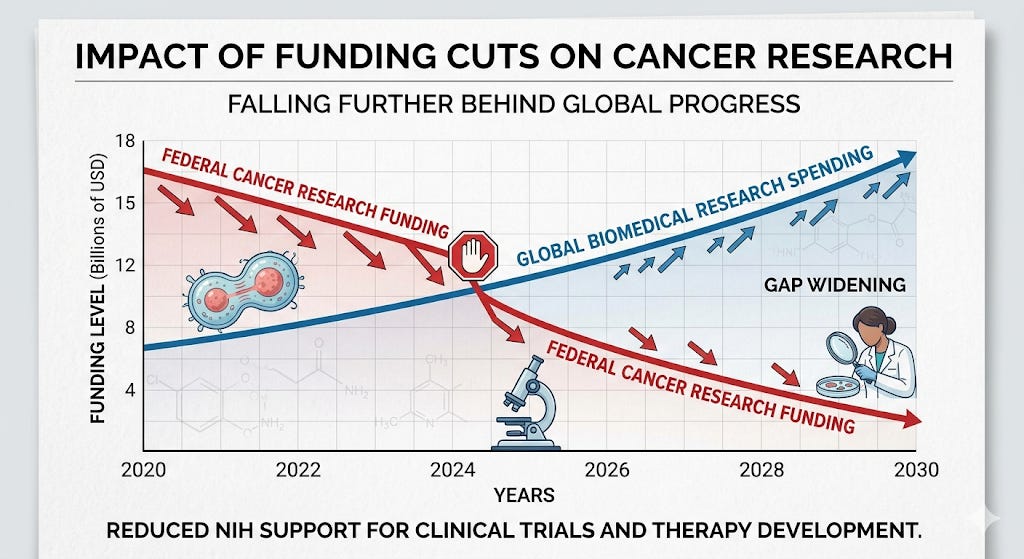
The damage radiates outward. The National Institutes of Health budget collapse — from roughly $47 billion to $27 billion — has terminated over 2,300 grants and 160 active clinical trials, including programmes in cancer immunotherapy, Alzheimer’s disease, and the mRNA platforms that proved themselves during the COVID-19 pandemic and that constitute the most promising avenue for vaccines against HIV, malaria, tuberculosis, and the next pandemic pathogen [10]. The National Science Foundation has eliminated 75% of its academic “rotator” positions, severing the connection between the federal science apparatus and the university research base [10]. A 15% cap on indirect cost reimbursements has financially starved private universities — using the pretexts of antisemitism, diversity, and “wokism” — forcing the closure of high-maintenance laboratories that can no longer cover their basic operational expenses [10, 11].
The global consequences are graver still. The American withdrawal from the World Health Organization, the dismantling of USAID, and the gutting of PEPFAR — the most successful public-health programme in history, credited with saving over twenty-five million lives since 2003 [X] — have left the global health architecture without its largest donor and its most capable scientific partner. The polio eradication endgame, within sight after four decades of effort, has been thrown into doubt [X]. Pandemic surveillance networks built painstakingly since SARS in 2003 have lost their American node. And vaccine hesitancy, like vaccine confidence, is contagious across borders: an American president denying the safety of MMR licenses the same denial in Lagos, Manila, and Kyiv. The downstream death toll of these decisions will not be tallied for years, but the actuarial mathematics is not in dispute.
The Reverse Migration
This modern ransacking of the intellectual commons is actively forfeiting the scientific prowess on which American global standing has rested [2]. Just as Hypatia’s death ended a continuous lineage of mathematical and astronomical teaching at Alexandria, the present dismantling has triggered a brain drain — a 14% exodus of the federal STEM workforce, more than 10,100 PhD-trained experts [12, 13]. Early-career researchers are departing for Canada, Europe, the Middle East, and the Asia-Pacific. The United States is exporting its next generation of innovation [13, 14].
The historical mirror is exact and painful. In the 1930s, the persecution of Jewish and dissenting scientists under National Socialism drove Einstein, Fermi, Bethe, von Neumann, Szilard, Wigner, and Teller — among many others — to American shores. That refugee influx, supplemented after the war by Operation Paperclip, gave the United States the human capital that won the war and built the Endless Frontier. The current migration runs the film in reverse. The receiving countries — through enhanced research visa schemes, expanded ERC funding in Europe, and the successor programmes to China’s Thousand Talents initiative — understand precisely what is being offered to them.
The centre of gravity has shifted accordingly. Chinese research spending crossed the $1 trillion threshold in 2026, reaching effective parity with the United States for the first time [13]. This was not inevitable. It is a chosen outcome.
The Missing Generation
What is being created is not a “gap” in the sense of Mendel’s thirty-four-year wait for recognition — a delay in acknowledging work already complete. What is being created is the severing of the training pipeline itself: postdocs not trained, principal investigators not mentored, instruments not built, collaborations not begun. The damage will compound across decades, because science is generational before it is institutional. A laboratory closed in 2025 is a problem; a generation of biologists, physicists, and physicians who never learned to run one is a civilisational wound.
The Library of Alexandria did not burn in a day, and its loss was not measured in scrolls but in the centuries of darkness that followed. The present dismantling will be measured the same way — not in the immediate ledger of cancelled grants but in the diseases not cured, those tens of thousands whose deaths will be directly attributable to the cancellation of medical aid and food, and the deterrents not maintained, the discoveries not made, and the generation of American scientists who, having watched their country choose ideology over inquiry, took their training and skills elsewhere.
© 2026 Farooq Hussain
This is the second part of the Ariadne’s Dispatches, on the dismissal of the National Science Board. The first part can be at the link below:

In 415 CE, Hypatia, a renowned Neoplatonist philosopher, astronomer, and mathematician, became a tragic casualty of this era’s escalating religious and political tensions. She was brutally murdered by a mob of Christian monks (the Parabalani) during a power struggle between the Bishop Cyril and the Roman Prefect Orestes. Her death remains a powerful symbol of the loss of intellectual freedom to religious fanaticism. Further Reading: Hypatia - Wikipedia, Library of Alexandria - Wikipedia
The Deconstruction of Federal Science: The Heritage Foundation’s Project 2025 (2024) outlines a transformative agenda to dismantle the “administrative state,” with profound implications for the U.S. scientific enterprise. Independent qualitative analyses identify the project’s core strategy as replacing non-partisan career civil servants with ideological loyalists to ensure federal research aligns with executive priorities (Fiedler, 2025).
The proposed cuts and institutional closures include:
NOAA and Climate Research: The mandate explicitly calls for the National Oceanic and Atmospheric Administration (NOAA) to be “broken up and downsized,” describing it as a primary driver of the “climate change alarm industry” (Heritage Foundation, 2024). This includes rescinding the 2009 Endangerment Finding, which legally compels the EPA to regulate greenhouse gases—a move recent National Academies studies suggest would ignore decades of accumulated scientific evidence (National Academies of Sciences, Engineering, and Medicine, 2025).
NSF and NIH Funding: Analysts highlight proposed budget cuts exceeding 50% to 66% for the National Science Foundation (NSF) and the National Institutes of Health (NIH), which have already led to the suspension of grant reviews and the termination of existing research pipelines (Eppley, 2026; Palmer, 2025).
NASA and STEM: The agenda advocates for a nearly 50% reduction in NASA’s science budget and the total elimination of the Office of STEM Engagement, threatening the long-term diversity and competitiveness of the American scientific workforce (AAS, 2026; Perez, 2026).
Workforce Reductions: By 2025, implementations aligned with these goals contributed to a net loss of over 219,000 federal workers, with nearly 90% of lost positions occurring within health and research sectors (Baehler, 2026).
References
AAS. (2026). Proposed federal science cuts threaten our future. American Astronomical Society.
Baehler, K. J. (2026). The Trump administration and the US federal government workforce, one year in. Open Journal System.
Eppley, M. G. (2026). Where we go from here: Harnessing queer perspectives to advance practice in ecology and evolutionary biology. PMC.
Fiedler, R. A. (2025). Project 2025: A blueprint for transforming Donald Trump’s administration 2.0. Journal of Modern Science, 4/64/2025, 103–120.
Heritage Foundation. (2024). Mandate for leadership: The conservative promise.
National Academies of Sciences, Engineering, and Medicine. (2025). Effects of human-caused greenhouse gas emissions on U.S. climate, health, and welfare.
Perez, E. J. (2026). Designing for change: Principles for STEM programs that foster organizational transformation. PMC.
Pennock, R. T. Tower of Babel: The Evidence Against the New Creationism, MIT Press, 1999.