

Things have moved on since the high drama of the Manhattan Project, launched eighty years ago to build the world’s first nuclear weapon. The motivating rationale was the fear that Nazi Germany would get there first. That proved untrue, but by the time the error was clear, the project’s momentum was too great to stop. When the war in Europe ended in May 1945, there was barely enough refined fissile material for only a handful of bombs, though production was rapidly accelerating.1 The first successful test came in July, and despite Japan’s deteriorating military position, the decision to use the weapon had already been made. After Hiroshima and Nagasaki, many of the scientists who had helped create the bomb turned unsuccessfully to returning the genie to the bottle.2
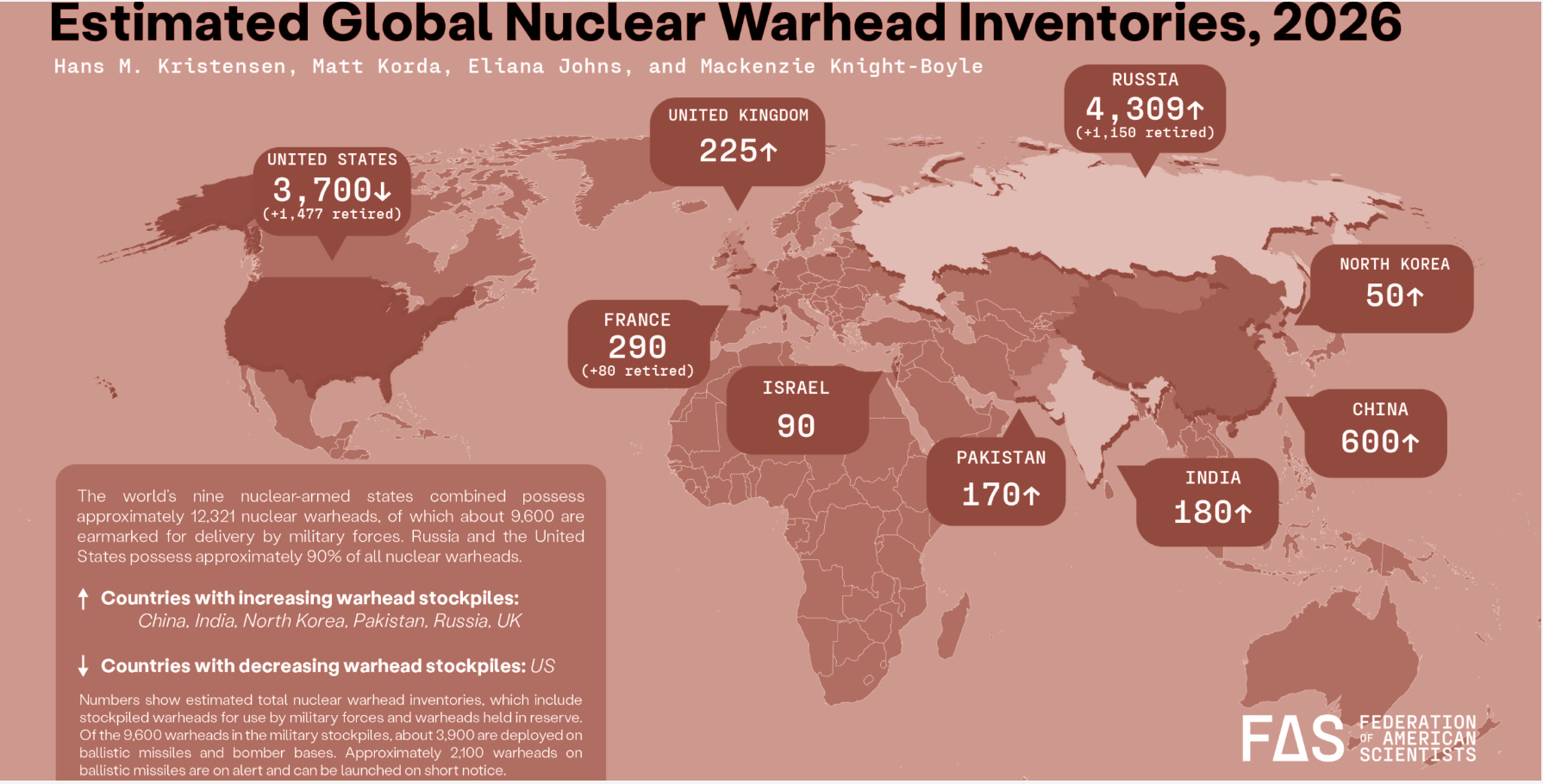
And here we are. The United States and the Russian Federation still possess the overwhelming majority of the world’s nuclear weapons,3 while seven other states maintain smaller arsenals. Perhaps most troubling of all is that attempts to prevent additional states from joining the nuclear weapons club—through diplomacy, sanctions, covert action, and at times the use of military force or the threat of it—have not eliminated the underlying incentives for some. North Korea is now firmly nuclear-armed, and Iran remains a persistent cause for concern.
New START Was Conceived as a Beginning, Not an End
The long-anticipated expiration of New START4 was never supposed to be a culminating act. Even the treaty’s name signaled a starting point: a stabilizing framework that would help create conditions for subsequent steps. New START achieved substantial, verifiable cuts in the numbers of launchers and warheads. It did not attempt to solve every problem in nuclear competition. It did not cover non-strategic (”tactical”) weapons. Nor did it encompass the intermediate-range systems that once fueled the most acute NATO–Warsaw Pact anxieties.
That division of labor—strategic systems addressed by START-type agreements, intermediate systems addressed by INF—was never elegant, but it worked tolerably well for a time.
The Collapse of the Intermediate-Range Firewall
The Intermediate-Range Nuclear Forces (INF) Treaty removed entire classes of U.S. and Soviet missiles (most famously Pershing II and SS-20) and reduced the risk of rapid escalation in Europe. Over time, however, that firewall eroded. Russia’s development and testing of systems that the United States assessed as violating the treaty5 became central to the treaty’s demise. In August 2019, the United States withdrew from the treaty, citing Russian noncompliance.
With INF gone and no replacement negotiated, Europe was left facing a widening gray zone: intermediate- and shorter-range systems—often dual-capable—whose deployment patterns can generate crisis instability even if neither side intends to use nuclear weapons.
The Treaty Was Hollowed Out Before It Expired
New START’s value was never only numerical limits. Its unique contribution was predictability: inspections, notifications, and data exchanges that reduced worst-case assumptions and enabled each side to manage deterrence without guessing. When Russia suspended on-site inspections and key transparency measures in February 2023,6 verification increasingly fell back on national technical means. The treaty still existed on paper, but its stabilizing function—the disciplined routine of reciprocal transparency—was gravely weakened.
That reality matters because the world does not become “safer” when it becomes less knowable. Arms control has always been as much about managing fear as about managing numbers.
A Pivot From Extending Limits to “A Better Deal”
As the expiration approached, U.S. policy messaging shifted from guarded openness to maintaining limits toward a deliberate “clean slate” posture. The public rhetoric came to emphasize three themes:
New START is an outdated or “badly negotiated” deal.
A successor agreement must include China.
Modernization and leverage first; negotiations later.
This approach treated lapse as a bargaining tactic: remove existing obligations, then compel adversaries back to the table under terms the United States prefers.
Yet the practical obstacles were obvious from the start. China has repeatedly argued that its arsenal remains far smaller than those of the United States and Russia and that it has no incentive to accept constraints that would lock in a permanent subordinate position. Russia, for its part, has linked arms control to broader political demands—ranging from verification terms to wider geopolitical conditions—ensuring that “extension” and “replacement” become entangled with unresolved conflicts.
What Changed on February 5, 2026
With New START’s expiration, the United States and Russia are no longer bound by legally enforceable limits on deployed strategic warheads and launchers. The immediate result is not an instantaneous numerical breakout; procurement and force-structure shifts are slow. The immediate result is something more corrosive: the removal of shared rules of the road.
Three losses matter most:
No binding ceiling on deployed strategic forces.
No treaty-based inspection regime to discipline uncertainty.
No routine data exchanges that reduce misinterpretation.
In theory, national technical means can still observe many indicators. In practice, inspections and notifications did something NTM cannot reliably replicate: they reduced ambiguity during tense periods, when ambiguity is most dangerous.
The danger was understood. On the day of expiration, the United States and Russia quietly re-established high-level military-to-military communications—a direct channel between defense departments that had been largely suspended since late 2021. This “deconfliction hotline” was presented as a crisis-management measure, a way to prevent miscalculation in the absence of treaty-mandated transparency.
But the establishment of an emergency backup reveals the contradiction. If New START was truly obsolete—a “badly negotiated deal” that constrained American power without delivering security—why did both sides need a replacement communication channel the moment it expired? The answer is straightforward: they recognized that the loss of treaty-based predictability made the world measurably more dangerous, even as the administration insisted that lapse was a path to leverage.
A military hotline is not a substitute for structured arms control. It is a crisis tool designed to manage acute situations in which communication failures could escalate into conflict. It does not provide the routine transparency, the baseline of shared data, or the institutionalized verification practices that made deterrence stable rather than merely mutual. The fact that both sides felt compelled to establish this channel—immediately, urgently—suggests they understood precisely what was being lost.
The Upload Reality: What “Unconstrained Competition” Actually Means
The rhetoric of modernization and a “better deal” obscures a simpler, more immediate reality: both the United States and Russia possess substantial latent capacity to increase deployed warheads without building a single new missile. This capacity—known as “uploading”—involves filling empty slots on existing Multiple Independently Targetable Reentry Vehicle (MIRV) launchers.
With the 1,550-warhead ceiling removed, uploading becomes the most readily available tool for demonstrating resolve or matching a perceived adversary buildup. It is faster than procurement, cheaper than new systems, and requires no new technology—only political decisions and maintenance cycles.
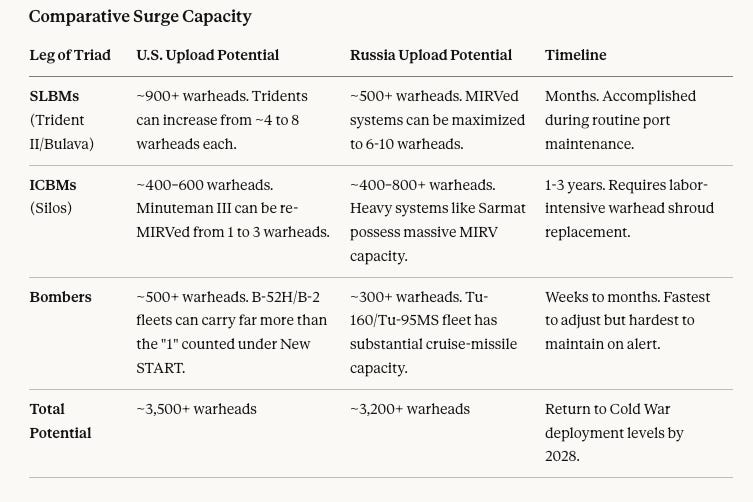
This is not theoretical speculation. Uploading uses existing infrastructure and represents the path of least resistance in a post-treaty environment. Russia, with its heavier MIRVed missiles, holds a structural advantage in this competition—a “war of the math” that favors neither side’s security but can be executed rapidly by both.
The Theater Nuclear Problem
The absence of constraints extends beyond strategic systems. Since the U.S. withdrawal from the INF Treaty in 2019, Russia has been free to expand its arsenal of theater nuclear forces—intermediate and short-range systems, many dual-capable, that threaten Europe but fall outside the scope of strategic arms control. Right-wing commentators sometimes characterize this buildup as a “violation,” but it is not. It is the predictable consequence of abandoning the INF Treaty without negotiating a replacement framework.
These theater systems—missiles like the 9M729 (SSC-8), which originally prompted the U.S. withdrawal from INF, along with an expanding array of dual-capable aircraft and sea-launched cruise missiles—now operate in a regulatory void. They are not covered by New START. They will not be covered by any prospective trilateral strategic agreement focused on long-range systems and warhead counts.
This creates a cascading problem: even if a trilateral treaty addressing strategic forces were somehow achievable, an entire category of destabilizing weapons would remain outside its scope, unconstrained and growing. Europe, having lost the INF firewall, faces an expanding threat that no combination of U.S.-Russia-China strategic negotiations will address. The administration’s “clean slate” approach has not simplified the problem. It has multiplied the number of unregulated systems while reducing the diplomatic tools available to manage them.
The Trilateral Requirement: Logically Attractive, Operationally Paralyzing
Insisting that any future treaty be trilateral has surface logic. But strategic logic and negotiating logic are not the same.
Strategic logic: China’s growth matters, and future stability will not be achieved by US–Russia mechanisms alone.
Negotiating logic: China’s smaller arsenal makes it rational—almost inevitable—for Beijing to resist binding limits until the two larger powers reduce substantially or until China has closed the gap.
The demand for trilateralism can therefore function as a veto disguised as ambition: a condition that sounds statesmanlike while ensuring talks never begin.
Words Versus Reality
Public statements about “denuclearization,” “better deals,” and “peace through strength” collide with stubborn realities:
Treaty negotiation takes years, not news cycles.
Ratification—especially by a polarized US process—requires political capital and supermajorities that seldom exist.
Modernization programs are already locked into long timelines and industrial constraints.
The fastest lever in a post-treaty world is not building new systems; it is changing loading patterns and alert practices on existing ones—precisely the kinds of actions that trigger reciprocal responses.
In other words, the likely early trajectory is not a dramatic “new treaty,” but a gradual shift toward strategic ambiguity: more hedging, more worst-case planning, more signaling, and less transparency.
The Larger Consequence: A Structural End to the Bilateral Arms-Control Era
The expiration of New START is often described as the end of “the last treaty.” The deeper truth is that it marks the exhaustion of a bilateral architecture built for a strategic geometry that no longer exists. The nuclear order is now multipolar, technologically heterogeneous, and doctrinally diverse. Yet public debate continues to recycle Cold War templates—either predicting a familiar arms race or celebrating freedom from “constraints.”
Both miss the real danger.
The gravest risk is not a sudden surge in warheads. It is a world in which deterrence competition continues, but the shared mechanisms that kept it legible—limits, verification, and predictable habits of restraint—fade away. In that world, misperception becomes easier, crises become harder to manage, and the pressure to demonstrate resolve grows.
New START was not a panacea. But letting it expire without acknowledging that it stayed within its launcher and warhead limits was irresponsible. It was an abdication dressed up as leverage—one that leaves the nuclear age’s central problem unchanged: how to prevent the ultimate weapons from becoming the ultimate default.
Conclusion: A Strategy of Circular Impossibilities
The administration’s stated goal—a “new, improved, and modernized” treaty that includes China—sounds ambitious. In practice, it is a framework designed to fail, constructed from mutually reinforcing impossibilities that guarantee inaction while providing rhetorical cover.
The Trilateral Trap
The demand for Chinese participation faces an insurmountable logical barrier. China, with roughly 500–600 warheads, has no rational incentive to accept constraints that would permanently lock it into a 6-to-1 disadvantage against the United States and Russia. Beijing has made this clear repeatedly: it will not negotiate until the two larger powers make “drastic and substantive” cuts—precisely what the current administration refuses to consider.
Russia, for its part, has already signaled that any trilateral framework must include Britain and France, Europe’s nuclear-armed states. Moscow’s position is straightforward: if China’s smaller arsenal justifies its inclusion, then so do the UK and French arsenals. The Kremlin expects the United States to deliver concessions on behalf of its NATO allies—or bring them to the table as formal participants.
Neither option is politically viable. Britain and France have consistently rejected participation in U.S.-Russia arms control frameworks, viewing their independent deterrents as essential to sovereignty. The United States cannot compel allied participation, nor is it willing to trade away capabilities it does not control.
The result is a diplomatic Gordian knot: China will not join unless the US and Russia reduce their forces. Russia will not proceed without the UK and France. The UK and France will not participate. And the United States will not reduce unilaterally. Each condition depends on the others, creating a perfect circle of non-negotiation.
The Regional Proliferation Void
Even if this trilateral architecture were somehow achievable, it would address the wrong problem. The most acute near-term nuclear risks are not posed by the legacy arsenals of the United States, Russia, or China. They are posed by regional actors: North Korea’s expanding and increasingly sophisticated arsenal, and Iran’s continued enrichment activities that leave it positioned as a threshold state.
Neither would be covered by a U.S.-Russia-China framework. North Korea has no interest in constraints and views its arsenal as existential insurance against regime change. Iran’s nuclear activities remain governed—tenuously—by the Joint Comprehensive Plan of Action (JCPOA), which the current administration has shown no inclination to rejoin or reinforce.
The traditional mechanism for addressing regional proliferation has been the Nuclear Non-Proliferation Treaty (NPT), which rests on a fragile bargain: non-nuclear states forgo weapons in exchange for peaceful nuclear cooperation and a commitment by nuclear-armed states to pursue disarmament in good faith under Article VI.
The upcoming NPT Review Conference (April–May 2026) will occur in the immediate shadow of New START’s expiration. If the administration approaches the conference with its current posture—dismissing disarmament obligations, demanding a “clean slate,” and emphasizing unconstrained modernization—it risks shattering what remains of the NPT consensus. Non-nuclear states, particularly in the Global South, already view the NPT as a bargain that the nuclear powers have violated. A U.S. stance perceived as hostile to Article VI obligations could produce the third consecutive Review Conference to end without a consensus Final Document, accelerating the treaty’s slow erosion.
In that scenario, the very framework that has constrained regional proliferation for half a century loses credibility—leaving North Korea and Iran outside any meaningful diplomatic structure, while the United States pursues a trilateral negotiation that cannot begin.
The Timeline Mirage
Even setting aside these diplomatic dead ends, the mechanics of treaty-making do not align with the administration’s political calendar. A treaty of the scope and complexity being described—covering three nuclear powers, multiple delivery systems, verification protocols, and potentially tactical and intermediate-range weapons—would require years of preparatory work, technical negotiation, and ratification.
Historical precedent is instructive. The original START I treaty took nine years to negotiate (1982–1991). New START, building on decades of prior frameworks and shared definitions, still required 18 months of intensive negotiation. A trilateral treaty starting from scratch, with no agreed baseline definitions, no established verification mechanisms, and no history of three-way cooperation, would face far steeper obstacles.
The U.S. Senate requires a two-thirds majority (67 votes) to ratify a treaty. In the current polarized environment, that threshold is nearly insurmountable. Ratification battles over arms control have historically been protracted and politically costly, even when the treaties themselves enjoyed broad expert support.
With roughly 24 months remaining in this presidential term, the timeline for achieving a negotiated, signed, and ratified treaty extends well into—and likely beyond—the next administration. The window for meaningful progress closes further after the 2026 midterm elections, when political capital dissipates and attention shifts toward the 2028 presidential cycle.
What the administration is offering, then, is not a roadmap but a placeholder: a rhetorical commitment to future negotiations that cannot realistically occur within its tenure.
The Budgetary Fantasy
The final disconnect lies in the gap between modernization rhetoric and budgetary reality. The administration has framed “peace through strength” as a justification for unconstrained increases in military force, suggesting that demonstrating capability will compel adversaries to negotiate on U.S. terms.
But the Congressional Budget Office’s projections reveal a different story. The nuclear enterprise is already consuming $946 billion over the next decade, with major programs like Sentinel running 81 percent over budget.7 Accelerating beyond these locked-in timelines is not a matter of political will; it is constrained by industrial capacity, specialized labor shortages, and the physical realities of nuclear weapons production.
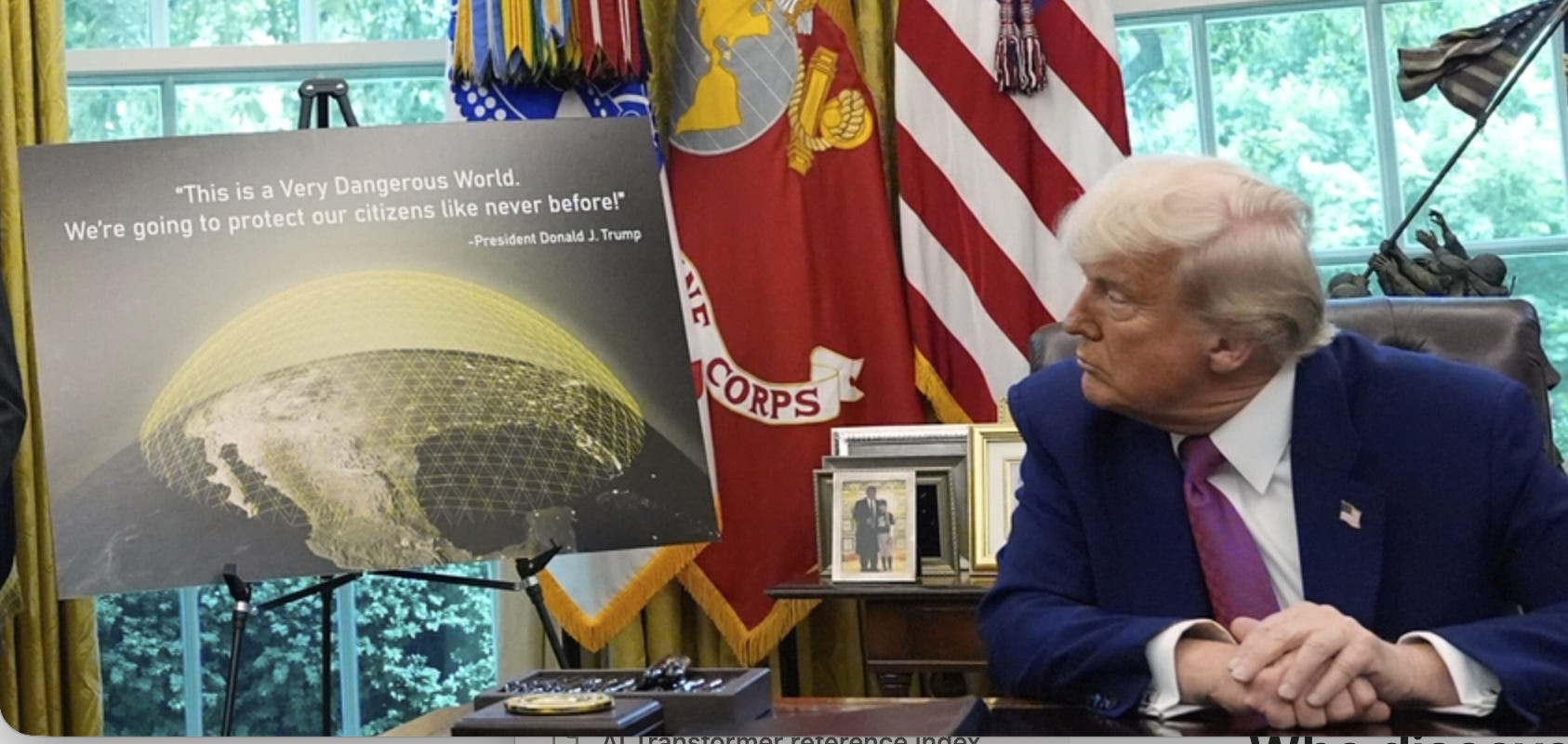
The “Golden Dome” missile defense initiative—a revival of the Strategic Defense Initiative concept from the 1980s—adds another layer of fiscal and technical implausibility. Missile defense has consumed hundreds of billions of dollars over four decades without producing a system capable of reliably defeating a sophisticated adversary’s strategic forces. The notion that a new iteration will achieve verified, operational success before the 2028 election defies both historical experience and engineering reality.
Meanwhile, the most immediate lever available in a post-treaty world—uploading existing launchers with additional warheads—costs far less and can be accomplished far faster. It is also the action most likely to trigger reciprocal responses, creating a cycle of incremental buildup without the transparency or predictability that treaties provide. By the time the U.S. spends the billions required to “upload” its fleet to 3,500 warheads, China will have likely achieved its “breakout” goal of 1,000+ warheads, rendering the “junior member” status obsolete.
In short, the administration can fund gradual, destabilizing competition. It cannot fund the revolutionary breakthroughs its rhetoric implies.
The Institutional Vacuum
Taken together, the institutional signals point to a strategic priority that is, at best, deferred. Strategic nuclear arms control does not appear on the agenda of the administration’s newly established “Peace Board,” nor has a chief negotiator or dedicated interagency team been publicly identified—developments that effectively leave the initiative resting with a State Department already operating under reduced staffing and reorganized structures. Procedurally, this places any prospective negotiation on the back foot before it has even begun.
The political calendar compounds the difficulty: the possibility of a shift in House control following the midterm elections would almost certainly narrow the administration’s legislative bandwidth for treaty-making, which requires sustained executive focus and eventual bipartisan support. Meanwhile, evolving U.S. policy toward NATO has encouraged deeper nuclear consultation between the United Kingdom and France and revived European discussion about reducing reliance on the American nuclear umbrella—an evolution that adds another layer of complexity to any future framework. Russia has indicated that British and French forces must be considered in subsequent arrangements, while China continues to resist participating in trilateral talks to formalize its numerical disadvantage. Against this backdrop, and with the NPT Review Conference approaching, the international environment increasingly resembles one of gathering strain rather than coordinated movement toward renewed arms control.
Set Up To Fail
The administration’s approach to arms control is not a strategy. It is a series of mutually incompatible demands wrapped in the language of dealmaking.
It proposes a trilateral treaty while refusing the reductions that would make Chinese participation rational.
It insists on including China while ignoring the UK-France complication that makes Russian participation conditional.
It dismisses the NPT framework while offering no alternative mechanism to address the regional proliferation threats that pose the most immediate danger.
It promises a “better deal” on a timeline that makes serious negotiation impossible.
And it pairs rhetoric about unconstrained competition with a budget reality that ensures slow, incremental changes rather than transformative shifts.
What remains after New START’s expiration is not a “clean slate” for ambitious diplomacy. It is a void—one in which the mechanisms that made nuclear competition legible and manageable are gone, replaced by strategic ambiguity, worst-case planning, and the steady erosion of the habits and institutions that have prevented the ultimate weapons from becoming the ultimate default.
The treaty did not die from natural causes. It was allowed to lapse as a bargaining tactic in pursuit of a negotiation that cannot happen, to achieve a treaty that cannot be written, within a timeframe that does not exist.
It was, from the moment the administration chose this path, set up to fail.
© 2026 Farooq Hussain
The war in Europe ended with Germany’s unconditional surrender on May 8, 1945 (V-E Day). The Trinity test occurred more than two months later, on July 16, 1945. At that time, only enough enriched uranium existed for one additional bomb (Little Boy, used on Hiroshima). Plutonium production from the Hanford reactors was increasing but still limited, producing enough for the Fat Man bomb (used on Nagasaki) with additional material coming online in subsequent weeks.
See the Franck Report (June 1945), which urged a demonstration rather than military use, and the subsequent formation of the Federation of Atomic Scientists (later Federation of American Scientists), which advocated for international control of nuclear weapons. The Szilard petition, signed by 70 Manhattan Project scientists, also opposed using the bomb on Japan without warning.
According to the Federation of American Scientists (January 2025), the United States and Russia together possess approximately 11,000 of the world’s roughly 12,100 nuclear warheads (including both deployed and reserve stockpiles).
The New Strategic Arms Reduction Treaty (New START) was signed on April 8, 2010, entered into force on February 5, 2011, and expired on February 5, 2026, after one five-year extension in 2021.
Russia’s 9M729 (NATO designation: SSC-8 / Novator) ground-launched cruise missile system, first deployed around 2017, violated the INF Treaty’s prohibition on ground-launched missiles with ranges between 500 and 5,500 kilometers. The United States assessed its range at approximately 2,500 km.
On February 21, 2023, President Vladimir Putin announced Russia’s suspension of participation in New START, including on-site inspections and the biannual exchange of data, though Russia stated it would continue to observe the treaty’s warhead and launcher limits.
Projected Costs of U.S. Nuclear Forces, 2025 to 2034, Congressional Budget Office (April 2025). The report estimates total costs at $946 billion, with $309 billion for modernization of delivery systems and $193 billion for warhead and plutonium infrastructure. See also: ICBM Modernization: Air Force Actions Needed to Expeditiously Address Critical Risks to Sentinel Transition, GAO-25-108466 (September 2025).
Additional Reading:
The Aftermath: The Expiration of New START and What It Means, Federation of American Scientists (February 2026).
Strategic Prudence and Extending New START, Quincy Institute for Responsible Statecraft (February 2026).
Projected Costs of U.S. Nuclear Forces, 2025 to 2034, Congressional Budget Office (April 2025).
ICBM Modernization: Air Force Actions Needed to Expeditiously Address Critical Risks to Sentinel Transition, GAO-25-108466 (September 2025).