

With the U.S.-Russia New START treaty set to expire on February 5, 2026, the world faces a critical juncture: Will strategic arms control survive, or will the last remnants of nuclear restraint collapse? The choices are stark—agree to extend the limits within existing agreements, unilaterally declare a decision to observe existing agreements while exploring ways to forge new ones, or let an era of unrestricted nuclear weapons begin.
In the 1970s and 1980s, arms control agreements helped de-escalate Cold War tensions, yet today’s nuclear landscape is remains horribly risky. The rhetoric of nuclear brinkmanship echoes the dark satire of Randy Newman’s song Political Science: “Let’s drop the big one and see what happens… they all hate us anyhow.” In an era where the risks of nuclear war often seem distant, the reality remains: these weapons still exist and could destroy civilization, causing mass extinctions and the total destruction of the planet within hours.
Trump’s Nuclear Record: Disengagement Without Direction
During his first presidential term, Donald Trump systematically dismantled key arms control agreements, withdrawing from:
• The Iran nuclear deal (JCPOA) in 20181
• The Intermediate-Range Nuclear Forces (INF) Treaty in 2019
• The Treaty on Open Skies in 2020
His administration also refused to extend New START, nearly allowing the last major U.S.-Russia nuclear treaty to lapse before Biden renewed it in 2021. While Trump cited broad Russian treaty violations and strategic concerns, his approach was widely criticized for abandoning agreements without securing replacements. Scrapping the INF Treaty, for example, was seen as reckless—especially since it was a landmark agreement from the late Cold War that helped reduce tensions in Europe. Though there had been long-standing concerns over Russian violations of the terms of the agreement, notably over the development of a ground-launched cruise missile.2 However, abandoning the agreement without a replacement agreement has left Russia to continue unchallenged.
A Sudden Change in Tone?
In a Davos World Economic Forum videoconference, Trump unexpectedly called for renewed nuclear discussions together with Russia and China, declaring that all three nations could work together toward denuclearization. However, he stopped short of proposing formal trilateral negotiations.3 His previous attempt to bring China into arms control talks towards the end of his first presidential term—rather than extending New START—ultimately failed.
Critics argue that Trump’s newfound interest lacks credibility. His administration actively opposed nuclear arms control, and his second-term appointments lack key figures with diplomatic experience and expertise in this field. Meanwhile, U.S.-Russia relations have only deteriorated since his first term, with Russia suspending arms talks after its 2022 invasion of Ukraine.4
Russia, China, and a Fractured Arms Control Landscape
The prospects for nuclear arms negotiations are dim. Russia, embroiled in a protracted war in Ukraine, suspended New START compliance in 2023 and withdrew from the Comprehensive Nuclear-Test-Ban Treaty (CTBT) in October of the same year. Kremlin officials say they will resume strategic negotiations only when the U.S. and Europe ease sanctions imposed as a result of Russia's invasion of the Ukranine—a highly unlikely scenario.
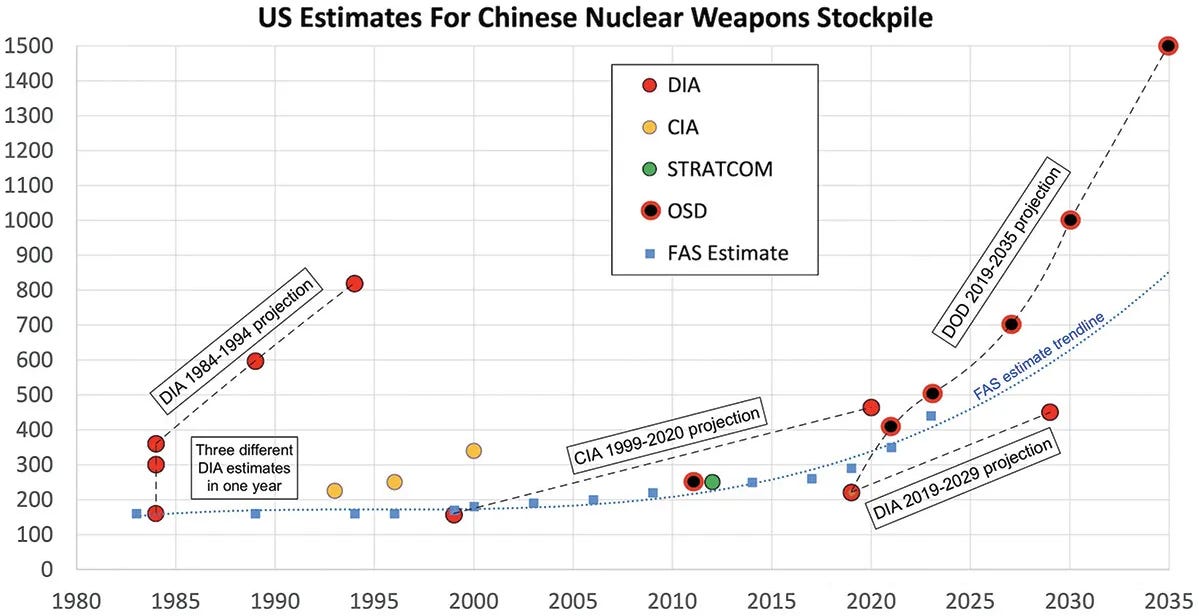
China, meanwhile, has never participated in nuclear arms limitation talks. The U.S. and Russia each maintain over 1,700 deployed warheads, dwarfing China’s estimated 350–500 nuclear warheads. The Pentagon speculates China could expand to 1,000 warheads by 2030, but this projection is highly speculative. Historically, China has maintained a “no first use” policy and a relatively modest arsenal, slightly larger than France or the UK but barely one-third the size of the US or Russia.
Adding China to a formal U.S.-Russia arms control framework would be challenging for several reasons:
1. Strategic Alignment with Russia – China has deepened its relationship with Moscow, financially backing Russia’s war effort while both nations pledge closer military cooperation.
2. Asymmetric Arsenal Sizes – China argues its smaller arsenal makes direct negotiations with the U.S. and Russia unbalanced in favor of the two major nuclear weapons nations.
3. Independent Nuclear Policies – Unlike the U.S. and Russia, China has no history of verifiable nuclear arms reduction agreements. Establishing a verification regime allowing all three nations to inspect each others arsenals to ensure compliance would present new challenges.
4. Speculative Growth Projections – Alarm over China’s potential nuclear expansion is based on speculative estimates rather unsupported by the historical growth record of the Chinese nuclear arsenal.
Testing the Waters: A Return to Nuclear Explosions?
One of the most concerning possibilities is a unilateral return to nuclear testing by the United States. North Korea is the last nation that conducted a nuclear test in 2017.5 The United States has not conducted a nuclear test since 1992, and the Comprehensive Test Ban Treaty (CTBT), though never ratified by the U.S. Senate, has been observed as a moratorium on nuclear testing worldwide with the exception of North Korea. However, Trump officials discussed the possibility of resuming tests during his first term, and some conservative groups, such as the Heritage Foundation’s Project 2025, have since advocated for a return.6 It should be noted though that there is no technical need for such tests, even for the development of new weapons designs based on the experience and historical data collected from the 1,030 nuclear weapons tests between 1945 and 1992.
Expert observers warn that breaking the moratorium would have severe global consequences, encouraging Russia, China, and other nations to restart testing together with removing any reluctance on the part of countries such as Iran to hold back from developing nuclear weapons. The potential environmental and health effects of resumed nuclear testing—such as radioactive contamination through groundwater leaks—are also deeply concerning.
Currently, the U.S. and other nuclear weapons nations rely on non-nuclear explosive or “subcritical” tests, using advanced supercomputer simulations to model the nuclear component. The US is deploying a new major particle accelerator facility, Scorpius, at it’s test site in Nevada to refine nuclear testing data, obviating the need for explosive testing. Many analysts argue this approach makes full-scale nuclear testing not only uncessary but also obsolete.
Modernization and a New Arms Race?
Both the U.S. and Russia are engaged in massive nuclear modernization programs:
• The U.S. is spending over $80 billion to upgrade its nuclear arsenal, including new ballistic missiles, cruise missiles, and warheads.
• Russia, meanwhile, has developed new strategic weapons, including hypersonic glide vehicles and potential space-based nuclear systems.
With no framework or prospective negotiations to replace New START, a new nuclear arms race could easily be initiated by actions such as a resumption of nuclear weapons testing. Trump’s past actions suggest he may push for expanding U.S. nuclear capabilities rather than constraining them. His first administration proposed a new sea-launched nuclear cruise missile, which the Biden administration attempted to cancel. If Trump returns to power, reviving this program is likely.7 Additionally, there are significant nuclear force modernization projects underway, including the Sentinel ballistic missile replacement for the land-based Minuteman III.
Looking Ahead: Negotiation or Escalation?
Trump’s track record suggests a contradictory approach: calling for negotiations while simultaneously undermining existing treaties. Whether he would genuinely pursue a new arms control agreement remains, based on record, highly unlikely.
The broader question is whether a new nuclear arms race can be avoided. With Russia threatening tactical nuclear use in Ukraine, a perceived threat of aggressive nuclear expansion by China, and U.S. domestic politics divided on nuclear strategy, together with the problems presented by a near-nuclear-capable Iran and North Korea, India, and Pakistan all pursuing nuclear modernization programs focused on intercontinental ballistic missiles.
A new approach should involve:
Extending New START beginning new negotiations while observsing existing limits.
Preventing a return to nuclear testing that could unravel global security norms.
Encouraging a forum to engage all nuclear weapons nations to enter dialogue—even if formal treaties remain elusive, threats posed by Iran’s nuclear weapons, North Korea’s continued development program together with those of other countries should seek some forum to enable forward movement with nuclear arms control.
Final Thoughts: A Return to Reykjavik?
The world has been here before. The Cold War’s peak saw over 70,000 nuclear warheads, yet diplomacy ultimately led to arms control breakthroughs—most notably the 1986 Reykjavik Summit, where Reagan and Gorbachev laid the groundwork for historic reductions.
Trump’s self-styled image as a dealmaker suggests he might attempt a bold move—perhaps seeking a historic agreement. However, without a coherent arms control strategy or the necessary diplomatic groundwork, his proposals may remain rhetoric rather than reality.
With nuclear tensions rising and strategic agreements eroding, the coming years will determine whether arms control is revived—or abandoned altogether. The stakes couldn’t be higher.
Key Takeaways
✔ New START expires in 2026, leaving nuclear arsenals unconstrained.
✔ Trump’s past actions suggest a pattern of withdrawal from arms control agreements.
✔ China’s nuclear expansion remains speculative and far below U.S./Russia levels.
✔ Russia’s nuclear posture has become more aggressive post-Ukraine invasion.
✔ A return to nuclear testing could destabilize global arms control efforts.
✔ Arms control diplomacy is at a crossroads—will the world step back from the brink?
updated: 8/7/2025
The Joint Comprehensive Plan of Action (JPOCA)) On July 14, 2015, the P5+1 (China, France, Germany, Russia, the United Kingdom, and the United States), the European Union (EU), and Iran reached a Joint Comprehensive Plan of Action (JCPOA) to ensure that Iran's nuclear program will be exclusively peaceful.The Joint Comprehensive Plan of Action (JPOCA)) On July 14, 2015, the P5+1 (China, France, Germany, Russia, the United Kingdom, and the United States), the European Union (EU), and Iran reached a Joint Comprehensive Plan of Action (JCPOA) to ensure that Iran's nuclear program will be exclusively peaceful.The Joint Comprehensive Plan of Action (JPOCA)) On July 14, 2015, the P5+1 (China, France, Germany, Russia, the United Kingdom, and the United States), the European Union (EU), and Iran reached a Joint Comprehensive Plan of Action (JCPOA) to ensure that Iran's nuclear program will be exclusively peaceful. While in many respects flawed, specifically in terms of verification of compliance with the agreement obligations by Iran, the JPOCA proved that it is possible to gather the major nuclear powers into collaboration over a nuclear weapons related agreement.
Gordon, M, (2017,February,14), Russia Deploys Missile, Violating Treaty and Challenging Trump. New York Times
Kelly, L (2025, January, 23), Trump Urges Nuclear Talks with Russia, China, thehill.com,
Conover, E. (2025, January 17). What nuclear weapons experts will watch for under Trump: Researchers will be monitoring arms control, the U.S. arsenal and the possibility of resumed tests. Science News.
Arms Control Association. (2025, January 24). ACA welcomes Trump’s acknowledgment of the “tremendous” cost and dangers of nuclear weapons and interest in “denuclearization” with Russia and China. Arms Control Association Press Release.
EU Today. (2025). Trump proposes trilateral nuclear reduction. EU Today.
Knox, J. (2024, November 20). We need to prevent a new era of nuclear weapons testing. Union of Concerned Scientists.
Nuclear Threat Initiative (2023, June 7) North Korea Nuclear Test Facility.
Hudson, J., & Sonne, P. (2020, May 22). Trump administration discussed conducting first U.S. nuclear test in decades. The Washington Post.
Broad, William J. (2024, July 5). Trump Advisers Call for U.S. Nuclear Weapons Testing if He Is Elected. The New York Times.
Fink, A. L. (2024, October 17). Nuclear-Armed Sea-Launched Cruise Missile (SLCM-N). Congressional Research Service.
Union of Concerned Scientists, (2024, July 24) Scientists Call for Cancelling New Land-based Nuclear Missiles
If you’ve enjoyed this Substack Please consider sharing using the button below.
As New START expires without a successor, strategic stability will depend less on new treaties than on practical, reciprocal limits that can keep pace with nuclear innovation.
The Last Treaty: Nuclear Weapons Innovation and What Comes Next — Farooq Hussain (Amazon, next month)
Incisive comprehensive article. Am better informed about the actions of governments and how the abuse of power, held by individuals dismantles the safety of agreements. Horror story well told.