

In this, the second installment in our Rosetta Stone series, we move from FAQs into the story of how Napoleon’s Egypt expedition jump-started modern Egyptology. He did so by organizing a state-sponsored brain trust of over 160 engineers, naturalists, artists, and linguists from across Europe, comprising the most talented and highly regarded in their respective fields. Given their preeminence, they became collectively known as the savants. Together they formed the Institut d’Égypte in Cairo and began a coordinated, government-backed program of fieldwork, cataloging, and publication—a Manhattan Project-style effort for the scientific and systematic study of antiquity. Their multi-volume Description de l’Égypte, published over a period of twenty years (1809–1829), set the foundation not only of the study of modern-day Egyptology but also a framework for the future study of ancient civilizations and cultures. While this was progressing, Jean-Francois Champollion, a brilliant linguist, solved the challenge of translating hieroglyphs, thereby opening the door to the study of four thousand years of ancient Egyptian civilization. Champollion’s work attracted celebrity attention; the decryption of Egyptian hieroglyphs was the discovery of the double helical structure of DNA of its day.
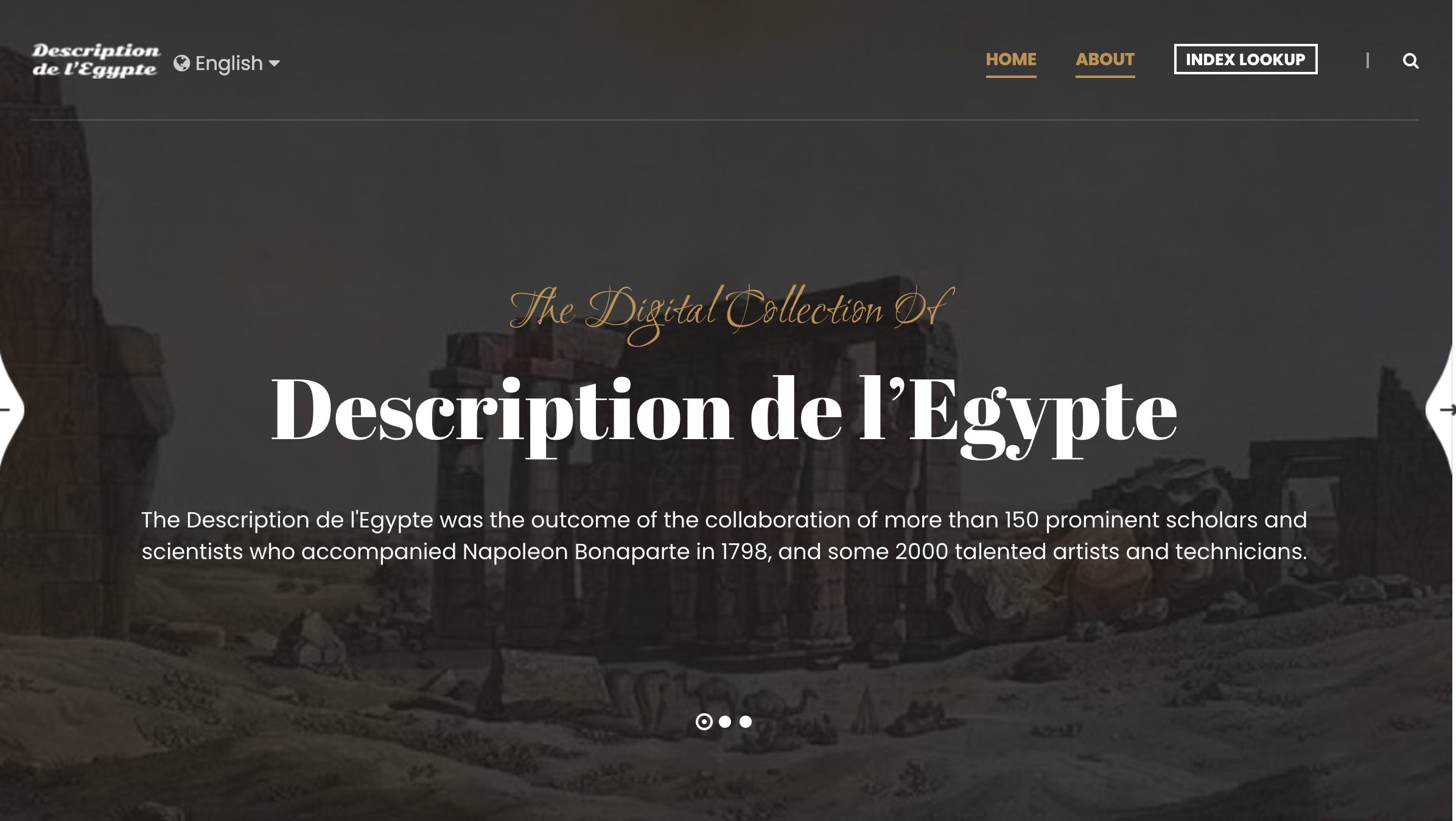
Description of Egypt 1 aimed to comprehensively catalog all known aspects of ancient and modern Egypt, as well as its natural history. The successful collaborative work of 167 civilian scholars and scientists who travelled to Egypt with Napoleon’s expedition, setting up shop in Cairo in 1798, they were supported by roughly 2000 artists and technicians, including 400 engravers, who would later compile it into a full work. At the time of its publication, it was the largest known published work of its kind in the world.
In July 1799, Lieutenant Pierre-François Bouchard, a French engineer attached to Napoleon’s expedition, inspecting the fortification works at Fort Julien near Raschid (Rosetta). On his walk he spotted by chance the corner of a large inscribed granite slab protruding from the ground. Trained enough in languages to recognize the ancient Greek text, and quick to see that the slab also bore inscriptions in both demotic and hieroglyphs, Bouchard realized the stone might prove invaluable to the savants who accompanied the army. At a moment when French and British rivalry for control of Egypt unfolded against the backdrop of a fading Ottoman presence, Bouchard understood the scholarly and political stakes, and he immediately had the tablet recovered for study.
Though well established in Cairo following Nelson’s rout of the French fleet at Alexandria, they were at the mercy of British administration. Thankfully, the British allowed the French scientific and natural history work to continue with very few constraints. The most famous, of course, is that they wanted the now much-talked-about Rosetta Stone, and the French wanted to keep it. It was shuffled around Cairo with a final resting spot in the home of General Menou, who was the officer commanding the French army in Egypt, as Napoleon had left the country to pursue other interests.
General Menou’s claim that the stone was his personal property and could not be treated as a spoil of war was not acceptable to the British commander, Major General Turner.2 Britain acquired physical ownership of the stone under the 1801 Capitulation of Alexandria agreement, and the stone reached London in February 1802. But not before the addition of the further inscriptions "Captured in Egypt by the British Army 1801" on the left side, and "Presented to King George III" on the right. It went on public display at the British Museum that March, where it has remained (with brief wartime storage) ever since. Of course, the stone itself was not needed to translate the Hieroglyphs, and copies of the texts and casts of the stone had been made before it was handed over to the British. Even though the stone was on display at the British Museum, they invited the French and all comers who wished to study it. Champollion’s 1822 breakthrough, announced in his Lettre à M. Dacier, then converted the Stone’s trilingual decree into the first systematic decipherment of hieroglyphs, thus opening up the universe of ancient Egyptian studies.
Introduction to the Rosetta Stone Repatriation Cause
What if the greatest threat to Egyptian antiquities wasn't nineteenth-century European collectors, but the activists now demanding their return?
The current campaign to repatriate the Rosetta Stone, mainly led by Egyptian archaeologist Zahi Hawass, presents itself as a righteous battle against colonial theft. Yet this narrative conveniently ignores a fundamental historical truth. Without Napoleon's expedition and the subsequent European fascination with ancient Egypt, we would have precious little Egyptian heritage left to argue about, plundered, despoiled, and desecrated over millennia.
The Inconvenient Debt to European Scholarship
The modern repatriation movement rests on a profound historical amnesia. When Napoleon landed in Egypt in 1798, he brought a vision and a team whose work would literally create the field of Egyptology. The resulting Description de l'Égypte, published between 1809 and 1821, provided the systematic foundation for all subsequent Egyptian archaeological study. Without this monumental French undertaking, the Rosetta Stone itself might have remained just another stone in some forgotten fortification o the Nile delta seversl hours drive from Alexandria even today.
This European intervention came at a crucial moment. For millennia before the first European archaeologist set foot in Egypt, ancient monuments had faced systematic destruction from grave robbers, treasure hunters, and those who saw pharaonic temple stones as convenient building materials which were ransacked in enormous quatities. Islamic rulers burned papyrus scrolls for fuel. Ottoman administrators stripped temple reliefs for decoration. The random looting and desecration of Egyptian monuments had been the norm for centuries, making it intellectually dishonest to blame European colonialism for what was already a millennia-old pattern of destruction.
The Politics of Repatriation
The current repatriation campaign with Egyptian antiquities cannot be separated from the personality mainly seen to be driving it. Zahi Hawass, despite his fall from official power following Egypt's revolution, has engineered a remarkable recovery that serves his personal brand as much as it does his connection to Egyptian heritage.3 His international lecture tours command hundreds of dollars per ticket for audiences who pay to hear hours of self-promotion wrapped in anti-colonial rhetoric.
Within Egypt, support for his cause often stems less from scholarly conviction than from professional survival. Running afoul of Hawass—even in his current unofficial capacity—can have dire consequences for archaeological careers. This creates an echo chamber where genuine scholarly debate about repatriation becomes nearly impossible.
Few other figures have shaped the global debate over returning Egypt’s antiquities more than Zahi Hawass. Secretary General of the Supreme Council of Antiquities until 2011, Hawass made the Rosetta Stone, Nefertiti bust, and Dendera Zodiac his “holy trinity” of restitution demands. “These are Egyptian icons,” he told reporters, “and they belong in Egypt.”
Yet his style has always been polarizing. A Smithsonian profile called him a “media-savvy showman” who mixed scholarship with politics and loyalty to Mubarak. Even after resignations and controversies, he reinvented himself through global lecture tours and luxury “VIP” trips to Egypt, where access to off-limits sites is marketed as part of his celebrity aura.
Recent revelations have further fueled calls for restitution. Newly examined correspondence suggests Howard Carter himself removed objects from Tutankhamun’s tomb that later surfaced in private collections—evidence that even celebrated “discoverers” were found to have stolen artifacts “Even Carter blurred the line between discovery and theft,” wrote The Guardian newspaper.
The Architecture of a Modern Campaign
Understanding the current repatriation movement requires examining how a century of sporadic requests transformed into today's sophisticated propaganda operation. The evolution reveals as much about political theater as it does about cultural justice.
A Century of Convenient Timing
Egypt's repatriation efforts have always coincided suspiciously with moments of political opportunity rather than genuine legal discovery. The Nefertiti bust, discovered in 1912 and transported to Berlin in 1913, prompted Egypt's first return request in 1920—coinciding with post-war German weakness, not any newfound evidence of illegal acquisition. Similarly, King Farouk's petition to the Allied Control Council after World War II exploited Germany's defeated status rather than advancing any novel legal argument.
The Rosetta Stone's case reveals even more creative legal reasoning. Egyptian officials have claimed the 1801 Treaty of Alexandria was invalid because it wasn't signed by Egypt's "rightful ruler"—a retroactive application of sovereignty concepts that would invalidate countless historical agreements. This argument conveniently ignores that Egypt was then part of the Ottoman Empire, making questions of "rightful" Egyptian rulership historically meaningless.
The Grand Orchestration of 2022
Hawass's October 2022 campaign represents the masterful culmination of this century-long effort. By combining three artifacts—the Rosetta Stone, Nefertiti's bust, and the Dendera Zodiac—into a single petition, he created a media spectacle that individual requests could never achieve. The timing, coinciding with the opening of Egypt's Grand Egyptian Museum, transforms what might appear as a scholarly debate into an obvious promotional strategy.
The campaign's language reveals its true nature. By claiming Western museums are "participating in imperialism" and committing "cultural violence," Hawass employs the rhetoric of contemporary social justice movements to reframe archaeological disputes as moral crusades. This linguistic strategy makes nuanced discussion nearly impossible—who wants to defend "cultural violence"?
Between the late 19th century and the years before independence, Egyptian officials themselves often presented antiquities as diplomatic gifts or tokens of gratitude. One striking case was the transfer to Italy of the painted tomb of Seti I, fragments of which were gifted and later reassembled into one of the most remarkable Egyptian monuments outside the country—now on display in the Museo Egizio in Turin and visited by tens of thousands each year. The irony is hard to miss: while today Egyptian archeologiests thunder against colonial plunder and demand the return of iconic objects like the Rosetta Stone or Nefertiti’s bust, they tend to remain quiet about—or exempt from—their own history of sanctioned giveaways.
The Signature Circus
The petition's millions of signatures provide impressive theater but raise questions about its legitimacy. Online petitions, particularly those framed in emotional terms of cultural theft, attract support from people with minimal understanding of the complex historical and legal issues involved. The British Museum's "little willingness" to return artifacts likely reflects not imperial arrogance but recognition that capitulating to social media campaigns would establish dangerous precedents for museums worldwide.
Notably, the Egyptian government has not officially endorsed Hawass's campaign, suggesting that even Cairo recognizes the potential complications of his approach. This distance allows Egypt to benefit from international pressure while maintaining plausible deniability about the more extreme claims.
The Selective Outrage Problem
The campaign's choice of targets reveals its opportunistic nature. Why these three artifacts and not thousands of others? The answer lies not in legal merit but in public recognition. The Rosetta Stone, Nefertiti, and the Dendera Zodiac are among the most famous Egyptian artifacts in Western museums—their return would generate maximum publicity for minimum effort.
This selectivity undermines claims about cultural completeness or spiritual significance. If these artifacts are truly essential to Egyptian identity, why weren't they priorities during the decades when Egypt had more pressing concerns? The timing suggests this is less about cultural restoration than about capitalizing on contemporary anti-colonial sentiment.
The repatriation movement's transformation from occasional diplomatic requests to coordinated international campaigns reveals a fundamental shift from legal arguments to propaganda operations. As we examine the specific claims about each artifact, this evolution becomes crucial to understanding what's really at stake.
The Global Museum Question
The repatriation argument fundamentally misunderstands how knowledge advances and cultures survive. The widespread distribution of Egyptian antiquities across magnificent collections worldwide has created something unprecedented in human history: a global constituency passionate about ancient Egyptian culture. Young visitors to the British Museum encounter the Rosetta Stone and become lifelong Egyptophiles. Students in Berlin marvel at Nefertiti and pursue careers in archaeology. Asian collectors fund expeditions that uncover new sites.
Without the enormous investments from European, Canadian, Asian, and American institutions, Egypt would have struggled impossibly with the costs of preserving and conserving its antiquities. The technical expertise, conservation facilities, and research infrastructure of major international museums have quite literally saved countless artifacts from decay, theft, and destruction.
The Real Stakes
This debate extends far beyond any single artifact. At its core, it asks whether cultural heritage belongs to geography or to humanity. The Rosetta Stone's current home in London makes it accessible to millions of international visitors annually, while its translations and reproductions circulate globally. Would relocating it to Cairo—however symbolically satisfying—actually serve scholarship or cultural understanding any better?
The repatriation movement's most dangerous premise is that nineteenth-century European interest in Egypt was purely extractive in nature. In reality, it was this "maniacal interest" that created the scholarly framework, conservation techniques, and international networks that continue to reveal new secrets of ancient Egypt today.
As we examine the specific case of the Rosetta Stone, we must ask ourselves: are we witnessing a legitimate reclaiming of cultural heritage, or a campaign that threatens to undermine the very international collaboration that has made modern Egyptology possible?
Over the past twenty-five years, Egypt has embarked on an ambitious transformation of its cultural landscape, expanding its museums and moving its pharaonic mummies with great internationally televised fanfare to their own Museum of Egyptian Culture and Heritage. The legendary Cairo Museum, founded by Mariette, now awaits UNESCO World Heritage designation and is set to be transformed into a cultural center. Meanwhile, after more than twenty years in development, the $1 billion Grand Egyptian Museum is finally opening—though even now, it remains only partially accessible, with the much-anticipated Tutankhamun Galleries and Khufu's Boats Museum yet to welcome visitors despite the announced November 2025 full opening.
Yet beyond the spectacle of these grand openings lies a more complex reality. Apart from the substantial Japanese investment in the GEM's creation, Egypt remains completely dependent on foreign financial, scientific, and technical assistance for the continued research, conservation, and communication of its cultural heritage—heritage it rightly cherishes but must share with the world. This raises profound questions about the current approach to archaeological stewardship. Moving rocks and relics around the planet amongst a gigantic and globally dispersed treasury of ancient Egyptian antiquity is not, in my view, a particularly useful approach to understanding or preserving our shared human heritage.
© 2025 Farooq Hussain
Reclaiming Heritage: The Case for Cultural Repatriation
This is the second installment in our series examining one of today's most compelling cultural debates: the repatriation of artifacts and treasures that have found their way into foreign collections through the complex legacy of colonialism—whether acquired through theft, dubious "gifts," or colonial extraction.
Our focus extends beyond simple ownership disputes to encompass the broader crisis facing world cultural heritage. While we advocate for returning displaced artifacts to their origins, we simultaneously witness the heartbreaking destruction of irreplaceable monuments—from Afghanistan's ancient Buddhas to Syria's Palmyra—lost forever to political extremism and warfare.
The Rosetta Stone: A Case Study in Cultural Custody
At the center of this discussion sits the Rosetta Stone, housed in the British Museum for over two centuries. This remarkable artifact, key to unlocking ancient Egyptian hieroglyphs, exemplifies the complex questions surrounding cultural ownership and institutional stewardship. Should it remain in London's galleries, or does it belong in Egypt, the land of its creation?
The Rosetta Stone represents just the beginning of our exploration. Our next issue of this series, we'll examine a diverse collection of displaced artifacts and art. Our final looks at how this granite fragment has gathered the sybolism and culutral heritage that belongs to the world, while as an object Heiroglphs would hadve been translated without it and come to think of it, even if Major General Turner had allowed it to remain General Menou’s personal property, on his return to France, he may not have found room for it in his luggage. Everything the savants needed from it they had taken long before.
From Hyderabad to the Crown: The Kohinoor's Journey
Consider the legendary Kohinoor diamond, mined from the fabled Golconda mines near my hometown of Hyderabad, India. This extraordinary gem now glitters in the British Crown Jewels. Remarkably, from its presentation to Queen Victoria in 1850 until Prime Minister Modi's recent diplomatic inquiries, no Indian leader had formally requested its return. This silence speaks volumes about the evolving nature of post-colonial relationships.
Why These Stories Matter
Each artifact tells a story not just of artistic achievement, but of power, politics, and cultural identity. Through these investigations, I aim to shed light on both the human stories behind these treasures and the nuanced arguments surrounding their rightful ownership.
I believe you'll find these histories as fascinating and complex as I do—stories that challenge us to think deeply about ownership, heritage, and justice in our interconnected world.
The Library of Alexandria offers a fully digitized high-resolution DVD of the complete Description de l’Egypte with a fully interactive viewer. Use this bookstore link for details
https://descegy.bibalex.org/en/BibliothecaAlexandrina
The Rosetta Stone: Journey from Alexandria to London. https://www.napoleon.org/en/history-of-the-two-empires/articles/the-rosettcga-stone-a-journey-from-alexandria-to-london/
Lawler, Andrew. "The Fall of Zahi Hawass." Smithsonian Magazine, 17 July 2011, www.smithsonianmag.com/history/the-fall-of-zahi-hawass-32319337/. Updated 26 July 2011.