

Bomb away— is the phrase WWII bombardiers used after releasing a payload over their target aim point.
At 8:15 AM on August 6, 1945, those words confirmed the release of "Little Boy" over Hiroshima. Three days later, "Fat Man" devastated Nagasaki. The world’s first use of nuclear weapons in war had taken place, and that WWII in the Pacific was brought to a sudden and dramatic end with Japan’s unconditional surrender that followed five days later on August 14, 1945.
But what followed reveals a far more complex—and morally troubling—reality than the standard narrative admits.
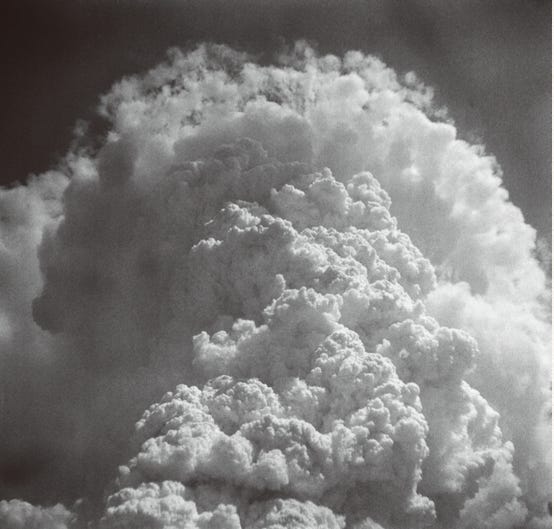
Three persistent myths have shaped public perception of the atomic bomb's development and use. The reality is far more disturbing.
The Scale of Destruction
The immediate devastation was unprecedented. In Hiroshima, estimates suggest 90,000 to 166,000 people were killed by the end of 1945, with the vast majority being civilians in a city of minimal military value.
Theoretical physics of the splitting of the nucleus became concrete images of the total destruction of entire cities by a single bomb and the tens of thousands of lives vaporized in the process.
Three days later, the plutonium-based "Fat Man"—the same design tested weeks earlier in the New Mexico desert—was dropped on Nagasaki, killing an estimated 60,000 to 80,000 people, again primarily civilians.1
These shocking numbers are even more sobering when compared to the broader destruction Japan had already suffered. General Curtis LeMay's firebombing campaign had systematically destroyed 67 cities, killing an estimated 300,000 to 330,000 civilians. The single most devastating raid—the March 9-10, 1945 firebombing of Tokyo—killed 80,000 to 100,000 people in one night, rivaling either atomic bomb’s toll.
Yet attempts to present this broader context have faced fierce resistance. The most dramatic example came in 1995, when the Smithsonian's National Air and Space Museum planned exhibit for the 50th anniversary of the bombings sparked a national controversy. Veterans' groups and the US Congress forced the cancellation of a comprehensive exhibit that was intended to include Japanese victim accounts and to raise questions about the necessity of the bombings. Though the exhibit had been planned with the participation of all stakeholders, under pressure the museum director resigned, and the Enola Gay was displayed with minimal historical context—a stark contrast to how other wartime decisions are examined.
This systematic resistance to nuance has preserved three fundamental myths.
Myth 1: The Race Against Nazi Germany
The Myth: The Manhattan Project was necessary to beat Hitler to the bomb.
The Reality: While fear of a Nazi atomic program drove the project's inception, key leaders learned by 1944 that Germany posed no real nuclear threat. By then, the machinery of the Manhattan Project had become unstoppable.
The Danish Revelation
Niels Bohr's spectacular escape from Nazi-occupied Denmark in October 1943 provided Los Alamos with vital intelligence. Through his conversations with Werner Heisenberg and other German physicists, Bohr confirmed that Hitler had deprioritized nuclear weapons development, viewing it as “Jewish physics,” while Germany’s reactor designs were fundamentally flawed.
Bohr’s revelations, shared with Robert Oppenheimer and other project leaders, made clear Germany lacked the scientific and industrial capability to build a bomb.
The Moral Reckoning
Joseph Rotblat, a Polish physicist who had joined the project to counter the Nazi threat, made the logical ethical choice: he resigned.
"The reason I went to Los Alamos was to help make a bomb that would prevent the Germans from winning the war. But the Germans surrendered, and it was no longer necessary."
- Joseph Rotblat, Nobel Peace Prize 1995, shared the prize with the Pugwash Conferences on Science and World Affairs
He was not alone. Leo Szilard, who had first proposed an American atomic bomb program in 1939, organized petitions among scientists opposing its use against Japan.
From Trinity's Triumph to Horror's Reality
The successful Trinity test in New Mexico on July 16, 1945, initially brought euphoria. Years of intensive complex mathematical calculations and experimentation, together with the harnessing of the nation’s vast industrial capability, culminated in a blinding fireball that vaporized the steel test tower and fused desert sand into radioactive glass—Trinitite, named for the test site where it was uniquely created.
But euphoria quickly turned to horror when military officials showed film footage of the bomb's effects. Entire cityscapes reduced to ash and radioactive rubble. The human shadows on the streets and remains of buildings left the only visible record of the people who were vaporized by the fireball.
The meticulously worked calculations of the scientists had finally translated into the traces of vaporized lives. Many scientists who had remained committed to the project despite knowing the German threat had ended now faced the full moral weight of what they had created. One project scientist described it as a “mass psychological crisis” at Los Alamos.
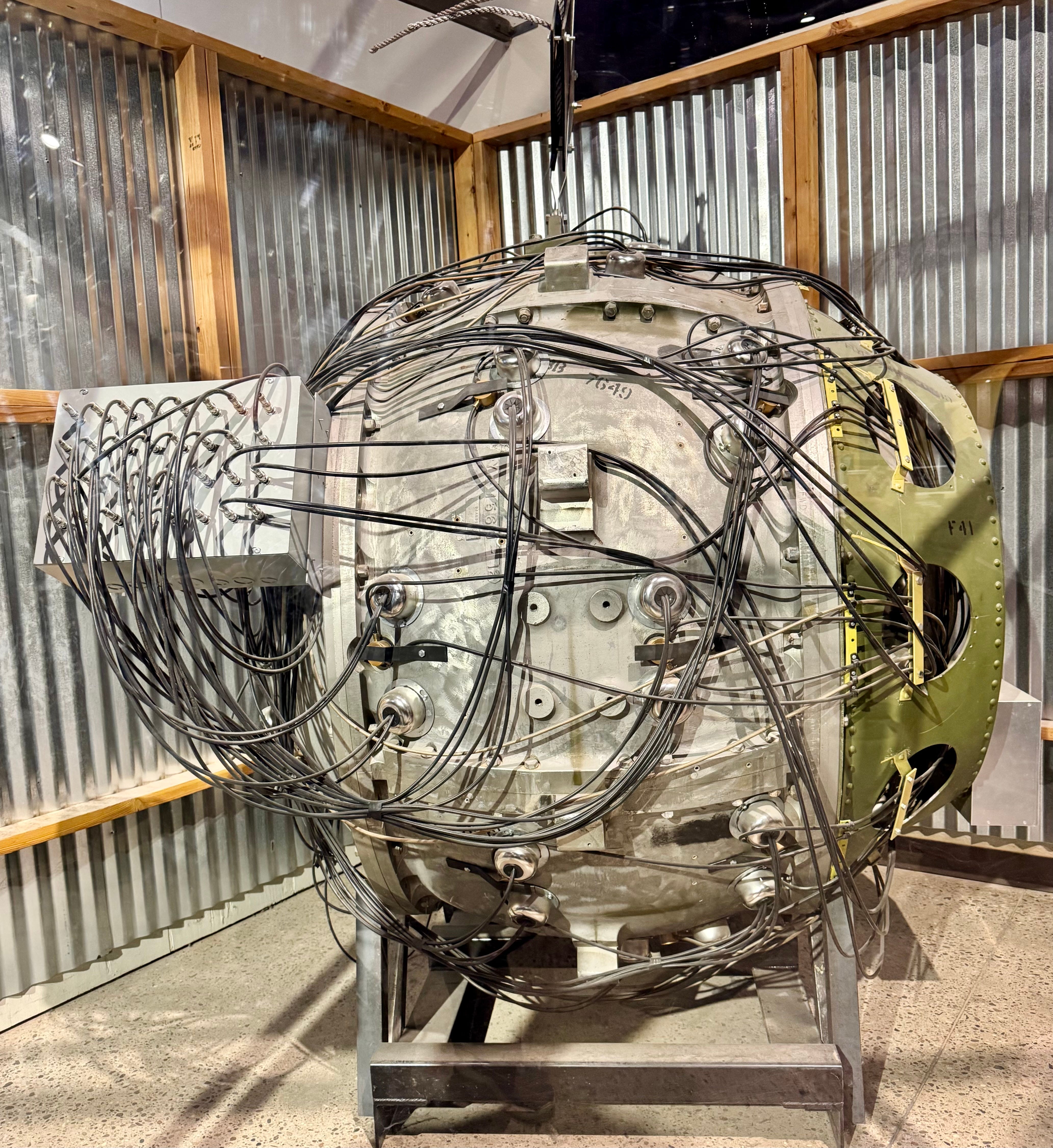
Trinity’s Forgotten Victims
Hours after the test, radioactive ash drifted down over nearby communities—including children at summer camps in Ruidoso, who mistook the fallout for snow. “It wasn’t cold—it was hot,” recalled one camper. “But we didn’t know any better.” According to reports, the fallout spread across a 100-mile stretch of New Mexico, contaminating homes, farms, livestock, and water.2 Despite warnings from Manhattan Project officials about potential civilian exposure, no evacuations or protective measures took place. In the aftermath, residents suffered cancers and radiation illnesses—without acknowledgment or federal compensation.
The United States disregarded the first American casualties of the nuclear era while researching the effects of radiation on Japanese survivors. Nearly 80 years later, the government still denies accountability for the victims downwind of Trinity.
The Great Escape
The psychological impact intensified when Robert Oppenheimer resigned as laboratory director shortly after the war's end. Oppenheimer, who had held the scientific community together through years of intense work, was himself deeply shaken by witnessing the bomb's effects. His famous reflection—"Now I am become Death, destroyer of worlds"—captured the profound moral transformation many scientists experienced.3
Oppenheimer was a figure both revered and adored by the scientists of Los Alamos; his departure triggered a sense of disappointment and led to an accelerated exodus from the laboratory. Scientists who had stayed for the war effort, for scientific curiosity, or simply because of institutional momentum suddenly confronted the reality that their theoretical work had created weapons of unimaginable horror. The footage had made abstract death counts viscerally real.
The Momentum Trap
Why did the project continue despite the eliminated German threat? The reasons reveal uncomfortable truths about bureaucratic momentum and sunk cost thinking:
- Resource Inertia: By 1944, the project employed over 130,000 people and had consumed nearly $2 billion (roughly $30 billion today)
- Scientific Pride: Many scientists wanted to prove the theoretical possibility could become practical reality
- Strategic Pivot: Military planners increasingly viewed the bomb as useful against Japan
- Bureaucratic Momentum: The massive bureaucratic machine had developed its own unstoppable inertia
Norris Bradbury took on the leadership of the laboratory following Oppenheimer’s departure and went on to become the lab’s longest-serving director, for whom the lab’s museum is named. Reassured by Bradbury, most scientists stayed, frequently citing these practical considerations rather than the original anti-Nazi rationale.
Myth 2: The Bomb Saved Lives by Ending the War
The Myth: Using atomic bombs saved hundreds of thousands of American lives by avoiding a costly invasion.
The Reality: Japan was already on the verge of surrender, and many top military leaders opposed using the bomb.
Japan's Desperate Situation
By July 1945, Japan's position was hopeless.
LeMay's devastating firebombing campaign had already killed more civilians than the atomic bombs combined
Naval blockades created starvation and supply shortages.
Intercepted cables revealed Emperor Hirohito was actively seeking surrender terms.
The Soviet invasion of Manchuria in August eliminated Japan's last hope of negotiating better surrender conditions. Japan's strategic position had become untenable long before the atomic bombs were ready for deployment.
Military Opposition
Contrary to popular belief, many top American military leaders opposed using atomic weapons:
- General Dwight Eisenhower: Later wrote that he told Secretary of War Henry Stimson the bomb was "completely unnecessary" and that "Japan was already defeated."
- Admiral William Leahy: Called the bomb "barbarous" and argued it violated "every Christian ethic I have ever heard of"
- General Curtis LeMay: Believed conventional bombing would force surrender within weeks
- Admiral Chester Nimitz: Argued that the naval blockade alone would compel surrender
The oft-cited figure of "hundreds of thousands" of American casualties were saved emerged only after the fact - as a political justification. Contemporary military estimates projected far lower invasion casualities.
Alternative Motivations
Historians now recognize several factors beyond ending the war drove the decision to use atomic weapons:
- Soviet Intimidation: Demonstrating American nuclear capability to Stalin as the Cold War began
- Domestic Politics: Justifying the massive secret expenditure to Congress and voters
- Scientific Curiosity: Testing the weapons' effects on urban targets
- Racial Attitudes: Wartime anti-Japanese sentiment shaped decision-making, amplified by the internment of Japanese Americans and the brutal treatment of prisoners of war by the Japanese
Myth 3: The Truth Was Hidden by Accident
The Myth: The full horror of atomic weapons emerged gradually as information trickled out.
The Reality: Military and political authorities systematically suppressed information about radiation effects and civilian casualties.
This pattern of suppression began immediately after Hiroshima and Nagasaki. During testimony to Congress, Maj. Gen. Leslie Groves, head of the Manhattan Project, claimed that death from radiation exposure was “a very pleasant way to die.”
For decades, public understanding of radiation risks was shaped by official reassurances that ignored mounting evidence. The consequences of those early distortions continue to influence debates over nuclear safety to this day.
The MacArthur Blackout
Following Japan’s surrender, General Douglas MacArthur imposed strict censorship:
Medical Suppression: Military doctors were forbidden from treating or studying radiation sickness.
- Scientific Blackout: Japanese scientists investigating radiation-induced illnesses received orders to destroy their collected data.
- Media Control: All journalists entering Hiroshima or Nagasaki required military escorts, and their stories subjected to censorship.
Breaking the Silence
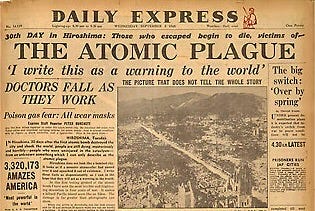
The first crack in this wall of silence came from Wilfred Burchett, an Australian war correspondent who evaded military handlers and traveled independently to Hiroshima in early September 1945. His story, published in the London Daily Express under the headline "The Atomic Plague," was the first to describe radiation sickness:
"In Hiroshima, 30 days after the first atomic bomb destroyed the city and shook the world, people are still dying, mysteriously and horribly—people who were uninjured in the cataclysm—from an unknown something that I can only describe as the atomic plague."
The US response was swift
Burchett was branded a communist sympathizer.
General Leslie Groves dismissed radiation sickness as "Japanese propaganda."
American outlets downplayed or discredited reports
Only John Hersey's groundbreaking article in The New Yorker in August 1946, humanizing six survivors, finally shattered the sanitized narrative.
Until this time, American and international media were promulgated not only by officials such as General Leslie Groves but also by planted journalists such as William Lawrence of the New York Times, who received a Pulitzer Prize for his reporting.4
The magazine's editor, William Shawn, made the unprecedented decision to dedicate the entire issue to Hersey's 31,000-word piece. The article was so powerful that The New Yorker sold out within hours, and Albert Einstein personally ordered 1,000 copies for his private distribution.
The Suppressed Science
Declassified documents reveal:
Manhattan Project Studies: Scientists had extensively studied radiation's biological effects on animals beforehand so that the radiation effects on the civilian population were understood in advance.
Japanese medical records detailing radiation sickness were confiscated.
Orders explicitly directed officials to downplay "residual radiation" concerns.
The Dangerous Legacy of Comfortable Lies
These myths endure because they shield the public from moral discomfort. They allowed Americans to view the bomb as necessary and humane.
Yet the truth is starkly different.
The Espionage Undercurrent
The fear of Soviet infiltration plagued the Manhattan Project. Those fears were justified—Klaus Fuchs, a German exiled British physicist and Soviet agent, confessed to passing nuclear secrets to Moscow.
Fuchs was stripped of his British nationality and returned to East Germany, where Soviet intelligence—under future Russian President Vladimir Putin, then a KGB officer—oversaw foreign assets and scientific operations.
Fuch’s espionage likely informed the Soviet nuclear program, though Soviet scientists involved in the development of their nuclear weapons have said that Fuch’s information reached them via Moscow and was not crucial to their progress.
Why The Official Narrative Endures
Even Christopher Nolan's acclaimed 2023 film Oppenheimer reinforced much of the traditional mythology. The film portrays the development of the bomb as a tragic but necessary act, emphasizing Oppenheimer's personal moral struggle over the bomb's justification. The distortion is no accident. The secrecy surrounding the Manhattan Project enabled officials to control the narrative, glorifying scientific achievement while burying moral complexities.
Throughout the Cold War, questioning nuclear weapons became unpatriotic
This persistence isn't accidental. The secrecy that shrouded the Manhattan Project allowed government officials to carefully control the narrative's release, emphasizing heroic scientific achievement while minimizing moral complexities. Throughout the Cold War, this sanitized version was further reinforced by anti-Communist fears and the arms race mentality that made questioning nuclear weapons seem unpatriotic or naive.
From Cold War Comfort to Contemporary Complacency
The Cold War's end lulled the public into believing nuclear risks were contained. But today:
The New START treaty faces expiration in February, 2026.
China is rapidly expanding its nuclear arsenal
North Korea continues its nuclear weapons and ballistic missile development
Iran: Despite the destruction of its nuclear facilities, the timing of its pursuit of nuclear weapons capability remains unclear.
The risk of nuclear conflict is as high—perhaps higher—than during the Cuban Missile Crisis.
The Urgent Need for Truth
Confronting the true history of the atomic bomb is not academic—it’s essential for survival.
The comfortable myths of Hiroshima have become luxuries we can no longer afford.
The atomic age began not as a reluctant measure to end war—but as a calculated demonstration of unprecedented destructive power.
Until we face that truth, we risk repeating history—this time with consequences from which there may be no recovery.
The next chapter of the nuclear story is being written now. Whether it echoes the comfortable lies of the past—or demands moral clarity—remains up to us.
This post is excerpted from my forthcoming book Nuclear Weapons: A Cultural History—a comprehensive exploration of humanity's most destructive creation and its profound impact on our world. From the blinding flash over Trinity to the tense standoffs of the Cold War, the book chronicles the weapons and the crises, accidents, near misses, and human stories that have shaped the nuclear age.
Here are the frequently neglected stories of those individuals who single-handedly prevented nuclear war between the US and Russia. The Soviet submarine commander who refused to fire a nuclear torpedo during the Cuban Missile Crisis despite depth charges exploding around him; the Russian officer who held back from launching ballistic missiles when a faulty electronic component triggered a false alarm; the emergency crews who risked their lives when a Titan missile exploded in its Kansas silo. Discover how popular culture—from the novel "On the Beach" to the documentary "The Day After"—shaped public perception of nuclear war, and explore the countless accidents, malfunctions, and split-second decisions that could have changed history.
Through declassified documents, eyewitness accounts, and recently uncovered stories, Nuclear Weapons: A Cultural History examines how these weapons transformed politics, culture, and the very nature of human existence from 1945 through the collapse of the Soviet Union and into the early 21st century.
Subscribe to Ariadne for updates on the book's release and exclusive excerpts before its publication in 2026.
Wellstein, Alex, Counting the Dead at Hiroshima and Nagasaki,Estimating deaths at Hiroshima, Bulletin of the Atomic Scientists, August 4, 2020
Blume, Leslie, Collateral Damage American Civilian Survivors of the 1945 Trinity Test, Bulletin of the Atomic Scientists, July 17, 2023
Oppenheimer's famous quote referencing Vishnu from the Bhagavad Gita—"Now I am become Death, destroyer of worlds"—was not actually spoken at the moment of the Trinity test, as popular accounts suggest. No witnesses recall him making this statement during the actual detonation. Instead, the quote first appeared years later during an NBC television interview for a documentary about the Manhattan Project, which remains viewable on YouTube today. What people who were present What was actually remembered about the testas Oppenheimer's more immediate reaction captured in that same NBC interview: "A few people laughed, a few people cried. Most people were silent." This more spontaneous observation, reflecting the mixed emotions of those witnessing humanity's entry into the atomic age, appears to be far more consistent with eyewitness accounts of what was actually said in that pivotal moment in the New Mexico desert.
Broad, William J., How a Star Times Reporter Got Paid by Government Agencies He Covered William L. Laurence, a reporter for The New York Times known as ‘Atomic Bill,’ became an apologist for the American military and a serial defier of journalism’s mores. August 9, 2021
Broad, William J., The Black Reporter Who Exposed a Lie About the Atom Bomb Charles H. Loeb defied the American military’s denials and propaganda to show how deadly radiation from the strike on Hiroshima sickened and killed. June 23, 2023