

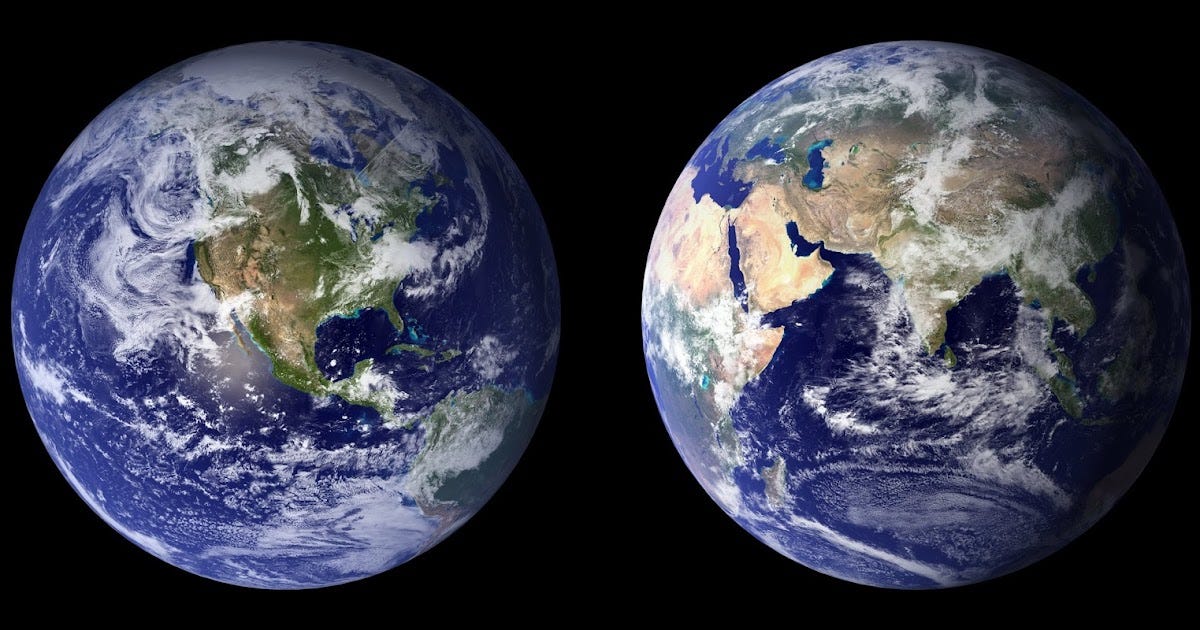
Perhaps the most significant acknowledgment of the oceans’ importance to planetary health came from tens of thousands of kilometers away—a single photograph taken by an astronaut on the last Apollo mission to the Moon.
It seems counterintuitive that our understanding of Earth’s dominant feature would be more dramatically influenced by leaving the planet than by centuries of sailing its surface and exploring beneath the waves. Yet the period from the 1970s to today has proven that satellites orbiting hundreds of kilometers above the surface can reveal oceanic processes invisible to any ship, submarine, unmanned submersible, or diver. NASA’s Landsat program1, launched in 1972, began capturing Earth in wavelengths that are invisible to the human eye, revealing ocean temperatures, phytoplankton blooms, and current patterns that shape global climate. Infrared imaging exposed the thermal architecture of the seas—the Gulf Stream’s warm ribbon, the cold upwelling zones that feed marine ecosystems, the El Niño oscillations that drive weather across continents.2
By 2012, when NASA released its stunning “Blue Marble 2012” composite from the Suomi NPP satellite, we possessed an 8000-pixel vision of our planet that no Apollo astronaut could have imagined: a cloud-free portrait showing Earth’s ocean systems in unprecedented detail, their blues ranging from the pale turquoise of shallow tropical waters to the deep indigo of abyssal plains.
This technological capability makes it all the more remarkable that the image which fundamentally changed how humanity views its home planet—the photograph that gave us the term “Blue Planet” and became the environmental movement’s most powerful icon—was captured not by sophisticated orbital instruments but by an astronaut’s handheld Hasselblad 500EL/70 camera3 on December 7, 1972, during Apollo 17’s journey to the Moon.
In 1969, I was lucky enough to have caught the attention of Monica Pidgeon, editor of Architectural Design magazine.4 Adventurous, far-sighted, and a risk-taker, Monica commissioned me to guest-edit an issue devoted to the ideas then being debated about underwater habitats and to raise awareness of the oceans’ importance. I quickly sought and secured help from the Cousteau family—Jean-Michel agreed to co-edit with me—and gained strong support from the US Navy Sealab project. True to form, Monica told me that as far as she was concerned, I was the guest editor and to stay focused on my responsibilities. I was at the time a research assistant to Keith Critchlow at the Architectural Association School. Keith, a follower and friend of Buckminster Fuller, was my advocate and advisor. We were all excited about the scope of the opportunity.
Shortly after, I published Living Underwater.5 My book’s cover featured a picture of Earth from space—that same Blue Marble image that would become the environmental movement’s defining symbol. Reflecting on how developments have unfolded, only the prescient concern for the health of the oceans has been sustained. The vision of human underwater habitation proved flawed and ultimately failed. But the notion that the oceans needed to be taken as seriously as space exploration was—and remains—true.
Yet knowing is not acting. Despite half a century of satellite surveillance revealing the oceans’ deteriorating health in ever-greater detail, the international response has been tragically inadequate. The UN High Seas Treaty—formally the Agreement on the Conservation and Sustainable Use of Marine Biological Diversity of Areas Beyond National Jurisdiction—took nearly two decades to negotiate and was finally adopted in June 2023. It represents the first comprehensive legal framework for protecting two-thirds of the ocean that lies beyond any nation’s jurisdiction. The treaty entered into force in 2024 after securing sufficient ratifications. Yet the United States, whose satellite technology provided much of the data documenting the need for such protections, stands as the most significant non-signatory—and has explicitly declared it will not observe the treaty’s provisions.
This pattern of selective engagement defines our relationship with ocean stewardship. The international community demonstrated it could act decisively when it chose to: the International Whaling Commission’s 1986 moratorium on commercial whaling helped pull multiple great whale species back from the brink of extinction, a conservation triumph that stands as proof of what coordinated global action can achieve. Yet simultaneously, we are witnessing the wholesale collapse of the world’s coral reefs—losing in decades what took millennia to build—as warming oceans trigger mass bleaching events that satellite thermal imaging predicted, but policy failed to prevent.
The contradictions multiply: We mapped Antarctic krill populations from space with extraordinary precision, revealing their fundamental role in Southern Ocean ecosystems, then permitted industrial factory ships to harvest them at scales that threaten the entire food web supporting penguins, seals, and the recovering whale populations we claim to protect. We developed acoustic imaging and bathymetric mapping that revealed the staggering biodiversity of the deep ocean floor—yet authorized deep-sea mining operations and destructive bottom-trawling fishing methods that scrape these ancient ecosystems into oblivion, erasing in hours what evolution built over millions of years. Our satellites can detect a single fishing vessel illegally operating in protected waters; our laws choose not to stop it.
Understanding what we stand to lose—and what we might still save—requires looking beyond the satellite view to the work being done at every scale, from the molecular to the planetary. This Blue Planet series, appearing across Ariadne’s Dispatches and Threads this year, will explore the science, policy failures, and occasional successes that define humanity’s relationship with the oceans that sustain us.
The investigation begins where the previous series left off: Part III of “Living Underwater” will examine how decades of marine exploration have revealed not just the ocean’s wonders but its vulnerabilities, connecting the pioneering spirit of underwater discovery to today’s urgent conservation imperatives. The Icarus podcast series will feature conversations with scientists working at the frontiers of marine conservation, beginning with Dr. Mary Hagedorn, whose groundbreaking work in coral cryopreservation represents both a technological marvel and a sobering acknowledgment—we are now banking coral genetics against the possibility that we cannot save the living reefs themselves.
The Blue Marble photograph showed us a planet defined by its oceans. The question now is whether that image will serve as an epitaph or a call to action. The technology that lets us see the Earth as a whole gives us no excuse for ignorance. What we do next will reveal whether we possess the wisdom to match our vision.
© 2025 Farooq Hussain
Thank you for reading Ariadne’s Dispatches! If you liked it, please consider sharing it with someone else who you think would enjoy it.
Oceanographer and Physicist Helen Czerski, author of The Blue Machine, a book that explains the complexity of the ocean as a system whose operation sustains life on the planet, does not like the comparison of ocean science with what has been learned about the moon. The comparison here is that the release of the image of the Earth substantially drew public attention to the oceans' ecological and environmental importance for the first time. At the time, explorers like Jacques Cousteau advocated a vision that recognized the importance of research for human habitation of the oceans on equal or greater terms than the mission to land a man on the moon by 1969. Bucky Fuller published his operating manual for “Spaceship Earth” to communicate the idea that the planet was a life-support system that required responsible stewardship by humanity. Fuller, R. Buckminster. Operating Manual for Spaceship Earth. Simon and Schuster, 1969
Pidgeon, Monica, Middleton, Robin, Architectural Design Magazine, April 1969, Volume XXXIX, No. 4
Hussain, Farooq, Living Underwater, Praeger, New York, 1970