

Today, humanity is just one misunderstanding, one miscalculation away from nuclear annihilation. We need the Treaty on Non-Proliferation of Nuclear Weapons as much as ever. That is why this Review Conference is so important. It’s an opportunity to hammer-out the measures that will help avoid certain disaster. And to put humanity on a new path towards a world free of nuclear weapons.
ANTÓNIO GUTERRES, United Nations Secretary-General
at the Tenth Review Conference of the Parties to the NPT
1 August 2022, New York
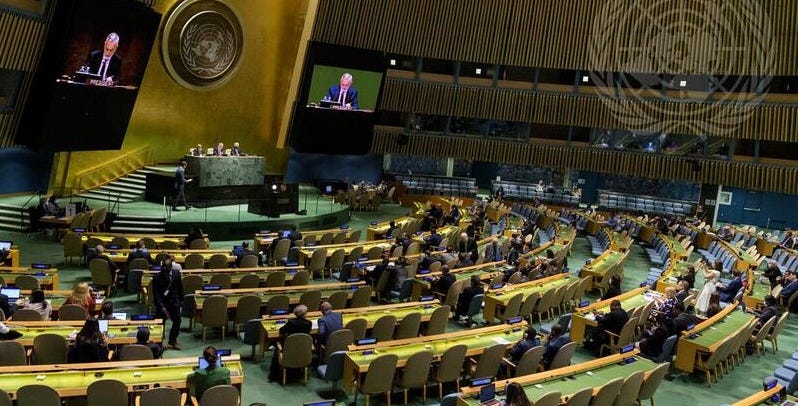
The 2026 Review Conference of the Parties to the Treaty on the Non-Proliferation of Nuclear Weapons (NPT) opens on Monday, April 27, 2026. The last major nuclear arms treaty, a keystone in the pursuit of nuclear disarmament, faces strong headwinds and may sink in the coming storm.
The Fragile Architecture of the Nuclear Order
As the 11th NPT Review Conference (RevCon) opens this Monday at the United Nations in New York, the diplomatic air is thick with the “head in the sand” optimism of the usual suspects. Organizations like the Arms Control Association and Nuclear Threat Initiative are already churning out the familiar refrains: calls for “bold leadership,” “renewed commitments,” and the “urgent pursuit of a nuclear-free world.”
But for those of us who have spent decades looking at the cold hardware of strategic theater and the meticulous logistics of arms control, the nursery rhyme of our title is more than a metaphor. The “King’s Men”—the scientists, the diplomats, and the verification experts—are currently staring at a Great Wall that has already fallen off. The “Humpty Dumpty” of the non-proliferation regime is shattered, and the current geopolitical posture suggests that no one is particularly interested in putting it back together again.
The Post-START Black Hole
The most immediate and glaring failure is the expiration of the New START Treaty this past February 2026. For the first time in decades, the United States and Russia are operating without a binding, verifiable limit on their strategic nuclear arsenals. While Russia offered to remain within the numerical limits on warheads and launchers of the expired treaty, the US will not commit to doing so.
The pragmatic reality is this: the logistics of diplomacy have ground to a halt. The State Department cut most of the relevant staff positions earlier last year, so it would be challenging to even initiate a follow-on framework. The “King’s Men” responsible for running the technical inspections and data exchanges are sidelined. Even if there appeared to be political will—which there is not, given the current administration’s stance—there is simply no time left on the clock to negotiate a complex successor before the end of the current term.
The Testing Trap: Beyond Sub-Criticality
While the “pillars” of the NPT—Disarmament, Non-proliferation, and Peaceful Use—remain the formal agenda, the real ticking fuse of the bomb at this conference is the US plan for a resumption of nuclear testing.
For years, we have lived in the comfort of “sub-critical” testing, allowed under the CTBT. However, the American position has shifted toward a “reciprocity” doctrine. Figures like Thomas DiNanno have already signaled at the UN that the US will match any “perceived” testing by rivals.
The danger here is the lack of evidentiary rigor. The US has accused China of a yield-producing test at Lop Nur in 2020 based on seismic data that the CTBTO itself found inconclusive. If the US decides to move above criticality to signal “resolve,” the CTBT—which the US never ratified but has observed—becomes a “zombie treaty.”

The Nevada Wall
There is, however, a pragmatic check on this federal ambition. A return to full-scale explosive testing is not just a strategic decision; it is a local one. Nevada has already moved to block such activities at the state level, citing everything from environmental impacts to the stability of the Las Vegas tourism economy. While federal supremacy is often cited, a legal and logistical stalemate between Carson City and Washington could provide a temporary, if unintended, brake on a return to the Nevada Test Site.
The Modernization Race
We must also be honest about the “Three Pillars.” The US is currently engaged in the most aggressive and fully funded nuclear modernization program in history—accelerated plutonium pit production, the Sentinel (GBSD) program, new sea-launched cruise missiles, and the recently completed B-61 air-delivered weapon.
To pick out France’s recent stockpile increase as the “problem,” as some reports have done, is to ignore the elephant in the room. When the “Haves” (the P3 - US, Russia, and China) are modernizing at this scale, their calls for Article VI “disarmament” ring hollow to the rest of the world. China, meanwhile, is using this US surge as the perfect shield to justify its own rapid silo expansion, refusing to join any trilateral talks until US and Russian numbers drop to levels that aren’t even on the horizon. While China has asked nations to commit to the NPT's disarmament articles, in practice, the move appears more like a call for Russia and the US to reduce their nuclear forces to bring them closer to parity with China's.
Predicting the Failure
Where will this conference fumble or even fail? The markers are easy to see:
The US will refuse to commit to a zero-yield standard, effectively torpedoing the CTBT pillar.
“Risk Reduction” will be offered as a face-saving substitute. The US will propose “hotlines” and “transparency,” which Russia and China will reject as “intelligence-gathering tools” devoid of treaty-based limits. But this remains a really important area, with prospective notification of ballistic missile testing and limiting the use of AI in nuclear-use decision-making.
The outliers will remain outliers. With the failure to restrain North Korea and the heightening tensions around Iran’s infrastructure, the NPT’s ability to govern non-signatories like Israel, India, and Pakistan has effectively evaporated.
A Prelude to Collapse?
The NPT has survived for decades on the “creative ambiguity” of its three pillars. But ambiguity requires a baseline of trust and a functioning verification regime. Today, we have neither.
As we watch the delegates gather in New York, we should look past the platitudes of the arms control lobby. The “King’s Men” aren’t trying to put Humpty Dumpty together again; they are simply trying to manage the broken bits lying all over the place.
The goal of this conference isn’t “progress”—it is a desperate, rear-guard action to save the NPT from total collapse. We have to admit that the architecture of 1970 is no longer fit for the multipolar reality of 2026.
History will record this conference. The question is whether it records it as the moment the international community finally faced what the non-proliferation regime has become — or as one more exercise in collective self-deception, buying time until the next crisis makes denial impossible. The King's Men are in New York this week. I'll be watching the proceedings closely — and when the delegates leave the room, whatever shape th’s in, Part II of this series will take stock of what, if anything, was salvaged from the wreckage.
© 2026 Farooq Hussain
Farooq Hussain’s new book: The Last Treaty, Nuclear Weapons Innovation and What Comes Next, is available on Amazon Kindle
He holds a PhD in War Studies from King’s College, London, and is the author of Adelphi Papers Future of Arms Control - “The Future of Arms Control: Part IV; The Impact of Weapons Test Restrictions”, “Adelphi Papers” Spring 1981, and has written extensively on ballistic missile testing and nuclear strategy.