

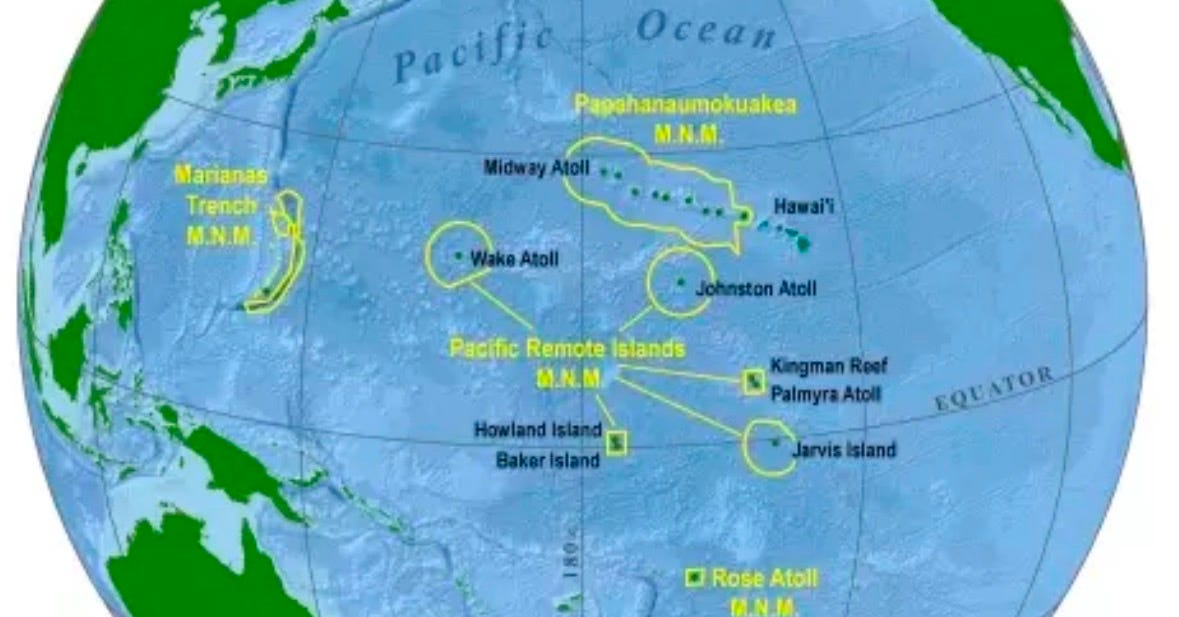
On June 11, 2026, President Trump signed Proclamation 11035, lifting commercial fishing restrictions from three Pacific Marine National Monuments — Papahānaumokuākea, the Islands Unit of the Mariana Trench, and Rose Atoll. Roughly half a million square miles of ocean, protected under three administrations spanning both parties since 2006, was reopened to industrial long-lining and purse seining with a single black Sharpie signature. It was the last of the five US marine national monuments to fall. The Pacific Islands Heritage monument went first, in April 2025. The Northeast Canyons and Seamounts monument in the Atlantic followed. By June 2026, over a decade of effort to protect these vulnerable areas of the planet’s oceans had been abruptly ended.
Taken alone, this is a fisheries policy story: an administration reallocating access between conservation and industry, the kind of pendulum swing the Antiquities Act has always invited. But Proclamation 11035 does not stand alone. It is the third act of a year-long retreat from ocean science and ocean governance that has cost the United States more than square miles. It has cost it a seat at the table.
Act I: an empty chair in Nice
In June 2025, more than fifteen thousand delegates gathered in Nice, France, for the third UN Ocean Conference — heads of state, marine scientists, mayors of coastal cities from Bergen to the Pacific islands. The United States prevented its scientific delegation from attending. Instead, the administration sent non-participating observers from the President’s Environmental Advisory Task Force, six weeks after signing an executive order asserting a national security interest in seabed mineral extraction. The absence of scientific participation was not accidental; it was consistent with an administration that had already made clear where it stood, in opposition to a consensus of the world’s nations.
The conference did not wait for Washington. Nineteen more nations ratified the High Seas Treaty in Nice, pushing the total past fifty. By September, the remaining ratifications needed brought the treaty into force — a binding international framework for governing the two-thirds of the ocean that lies beyond any nation’s jurisdiction, written and adopted without the country that has the largest exclusive economic zone on Earth. The treaty’s fight was over “biodiversity beyond national jurisdiction” — marine genetic resources, benefit-sharing, and a mechanism for establishing high-seas marine protected areas. American biotech and pharmaceutical interests had lobbied against the benefit-sharing provisions as a tax on innovation. The rest of the world moved on without them.
Act II: the buoys come up
In May 2026, the National Science Foundation announced it would dismantle the Ocean Observatories Initiative — nine hundred instruments across the Pacific, the Atlantic, and the waters off Greenland, in continuous operation since 2016, monitoring everything from coastal flooding risk to the health of the Atlantic Meridional Overturning Circulation. The stated saving was $48 million a year against a $368 million system. By mid-June, buoys were already off the water in Newport, Oregon, loaded onto flatbed trucks, when a unanimous Senate vote and a bipartisan revolt from lawmakers who called the plan “supreme stupidity” forced newly installed NSF leadership to reverse course. The equipment sat in a warehouse. The European Union, watching the American system come apart, announced it would spend €92 million bolstering its own ocean observation capacity — taking over where the US had opted out.
The reversal was real, and it mattered — an oceanographer’s plea and a Republican senator from Alaska worried about her state’s fisheries did more for American ocean science in three weeks than a year of advocacy. But reversal is not restoration. The Endurance Array had already been pulled from the water. Redeployment, NSF acknowledged, would take months. The data gap during that window does not refill itself once the buoys go back in the water — and American participation in the global observing system will be re-established on new terms, where the de facto acceptance of US leadership will be harder to regain.
Act III: the monuments
Which brings the story back to June 11. The administration’s own language in Proclamation 11035 is instructive: it argues that the monuments’ scientific and historic objects are already protected by existing federal statutes — the Magnuson-Stevens Act, the Marine Mammal Protection Act — so monument-specific fishing bans are “not necessary at this time.” This is the same reasoning, almost verbatim, that dismantled the Pacific Islands Heritage monument in April 2025 and the Atlantic’s Northeast Canyons and Seamounts before it. It is not an argument about any particular monument. It is a template, applied five times, for treating a specific instrument of ocean protection as redundant with the general regulatory background — even though the entire history of the Antiquities Act’s use in the ocean rests on the judgment that the general background has proven insufficient.
The pattern, not the episode
None of these three retreats, examined separately, is unprecedented. Presidents have expanded and contracted monument protections before. Congress has fought NSF over budget priorities before. Treaty negotiations have gone forward without American ratification before — the UN Law of the Sea Convention itself remains unratified by the US more than four decades after it was opened for signature.
What is different is the compression. In the space of twelve months, the United States absented itself from the room where ocean governance was being written; planned to end its own systems for observing what was happening in the water, until prevented by Congress from doing so; and then opened that same water to mineral and fishery exploitation whose economic value, weighed against the risk of irreversible environmental damage, has never been seriously considered. Each decision was defended in the language of efficiency, sovereignty, or economic opportunity. Together they describe something else: a country choosing, deliberately and repeatedly, to know less about the ocean and to exert less influence over its governance, at the exact moment its competitors were doing the opposite.
The Hawai’i longline fleet’s own record supplies the cautionary number. The last time these waters were open to industrial fishing at this scale, in 2015, the fleet caught 7,800 sharks and discarded more than 99 percent of them as bycatch. That is not a hypothetical cost of reopening half a million square miles. It is a documented one, from the last time the experiment was run.
The ocean does not send delegations to protest its exclusion from Nice, and it does not hold an emergency vote in the Senate to save its own monitoring buoys. It simply continues generating the currents, the fish stocks, and the warming trends the instruments were built to measure — now, moving forward, with fewer American eyes watching, and less American authority to act on what they might have seen.
© 2026 Farooq Hussain


