

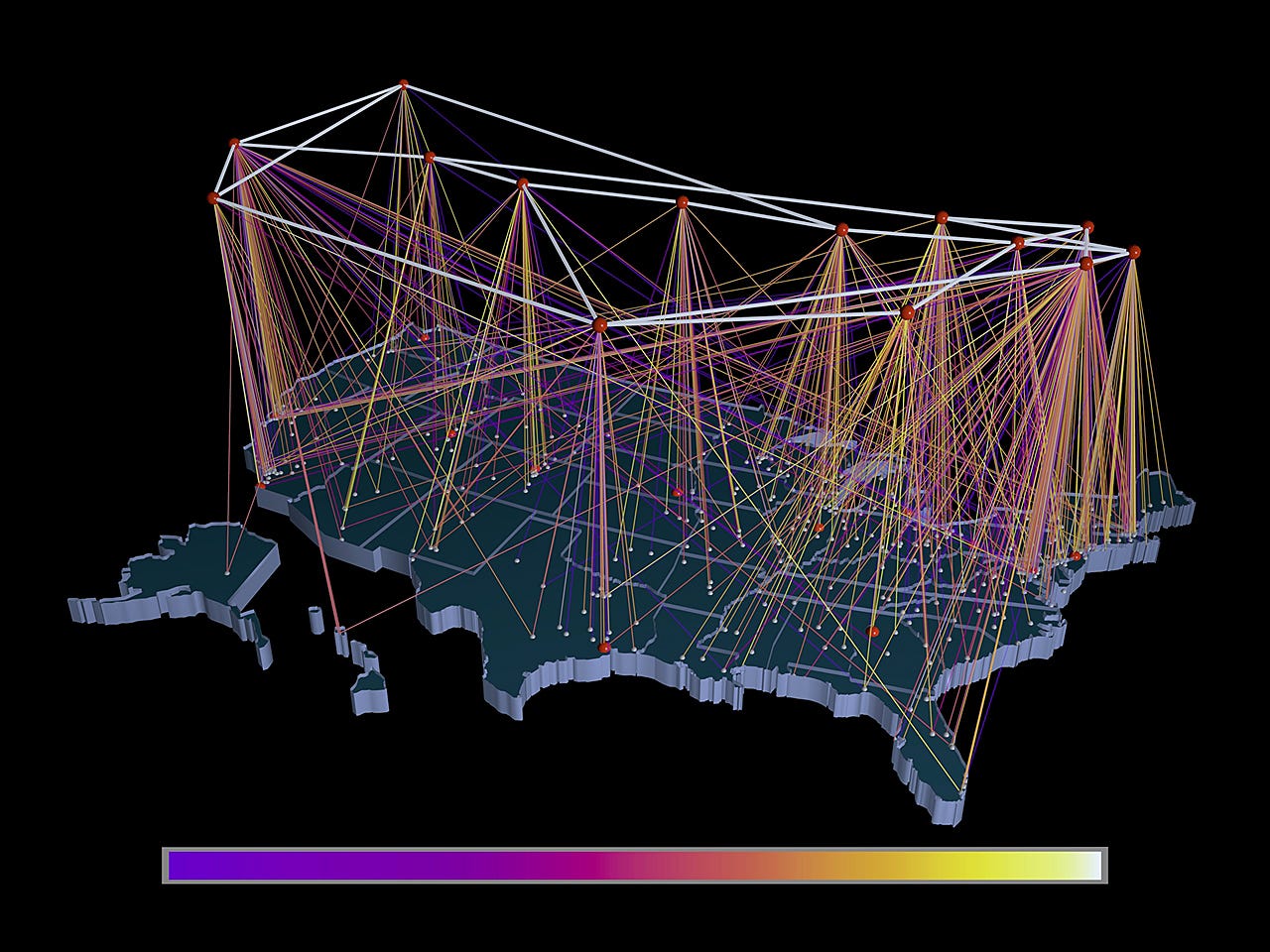
In the spring of 1995 I found myself in a conference room in Ann Arbor, Michigan, making a presentation to the board of Merit Network — one of the most consequential regional academic networks in the United States and the organization that operated the NSFNET backbone on behalf of the National Science Foundation (NSF). I was there as a member of a team from telecom company Sprint, which was competing for the NSFNET’s successor services. My presentation was on the provision of Network Access Points — NAPs — that the NSF had specified in its request for proposals (RFP) for the transition of the NSFNET backbone to commercial operation. Merit though a key player was not exactly a happy audience. The NSFNET had been their project, their managed network infrastructure, their vision of what a publicly stewarded Internet could and should be. Now they were being asked to evaluate a presentation from one of the commercial operators that would replace it.
When I finished, the chair of FARNET — the Federation of American Research Networks, the body that represented the academic networking community whose interests were most directly threatened by what we were proposing — offered what I took to be a compliment. The NAPs, he said, would enable networks to interconnect, to eventually connect everyone. “A thousand points of light.” The phrase landed with a slightly awkward thud. It was borrowed from George H.W. Bush’s 1988 acceptance speech, where it had described citizen voluntarism — an oddly utopian register for a room full of network engineers contemplating a commercial handover. We took it as gracious. But I think everyone in that room understood, without saying so, that the thousand points of light he was describing and the thousand points of light we were actually building were not quite the same thing.
That gap — between the internet that the academic founders imagined and the Internet that commercial privatization actually produced — is what this piece is about.
The NSFNET had been, in its way, a remarkable experiment and amongst the long list of great accomplishments in the NSF’s storied history. Launched in 1986 as a high-speed backbone connecting six elite supercomputing centers, it expanded over less than a decade to serve thousands of academic institutions across the United States and beyond. Its Acceptable Use Policy (AUP) was explicit: no commercial traffic. The Internet it sustained was an egalitarian commons, governed by committees of dedicated voluntary scientists and engineers. Founded on the assumption that the protocols themselves — open, non-proprietary, indifferent to who was sending what to whom — were sufficient architecture for a free and open network. It was a beautiful idea. It was also, as events would demonstrate, catastrophically innocent about the power of good over evil.
By April 30, 1995, the day the NSF formally decommissioned the NSFNET backbone, that innocence was already over. What replaced it was not the open marketplace of competing networks that the NSF’s RFP had hoped for or anticipated. Though it was something that anyone who had spent time around telecommunications and the break up of the AT&T monoply might have predicted: an oligopoly, consolidating with remarkable speed around whoever controlled the physical infrastructure.
The First eXchange
Before the NAPs, before the RFP, before the formal machinery of the NSFNET transition had been set in motion, the architecture of commercial Internet interconnection was already being built outside institutional channels and their advice or consent - neither of which was strictly required.
The NSFNET backbone in its final years was operated not directly by the NSF but by Advanced Network Services ANS — a consortium led by IBM that used MCI as it’s telecom infrastructure provider) which carried the NSFNET traffic under the restrictions of the AUP. The ANS consortium occupied a peculiar and increasingly untenable position: it controlled the primary backbone infrastructure of what was becoming hugely commercially viable, while being contractually prohibited from carrying commercial traffic on it. Rather than treating this as a transitional arrangement, ANS leveraged its infrastructure dominance defensively, refusing to peer — to exchange traffic on equal terms — with the commercial networks that were beginning to emerge alongside it. UUNET and PSInet, the first true commercial Internet service providers, found themselves locked out of the backbone. So, for that matter, did Sprint, at the time the only traditional telecommunications carrier operating a commercial national internet backbone service whose underlying infrastructure carried all international connections to the NSFNET and peered with ANS for this purpose.
The response was not to petition the NSF or negotiate with ANS. It was to route around them. In 1991, UUNET, PSInet and Sprint connected to each other over a 100 megabit per second metropolitan area Ethernet circuit and began exchanging commercial internet traffic directly. This was the Commercial Internet Exchange — the CIX — and it was, in the most literal sense, the first commercial internet exchange point in history.1 I was there to witness it: three networks, a shared Ethernet, and the first time commercial internet traffic moved across the United States without touching the NSF’s infrastructure or seeking its blessing.
The CIX demonstrated something that the NSF’s architecture had not anticipated and ANS had actively tried to prevent: that neutral interconnection worked, that it could be built quickly and cheaply, and that it did not require the participation of whoever happened to control the dominant backbone. The lesson was not lost on the NSF. When the agency began designing the NSFNET transition, the NAP architecture drew directly on what the CIX had proved possible. In that sense the RFP was the NSF’s attempt to formalize and institutionalize a model that the commercial networks had already built in spite of it.
But by the time the RFP appeared, UUNET and PSInet had drawn their own conclusions from the CIX experience. They had built their networks, established their customer relationships, and demonstrated that commercial internet services could thrive entirely outside the NSF’s gravitational pull. They had no interest in re-entangling themselves with institutional procurement processes or neutrality requirements that might constrain what they had spent years building the freedom to do. They sat the NAP competition out entirely — and proceeded to compete directly and successfully against MCI, which had won the regional network relationships the NSF’s award structure had effectively reserved for it. The NSF, caught between IBM’s defensive entrenchment and the commercial networks’ determined independence, found that its carefully designed transition architecture was being bypassed almost before it was built.
The Architecture of Good Intentions
The NSF’s request for proposals for the NSFNET transition was, in retrospect, a document that understood infrastructure but not markets. It specified three Network Access Points — neutral interconnection facilities where the new commercial backbone networks would exchange traffic with each other and with the regional academic networks that had grown up under the NSFNET umbrella. The neutrality requirement was sensible; telecommunications carriers had long experience with neutral interconnection arrangements, and Sprint, as both a NAP bidder and a backbone network operator, had no difficulty incorporating the necessary provisions into its proposal. The architecture on paper was coherent. What the NSF appeared not to have fully gamed out was what would happen when commercial incentives met the physical reality of where network infrastructure already existed.
The first structural problem was the award itself. Rather than designating a single neutral operator for each of the three NAPs, the NSF split the award between two companies. The logic may have been to preserve competition. The effect was to immediately undermine the neutrality the NAPs were supposed to embody. Two competing NAP operators meant two competing interconnection points, which meant the backbone networks that were supposed to meet at the NAPs now had a choice — and choices, in telecommunications, tend to be resolved by wherever your cables already run.
Sprint’s NAP was located at such a co-location facility where multiple telecommunications carriers had long maintained infrastructure for the exchange of traffic between networks. It was, in physical terms, an entirely logical place to build an internet interconnection point. It was also, crucially, not unique. The backbone networks could peer with each other at any number of locations where their infrastructure happened to converge, and they had every commercial incentive to do so bilaterally rather than routing traffic through a designated — and potentially congested, potentially competitor-controlled — NAP facility. Settlement-free peering agreements between national backbone networks proliferated rapidly, bypassing the NAPs entirely.
The commercial picture worsened when the NSF regional networks — the academic institutions that the transition was ostensibly designed to serve — made their carrier selections. The majority signed with MCI, and not entirely by accident: the NSF had structured its awards in such a way that only MCI was positioned to walk away with the old NSFNET regional network relationships intact. The real competitive battle that followed was not the one the NSF had designed for. It was fought between MCI and the commercial network service providers — UUNET and PSInet chief among them — who had never competed for NAPs at all and were therefore entirely unconstrained by the architecture the NSF had built. They went head to head against MCI on purely commercial terms and succeeded. Sprint, meanwhile, pulled in behind.
What emerged from the lopsided award was an imbalance in the networks awarded to the Tier 1 national backbones that heavily favored the incumbent carrier MCI that provisioned the network barebones for ANS, and the division of the NAP award between a carrier Sprint, and Bellcore a carrier neutral service provider that had anticipated receiving the award for all three. But the NAP concept, stripped of commercial ambitions, proved to be architecturally durable. Internet eXchange Points — IXPs — proliferated globally in the years that followed, drawing directly on the model of neutral co-location facilities where networks could exchange traffic efficiently and cheaply. Today there are hundreds of them, from Frankfurt’s DE-CIX to Singapore’s Equinix exchanges, handling traffic volumes that would have been unimaginable in that Ann Arbor conference room in 1995. In that sense the thousand points of light did eventually materialize — just not as anyone in the NSF’s procurement process had planned, and not in a form that benefited the companies that took the original commercial risk.
The NAPs were, in the end, a failed experiment that generated a successful idea. Sprint planted a seed it couldn’t harvest. The harvest came later, elsewhere, and largely outside the commercial logic that had driven the original transition. What the NAP experience did establish, with uncomfortable clarity, was the pattern that would define the internet’s subsequent development: well-intentioned institutional design, structurally compromised at the moment of execution, superseded by dynamics its architects had not anticipated and could not control.
The Free For All That Wasn’t
The promise of the commercial internet, as the NSF and its regional network community understood it in 1995, rested on a single elegant assumption: that the exchange of traffic between networks would remain essentially free, governed by bilateral settlement-free peering agreements in which networks of roughly equal size and traffic volume would swap packets without payment. The model had worked well enough in the academic commons, where traffic flows were relatively balanced and the participants shared an institutional culture of cooperative exchange. It was always going to struggle in a commercial environment where traffic volumes were determined not by research needs but by consumer demand — and where consumer demand was about to become extremely large and extremely asymmetric.
The asymmetry problem was structural and predictable. As the internet became a mass medium, traffic stopped flowing in rough equilibrium between networks and began flowing overwhelmingly in one direction: from the content and backbone networks toward the consumer. A network carrying mostly residential internet customers generated far more inbound traffic than outbound. Under settlement-free peering, that network was receiving a service — delivery of its customers’ content — without compensating the networks providing it. The Tier 1 backbone networks, which carried the heaviest loads and had invested most heavily in physical infrastructure, were the first to draw the obvious conclusion. They declined peering agreements with smaller networks that could not demonstrate traffic parity, forcing them onto paid transit arrangements instead. Settlement-free peering, the foundational promise of the Internet, became a privilege reserved for networks large enough to be worth peering with — which is to say, the exactly those networks that already dominated the infrastructure from the start.
The result was precisely the oligarchical hierarchy that the NSF’s open competition model had been designed to prevent. A small group of Tier 1 backbone providers — networks whose physical infrastructure was extensive enough to command settlement-free peering with each other — sat at the top of a rigid commercial pyramid. Below them, regional and local networks paid transit fees for access to the global grid. The further from the core, the higher the effective cost of connectivity. The borderless, frictionless Internet of academic imagination had been replaced, within a few years of the NSFNET shutdown, by a toll road system whose operators were a handful of well-capitalized survivors of the privatization scramble.
The Consolidation and Its Consequences
Into this environment of rapid consolidation came the dot-com boom — and with it a wave of speculative capital that accelerated the concentration of infrastructure ownership to a degree that would have seemed implausible in the Ann Arbor conference room of 1995. The Netscape IPO of August that year, which valued a company with negligible profits at nearly three billion dollars on its first day of trading, functioned as a starting pistol for a gold rush whose participants largely abandoned the discipline of asking whether their investments would ever generate returns. Startups were valued on “eyeballs” and “mind share.” Venture capital flooded in. Loss-making companies bought advertisements on other loss-making companies, inflating traffic metrics and revenue figures in a circular economy that bore no relationship to the underlying economics of what the internet actually was — a physical network of copper, fiber and routing equipment whose construction and maintenance cost real money.
No company embodied the speculative logic of this period more completely than WorldCom. Under CEO Bernie Ebbers, WorldCom executed a relentless acquisition strategy premised on the assumption that internet traffic would grow exponentially and without limit, and that whoever controlled the most infrastructure would capture the value of that growth. The strategy’s culmination was the $37 billion acquisition of MCI — the same MCI that had walked away from the NSFNET transition with the regional network relationships the NSF’s award structure had effectively reserved for it. WorldCom had now absorbed the institutional heir to the academic internet backbone and was betting its entire financial structure on infinite growth.
When the NASDAQ peaked at 5,048 in March 2000 and the speculative bubble began its long deflation, the bet was exposed. Internet traffic was growing, but not at the rates WorldCom’s acquisition prices had assumed, and the fiber networks it had built or bought were carrying far less traffic than projected. To conceal the resulting revenue shortfall from Wall Street, WorldCom’s leadership turned to fraud, reclassifying billions of dollars in routine operating expenses as long-term capital investments. When internal auditor Cynthia Cooper uncovered the conspiracy, the scale of the deception was staggering — eleven billion dollars in falsified accounts. On July 21, 2002, WorldCom filed for bankruptcy, at the time the largest in United States history. The network the NSF had effectively delivered to MCI had passed through WorldCom’s hands and into a bankruptcy court in less than a decade.
Though UUNET and PSI had played a foundational role in the establishment of the Internet did not survive their expansive growth when the Internet Bubble burst. MCI after a failed merger with British Telecom was acquired by WorldCom which filed for bankruptcy within a few years and sold its Internet assets to Verizon. In an ultimate irony, MCI which had fought to break the AT&T monopoly and the de-regulation of telephony in the US was swallowed up by old Ma Bell in the end - Verizon was the new name of the former AT&T regional carrier Bell Atlantic.
The Undersea Bet
While WorldCom was consolidating the domestic backbone, a parallel and equally speculative drama was playing out beneath the world’s oceans. Global Crossing was not a retail Internet provider or even a conventional backbone network. It was a carrier’s carrier — a wholesale infrastructure company whose business was laying and operating the undersea fiber optic cables that connected continents, selling capacity to the telecommunications carriers and backbone networks that needed transatlantic and transpacific connectivity to serve their customers.
The logic was the same as WorldCom’s: traffic would grow without limit, bandwidth would remain scarce and therefore expensive, and whoever controlled the physical cables would capture the rents from that scarcity. Global Crossing raised billions on that premise, building a network of undersea cables that genuinely did internationalize the Internet’s backbone infrastructure, connecting Europe, Asia and the Americas in ways that Sprint’s International Connections Manager work had pioneered on a much more modest, institutionally anchored scale. When the bubble burst, Global Crossing collapsed into bankruptcy in January 2002, six months before WorldCom, in what was at that moment the fourth largest bankruptcy in American history.
When WorldCom internal auditor Cynthia Cooper uncovered the company’s fraudulent activity, the scale of the deception was staggering — eleven billion dollars in falsified accounts.On July 21, 2002, WorldCom filed for bankruptcy, at the time the largest in United States history.The network the NSF had effectively delivered to MCI had passed through WorldCom’s hands and into a bankruptcy court in less than a decade.
The aftermath was also instructive. The undersea cables didn’t disappear. They were acquired at a fraction of their construction cost by carriers and investment vehicles that could now offer international bandwidth at prices that would have been unimaginable during the boom. The collapse of the speculative infrastructure bet produced, almost accidentally, the cheap international connectivity that made the global internet economically viable for the billions of users who would come online in the following decade. It was the same paradox as the NAPs: a commercial failure that generated an infrastructural legacy. The difference was one of scale. The NAPs had seeded the global IXP ecosystem. Global Crossing’s bankruptcy had priced the Internet for the world.
No Oppenheimer Moment
In the summer of 1945, as the Manhattan Project scientists prepared to test the first nuclear device at Trinity, New Mexico, several of them were already writing the warnings. Leo Szilard circulated a petition. Niels Bohr had already argued, unsuccessfully, for international control before the bomb was used. Robert Oppenheimer would spend the rest of his life in the complicated purgatory of a man who had built something he understood to be dangerous and said so, repeatedly and publicly, until the government stripped him of his security clearance for the trouble. The warnings did not prevent the arms race, the proliferation, or the decades of existential anxiety that followed. But they established, early and irreversibly, a framework of danger within which nuclear technology has been managed — imperfectly, incompletely, but managed nonetheless. The Non-Proliferation Treaty exists. The IAEA exists monitoring the level of nuclear risk globally. The Bulletin of Atomic Scientists still moves its clock a little closer to midnight at the end of each year. The guardrails are inadequate but they are there, and they are there because the architects of the technology screamed and the public pressured politicians to listen.
The Internet had no Oppenheimer moment. The men and women who built it — who designed the protocols, managed the academic commons, fought the peering wars, won and lost the mergers and aquistions — did not issue proclamations or warnings about the societal and consequences of what they were unleashing, if indeed they perceived any. They mostly didn’t believe they were unleashing anything dangerous or that might be used to cause injury and hurt. The protocol was open, non-proprietary, indifferent. It was a tool for sharing research. That it would restructure human cognition, destabilize democratic institutions, create new architectures of addiction and manipulation, and concentrate information power in the hands of a handful of platform companies was not something the academic founders foresaw — and by the time it was visible, the infrastructure was captured, the business models were entrenched, and the users were already dependent. There was no moment at which a critical mass of the internet’s architects stood up and said: we have built something that could go very wrong. There was only the accumulated silence of people who believed the technology was inherently benign, followed by the slow realization that it was not.
Artificial intelligence has been different, at least in its rhetoric. Stephen Hawking warned, in terms that could not have been clearer, that the development of full artificial intelligence could spell the end of the human race. Geoffrey Hinton, who won the Nobel Prize for the foundational work that made modern AI possible, resigned from Google in 2023 specifically to speak freely about the dangers of what he had spent his career building. The early AI safety movement produced manifestos, research agendas, and institutional frameworks with an urgency that the internet’s architects never felt. And yet the warnings appear to be producing roughly the same result as no warnings at all. The competitive dynamic between the United States and China has installed the same logic that drove the dot-com frenzy and the WorldCom acquisition spree: move fast, build first, worry later. The arms race has its own momentum, and precautionary instinct dissolves in its heat. Hinton warned. Then the models kept getting larger.
Which brings us, by a long road, to Australia and the United Kingdom introducing legislation protecting children from the dangers of the applications which would not have been possible without the Internet. Facebook, Twitter, and TikTok were unimagined before it, and their possible societal impact were mostly seen as beneficial as in empowering democratizing movements such as the Arab Spring. In fact, the resistance to its early adoption by the telephony carrier industry and government regulatory restrictions and the Internet’s zero-settlement mantra added to its cache. The arrival of the Internet, the unprecedented pace of its growth and technological innovation was also the sword with which to democratize the world.
Over the years a darker side emerged, software was developed to propagate over the net holding healthcare networks to ransom, stole money from everyone, and permitted the psychological torture of individuals including children, to touch on a few. In 2024 Australia passed legislation restricting children under sixteen from accessing social media platforms. The United Kingdom has moved in the same direction, tightening the Online Safety Act’s provisions around children’s access to applications and platforms. These measures are reasonable responses to documented harms — the evidence linking social media use to adolescent mental health deterioration is substantial and growing. They are also, in a deeper sense, a confession of institutional failure. We are reduced to legislating which applications children may use because we built a global communications infrastructure on the assumption that it would govern itself, handed it to commercial operators who optimized it for engagement rather than wellbeing, and then watched for three decades as it rewired the cognitive and social development of every generation that grew up inside it. The thousand points of light that the FARNET chairman invoked in that Ann Arbor conference room in 1995 did illuminate the world. They also, in ways none of us in that room fully grasped at the time, cast very long shadows.
The Internet was one of the greatest scientific and engineering ideas of the twentieth century not only for what it was, but also for the human ingenuity it enabled, perhaps the greatest practical realization of networked communication in human history. Much of its potential has been realized in ways that genuinely have transformed human life for the better — in access to knowledge, in the compression of distance, in the connections it has made possible between people who would otherwise never have found each other. None of that is trivial. But the challenges it has created are serious, deeply entrenched, and the architecture of the beast facilitates them in ways that were not anticipated or within the scope of electrical engineering to manage. With nuclear technology we saw the danger and built imperfect guardrails. With artificial intelligence we see the danger and the guardrails appear to be losing the race. With the Internet we built it, they came, thirty years later, still grappling with the negative consequences.
The children’s app restrictions in Australia and the United Kingdom are not the end of that story. They are instead the most recent footnote in the long reckoning with a scientific and technological revolution — the most consequential communications technology in human history, deployed without an Oppenheimer, managed without a treaty - indeed it’s ad hoc almost naive governance arrangements are still, in ways we are only beginning to measure, reshaping what it means to be human.
Authors note: The events presented here are recalled from the authors memory and personal records. As an employee of Sprint he supported the SprintLink Internet service and the International Connections Manager program of the NSF. He was the NSF Principal Investigator for the Sprint NAP after which he joined MCI leaving around the time of the failed BT merger.
© 2026 Farooq Hussain
The last CIX router, a collection of early documentation regarding the formation of the first commercial Internet traffic exchange gathered from various participants was accepted from me (as a retiring board member of the CIX) by the Smithsonian Museum of American History.