

I’ve loved museums since my earliest memory of being taken to one — the Museum of Natural History in London. I couldn’t imagine how the collection had been assembled, but each object seemed to carry a secret story I longed to have told to me. I listened enthralled to Neil MacGregor’s A History of the World in 100 Objects1, and I’ve been equally captivated by Roman Mars’s unfolding A History of the United States in 100 Objects2, which opens with the contents of a century safe, unsealed to a rather baffled reception a hundred years after it was closed.
Both works inspired this one. My plan is to identify not only artifacts but places and events, natural and historical, and — like MacGregor and Mars — to explain each selection’s historical and contextual importance as I see it. A number of one hundred has been the common denominator among these collections. I’ve chosen forty-two.
I’m not yet sure how often new entries will appear, but for the first I’ve chosen a portrait. I can gaze at some for so long I feel in conversation with the subject, while others usher me along. Living subjects can have uncomfortable reactions to their own rendering. Winston Churchill didn’t care for Graham Sutherland’s representation of him — a gift from both Houses of Parliament for his eightieth birthday, presented at Westminster Hall in 1954. His wife Clementine had it hidden away at Chartwell, and little more than a year later had it carried off in the middle of the night and burned on a bonfire. A few photographs survive to recall what it looked like, and Sutherland declined the idea of producing a second one.
Contrast this with what we believe to be a likeness of William Shakespeare, hanging at London’s National Portrait Gallery. We can’t be certain it’s him, nor confident of who painted it, nor is it prominently displayed — and yet it draws millions of viewers a year.
A portrait, then, is never the sum of the materials that make it. Rather, it’s an interpretation of how a person should be remembered, made by an artist and a subject and — increasingly — an institution, and the three don’t always agree. Washington keeps its own version of this running at all times, in a building most visitors walk past, perhaps because the National Portrait Gallery came later in the growth of the Smithsonian’s museums, reviving the historic Old Patent Office Building.
Every nation keeps an attic. Ours is the Smithsonian — twenty-one museums, a zoo, more than 150 million objects, the accumulated evidence of what a country decided was worth keeping. This series is about that attic — not the whole collection, but the pieces of it that argue loudest, each marking a moment in history commemorated or forgotten, with a story I want to share with you. Some will be places, or moments, or things the institution deliberated over and could not decide how to keep. The frame is simple: what an object is, what its label used to say, and what its label says now, if it says anything at all.
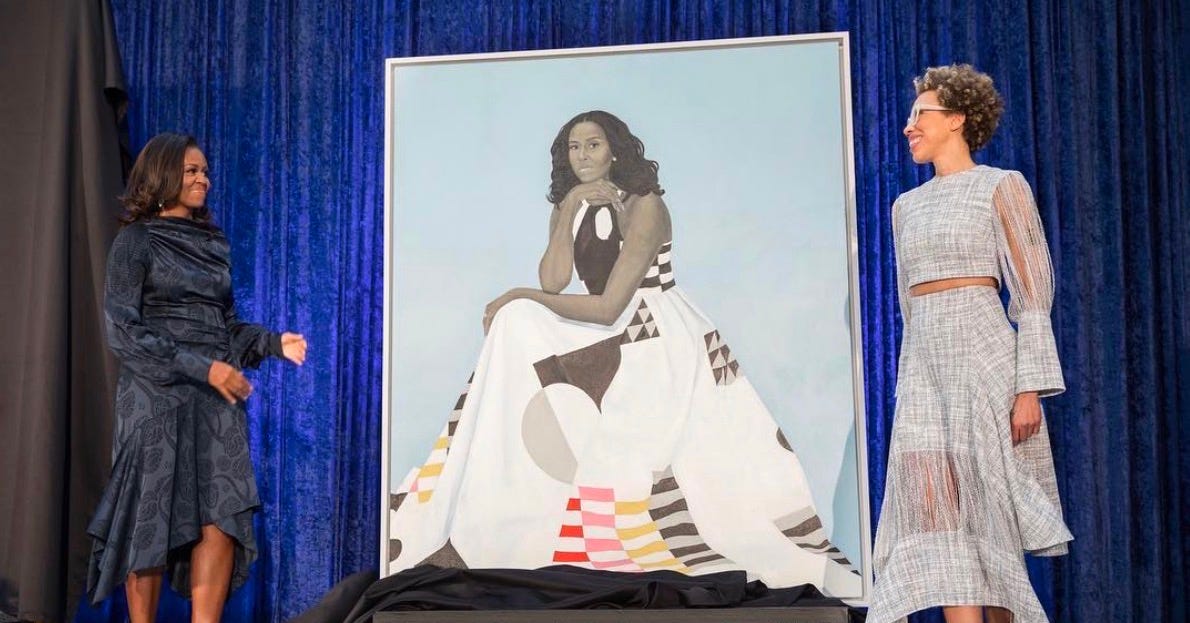
The first thing is a painting, and it earns the position on its own merits, not on the mythology that now also envelops it. In February 2018, the National Portrait Gallery unveiled Amy Sherald’s portrait of Michelle Obama, titled “Michelle LaVaughn Robinson Obama” — a seated figure in a grayscale so unusual that some early viewers complained it didn’t look like her at all. Within months, the complaint was moot. The painting became one of the most photographed works of art in the country, drawing crowds that stood in line for a museum selfie the way tourists queue for Da Vinci’s Mona Lisa at the Louvre in Paris. It has been reproduced on magazine covers, parodied, quoted in fashion editorials, and taught in art schools on three continents. Whatever else it is, Michelle Obama’s portrait is now something rarely found even in the National Portrait Gallery’s seemingly inexhaustible collection: an image the whole world recognizes on sight. That is why Sherald’s portrait of the First Lady opens this series. What happened to her next exhibition is why this series of things exists at all.
Sherald did not arrive at that commission by appointment or favor. In 2016, she won the Portrait Gallery’s own Outwin Boochever competition, first prize out of twenty-five hundred entries submitted blind — the first woman, and the first Black artist, to take it. The prize came with the right that mattered: a commission to paint a living subject for the museum’s permanent collection. The Obamas chose their own portraitists the way any subject does, by meeting the candidates and deciding whom to trust with the likeness; Sherald has said she knew the arrangement would work within the first few sentences of the interview. Nothing about the process was extraordinary. It was the National Portrait Gallery doing exactly what it exists to do — find the artist, trust the artist, hang the result — and for eight years, it worked.
The exhibition that should have been the National Portrait Gallery’s marquee event of the year does not exist there. “American Sublime” had already toured from San Francisco to the Whitney, where it remained on view in New York through early August, before its final scheduled stop: the National Portrait Gallery, opening September 19, 2025. American art has weathered public outrage before — Serrano’s “Piss Christ,” the Mapplethorpe retrospective the Corcoran canceled in 1989, the NEA’s own near-death over funding fights in the same era. What hadn’t happened, in any of those episodes, was a sitting Vice President serving on the museum’s own governing board while one of its artists’ paintings came under review. Vance sits on the Smithsonian’s Board of Regents — a seat the Vice President holds by statute — and the March executive order tasked that board with removing “divisive” content. It was through the board that concerns reached Sherald about “Trans Forming Liberty,” her reimagining of the Statue of Liberty as a Black transgender woman. The Smithsonian called it wanting to “better contextualize” the work. What that meant in practice was a proposal to pull the painting from the exhibition and replace it with a video. In a letter to Smithsonian Secretary Lonnie Bunch, Sherald wrote that the video “would have opened up for debate the value of trans visibility,” and that she would not make that debate part of “American Sublime.” She withdrew the entire show in July 2025, eight weeks before it was due to open in Washington — while, in New York, the same painting was still hanging, unchallenged, at the Whitney.
The Baltimore Museum of Art stepped in on two months’ notice, opening the show that November. It became the museum’s most-attended exhibition since 2000, drawing 84,000 visitors — more than double the museum’s own projection — before closing in April. It has since moved to its final stop, the High Museum in Atlanta, where it runs through late September. The painting a Vice President’s board could not display without a rebuttal attached is on public view, unaccompanied, in the capital of Georgia. The federal government owns the building where the likenesses of memorable Americans are supposed to be kept. It does not own the museum in Baltimore.
There is a version of this story that turns on the painting itself — its politics, its provocations, whether an eight-foot Statue of Liberty in a different body is a fitting subject for display in a government building. That is not this story. This is an account of what happened before anyone on the Smithsonian board chose whether they agreed with the painting being shown, because the arrangement on offer was never about the painting. It was about who gets to attach a caption to the work, and whether the artist gets a say in what her own painting is made to argue with. Sherald had already answered a version of that question once, eight years earlier, when a national jury of curators sifted twenty-five hundred submitted portraits and settled, without controversy, on hers. Nobody asked her then to hang a rebuttal beside Michelle Obama’s dress.
Sherald did not need anyone’s permission for the first painting to become what it became. Nobody in Washington promoted it, decided it mattered, or told the public what to feel about a woman in a grey dress. It became the most photographed portrait in the museum’s history because millions of separate people, over eight years, kept deciding on their own that it was worth standing in line for. That is the only mechanism that has ever reliably produced an icon, and it is the one thing a government cannot order into being.
Which is what makes the attempt on the second painting so instructive. A Vice President sitting on the Smithsonian’s board, a proposal to swap a painting for a video, a withdrawal, a scramble to Baltimore — all of it was an effort to manage what the public would be allowed to see and conclude, by the same office that cannot manufacture an icon on command. It didn’t work. “Trans Forming Liberty” is hanging in Atlanta this month, seen by more people than a quiet run in Washington would likely have drawn. The attempt to control its reception became part of its story instead of preventing one.
Put the two paintings side by side — as the High Museum now literally does — and they teach the same lesson from opposite directions. The first is the icon no office in Washington could have manufactured: it became the most photographed portrait in the museum’s history because millions of people decided on their own that it was worth the line. The second is the painting no office in Washington could make disappear: the attempt to manage its reception only enlarged its audience. A government can commission a survey, hire a publicist, hold a premiere at the Kennedy Center. It cannot make people love what they’re told to love, and it cannot unmake what they’ve already decided to love — which is why both paintings are hanging together in Atlanta this summer, drawing the kind of line that formed outside the Baltimore Museum of Art on a Tuesday morning, for a show the government had decided Washington couldn’t see.
© 2026 Farooq Hussain
Notes:
MacGregor, N. (2010). A history of the world in 100 objects. Allen Lane, BBC Podcast https://www.bbc.co.uk/programmes/b00nrtd2
Mars, R. (Host). (2026–). A History of the United States in 100 Objects [Audio podcast]. 99% Invisible / BBC Studios.. BBC Radio 4. https://www.bbc.co.uk/programmes/p0nyhpl5